
Past exam of the mathematics course of the University of Cambridge 2017 ii Paper 4 18G c Created 2026-09-24 Updated 2026-09-24
Past exam of the mathematics course of the University of Cambridge 2017 ii Paper 4 18G b Created 2026-09-24 Updated 2026-09-24
Past exam of the mathematics course of the University of Cambridge 2017 ii Paper 4 18G a Created 2026-09-24 Updated 2026-09-24
Past exam of the mathematics course of the University of Cambridge 2017 ii Paper 4 17I c Created 2026-09-24 Updated 2026-09-24
Past exam of the mathematics course of the University of Cambridge 2017 ii Paper 4 17I b Created 2026-09-24 Updated 2026-09-24
Past exam of the mathematics course of the University of Cambridge 2017 ii Paper 4 17I a Created 2026-09-24 Updated 2026-09-24
Past exam of the mathematics course of the University of Cambridge 2017 ii Paper 4 16H iv Created 2026-09-24 Updated 2026-09-24
Past exam of the mathematics course of the University of Cambridge 2017 ii Paper 4 16H iii Created 2026-09-24 Updated 2026-09-24
Past exam of the mathematics course of the University of Cambridge 2017 ii Paper 4 16H ii Created 2026-09-24 Updated 2026-09-24
Past exam of the mathematics course of the University of Cambridge 2017 ii Paper 4 16H i Created 2026-09-24 Updated 2026-09-24
Past exam of the mathematics course of the University of Cambridge 2017 ii Paper 4 15H Solution Created 2026-09-24 Updated 2026-10-05
Use the convention that the transitive closure of is the least transitive set containing as a subset. Define and . For each natural number , a finite sequence of length with these properties exists by induction, and is unique because each next entry is the uniquely determined union of the previous entry. Thus the relation sending to its last entry is a definable function-class, not just a putative recursive specification. The Axiom schema of replacement applied to gives the set of all . The Axiom of union then givesIf and , then , so this set is transitive. It contains , and any transitive set containing contains all by induction; hence it is least. The convention requiring itself as an element instead uses .
The Axiom of foundation says every nonempty set has an element with . Epsilon induction says that for every formula ,To derive induction from Foundation, if fails, form by axiom schema of separation the nonempty set of counterexamples in . A Foundation-minimal counterexample has every member satisfying , by transitivity, contradicting the inductive hypothesis. Conversely, if a nonempty set has no Foundation-minimal member, every has a member in . The formula is then progressive: if all members of are outside , must also be outside . Epsilon induction makes empty, a contradiction. Thus the two principles are equivalent given the other axioms.
The epsilon-recursion theorem states that for a definable class operation assigning a unique set to each set-indexed function, there is a unique definable function-class such that for every set . A version with explicit in the argument is equivalent. Foundation gives well-foundedness and Replacement makes each restriction set-sized. Its ordinal restriction gives transfinite recursion and constructs the printed .
Here “countable” means at most countable, including finite sets and the empty set. By transfinite induction each is transitive, each of its elements is countable, and . At a successor this follows because a member of is a countable subset of ; at a limit use the increasing union. Let be the first uncountable ordinal. Every countable subset of lies in some with , since countably many countable ordinal bounds have a countable supremum. It therefore belongs to . ConsequentlyThere is no earlier stabilization: for every countable ordinal , induction gives , so , while excludes by its rank. Thus is the first such stage. The fixed set is the set of hereditarily countable sets.
Past exam of the mathematics course of the University of Cambridge 2017 ii Paper 4 14E Solution Created 2026-09-24 Updated 2026-11-05
The Euler-Lagrange equations for the kinetic Lagrangian areExpanding and multiplying by the inverse metric gives the geodesic equationThe kinetic variational principle uses an affine parameter; the energy is constant along its solutions. Constant curves are also geodesics.
For the Poincaré half-plane model, translation in gives the conserved quantity , and the energy is . If , the nonconstant geodesics are vertical lines, with . If ,Writing and integrating yields . Thus nonconstant geodesic images are vertical lines or upper semicircles meeting the real axis orthogonally.
For the two specified points, the circle centre is and the radius is five:For example, an affine unit-speed parametrization is , . The endpoints on the real axis are and , outside the hyperbolic surface.
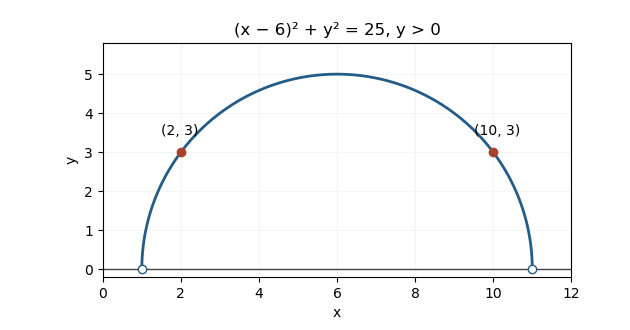
The upper-half-plane geodesic through the two specified points
. Details. Past exam of the mathematics course of the University of Cambridge 2017 ii Paper 4 13B Solution Created 2026-09-24 Updated 2026-10-14
A positive spatially homogeneous equilibrium satisfies and , givingIt exists iff . The reaction Jacobian matrix isThus linear stability analysis gives strict homogeneous stability precisely whenThe boundaries are not included: at the linearization has purely imaginary exponents, and at the positive equilibrium ceases to exist.
For a mode , put . The perturbation matrix is . In the homogeneously stable region its trace is still negative, so a growing mode exists iff its determinant is negative:This upward quadratic is negative for some precisely whenSuch a Turing instability region is nonempty iff . The unstable band isFor a finite domain only the admissible boundary-condition wavenumbers in this band grow. The region shown below describes a continuous wavenumber spectrum.
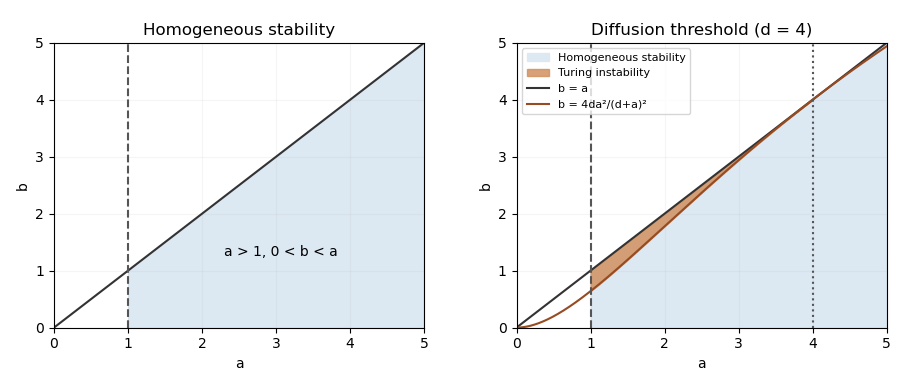


At onset the minimum of is zero and . On the threshold , substitution gives . HenceThis last expression is the threshold wavenumber; away from onset the fastest-growing mode need not coincide with the minimum of the determinant.
Past exam of the mathematics course of the University of Cambridge 2017 ii Paper 4 12J d Created 2026-09-24 Updated 2026-09-24
Past exam of the mathematics course of the University of Cambridge 2017 ii Paper 4 12J c Created 2026-09-24 Updated 2026-09-24
Past exam of the mathematics course of the University of Cambridge 2017 ii Paper 4 12J b Created 2026-09-24 Updated 2026-09-24
Past exam of the mathematics course of the University of Cambridge 2017 ii Paper 4 12J a Created 2026-09-24 Updated 2026-09-24
Past exam of the mathematics course of the University of Cambridge 2017 ii Paper 4 11F e Created 2026-09-24 Updated 2026-09-24
Past exam of the mathematics course of the University of Cambridge 2017 ii Paper 4 11F d Created 2026-09-24 Updated 2026-09-24
Past exam of the mathematics course of the University of Cambridge 2017 ii Paper 4 11F c Created 2026-09-24 Updated 2026-09-24
There are unlisted articles, also show them or only show them.