
Past exam of the mathematics course of the University of Cambridge 2017 ii Paper 3 36D iv Created 2026-09-24 Updated 2026-09-24
Past exam of the mathematics course of the University of Cambridge 2017 ii Paper 3 36D iii Created 2026-09-24 Updated 2026-09-24
Past exam of the mathematics course of the University of Cambridge 2017 ii Paper 3 36D ii Created 2026-09-24 Updated 2026-09-24
Past exam of the mathematics course of the University of Cambridge 2017 ii Paper 3 36D i Created 2026-09-24 Updated 2026-09-24
Past exam of the mathematics course of the University of Cambridge 2017 ii Paper 3 35D Solution Created 2026-09-24 Updated 2026-10-05
The Maxwell equations with vacuum permittivity and permeability give and . The current identity is the Ampère-Maxwell equation, and Faraday's law gives . With ,The identity , and its electric analogue, turn this into the divergence of the Maxwell stress tensor . Thus the tensor in the question is its negative:The vector is electromagnetic momentum density, and is the outward flux of its th component across a surface normal in the direction. In static conditions the total force on matter is ; generally subtract the time derivative of the enclosed electromagnetic field momentum as well.
For the two infinite sheets, superposition and the electromagnetic field jumps give , between them and zero outside. Substitution yields exactlyA thin pillbox enclosing the sheet has only its face in the interior electromagnetic field. ThereforeDirectly, omit the sheet's self-electromagnetic field: the other sheet supplies and . The Lorentz force per area is , giving the same result. The electric contribution is attractive and the magnetic contribution repulsive.
If for a single moving charge population, use to obtain . For physical this is attractive, so motion of these charges cannot make the force repulsive. Independently imposed currents need not satisfy that restriction on .
Past exam of the mathematics course of the University of Cambridge 2017 ii Paper 3 34D b Created 2026-09-24 Updated 2026-09-24
Past exam of the mathematics course of the University of Cambridge 2017 ii Paper 3 34D a Created 2026-09-24 Updated 2026-09-24
Past exam of the mathematics course of the University of Cambridge 2017 ii Paper 3 33C Solution Created 2026-09-24 Updated 2026-10-05
For a multiplication operator , . Therefore the mechanical momentum satisfiesThe displayed ladder operators implicitly require , so that their denominator is real and the second is the adjoint of the first. Then andThe free longitudinal motion gives a continuous spectrum in , and the transverse Landau levels have guiding-centre degeneracy of a Landau level. For arbitrary sign of , use in the energy and . The question's normalizable wavefunctions likewise assume .
For the stated symmetric-gauge wavefunction, , whose peak for is at . Thus the largest useful angular index is about , givingThe state should also be included in the usual lowest Landau level; its omission by “positive integer” changes only an order-one term. Including the radial measure shifts the most probable radius to , again only an order-one counting correction. Boundary conditions and the tails of the wavefunctions make this a large-flux estimate, not an exact finite-disc count.
Past exam of the mathematics course of the University of Cambridge 2017 ii Paper 3 32C Solution Created 2026-09-24 Updated 2026-10-05
Put and . The canonical commutation relations give , , and the analogous relations for , with all cross-mode operators commuting. Consequently and . Alsoso . This is the Schwinger boson representation of the angular momentum algebra, with in the stated commutators.
The vacuum has , and has occupation numbers , hence eigenvalue . With ,Thus . It is the highest-weight state of the spin-one irreducible representation. There are two other states in this multiplet, and , with eigenvalues . A normalized basis is , , . This count assumes the usual two-mode bosonic Fock space; an extra unmentioned vacuum multiplicity could replicate the multiplet.
Past exam of the mathematics course of the University of Cambridge 2017 ii Paper 3 31A Solution Created 2026-09-24 Updated 2026-10-05
With the sign convention of the displayed operator, the Lax equation is . Differentiating shows that is another solution at the same spectral parameter. The normalization at fixessince there. At , comparison of the two plane-wave coefficients givesThus the transmission denominator is time independent. This is the Time evolution of KdV scattering data for the stated normalization.
The logarithmic derivative obeys the Riccati equationIts formal large- expansion givesThere is an important qualification to the integral identity in the question. For real with nonzero reflection, has no limit at , so the literal improper integral of the exact need not exist. Continue to , where the reflected exponential decays relative to , and take sufficiently large away from zeros and with a consistent logarithm. Then the normalization givesThe second equality is an asymptotic expansion, not an asserted convergent series. Time independence of fixes every coefficient, so each is a conserved quantity of the Korteweg-De Vries equation. The first two nontrivial examples are and .
For the usual real-valued KdV potential and real formal , write with real coefficient functions. Its imaginary part of the Riccati equation is , henceIn the formal expansion, contains precisely the even-indexed and the odd-indexed ones. Rapid decay of and its derivatives makes every coefficient of the logarithm vanish at both spatial ends. Therefore . This is a coefficientwise formal identity; it does not claim that the exact real-axis reflected solution has a convergent integral of . The analytically continued scattering identity and the formal expansion are the conventions needed to make the requested argument valid.
Past exam of the mathematics course of the University of Cambridge 2017 ii Paper 3 30A Solution Created 2026-09-24 Updated 2026-10-14
The centre manifold theorem gives, near an equilibrium of a sufficiently smooth system, a local invariant manifold tangent to the generalized eigenspaces with zero-real-part eigenvalues, expressible as a graph of a function over them. Its reduced dynamics govern local equilibria and their stability in the presence of strictly stable transverse directions. The manifold need not be unique or analytic; finite Taylor jets can nevertheless be determined from invariance. Treating a parameter as a variable with gives the extended centre manifold for a parameter.
At the linearized block has eigenvalues , and the direction has eigenvalue . Thus the origin is a nonhyperbolic equilibrium, with stable dimension two and non-extended centre dimension one. The extended centre dimension is two. The transformed equations areThe graph of a function satisfies and , with invariance equations and . Symmetry permits odd and even in . Giving weight one and weight two, comparison yieldsHere means terms of weighted order at least under the stated scaling. If , the pitchfork bifurcation is supercritical: stable branches appear for as the origin loses stability. If , it is a subcritical pitchfork bifurcation: unstable branches occur for , while the origin is stable there.
For , assign weight four. The leading cubic terms in cancel. The invariance equations now give and : first contributes at weight six and also first contributes there. Substitution then givesThe derivative along the nonzero branches is , so they are unstable. The origin is stable for , unstable for , and nonlinearly unstable at because the leading term is . This is a degenerate subcritical pitchfork bifurcation.
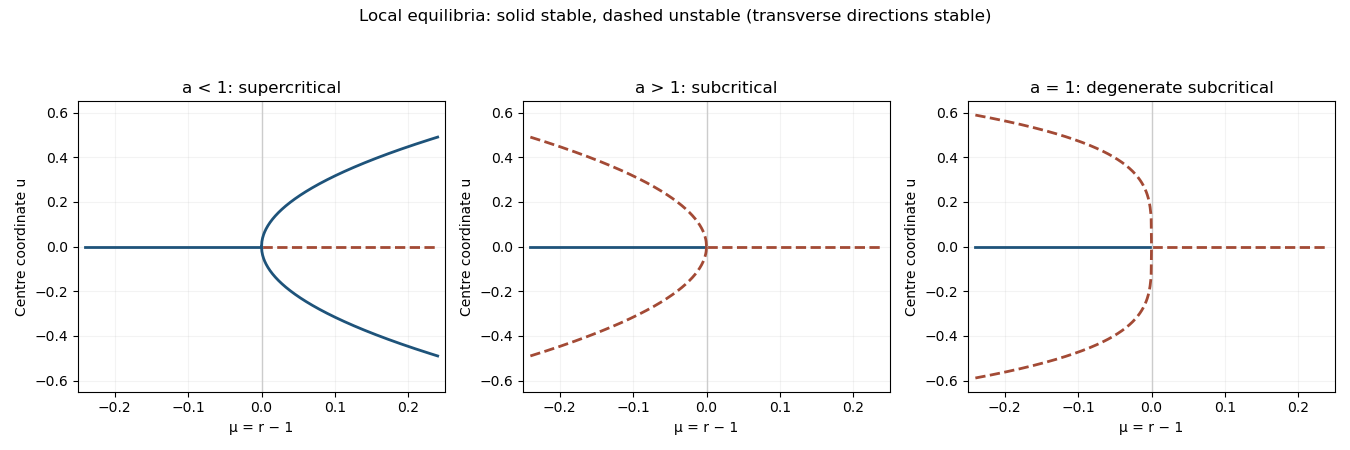
Bifurcation diagram for the equilibrium branches
. Details. 
Past exam of the mathematics course of the University of Cambridge 2017 ii Paper 3 2F c Created 2026-09-24 Updated 2026-09-24
Past exam of the mathematics course of the University of Cambridge 2017 ii Paper 3 2F b Created 2026-09-24 Updated 2026-09-24
Past exam of the mathematics course of the University of Cambridge 2017 ii Paper 3 2F a Created 2026-09-24 Updated 2026-09-24
Past exam of the mathematics course of the University of Cambridge 2017 ii Paper 3 29E Solution Created 2026-09-24 Updated 2026-10-05
The exponent has saddles , with and . Since the integrand is analytic off the origin, deform the contour to the unit circle and rotate . This gives the exact representationThe dominant saddle at is a steepest-descent direction for the method of steepest descent: . Set and expand the analytic amplitude against . Integrating its Gaussian moments gives the leading factor ; the rest of the contour is exponentially smaller than this dominant contribution outside any fixed neighbourhood of the maximum.
To obtain every coefficient efficiently, the integral satisfies , by differentiating and integrating the derivative of . Substitute to get and . Therefore the full asymptotic expansion isHere . For each fixed truncation at , the relative remainder is as . The infinite series is generally divergent, and this all-orders expansion does not purport to resolve exponentially small saddle contributions or their Stokes phenomenon.
Past exam of the mathematics course of the University of Cambridge 2017 ii Paper 3 28K Solution Created 2026-09-24 Updated 2026-10-05
The stochastic objective is interpreted as its expectation; a literal pathwise minimization is generally impossible without knowing future noises. Let the value function from time be , with . Independence from past observations and zero contemporaneous covariance giveThe Bellman equation is . Completing the square yieldsThis feedback is optimal among all controls measurable from the specified past, not merely linear controls. It depends on and does not depend on , though the minimal cost does. There is no cost-relevant in the displayed objective.
The backward Riccati recurrence iterates from . It is increasing, maps into , and has exactly one positive fixed point. Consequently it converges toAs , the finite-horizon feedback at any fixed time tends to this feedback. The closed-loop multiplier is , and its squared-mean factor is less than one, since and . Thus the second moment tends to . The finite-horizon value has ; its average converges by Cesaro summation. For a fixed initial state of finite second moment,The same average is attained by the stationary feedback, by the stationary Bellman equation and bounded second moments.
Past exam of the mathematics course of the University of Cambridge 2017 ii Paper 3 27J c Created 2026-09-24 Updated 2026-09-24
Past exam of the mathematics course of the University of Cambridge 2017 ii Paper 3 27J b Created 2026-09-24 Updated 2026-09-24
Past exam of the mathematics course of the University of Cambridge 2017 ii Paper 3 27J a Created 2026-09-24 Updated 2026-09-24
Past exam of the mathematics course of the University of Cambridge 2017 ii Paper 3 26K d Created 2026-09-24 Updated 2026-09-24
There are unlisted articles, also show them or only show them.