
Past exam of the mathematics course of the University of Cambridge 2002 ia Paper 2 5D Solution Created 2026-09-24 Updated 2026-10-14
An integrating factor for a differential one-form is a nonzero function for which is an exact differential, say . Then solutions lie on level sets . Locally, the compatibility condition is .
Here multiplication by , which is nonzero for , producesThe initial condition makes this first integral equal to . Taking the positive branch yields the solutionon the connected interval containing zero where the radicand is positive. This domain restriction matters because the original differential equation is singular at .
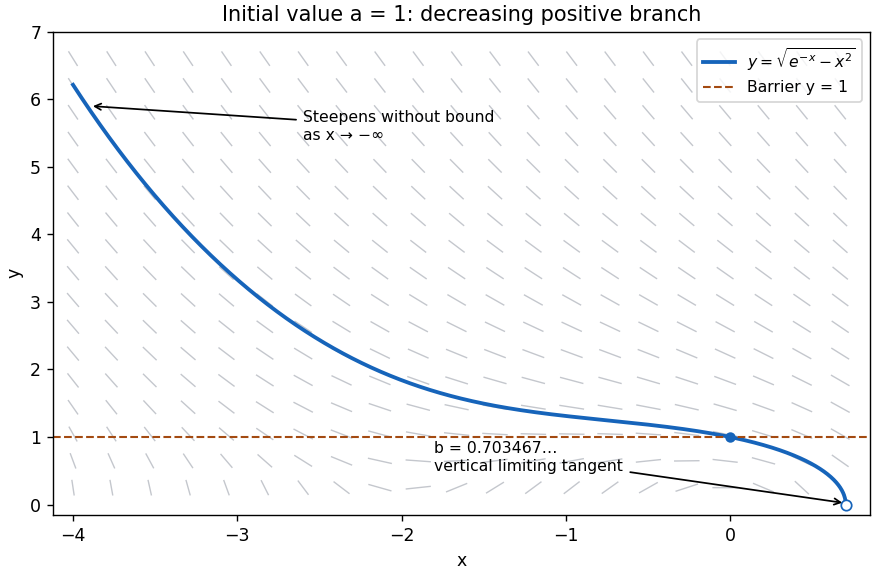
Completing the square gives . As , the differential equation consequently impliesAt , . Thus, moving a little to the left from , the curve rises above . Throughout every segment of the direction field points downwards as increases, by the inequality above. Tracing backwards therefore makes rise further, so it cannot return to . This graphical barrier argument proves and for every on the solution. The explicit first integral also shows this branch extends throughout : writing , the minimum of is , so for . Including the initial point, for all .
For the curve is on , where the strictly increasing function has the unique positive root at . The curve decreases through with slope and reaches only as a limiting endpoint. Its derivative isAs , and . As , the numerator tends to and the denominator to zero from above, so again . More precisely, at the endpoint. Both ends have the requested unbounded negative slope.

Past exam of the mathematics course of the University of Cambridge 2002 ia Paper 2 4F Solution Created 2026-09-24 Updated 2026-10-14
After independent tosses, an even count arises in exactly two disjoint ways: an even count after tosses followed by a tail, or an odd count followed by a head. Independence of the last toss from the preceding ones therefore givesSubtracting the fixed point turns this into the linear recurrenceAs zero is even, , so the probability isFor this is for every ; for it is always one; for it alternates between one and zero according to the parity of .
Past exam of the mathematics course of the University of Cambridge 2002 ia Paper 2 3F Solution Created 2026-09-24 Updated 2026-10-14
The indicator function equals one when the event occurs and zero otherwise. Its expected value is . By linearity of expectation, no independence assumption is needed to obtainSince , including , the variance isIn particular, correlations between the events cannot simply be discarded.
Write . If , then implies . Applying Chebyshev's inequality therefore givesEquivalently, the contribution of to is . A positive mean is necessary for the displayed ratio to be defined. If , nonnegativity instead gives almost surely, and the printed ratio would be .
Past exam of the mathematics course of the University of Cambridge 2002 ia Paper 2 2D Solution Created 2026-09-24 Updated 2026-10-14
This is a separable differential equation. On the solution with , integration from the initial condition givesThe right side lies in , so taking its sine stays on the required branch. The solution isNear the origin, , so and the tangent line is horizontal. At the other end, , whileThus the curve has a vertical limiting tangent line as , even though is excluded from the domain.
For the direction field, the slope is nonnegative everywhere in the square. The segments are horizontal on and on , become steeper as increases at fixed , and become flatter as increases at fixed . Near they are almost vertical unless is correspondingly close to one. The excluded corner has no single limiting slope: the ratio depends on the path of approach.
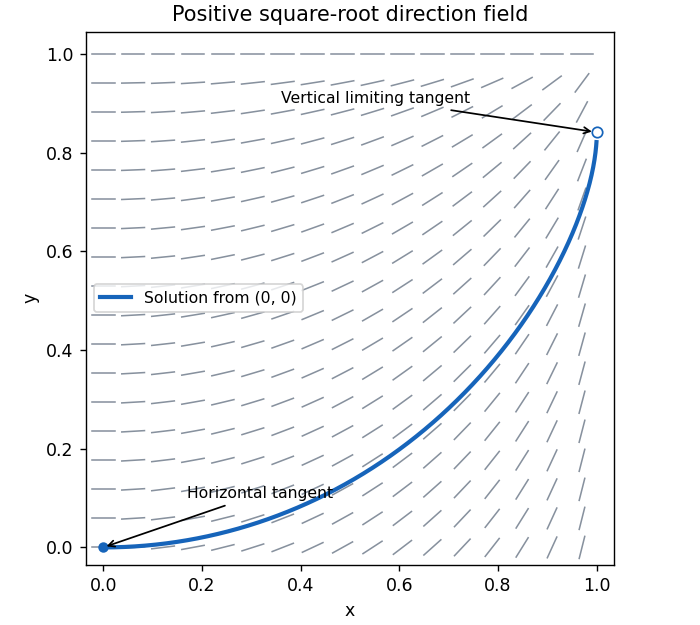
Positive slope field and the solution from the origin, with its horizontal and vertical limiting tangents
. Details. 
Past exam of the mathematics course of the University of Cambridge 2002 ia Paper 2 1D Solution Created 2026-09-24 Updated 2026-10-14
The characteristic equation of the homogeneous linear differential equation is , giving the homogeneous solution . For the first forcing, a particular solution of the form gives , soThe initial conditions impose and , whence , . Thus the first solution isFor the second forcing, is already a homogeneous solution, so the usual exponential trial must be multiplied by . Substitution of the particular solution gives , hence . Now , and the initial conditions give , . Therefore the resonant solution isThe additional factor reflects resonance in a differential equation.
Past exam of the mathematics course of the University of Cambridge 2002 ia Paper 2 12F d Created 2026-09-24 Updated 2026-09-24
Past exam of the mathematics course of the University of Cambridge 2002 ia Paper 2 12F c Created 2026-09-24 Updated 2026-09-24
Past exam of the mathematics course of the University of Cambridge 2002 ia Paper 2 12F b Created 2026-09-24 Updated 2026-09-24
Past exam of the mathematics course of the University of Cambridge 2002 ia Paper 2 12F a Created 2026-09-24 Updated 2026-09-24
Past exam of the mathematics course of the University of Cambridge 2002 ia Paper 2 11F d Created 2026-09-24 Updated 2026-09-24
Past exam of the mathematics course of the University of Cambridge 2002 ia Paper 2 11F c Created 2026-09-24 Updated 2026-09-24
Past exam of the mathematics course of the University of Cambridge 2002 ia Paper 2 11F b Created 2026-09-24 Updated 2026-09-24
Past exam of the mathematics course of the University of Cambridge 2002 ia Paper 2 11F a Created 2026-09-24 Updated 2026-09-24
Past exam of the mathematics course of the University of Cambridge 2002 ia Paper 2 10F c Created 2026-09-24 Updated 2026-09-24
Past exam of the mathematics course of the University of Cambridge 2002 ia Paper 2 10F b Created 2026-09-24 Updated 2026-09-24
Past exam of the mathematics course of the University of Cambridge 2002 ia Paper 2 10F a Created 2026-09-24 Updated 2026-09-24
Past exam of the mathematics course of the University of Cambridge 2002 ia Paper 1 9C iv Created 2026-09-24 Updated 2026-09-24
Past exam of the mathematics course of the University of Cambridge 2002 ia Paper 1 9C iii Created 2026-09-24 Updated 2026-09-24
Past exam of the mathematics course of the University of Cambridge 2002 ia Paper 1 9C ii Created 2026-09-24 Updated 2026-09-24
Past exam of the mathematics course of the University of Cambridge 2002 ia Paper 1 9C i Created 2026-09-24 Updated 2026-10-14
There are unlisted articles, also show them or only show them.