
Past exam of the mathematics course of the University of Cambridge 2001 ib Paper 3 6E Solution Created 2026-09-24 Updated 2026-10-14
Write . If is an interpolation node, the polynomial interpolation error is zero. Otherwise setThe function has distinct zeros: the interpolation nodes and . Repeated Rolle's theorem therefore gives a point strictly between the smallest and largest of these points with . Since and , this yields the polynomial interpolation errorAll differentiations are justified by . At an interpolation node the same displayed equality holds with any , because the product is zero.
Past exam of the mathematics course of the University of Cambridge 2001 ib Paper 3 5D Solution Created 2026-09-24 Updated 2026-10-14
The equality-constrained Lagrangian sufficiency theorem says: if is feasible and, for some fixed multipliers, it globally minimizes the optimization Lagrangian over all , then it globally minimizes the objective over feasible . On the feasible set the constraint terms vanish, so the two minimizations agree. No convexity assumption is needed for this version once global minimization of the optimization Lagrangian has been established.
Let , , and . Sincethe two constraints are independent. For the squared Euclidean norm objective in the original PDF, takeCompleting the square shows that its unique global minimizer has . The constraints become , , giving , . The Lagrangian sufficiency theorem therefore givesFor the value, use . Uniqueness also follows directly: for every feasible , the cross term in vanishes, so the difference of objectives equals that strictly positive sum unless . This is the minimum squared norm under two affine constraints.
Past exam of the mathematics course of the University of Cambridge 2001 ib Paper 3 4B Solution Created 2026-09-24 Updated 2026-10-14
For a spherical triangle on a sphere of radius , bounded by shorter great circle arcs and with interior angles , the spherical excess formula, the triangular form of the Gauss-Bonnet theorem, isHere is an area proof. On the unit sphere, a spherical lune of angle has area : rotating around its vertices shows it occupies a fraction of the sphere when one uses the full angular width, or directly integrates . The three side great circles of the triangle divide the sphere into eight regions, including the triangle and its antipodal triangle . Choose, at each vertex, the lune containing , and also its antipodal lune. Each of and is covered three times by these six lunes; each other region is covered once. Thus, with the area of ,This proves ; scaling lengths by scales area by .
Radially project each face of the regular dodecahedron from its centre onto the unit sphere. Each edge and the origin lie in a plane, so its image is a shorter great circle arc. The twelve faces give congruent convex regular spherical polygons partitioning the sphere. At each projected vertex three congruent face angles fill the tangent plane. Hence each spherical pentagon has angle at each of its five vertices. Splitting a pentagon into three spherical triangles and summing the spherical excess formula givesThis also agrees with , as required by the spherical partition.
Past exam of the mathematics course of the University of Cambridge 2001 ib Paper 3 3B Solution Created 2026-09-24 Updated 2026-10-14
A convenient version of Rouché's theorem is: if are holomorphic functions on a neighbourhood of a closed disk, and on its boundary, then and have the same number of zeros, counted with multiplicity, in the disk. In particular neither has a boundary zero under this comparison.
Put and use the boundary . There , , and .
For , compare with :The comparison polynomial is , which has three zeros in the disk, counting the double zero at .
Past exam of the mathematics course of the University of Cambridge 2001 ib Paper 3 2G i Created 2026-09-24 Updated 2026-10-14
Past exam of the mathematics course of the University of Cambridge 2001 ib Paper 3 20F b Created 2026-09-24 Updated 2026-09-24
Past exam of the mathematics course of the University of Cambridge 2001 ib Paper 3 20F a Created 2026-09-24 Updated 2026-09-24
Past exam of the mathematics course of the University of Cambridge 2001 ib Paper 3 1A b Created 2026-09-24 Updated 2026-09-24
Past exam of the mathematics course of the University of Cambridge 2001 ib Paper 3 1A a Created 2026-09-24 Updated 2026-10-14
Past exam of the mathematics course of the University of Cambridge 2001 ib Paper 3 19B Solution Created 2026-09-24 Updated 2026-10-14
First write with . Direct multiplication givesThe inner product of its two columns isIf is orthogonal this is zero, and positivity of the bracket forces . The first column must then have length one, so . Thus , , and .
For the general QR decomposition, apply the Gram-Schmidt process to the ordered columns of the invertible real matrix . At stage , subtract projections onto the already chosen orthonormal vectors to get ; independence of the columns gives . Set . The matrix with columns is orthogonal, andis upper triangular. Its diagonal entry is strictly positive. This proves with the required properties.
Now suppose in dimension . Substitution of givesThe matrix is orthogonal, as are and , so this matrix and are orthogonal. Regard as upper triangular in blocks, with invertible diagonal blocks . The inverse is upper triangular in the same blocks, by solving the triangular block equations; multiplication by block diagonal preserves this pattern. Thus is block upper triangular.
An orthogonal block upper-triangular matrix is block diagonal. Indeed its first two columns are supported in the first two rows and are orthonormal, so span that first coordinate plane. Orthogonality of every subsequent column to them makes its first two entries zero. The remaining lower-right matrix is orthogonal; iterate this argument. Therefore with each orthogonal. The rule for diagonal blocks of products of block upper-triangular matrices givesEach is itself an upper-triangular real matrix with positive diagonal. The first calculation gives . Consequently , whence . Finally is a product of matrices commuting with , so . We have provedThis is positive-diagonal QR decomposition preserves a complex structure; the positivity convention is important in the two-dimensional step.
Past exam of the mathematics course of the University of Cambridge 2001 ib Paper 3 18G Solution Created 2026-09-24 Updated 2026-10-14
For inviscid flow that is also incompressible flow and irrotational flow with velocity potential , the Euler equations integrate to the Unsteady Bernoulli equationThe same applies throughout a connected irrotational fluid region; an additive time-dependent potential can absorb it. With gravity absent, fluid at rest at infinity and , it is .
Take the cylinder centre at laboratory position with , and define relative to this moving centre. The circulation-free potential flow satisfies Laplace's equation, decays at infinity, and has surface condition . The harmonic solution is consequentlyThe velocities are and , hence .
The time derivative must be taken at fixed laboratory coordinates, not fixed . At a fixed fluid point , , soSubstituting into the Unsteady Bernoulli equation gives the entire pressure fieldAt the cylinder surface this is . Pressure acts against the outward radial normal of the cylinder, so the force per unit length isAll steady terms cancel by trigonometric orthogonality. ThereforeThis identifies the added mass of a circular cylinder as the mass of displaced fluid per unit length. The solution assumes the ambient fluid is initially at rest and has no separately prescribed circulation; these select the usual pure translating-cylinder flow.
Past exam of the mathematics course of the University of Cambridge 2001 ib Paper 3 17C Solution Created 2026-09-24 Updated 2026-10-14
Work in the finite-dimensional vector space implicit in the requested matrix representation and . Put , with . These form an increasing sequence ending in , and . Choose a basis of , extend it to a basis of , and continue until a basis of is obtained. Each basis vector introduced at stage maps into the span of vectors chosen at earlier stages. Its matrix column can therefore have nonzero entries only in earlier rows. This proves that the matrix is strictly upper triangular.
For a strictly upper-triangular matrix , a nonzero contribution to requires an index chain . No such chain has links among indices. Consequently . An example with exact index four is the Nilpotent Jordan blockHere has entry one in position and all others zero, while .
In the adapted basis, is upper triangular with diagonal entries one, so all its eigenvalues are one. This does not persist for the product of two such matrices with unrelated adapted bases. TakeBoth square to zero, buthas characteristic polynomial and eigenvalues , neither equal to one. The obstruction is that the two nilpotent matrices need not admit a common triangularizing basis.
Past exam of the mathematics course of the University of Cambridge 2001 ib Paper 3 16E b Created 2026-09-24 Updated 2026-09-24
Past exam of the mathematics course of the University of Cambridge 2001 ib Paper 3 16E a Created 2026-09-24 Updated 2026-09-24
Past exam of the mathematics course of the University of Cambridge 2001 ib Paper 3 15D Solution Created 2026-09-24 Updated 2026-10-14
Use the original PDF constraints, whose right sides are and . Introduce nonnegative surplus variables , slack , and artificial variables :All seven variables are nonnegative. Phase I of the two-phase simplex method minimizes with initial basis . The initial simplex dictionary isEnter and leave : the ratio test gives . Substituting givesNow enter and leave . The bounds from are , so the ratio test selects . The new dictionary isThe associated basic solution has and , which is a global minimum because artificial variables are nonnegative. Delete their columns for Phase II. In the remaining basis the objective isFor , both reduced costs are nonnegative, so the simplex method has reached the optimum at :For , the coefficient of is negative. Enter ; the ratio test gives from and from , so leaves. Eliminating givesand henceThe two reduced costs are now positive, so is optimal andAt the whole feasible edge from to is optimal; both value formulas agree. These dictionaries explicitly carry out both phases rather than inferring the answer solely from a feasible-region sketch.
Past exam of the mathematics course of the University of Cambridge 2001 ib Paper 3 14B b Created 2026-09-24 Updated 2026-09-24
Past exam of the mathematics course of the University of Cambridge 2001 ib Paper 3 14B a Created 2026-09-24 Updated 2026-10-14
Past exam of the mathematics course of the University of Cambridge 2001 ib Paper 3 13B Solution Created 2026-09-24 Updated 2026-10-14
The product topology on consists of arbitrary unions of rectangles with , open. Such rectangles form a basis of a topology: every point lies in one, and intersections of two rectangles are rectangles with open factors.
If induce the factor topologies, setDefiniteness and symmetry are immediate. Each factor triangle inequality bounds its distance by the sum of the two relevant product distances; taking the maximum proves the product triangle inequality. A ball of radius is exactly , so every metric-open set is product-open. Conversely an open rectangle containing contains a product ball with radius the minimum of two suitable factor radii. Hence the maximum product metric induces precisely the product topology.
A compact space is one for which every open cover has a finite subcover. Let cover , with both factors compact; if either is empty the result is immediate. For each fixed and each , choose a rectangle containing and lying in a member of . The sets cover , so finitely many, indexed by , suffice. Their -neighbourhoods have open intersectioncontaining . The finitely many selected members of cover all of . Now the sets cover , so select finitely many of these by compactness of . Taking the union of their finite selections from gives a finite cover of the whole product. The product of two compact spaces is compact, without requiring the factors to be Hausdorff.
Past exam of the mathematics course of the University of Cambridge 2001 ib Paper 3 12H Solution Created 2026-09-24 Updated 2026-10-14
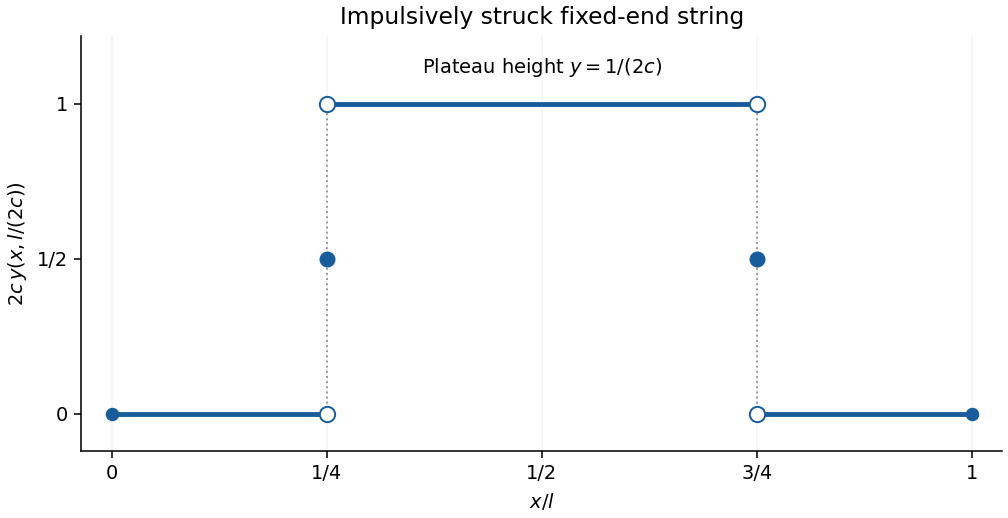
Assume for the interior pulse; endpoint variants use the same coefficient formula. Orthogonality of the Fourier sine basis givesThe Fourier sine series equals at its interior continuity points and takes value at the jumps ; the sine series is zero at both endpoints. Thus it does not retain an arbitrarily assigned value at a jump.
For the string, write . The wave equation on a string givesThe last equality is the Fourier sine series of the Dirac delta at . Solving the modal ordinary differential equations givesThis impulsively struck fixed-end string is understood as a distributional weak solution; the initial velocity is a distribution, not a classical continuous function.
To evaluate the requested time, take the odd -periodic extension of and use the D'Alembert formula . At , the interval contains the positive impulse at . For , it also contains the negative reflected impulse at , so the contributions cancel. For only the positive impulse contributes. For neither contributes. Thus the midpoint-valued Fourier series givesThe discontinuity values are a convention for the Fourier representative and do not affect the distribution. The sketch shows the reflected negative front cancelling the left portion of the initially generated plateau.

Past exam of the mathematics course of the University of Cambridge 2001 ib Paper 3 11A Solution Created 2026-09-24 Updated 2026-10-14
For the differentiability from continuous partial derivatives argument, choose a small box around zero inside the given open set. For in that box, telescope by changing one coordinate at a time. The one-dimensional mean value theorem on the th coordinate segment giveswhere lies on that segment, and therefore . A zero-length segment contributes zero and needs no choice of intermediate point. Set . For every , continuity of the finitely many partial derivatives at zero gives when is sufficiently small. Then the Cauchy-Schwarz inequality givesThus is Fréchet differentiable at zero, with derivative . No continuity of the partial derivatives away from zero was used.
For the supplied one-dimensional function,The derivative at zero follows from . For nonzero the derivative is continuous. At zero, the sequences and give derivative values and . Since , the partial derivative is continuous exactly where , irrespective of .
Nevertheless is differentiable at every point of the plane. The one-dimensional function is differentiable at every real number. At a fixed ,Their sum has remainder , which proves Fréchet differentiability with derivative . In particular, at the origin , an immediate remainder bound. Continuity of all partial derivatives is sufficient, not necessary, for differentiability.
There are unlisted articles, also show them or only show them.