
Past exam of the mathematics course of the University of Cambridge 2002 ib Paper 2 14B d Created 2026-09-24 Updated 2026-09-24
Past exam of the mathematics course of the University of Cambridge 2002 ib Paper 2 14B c Created 2026-09-24 Updated 2026-09-24
Past exam of the mathematics course of the University of Cambridge 2002 ib Paper 2 14B b Created 2026-09-24 Updated 2026-09-24
Past exam of the mathematics course of the University of Cambridge 2002 ib Paper 2 14B a Created 2026-09-24 Updated 2026-09-24
Past exam of the mathematics course of the University of Cambridge 2002 ib Paper 2 13G c Created 2026-09-24 Updated 2026-09-24
Past exam of the mathematics course of the University of Cambridge 2002 ib Paper 2 13G b Created 2026-09-24 Updated 2026-09-24
Past exam of the mathematics course of the University of Cambridge 2002 ib Paper 2 13G a Created 2026-09-24 Updated 2026-09-24
Past exam of the mathematics course of the University of Cambridge 2002 ib Paper 2 12H Solution Created 2026-09-24 Updated 2026-10-14
For independent observations from a normal distribution with unknown mean and positive variance, the maximum likelihood estimation of the mean givesIndeed , which is minimized at . The likelihood isFor fixed , differentiation in gives the maximizer . Thus the unrestricted fit has , whereas under the null hypothesis the fitted variance is . Both maximize rather than minimize the likelihood: it tends to zero at either variance endpoint when the residual sum of squares is positive.
The restricted-to-unrestricted likelihood ratio is thereforeThe generalized likelihood-ratio test rejects for small , equivalently large . Under the null, is standard normal, has a chi-squared distribution with degrees of freedom, and they are independent. To see the independence, apply an orthogonal matrix to the standardized normal sample, taking its first row to be : the transformed coordinates remain independent standard normal variables, and is the sum of squares of the other coordinates. Hence has Student's t-distribution with degrees of freedom.
Past exam of the mathematics course of the University of Cambridge 2002 ib Paper 2 11C Solution Created 2026-09-24 Updated 2026-10-14
Under a Cartesian frame change , where is an orthogonal matrix. Orthogonality gives and . Thereforewhich is the tensor component transformation law. Also directly, proving that it is a symmetric Cartesian second-rank tensor for every choice of the two scalars.
For , the direction of is an eigenvector with eigenvalue . Every vector perpendicular to is an eigenvector with eigenvalue , a two-dimensional eigenspace. If , these eigenvalues coincide and every nonzero vector is an eigenvector. If , the tensor is zero and again every nonzero vector is an eigenvector, now with eigenvalue zero.
For the position-dependent field with zero divergence, the product rule givesContraction of the two Levi-Civita symbols in the curl and cross product givesConsequentlyThese constants give the magnetic part of the Maxwell stress tensor, with its physical prefactor suppressed. They are forced if the identity is to hold for every divergence-free field: forces ; at the origin then forces .
Apply the divergence theorem separately to each component:Since the whole vector field vanishes on , all components of vanish there, and hence the vector volume integral is zero. The argument assumes a differentiable field and a boundary for which the divergence theorem applies.
Past exam of the mathematics course of the University of Cambridge 2002 ib Paper 2 10E c Created 2026-09-24 Updated 2026-09-24
Past exam of the mathematics course of the University of Cambridge 2002 ib Paper 2 10E b Created 2026-09-24 Updated 2026-09-24
Past exam of the mathematics course of the University of Cambridge 2002 ib Paper 2 10E a Created 2026-09-24 Updated 2026-09-24
Past exam of the mathematics course of the University of Cambridge 2002 ib Paper 1 9D Solution Created 2026-09-24 Updated 2026-10-14
A normalizable bound state has : the potential is nonnegative, while exponential decay is needed on the infinite right-hand region. Set and . The hard-wall condition and decay selectContinuity at has already been used. Since the finite step contains no delta interaction, integrating the Schrödinger equation across it also requires derivative continuity. Thus , givingThe ground-state solution uses the first branch and has no internal node. It starts at zero, rises to one maximum inside the well, decreases to a positive value at , and joins smoothly onto a decaying exponential tail.
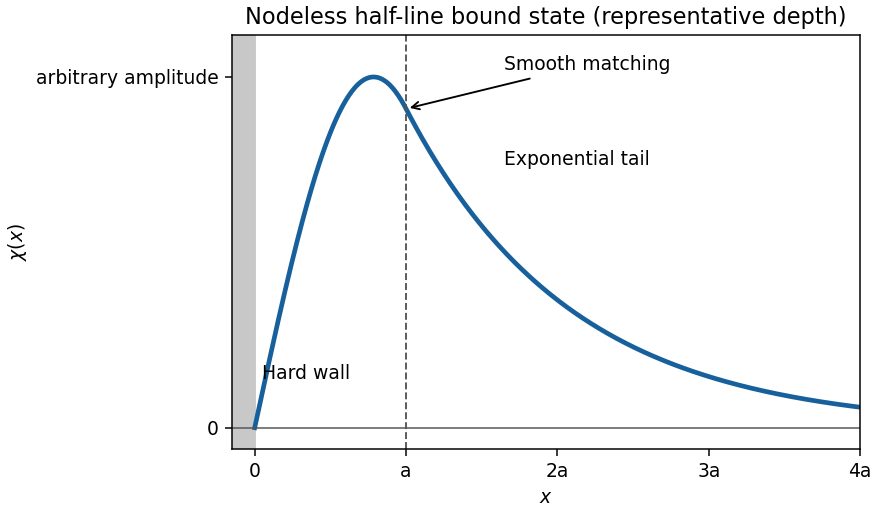
To see the precise existence condition, set and . The first-branch matching equation gives on . This increases strictly from to infinity, since its derivative is . Thus the bound ground state exists exactly when , or , as in the bound-state thresholds for a square well with one hard wall. At equality and the exterior solution is not square-integrable. Below it there is no normalizable energy eigenfunction of the requested ground-state type. The sketch assumes the binding condition and uses one representative solution, not a specified numerical well depth.
Past exam of the mathematics course of the University of Cambridge 2002 ib Paper 1 8F Solution Created 2026-09-24 Updated 2026-10-14
For a real symmetric bilinear form, a basis puts its quadratic expression in diagonal form with positive, negative and zero squares. Its rank is , the rank of the coefficient matrix, or equivalently the codimension of its radical. Its signature is ; the signature pair is , another common convention.
These quantities do not depend on the basis. A basis change replaces the matrix by with invertible, preserving matrix rank. The number is intrinsically the largest dimension of a subspace on which the form is positive definite. In a diagonal representation the positive coordinate space attains this dimension; any subspace of dimension greater than intersects the negative-plus-null coordinate space nontrivially and therefore cannot be positive definite. The same argument with signs reversed characterizes . This proves the needed invariance, rather than assuming it from a chosen representation.
Decompose the full matrix space asusing the symmetric traceless, skew-symmetric and scalar parts. The summands are orthogonal for the given form. Indeed for symmetric and skew-symmetric , by transposition and cyclic invariance of trace, while both non-scalar summands are traceless and hence orthogonal to . On them,for nonzero vectors in their respective summands. The dimensions are , and one. Therefore the modified trace form on real matrices hasThere is no radical for .
Past exam of the mathematics course of the University of Cambridge 2002 ib Paper 1 7B Solution Created 2026-09-24 Updated 2026-10-14
Fix real and use a rectangle with vertical sides at real coordinates . The function is entire, so its closed contour integral is zero by Cauchy's integral theorem. The bottom horizontal side contributes and the top contributes the negative of . This identity applies for either sign of , with the corresponding oriented rectangle.
On a vertical side, with , andThe sum of the two vertical integrals in absolute value is at most . Both horizontal improper integrals converge absolutely, since . Letting therefore provesComplete the square in the Fourier transform:The shifted-integral identity applies after scaling by . The Gaussian integral is : the square of becomes in polar coordinates. Thus the Gaussian Fourier transform yieldsThe eigenvalue reflects the unnormalized transform convention in this question.
Past exam of the mathematics course of the University of Cambridge 2002 ib Paper 1 6C Solution Created 2026-09-24 Updated 2026-10-14
The divergence is , so this is an incompressible flow. With the planar convention , one stream function isAt a fixed nonzero , the streamlines have and , since the instantaneous velocity is purely axial. If , every point is instantaneously stationary and there is no distinguished streamline direction.
Follow a marked particle initially at . Its trajectory satisfies and , soThese points form a straight segment on , , not an instantaneous horizontal streamline. Its length isThe directed angle of its vector from the origin to the marked endpoint isFor and , this is ; it equals at . If an unoriented acute angle to the axis is intended, use , with when . This distinction handles a negative value of the given constant as well. If , the marked set is a single point: the length formula gives zero and no line direction is defined.
Past exam of the mathematics course of the University of Cambridge 2002 ib Paper 1 5G Solution Created 2026-09-24 Updated 2026-10-14
Relative to the coordinate basis, the linear map has matrixExpanding in its first column gives the monic characteristic polynomialIts eigenvalues are and , three distinct complex numbers. Eigenvectors corresponding to distinct eigenvalues are linearly independent, so they form a basis of and is diagonalizable.
Every annihilating polynomial must vanish at all three eigenvalues: applying to a corresponding eigenvector gives . Conversely, in the eigenbasis the product of the three distinct linear factors annihilates . Hence the minimal polynomial isIf with scalars not both zero, the nonzero polynomial of degree at most two would annihilate , contradicting this minimal degree of three. Thus and are linearly independent endomorphisms.
Past exam of the mathematics course of the University of Cambridge 2002 ib Paper 1 4E Solution Created 2026-09-24 Updated 2026-10-14
Let be the finite group and choose a point . Its orbit is a nonempty finite set. Every group element permutes and maps a closed metric disc onto a disc of the same radius. By the permitted uniqueness of the smallest enclosing disc, it fixes that disc and therefore its centre . Thus lies in the orientation-preserving stabilizer of one point.
In the Euclidean plane, translate to zero. Every isometry fixing zero is an orthogonal linear map: distance preservation gives preservation of inner products by the polarization identity, and its values on an orthonormal basis then determine the linear map. Orientation preservation gives determinant one, so it is a rotation. Consequently embeds in the circle group of rotation angles.
For the hyperbolic plane, use this precise standard fact about its isometries: after placing a point at the origin of the Poincare disc model, every orientation-preserving isometry fixing it has the form . Equivalently, its point stabilizer is the rotation group, and its action on directions at the point is faithful. This is a general hyperbolic-plane fact allowed by the question. It again identifies with a finite subgroup of the circle group.
Finally, a nontrivial finite rotation group has a least positive angle in . Divide any other angle by : the remainder is another group angle in , so it must be zero. Similarly the remainder of is zero, and for an integer . The rotation through generates the group. The trivial group is cyclic as well. Therefore both finite orientation-preserving plane isometry groups are cyclic. This proves the finite orientation-preserving plane isometry groups are cyclic result using the same enclosing-disc argument in both geometries.
Past exam of the mathematics course of the University of Cambridge 2002 ib Paper 1 3H Solution Created 2026-09-24 Updated 2026-10-14
For a dominated family of sample distributions, a statistic is a sufficient statistic precisely when the probability mass function or density factors aswhere does not depend on the parameter. This is the Fisher-Neyman factorization theorem.
Here is the discrete proof in both directions. Suppose the factorization holds, and write . Then . Whenever this probability is positive, is finite and positive andis independent of . Thus the conditional distribution of the whole sample given is parameter-free, which is the definition of a sufficient statistic.
Conversely, if is sufficient, let denote this common conditional mass function on each possible fiber. ThenTake and to obtain the factorization. Fibers impossible for every parameter can be assigned ; conditional probabilities are required only for fibers with positive probability.
For the independent Poisson sample the joint mass function isAll parameter dependence is throughso this is a one-dimensional sufficient statistic. The sample mean contains the same information, since is known.
Past exam of the mathematics course of the University of Cambridge 2002 ib Paper 1 2A Solution Created 2026-09-24 Updated 2026-10-14
The Fourier sine series has coefficientsby integration by parts. ThusIts odd extension is on , continued with period . The usual Fourier convergence result for a piecewise smooth periodic function gives the value at a continuous point and the mean of one-sided limits at a jump. At , subtracting one period gives , a continuous point of this extension. Therefore the sine series converges to there.
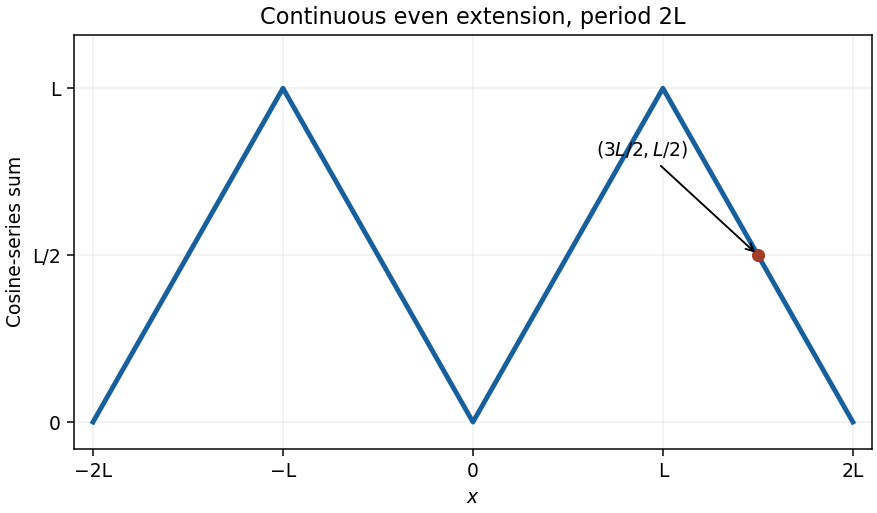
For the Fourier cosine series, the even extension is on , continued with period . Its triangular wave is continuous even at the joining points, so the cosine series converges to that extension everywhere. On the requested interval its graph isThe vertices are . In particular, its value at is .


There are unlisted articles, also show them or only show them.