
Past exam of the mathematics course of the University of Cambridge 2002 ia Paper 4 7B a Created 2026-09-24 Updated 2026-09-24
Past exam of the mathematics course of the University of Cambridge 2002 ia Paper 4 6F c Created 2026-09-24 Updated 2026-09-24
Past exam of the mathematics course of the University of Cambridge 2002 ia Paper 4 6F b Created 2026-09-24 Updated 2026-09-24
Past exam of the mathematics course of the University of Cambridge 2002 ia Paper 4 6F a Created 2026-09-24 Updated 2026-09-24
Past exam of the mathematics course of the University of Cambridge 2002 ia Paper 4 5F Solution Created 2026-09-24 Updated 2026-10-14
A set is countable if it is finite or admits an injection into the natural numbers; an infinite countable set can equivalently be listed as a sequence. Let with each countable. Choose an enumeration of each nonempty , allowing repetition if it is finite. List the pairs in successive finite diagonals of constant and output the th member of . This lists every member of , so is countable; empty sets contribute nothing, and repetitions can be removed by retaining first occurrences. This is the countable union of countable sets theorem, in the usual setting with axiom of countable choice for selecting the enumerations.
Each positive-length interval has a nonempty interior containing a rational number by the density of the rational numbers. Fix one enumeration of the rational numbers and let be its first member in the interior of . Disjointness gives , so is an injection of into a countable set. Hence is countable. This proof of the countability of disjoint positive-length intervals uses a fixed enumeration and needs no arbitrary simultaneous choice of rationals.
Past exam of the mathematics course of the University of Cambridge 2002 ia Paper 4 4E Solution Created 2026-09-24 Updated 2026-10-14
Apply the rotating-vector derivative rule first to the position vector and then to its velocity. Since is constant,For example, the derivative of contributes , while that of contributes the other two terms. This is the equation of motion in a rotating frame. The mutual central forces are unchanged in form because rotations preserve lengths and differences of position vectors. Newton's second law for particle becomesSet . The velocity-dependent Lorentz force is , and it cancels the Coriolis force . The remaining terms combine to and are quadratic in the magnetic field. Neglecting them givesidentical to the zero-field equations to first order. The Larmor theorem requires the common charge-to-mass ratio; a mixture with different ratios cannot use one rotating frame to cancel every magnetic term.
Past exam of the mathematics course of the University of Cambridge 2002 ia Paper 4 3E Solution Created 2026-09-24 Updated 2026-10-14
Put and . Multiplying the equation by givesso its first integral isThese level curves give the positive phase plane for the avalanche front with linear mass entrainment. For , the curve starts at , and rises. For , it diverges as , has a minimum at , and then rises. The curve is . Forward-time arrows have increasing ; at a zero-velocity endpoint the equation gives .
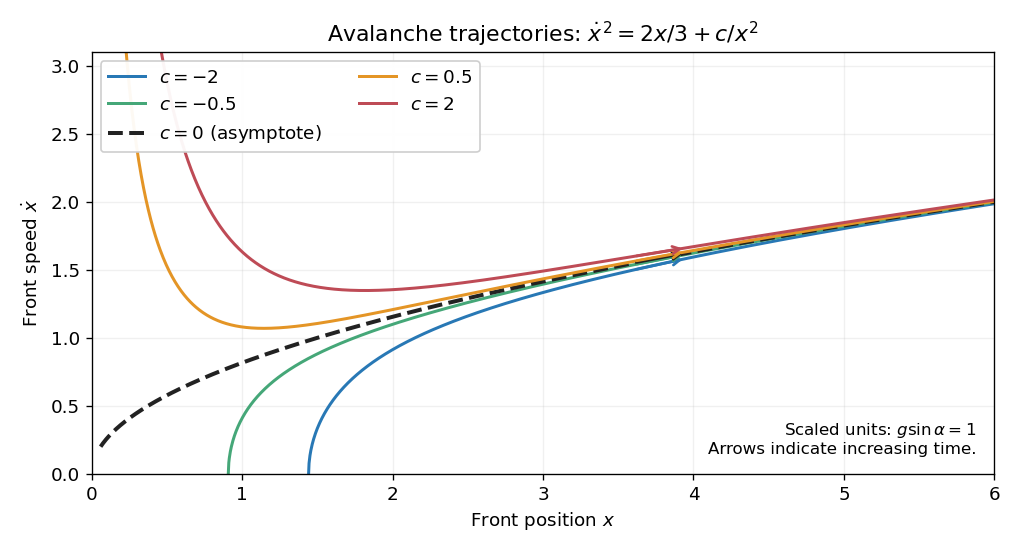
Avalanche phase trajectories approaching the linear-entrainment asymptote
. Details. 
Every forward-moving trajectory has : after it has entered , a bounded limiting would force a zero of the displayed positive-branch speed ahead of it, but its only possible zero is the lower endpoint. For large ,Expanding the equation as and substituting the first integral givesThus both the asymptotic phase plane trajectory and the limiting acceleration are independent of the initial data.
Past exam of the mathematics course of the University of Cambridge 2002 ia Paper 4 2C Solution Created 2026-09-24 Updated 2026-10-14
The base case is the product rule. Suppose the Leibniz rule holds at order . Taking one more derivative of each term and collecting the coefficient of givesHere binomial coefficients outside are zero. For , the factorial definition proves Pascal's identity directly:At , the identity is . Substitution gives the required order- formula, completing the induction.
Past exam of the mathematics course of the University of Cambridge 2002 ia Paper 4 1C iv Created 2026-09-24 Updated 2026-09-24
Past exam of the mathematics course of the University of Cambridge 2002 ia Paper 4 1C iii Created 2026-09-24 Updated 2026-09-24
Past exam of the mathematics course of the University of Cambridge 2002 ia Paper 4 1C ii Created 2026-09-24 Updated 2026-09-24
Past exam of the mathematics course of the University of Cambridge 2002 ia Paper 4 1C i Created 2026-09-24 Updated 2026-10-14
Past exam of the mathematics course of the University of Cambridge 2002 ia Paper 4 12E Solution Created 2026-09-24 Updated 2026-10-14
The moment of inertia of a uniform length- rod about its transverse central axis isThe kinetic energy decomposition about the center of mass gives for center speed and rod angle .
For a falling arch with , the symmetric two hinged rods with both ends sliding on a floor have the following motion. The hinge remains vertically over the arch center. Their centers are , so each has squared speed . Total kinetic energy is , and total gravitational potential energy is . Conservation of energy from rest at angle gives . At the hinge impact , its height derivative is , givingThe floor-contact assumption is consistent: differentiating the energy relation gives , and the normal reaction on each outer endpoint is . Completing the square shows throughout the fall.
Past exam of the mathematics course of the University of Cambridge 2002 ia Paper 4 11E Solution Created 2026-09-24 Updated 2026-10-14
Neglecting gravity, the equation of motion is , where . Dotting with the velocity gives , because a cross product is perpendicular to its factors. Thus the speed is constant. The vector triple product givesHence the generalized angular momentum in a radial monopole field isDotting with gives , or . For , the direction of therefore makes the fixed angle with the axis , describing a right circular conical surface with vertex at the North Pole. Orthogonality gives , so this cosine is in . Radial motion gives a degenerate cone; when and the ordinary angular momentum is nonzero the cone is the usual orbital plane. If , the norm identity forces and , giving a radial straight line.
Past exam of the mathematics course of the University of Cambridge 2002 ia Paper 4 10E Solution Created 2026-09-24 Updated 2026-10-14
A central force has zero torque, so is constant and the angular momentum is . The areal velocity is . Put and let primes denote angular derivatives. Then , , and . The radial equation with inward force magnitude is , giving the Binet equationChoose the angular origin along a diameter of a radius- circle through . Its polar equation is , so on . Since , substitution gives and henceThe force is attractive. For fixed force coefficient and mass, , so is inversely proportional to the magnitude of the angular momentum. The time along the circle isThis circular orbit through an inverse-fifth-power singularity reaches the force center at the two endpoints of this angular interval. The integral is finite; continuation through the singular collision is not specified by the force law alone.
Past exam of the mathematics course of the University of Cambridge 2002 ia Paper 3 9A Solution Created 2026-09-24 Updated 2026-10-14
The chain rule along the specified straight line givesHere equality of mixed partial derivatives follows from smoothness. Apply Taylor theorem in the single variable :Writing and produces the linear and quadratic termswith all displayed partial derivatives evaluated at . For a remainder valid uniformly over directions, apply the Taylor formula with integral remainder to :Continuity of the Hessian matrix makes the difference between the integral and be . The printed ellipsis is therefore justified as a finite Taylor expansion with a remainder. Smoothness alone does not assert convergence of an infinite Taylor series.
At a stationary point, the linear term vanishes. The symmetric Hessian matrix satisfiesIf and , this is a positive-definite quadratic form. Its minimum over the unit circle is a positive number , so . The Taylor remainder is smaller than for sufficiently small , proving for nonzero nearby . Thus the stationary point is a strict local minimum.
For the given polynomial, the gradient equations reduce toThe stationary points are , andAt both points with , we have and . ConsequentlyAt the origin the determinant of the Hessian matrix is , giving a saddle point. An independent check is the identity , which proves that the two displayed local minima are also the only global minima.
Past exam of the mathematics course of the University of Cambridge 2002 ia Paper 3 8B b Created 2026-09-24 Updated 2026-09-24
Past exam of the mathematics course of the University of Cambridge 2002 ia Paper 3 8B a Created 2026-09-24 Updated 2026-09-24
Past exam of the mathematics course of the University of Cambridge 2002 ia Paper 3 7A Solution Created 2026-09-24 Updated 2026-10-14
For the linear map represented by , a solution to the system of linear equations exists precisely when . If is one solution, thenThus the affine solution space of a linear equation completely describes the possibilities: no solutions when ; one solution when and ; and infinitely many solutions when and . In the last case, a nonzero supplies the distinct solutions for every real . In dimension three, the rank-nullity theorem also says that a trivial kernel is equivalent to an invertible matrix .
For the matrix equation, means that , where is represented by . Necessarily . Conversely, if that containment holds, choose an -preimage of each for the three standard basis vectors, and use those preimages as the columns of . Their linear extension gives . This proves the image criterion for a matrix factorization:Whenever it is solvable, every solution is with . It is unique exactly when . Indeed, a nonzero produces a nonzero matrix with first column and other columns zero, so uniqueness fails for any compatible if the kernel is nontrivial.
For the printed numerical matrix , its determinant is , so the solution is unique. To calculate it, solve . The last equation gives ; the second then gives . Substitution into the first yieldsApplying these formulas to the three columns of the PDF's givesMultiplication gives , confirming the result against the printed matrix.
Past exam of the mathematics course of the University of Cambridge 2002 ia Paper 3 6E b Created 2026-09-24 Updated 2026-09-24
There are unlisted articles, also show them or only show them.