
Vanishing-viscosity limit Created 2026-09-24 Updated 2026-11-05
A vanishing-viscosity limit studies solutions as the viscosity coefficient tends to zero. Uniform estimates and compactness can make the viscous term disappear weakly while retaining enough strong convergence to pass nonlinear transport terms to an inviscid equation.
Damped-vorticity maximum estimate Created 2026-09-24 Updated 2026-11-05
For a steady damped vorticity equation with , divergence-free transport, and bounded forcing, multiplication by gives . Sending to infinity yields
D'Alembert formula with initial velocity Created 2026-09-24 Updated 2026-10-14
For the wave equation with zero initial displacement and initial velocity , D'Alembert's formula becomesFor this is the original speed-one form when the initial velocity is named . The integral records the total initial kick inside the domain of dependence.
For a computed example, set on and zero elsewhere, with . This discontinuous datum gives a weak solution:At the centre, . For , and , this is at and at . Once , a central plateau occupies . In contrast, central zero region for odd compactly supported initial velocity follows when the full integral of vanishes. Finite propagation speed permits an interior tail; it does not imply the Strong Huygens principle.
Maximal cyclotomic extension Created 2026-09-24 Updated 2026-09-29
For a field inside a fixed algebraic closure, the maximal cyclotomic extension is the union of the fields generated by roots of unity.
Seventh cyclotomic field Created 2026-09-24 Updated 2026-11-05
For a primitive seventh root of unity ,where . Its four intermediate fields correspond to the four subgroups of the cyclic group .
Roots of unity in a rational cyclotomic field Created 2026-09-24 Updated 2026-11-05
Kriz theorem for cyclic transitive point sets Created 2026-09-24 Updated 2026-09-24
Every finite cyclic transitive point set is a Euclidean Ramsey set. In particular every regular polygon is Euclidean Ramsey.
Generator of a group Created 2026-09-24 Updated 2026-10-14
A generator of a group is a single element for which : every group element is an integer power of . A group admitting such an element is a cyclic group. In additive notation, every element must be an integer multiple of .
Distinguish a single generator of a group from a generating set of a group. The Klein four-group needs two elements to generate it, although it has only four elements; no single element visits all four. A cyclic group need not have a unique generator of a group: has and , while the additive integers have and .
Finite subgroup of the multiplicative complex numbers Created 2026-09-24 Updated 2026-11-05
Pancyclic graph Created 2026-09-24 Updated 2026-09-24
Hamilton cycle Created 2026-09-24 Updated 2026-10-14
A Hamilton cycle, also called a Hamiltonian cycle, is a cycle in a graph containing every vertex of the graph. Here the convention is a finite simple graph whose edges are undirected, with . A traversal is a sequencewhere are all the distinct vertices and for . Thus "once" means once before the closing return: the start appears again at the end, and there are exactly traversed edges. The graph may contain additional unused edges.[ref]
Hamilton Cycles. Diestel, Graph Theory, Chapter 10, opening paragraph, printed p. 323: Hamilton cycles, Hamilton paths, and the contrast with Euler tours
A Hamiltonian path visits all vertices once without requiring a return. Removing an edge from a Hamilton cycle gives a Hamiltonian path; a particular Hamiltonian path closes only if its endpoints are adjacent. An Euler circuit instead traverses every edge exactly once and can revisit vertices midway. The two requirements are independent, as these original labelled examples show.
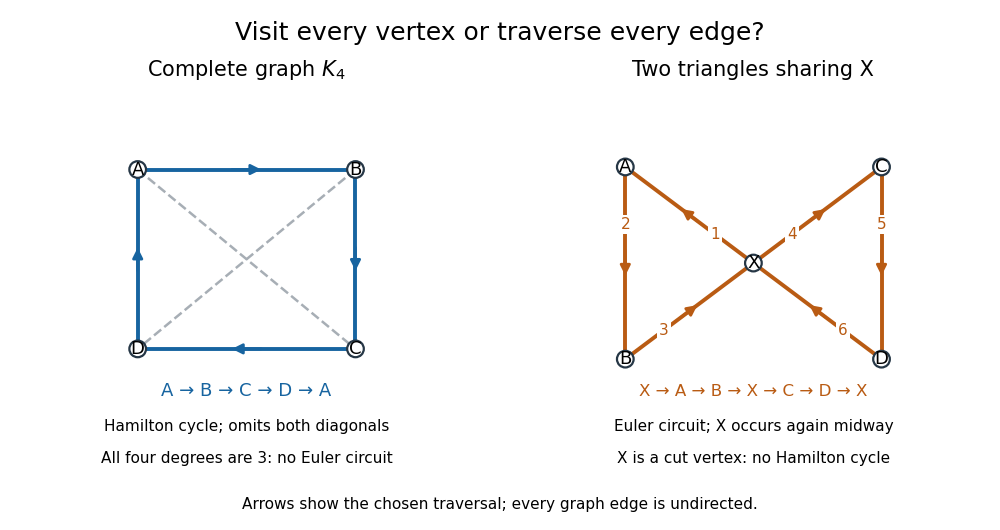
Two graphs separate Hamilton cycle vertex coverage from Euler circuit edge coverage; arrows mark traversal order, not directed edges
. Details. 
For the complete graph , use and , where abbreviates the unordered pair . The route is a Hamilton cycle: it visits every vertex and uses four of the six edges, omitting and . It is not an Euler circuit, and the graph admits no Euler circuit at all: every vertex degree is three, contradicting the Euler circuit criterion. The crossing of the drawn diagonals is not another vertex.
Conversely, take two triangles in a graph sharing only , with and . The route is an Euler circuit, using all six edges once; the vertex degrees are . It cannot be a Hamilton cycle, since occurs midway as well as at the start and end. More strongly, no Hamilton cycle exists: is a cut vertex, and deleting it leaves the two separate edges and . Nevertheless, is a Hamiltonian path, whose endpoints are not adjacent.
Plane curve reconstructed from curvature Created 2026-09-24 Updated 2026-10-03
Given a smooth function , setThen is unit speed and has signed curvature . This gives the existence part of the fundamental theorem of plane curves.
Cohomology ring Created 2026-09-24 Updated 2026-09-28
The cohomology ring is the graded ring whose multiplication is the cup product. It records intersection information that the graded cohomology groups alone do not detect.
Uniform convergence of distribution functions to a continuous limit Created 2026-09-24 Updated 2026-11-05
If distribution functions converge pointwise to a continuous distribution function , then the convergence is uniform. Choose finitely many points whose successive -increments and two tails are small, then use monotonicity to squeeze between its values at adjacent points.
Mean parameter of an exponential family Created 2026-09-24 Updated 2026-10-14
Exponential-family derivative identities Created 2026-09-24 Updated 2026-09-24
Differentiating the normalization identity gives
Cardano formula Created 2026-09-24 Updated 2026-11-05
For a depressed cubic over a field of characteristic zero, putChoose with , , and . Then is a root, becauseFor , choose a nonzero and set ; this enforces the compatibility rather than choosing two arbitrary cube roots. If , take a cube root of directly. With a primitive cube root of unity , the other roots are and .
The Lagrange resolvent for a cubic explains why a quadratic equation appears inside the formula. Even when the cubic has three real roots, complex intermediate radicals may occur; the compatible pairing of cube roots is what makes the resulting expressions solve the original equation.
Elastic Bragg scattering condition Created 2026-09-24 Updated 2026-11-05
For elastic scattering of a plane wave by a periodic crystal, a diffraction contribution can occur when the momentum transfer is a reciprocal lattice vector:Squaring giveswhere is the angle between incident and outgoing wavevectors. This is the Ewald sphere construction. For planes with spacing and first reciprocal spacing , it becomes Bragg's law .
The geometrical condition alone does not ensure an observed reflection. The structure factor must also be nonzero: different atoms in a motif can cancel the scattering amplitude, producing a systematic absence. The diamond-basis diffraction extinction is a concrete example.
For a powder or a crystal rotated to reach the required orientation, the smallest possible nonzero diffraction angle is therefore determined by the shortest allowed reciprocal lattice vector with nonzero structure factor and . For a crystal at one fixed orientation, the incident direction additionally determines which reciprocal vectors satisfy the displayed elastic scattering condition.
Crystal lattice structure factor Created 2026-09-24 Updated 2026-11-05
For a finite set of crystal sites, the lattice structure factor at momentum transfer isIt multiplies the single-atom scattering amplitude.
Bravais lattice Created 2026-09-24 Updated 2026-11-05
There are unlisted articles, also show them or only show them.