Canonical partition function
ID: canonical-partition-function

The partition function is the sum of the Boltzmann weights over individual microstates. Dividing by it makes their probabilities sum to one. When summing distinct energies instead, include the state degeneracy: . For two independent distinguishable two-level systems,The middle coefficient counts two microstates, exactly as in the preceding figure. For such units, ; this factorization requires additive energy and independence, and generally fails with interactions.
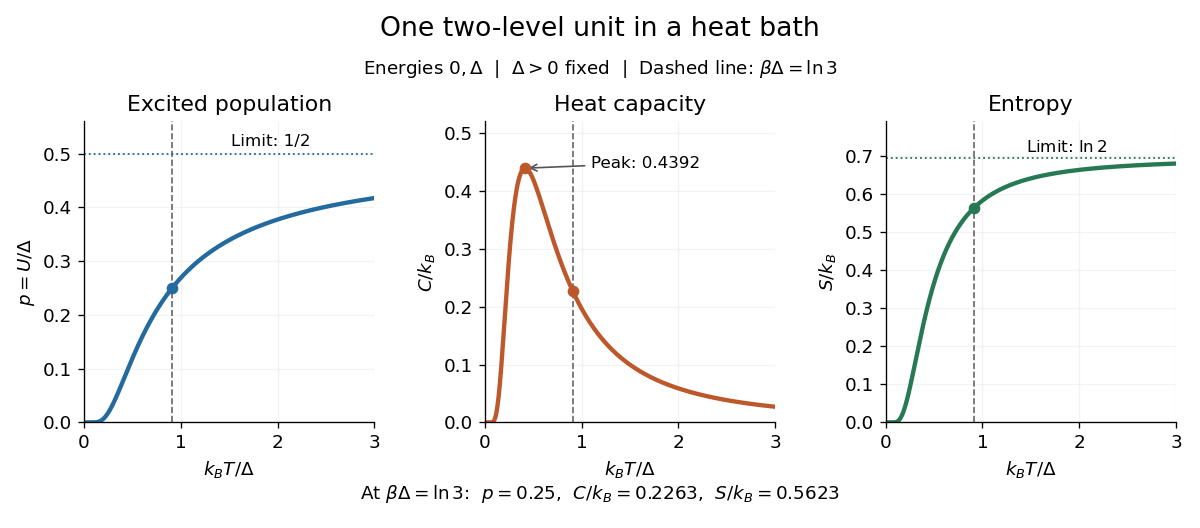
The usefulness goes beyond normalization. For fixed energies, derivatives of the natural logarithm of the partition function yield measurable quantities:Here is internal energy, the second expression is the energy variance, and is Gibbs entropy. For one two-level system at fixed , its heat capacity and entropy areAt , these give , and . For independent units, all three quantities add.
The figure shows why heat capacity peaks. At low temperature, the excited energy is rarely occupied; at high temperature, the probabilities are almost equal and further warming barely changes internal energy. The largest response lies between these limits, at , where . Meanwhile entropy rises from zero toward , reflecting two equally likely alternatives. This high-temperature limit belongs to the stipulated two-level system; extra accessible energy eigenstates would change it.

New to topics? Read the docs here!