
Helicobacter pylori Created 2026-10-31 Updated 2026-11-05
Salmonella Typhi Created 2026-10-31 Updated 2026-11-05
Mycobacterium tuberculosis Created 2026-10-31 Updated 2026-11-05
The bacterial species associated with tuberculosis. Bulk lesion chemistry does not by itself establish its presence.
Staphylococcus aureus Created 2026-10-31 Updated 2026-11-05
Clostridium tetani Created 2026-10-31 Updated 2026-11-05
Vibriones Created 2026-10-31 Updated 2026-11-05
Vibrio Created 2026-10-31 Updated 2026-11-05
Treponema pallidum Created 2026-10-31 Updated 2026-11-05
Treponema pallidum is a spiral-shaped bacterium associated with syphilis. Its interaction with a host involves multiple tissues and stages; the organism, the resulting infection and a particular clinical manifestation are different concepts.[ref]
Syphilis treatment guidance by CDC. causal organism and stages
Vibrio cholerae Created 2026-10-31 Updated 2026-11-05
Acetic acid bacteria Created 2026-10-31 Updated 2026-11-05
A group of bacteria capable of oxidative production of acetic acid from ethanol; particular cultures can contain several species.
Streptococcus Created 2026-10-31 Updated 2026-11-05
The nullclines meet at the origin and . At the origin, the Jacobian matrix has trace three, determinant and discriminant , giving an unstable node. At , its determinant is , giving a saddle equilibrium. The horizontal component is positive below the parabolic nullcline and negative above it; the vertical component is positive above the straight nullcline and negative below it. These signs determine the directional regions of the phase portrait.
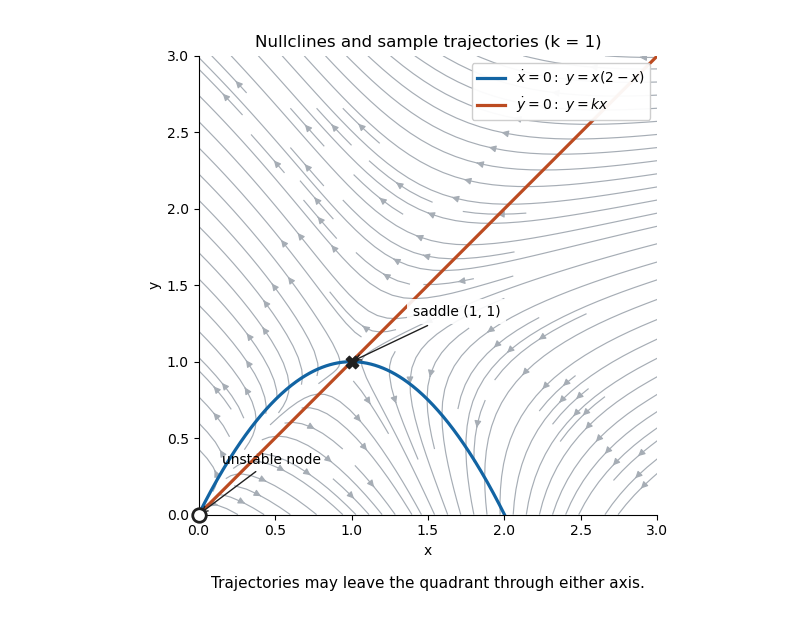

The quadrant is not positively invariant: nonzero points on either axis have an outward-pointing component. Restricting a drawing to that quadrant does not keep its trajectories there. For , only the saddle at the origin remains in the quadrant, and an exponential Dulac multiplier for a quadratic planar system excludes nonconstant periodic orbits there.
Autonomic nerve Created 2026-10-31 Updated 2026-11-05
An autonomic nerve carries fibers involved in regulation of internal organs, glands or vascular targets through the autonomic nervous system. A named peripheral nerve can contain autonomic fibers together with sensory or somatic motor components. The fiber’s function and its anatomical route are different classifications.
Strange attractor Created 2026-10-31 Updated 2026-11-05
A strange attractor, in the geometric convention, is an attractor whose structure is irregular or fractal rather than a smooth point, cycle or torus. The geometry concerns the set of possible long-term states. Chaos concerns evolution on that set. Some authors include chaos in the meaning of strange, so the convention must be stated.
The separation matters because the same plot cannot answer every question. A box-counting dimension calculation asks how many boxes are needed to cover a set as their size decreases. A Lyapunov exponent calculation follows the growth of a perturbation along a trajectory. These measure different features, and neither number can be substituted for the other.
Strange nonchaotic attractors provide the explicit warning: geometrically complicated attraction can occur without a positive Lyapunov exponent. The original construction used systems driven by two incommensurate frequencies.[ref]
Strange attractors that are not chaotic by Celso Grebogi and others. 1984 paper, abstract: geometric strangeness is distinguished from exponential orbit divergence
Thus fractal-looking geometry alone is insufficient evidence for a chosen definition of chaos. Attraction in a dynamical system 2026-10-31
Attraction in a dynamical system means convergence of nearby forward trajectories toward a specified invariant state or set. Attraction and Lyapunov stability are separate properties; together they give the usual local asymptotic stability of an equilibrium.
Liquor Atropiae Created 2026-10-31 Updated 2026-11-05
Liquor Atropiae is an atropine-containing solution. The salt, solvent and specified strength remain necessary parts of identifying a particular historical liquid.[ref]
The Essentials of Materia Medica and Therapeutics by Alfred Baring Garrod (1865). Liquor Atropiae, named preparation in the corresponding monograph
Unguentum Atropiae Created 2026-10-31 Updated 2026-11-05
Unguentum Atropiae is an atropine-containing ointment. Its semisolid vehicle defines a local formulation distinct from an atropine solution.[ref]
The Essentials of Materia Medica and Therapeutics by Alfred Baring Garrod (1865). Unguentum Atropiae, named preparation in the corresponding monograph
Pulse wave velocity 2026-10-31
The propagation speed inferred from an effective path distance and the travel-time difference of corresponding features in two arterial waveforms. Path definition, synchronized timing and reflections matter; a pulse peak need not track an unchanged waveform.[ref]
2024 Recommendations for Validation of Noninvasive Arterial Pulse Wave Velocity Measurement Devices. Pressure-waveform acquisition and transit-time estimation
Marsh test Created 2026-10-31 Updated 2026-11-05
A historical arsenic-separation and recognition procedure associated with James Marsh. Volatile arsine carries arsenic away from a sample matrix and yields a deposit; stibine can interfere.
There are unlisted articles, also show them or only show them.