
Golay generator polynomial 2026-10-14
Extended binary Golay code 2026-10-14
The extended binary Golay code is the parity extension of the length- binary Golay code. It is a self-dual code and a doubly even code, with minimum Hamming distance eight. Its radius-three Hamming balls are disjoint but do not cover its Hamming space; it is not a perfect code.
A single step has negative entropy production with probability , independent of how long an observation lasts. A whole window is negative only if negative steps outnumber positive ones:For even , the tie has zero entropy production and is excluded. At , the negative-window probabilities for are approximately , , and . Longer windows still contain negative increments: their expected number is . Their total is usually positive because the expected number of positive increments is .
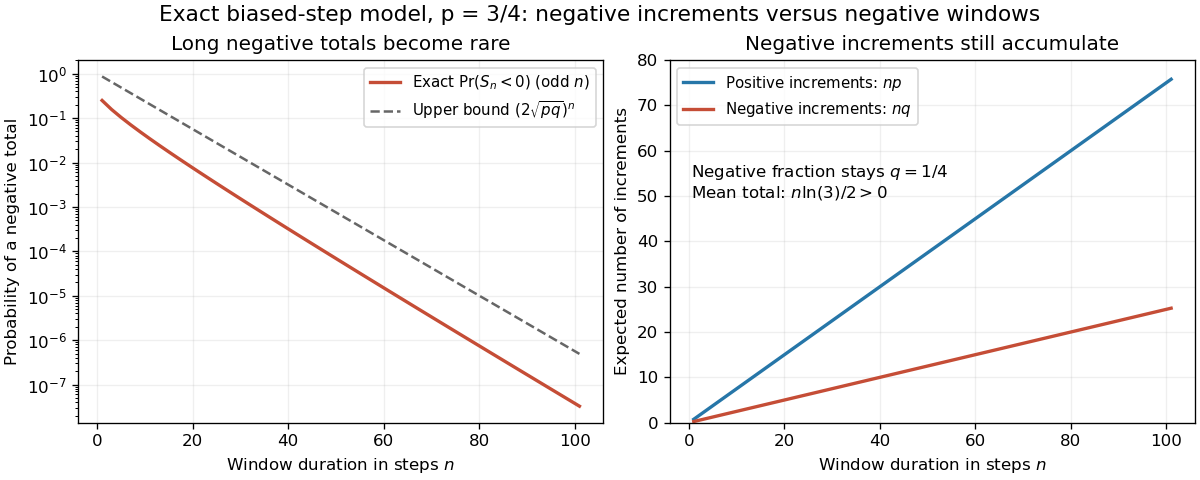
Exact biased-step model: negative totals become rare with duration while negative increments remain frequent
. Details. 
Only odd window lengths are plotted to avoid alternating tie effects. The left panel gives the exact negative-window probability and the upper bound ; the right gives expected counts and . For steps of fixed duration , physical duration is . These are counts and probabilities predicted by the model, not bead traces. The bound follows from . Since for , negative totals are exponentially suppressed even though the negative-step fraction stays .
If a Lie group has an Adjoint representation of a Lie group element with a real eigenvector of eigenvalue whose modulus differs from one, it has no bi-invariant Riemannian metric. Conjugation is a composition of left and right translations, hence would preserve the positive identity inner product. Applying it to that eigenvector gives , a contradiction. The orientation-preserving affine group of the real line supplies a connected example: conjugation by dilation of factor two multiplies the infinitesimal translation by two.
Barrier in better-quasi-order theory 2026-10-14
A barrier on an infinite is a family of nonempty finite increasing sequences, viewed as finite subsets, no one contained properly in another, such that every infinite subset of has a member of the family as an initial segment. Write if there is a finite increasing sequence of which is an initial segment and of which is an initial segment after its first term is deleted. This shift relation underlies the good-array definition of better-quasi-ordering.
A continuous array takes infinite subsets of an infinite , in the ordinary topology on infinite subsets, to a discrete preorder . It is bad if for every infinite . A barrier in better-quasi-order theory array induces such a continuous array by evaluating its unique barrier initial segment. The continuous-array and barrier formulations of better-quasi-ordering are equivalent, using refinement of fronts to barriers in the reverse direction.
Power-set closure of better-quasi-orderings 2026-10-14
If is a better-quasi-ordering, its full power set is better-quasi-ordered by the Hoare domination preorder. A bad continuous array of subsets would allow a choice of not below any member of , where deletes the least element. Choose this witness as a fixed function of the two locally constant subsets. Then is a bad continuous array in better-quasi-order theory into , a contradiction. Empty source subsets cannot occur in a bad array because they precede every subset.
Standard Model one-loop gauge coefficients 2026-10-14
For three quark generations, their corresponding leptons, and one complex Higgs doublet, use and . In the coefficients are the displayed values. Per generation, the fermionic Dynkin index sums are two for both non-Abelian factors and the sum of squared hypercharges is . The Higgs index for and its sum of squared hypercharges are each . Gauge terms are for , respectively. For the grand-unified normalization , the Abelian coefficient instead is .
In , the quartic scalar coupling has engineering dimension . Factoring out makes the renormalized running coupling dimensionless. Differentiating its bare expression at fixed bare parameters generates the linear term , even when the quantum contribution to the renormalization-group beta function begins quadratically. The simple-pole formulas for minimal-subtraction renormalization group functions determine the remaining contribution from the simple pole of .
For a four-dimensional dimensionless gauge coupling, the one-loop correction is cubic in . With , the chain rule and give the displayed conversion. In QCD, , hence . Other types of coupling or several interacting couplings can have different leading expansions; the squared-scale convention must not be mixed with the unsquared one.
For a field in a tensor-product representation of a product gauge group, its contribution to the beta function of factor includes the dimensions of all other factors. Those indices label independent copies for that factor. For an Abelian factor, replace its Dynkin index by the squared charge. Thus a quark weak doublet contributes three copies to the weak beta function and two copies to the colour beta function; hypercharge sums include all six components. Chirality conjugation changes a representation and the sign of an Abelian charge, but not its quadratic index.
Undecidability of beta equivalence 2026-10-14
Beta equivalence is semidecidable: enumerate finite conversion proofs. It is not decidable. A proposed total numeral-valued classifier of two nonempty disjoint beta equivalence classes can be reversed by a Church Boolean selector; a self-quoting fixed point of this reversal then belongs to the opposite class from the classifier output.
Uniform-count predictive property 2026-10-14
A uniform prior distribution on the success chance makes the number of successes in any fixed number of Bernoulli trials uniform on , because . This is a statement about counts, not a uniform distribution over the ordered outcome sequences. It also makes predictions reversible between equally sized batches: their joint probability distribution is symmetric and their marginal count distributions are the same uniform distribution.
For Brownian motion started at radius , the displayed process is a continuous local martingale. It is a bounded true martingale when , but a strict local martingale when or . In the latter case the boundary is outside the starting point, so stopping does not remove the singularity at the origin. Brownian scaling gives ; when , the stopped expectation tends to .
Holonomic Weyl algebra module 2026-10-14
A nonzero finitely generated Weyl algebra module over is holonomic when it attains the lower bound in the Bernstein inequality for Weyl algebra modules. The zero module is also conventionally called holonomic. Nonzero subquotients of a holonomic module remain holonomic. Additivity and integrality of the leading Hilbert-polynomial multiplicity then bound the number of nonzero factors in any submodule chain, giving finite composition length.
A good Bernstein filtration on a finitely generated module produces a finite graded module over . Its support is the characteristic variety for this filtration. Its algebraic dimension is the Bernstein growth dimension of a Weyl algebra module, which is independent of the choice of good filtration.
Quadratic Bernstein coefficient bound 2026-10-14
Write on . Endpoint evaluation gives and , while midpoint evaluation gives . Thus implies and . These bounds are sharp: has uniform norm one and coefficients .
The explicit Bernoulli stochastic differential equation solution remains positive and finite on every finite interval when . For it diverges when the displayed integral reaches its threshold. At this occurs deterministically. At , Brownian motion has positive probability of making the integral exceed any threshold on a fixed interval, so global existence is not almost sure. The distinction between positive explosion probability and certain explosion matters: the negative linear drift of makes its total positive-power exponential integral finite almost surely when .
Intersection and join of benign subgroups 2026-10-14
For benign subgroups , amalgamate their finite-presentation witnesses over the finitely generated , then adjoin independent stable letters centralizing their finite-generation witnesses. Britton's lemma identifies the subgroup generated by with the extension centralizing . In it, and . Both conjugate witnesses are finitely generated, proving benignity. For the second identity, the subgroup generated by is the iterated amalgamated free product ; its normal forms show that adjoining each outer copy intersects the central copy only in the subgroup already generated by .
Normal benign subgroup quotient embedding 2026-10-14
If is a benign subgroup, use its witness inside a finitely presented group. Enumerate words on the generators of , together with proofs that each equals a substituted word on the generators of . This enumerates exactly the null words of , giving a recursive presentation of a group. The Higman embedding theorem then embeds the finitely generated quotient in a finitely presented group.
There are unlisted articles, also show them or only show them.