
Small-ball Brownian hitting asymptotic 2026-10-14
For , fixed and , apply optional stopping to with . The resulting identity is . The last term tends to zero by integrability of and the vanishing total hitting probability. The Newtonian potential of the Brownian heat kernel identifies the remaining difference.
The Brownian first-passage subordinator has a countable dense set of jump levels almost surely, and is continuous at every other level. Its paths are finite nondecreasing functions, so on a bounded level interval there can be only finitely many jumps larger than any fixed positive size; a countable union proves countability. For density, suppose its path were continuous throughout an open level interval. It is strictly increasing, since the original continuous Brownian path takes different values at different passage times. Its continuous inverse on that interval would parametrize a positive-length time interval on which the Brownian path increases monotonically. This contradicts nowhere monotonicity of Brownian motion. Thus every level interval contains a jump. In particular dense discontinuities do not mean that the path is nowhere continuous: it is continuous at every level outside a countable random set.
Brownian exit-time skeleton 2026-10-14
Successive exits from intervals of radius around the current position embed a simple symmetric random walk into Brownian motion. The Strong Markov property makes the durations independent with common law ; the displacements divided by are independent symmetric signs. The displacement sequence is independent across exits; no independence between a given displacement and its duration is needed for these conclusions.
Asymmetric Brownian interval-exit transform 2026-10-14
For standard Brownian motion started at zero and exit time from , , stop the two exponential Brownian martingales with parameters and . Their stopped values are bounded by . The optional stopping theorem and dominated convergence theorem give and , where are the discounted upper and lower exit probabilities. Solving gives the displayed formula and . ThusAt , the first ratio has its removable value , and the second equals one. Finiteness of follows from a uniformly positive one-unit-time chance to leave any fixed bounded interval.
Quartic impulse-response Laplace resolvent 2026-10-14
For the whole-line equation with , the dispersion relation is . The temporal Laplace transform of the impulse response at zero is the real-k integral of . Factor the denominator as with for large . Partial fractions give the displayed resolvent. Square-root sheets are chosen by continuation from this causal large-s region; choosing roots independently can introduce false spatial pinch points.
For , real-wavenumber growth is . A nonzero cubic coefficient is unbounded above on one side; after it vanishes, a positive quadratic coefficient is unbounded above on both sides. The displayed conditions are therefore necessary and sufficient for a finite temporal upper bound, which is then . The bound permits the initial causal temporal contour required by the Briggs-Bers criterion.
Suppose every nonidentity element of a finite group is either a pi-element or an element for complementary primes. An elementary subgroup cannot have nontrivial factors of both kinds, since the product of nonidentity commuting coprime-order elements would have mixed prime order. Choose an integer congruent to modulo and to modulo . Set , on nonidentity pi-elements and on the other nonidentity elements. On each elementary subgroup this is an integer combination of the trivial and regular characters. Brauer's characterization of characters supplies the asserted generalized character.
Brauer quotient of a module 2026-10-14
For a -subgroup , the Brauer quotient removes all fixed vectors produced by proper-subgroup relative traces. On a permutation module it has a basis of the permutation-basis elements fixed by : nonsingleton orbit sums are traces and disappear. The construction commutes with direct sums and idempotent projections. For an indecomposable trivial source module, it is nonzero exactly when a vertex contains a conjugate of .
For a normal p-subgroup , every central idempotent of satisfies . Indeed a nonfixed conjugation orbit sum maps to zero in , so belongs to the nilpotent ideal . Normality makes the Brauer image a central idempotent of , and two central idempotents congruent modulo a nilpotent ideal coincide. Consequently the blocks of a group algebra of correspond to -orbits of blocks of .
Nagao module theorem 2026-10-14
For a central idempotent , a module , and , put . Then , and every indecomposable summand of the second term has vertex not containing . Indeed is a sum of -orbit sums of group elements not centralizing . Each is a relative trace from a centralizer not containing . Applying these traces to the module and using the local endomorphism ring of an indecomposable summand proves relative projectivity for one such subgroup.
Block induction 2026-10-14
Let be a block of a group algebra of with defect group of a block , where . Apply Brauer first main theorem inside to obtain its correspondent in . Composing that correspondent's central character of a block with the Brauer morphism from selects a unique block of a group algebra . It is the unique block of a group algebra whose restriction to contains the block bimodule as a direct summand. Its defect group of a block can be larger than when does not contain .
Brauer third main theorem 2026-10-14
If a block of a group algebra of has defect group of a block and , then its block induction is the principal block if and only if is the principal block. Equivalently, the Brauer morphism of the principal block idempotent at any p-subgroup is the principal block idempotent of .
Brauer correspondent of a block 2026-10-14
The Brauer correspondent of a block of a group algebra with defect group of a block in is the corresponding block of furnished by Brauer first main theorem. The more general induced block is defined by block induction when the subgroup contains the centralizer of a defect group of .
Quadratic branch parity criterion 2026-10-14
In characteristic zero with algebraically closed constants, a local unit has a square root. Thus near a point is equivalent to adjoining the square root of the local parameter to the power . Even order is unramified; odd order gives ramification index two. For a polynomial , its order at infinity is minus its degree, so infinity branches exactly for odd degree.
Wall of marginal stability 2026-10-14
A wall of marginal stability is a locus in the parameter or vacuum space where the complex central charges in supersymmetry of possible decay products align in phase. The triangle inequality then becomes an equality, , permitting a BPS state to reach the threshold for decay into other BPS states. Away from such alignment, the strict triangle inequality can prohibit the decay. Supersymmetry protects the mass-charge relation of an existing short state; it does not guarantee that the state exists or remains stable everywhere in parameter space.
Error bounds for bounded monotone sequences 2026-10-14
For an increasing sequence converging to , its absolute error is and is nonincreasing. For a decreasing sequence, the absolute error is and is also nonincreasing. This tells us that later terms cannot be worse, but does not supply a computable stopping index for a chosen tolerance.
Suppose an increasing lower approximation and a decreasing upper approximation enclose the same limit of a sequence . Their observable gap givesIf , the squeeze theorem certifies a common limit of a sequence; the midpoint has a certified absolute error at most half the gap. This is the principle behind the bisection method. In the symmetric example , , the gap is , each endpoint's exact absolute error is , and the midpoint happens to equal one exactly. The bound is valid even when such symmetry is absent.
A fixed upper bound by itself supplies less. If and for all , then and , but the last gap need not vanish. Taking and makes . A shrinking bracket or an explicit remainder formula adds information that qualitative convergence does not provide.
Dropping either condition destroys the implication. The increasing sequence has a lower bound one but no upper bound, and no finite limit of a sequence. For any real threshold , the Archimedean property gives an index , and monotonicity gives for all . Its divergence to in the extended real number line is different from convergence to a real number.
Conversely, is a bounded sequence, with , but is not a monotone sequence and has no limit of a sequence. Its subsequence at even integers is constantly one, and its subsequence at odd integers is constantly minus one. These two subsequential limits cannot both equal a single limit of a sequence. [ref]
Basic Analysis: Introduction to Real Analysis, Volume I by Jiří Lebl. §2.1, Example 2.1.5: divergence of the alternating sequence; §2.1.1, examples immediately after Definition 2.1.9: the increasing sequence n
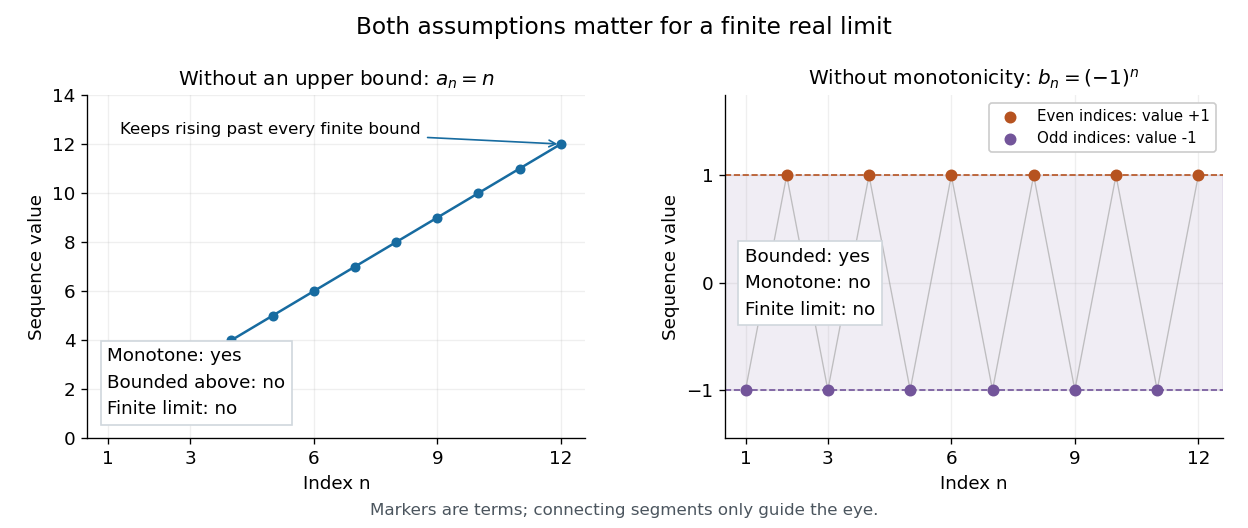
Neither monotonicity alone nor boundedness alone ensures a finite limit of a sequence
. Left: is increasing but unbounded above. Right: stays in but alternates between two distinct subsequential limits. Both plots show finitely many terms; the formulas and the arguments establish the counterexamples for all indices. Details.
The ambient real numbers also matter. An original example using the floor function isEvery is a rational number, because , andThe strict lower inequality uses the irrationality of the square root of two. Hence this bounded sequence converges to in the real numbers, but has no limit of a sequence in the rational numbers. Convergence to a rational candidate would also be convergence in the real numbers, contradicting uniqueness of the limit of a sequence. The formulas give , , , : this counterexample even has a plateau. This illustrates why completeness of the real numbers matters: the rational numbers lack the least-upper-bound property needed to contain the required supremum. [ref]
The supremum of an increasing bounded sequence need not be a maximum of its set of terms. For , every term is strictly less than one; the supremum and limit of a sequence are one, but there is no maximum. Every candidate term is beaten by the next. The decreasing sequence similarly has infimum one without a minimum.
If an increasing sequence with limit of a sequence attains , it must remain there: for . The decreasing case is identical with inequalities reversed. Thus attainment of the limit of a sequence is equivalent to an eventually constant tail of a sequence for a convergent monotone sequence. The increasing sequence has both supremum and maximum one. [ref]
Basic Analysis: Introduction to Real Analysis, Volume I by Jiří Lebl. §2.1, Exercise 2.1.13: a convergent monotone sequence attaining its limit
For the two sequences in bounded monotone sequence theorem,Their directions and bounds are explicit. One is a succession of lower approximations and the other a succession of upper approximations to the same limit of a sequence. To obtain absolute error strictly below , it suffices to choose an integer , and then every works. For , the first such index is ; at the absolute error equals the tolerance.
A geometric sequence offers a faster example. The recurrence relation , gives . Thus is an increasing bounded sequence with limit of a sequence one and absolute error . For , already works, since , whereas . The bounded monotone sequence theorem guarantees both examples converge; the formulas explain their different speeds.
For a connective spectrum with , an -homology isomorphism of simply connected spaces is a weak homotopy equivalence. Its simply connected homotopy mapping cone is -acyclic. If it had a first nonzero integral homology group, the Hurewicz theorem and the bottom-degree generalized Hurewicz isomorphism would produce a nonzero -homology group. Thus the cone is integrally acyclic and the homological Whitehead theorem applies.
There are unlisted articles, also show them or only show them.