
Write , using the square-root branch positive on real . Integrating the differential equation and using boundedness at zero givesThe integration constant is zero since . Continuity of then shows , so extends continuously with .
The Laplace transform of a derivative and differentiation under the integral sign giveIntegrating and using as real fixes the constant:The initial value theorem for Laplace transforms gives . It is tempting to apply the derivative rule immediately to , but its stated regularity is only continuity. To justify that step, define . ThenUniqueness of the Laplace transform gives , and hence is continuously differentiable and
Multiplication of a distribution by a smooth function is defined by moving that function onto the test function. The Dirac delta multiplication identity givesIn fact is the zero distribution, independently of the special positivity assumptions on .
Suppose were invertible at some . The inverse function theorem supplies a neighborhood of for which is a nonempty open subset of . But , and a one-dimensional embedded submanifold of has empty interior. To see this last assertion, a slice chart for an embedded submanifold takes locally into a coordinate line; a coordinate line cannot contain an open plane neighborhood, and a chart preserves openness. This is a contradiction.
Thus is singular everywhere. Part (c)(i) strengthens singularity to everywhere. By (b) and connectedness of ,The special form of the Jacobian matrix is essential: an arbitrary differentiable map can have nonconstant image in a curve with derivative of rank one.
Write and . The Cauchy-Riemann equations giveConsequentlyEquivalently, it is singular exactly when all four partial derivatives vanish. The sum of squares is over , so no cancellation is possible.
No. On letIt is a bijection onto , with inverse . Nevertheless is singular whenever . Set-theoretic invertibility, even together with a continuous inverse, does not force invertibility of the total derivative. If the inverse were assumed differentiable, the chain rule applied to would force both derivatives to be invertible; that stronger assumption is absent here.
Take andIts Jacobian matrix and determinant areThus its total derivative is invertible everywhere, and the inverse function theorem makes it locally invertible. But , so it is not injective and has no global inverse on its image. The domain is open and connected as required.
Choose a point off , then a point on distinct from . PutThese four points form a projective frame: lie off , and meets at neither nor . Form, using only joins and intersections,Here the point called in (i) is , while is . Thus (i) gives . Interchanging the last two arguments reciprocates the cross-ratio, soAll auxiliary choices are possible over a field of characteristic zero, which is infinite. Uniqueness from (a)(ii) shows that the final point is independent of those choices. The picture uses an affine chart in which every relevant intersection is finite; parallel-line exceptions in another chart are ordinary intersections on the projective line at infinity.
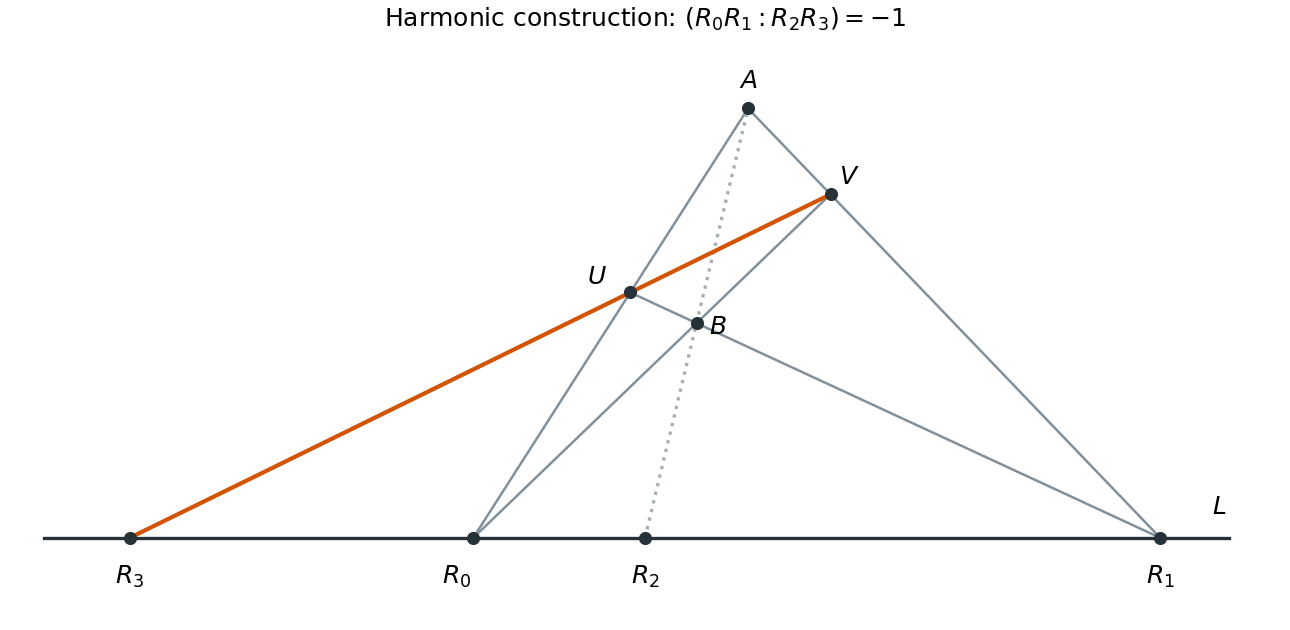
Construction of harmonic conjugate points by joins and intersections
. Details. 
The four points form a projective frame: no three are collinear. By the allowed uniqueness theorem and cross-ratio invariance, useIntersecting the indicated projective lines givesA point of has coordinates . Intersecting with , whose equation is , gives . On that line use its first two homogeneous coordinates. The cross-ratio from (a)(ii) isThe characteristic of a field being zero ensures that . The construction is the diagonal-point property of a complete quadrangle, producing harmonic conjugate points.
Choose nonzero vectors representing , and write . Use the cross-ratio conventionDistinctness makes the denominator nonzero. Every rescaling of a representative occurs once in numerator and denominator, so the value depends only on the projective points. Swapping both pairs simply exchanges the numerator's factors and the denominator's factors:Under an invertible linear map , . Two factors of occur above and below the fraction, proving projective transformation invariance.
Finally choose homogeneous coordinates making , , . This normalization exists by the allowed theorem about a projective frame. A point distinct from is uniquely , and the displayed cross-ratio is . Thus equality of the two cross-ratios forces equal coordinates andThis also shows that for fixed first three distinct points the fourth point is determined by its cross-ratio.
A projective transformation of is induced by an invertible linear map :This is well defined because replacing by a nonzero scalar multiple does not change . Multiplying by a nonzero scalar also leaves unchanged. Conversely these are precisely the transformations in the projective linear group . No field automorphism is included in this definition.
The second supplementary law for the Legendre symbol is . To multiply these signs, observe that for odd ,Both factors in the numerator are divisible by , so the right side is even. Applying this identity repeatedly to the prime factorization givesAgain the convention at agrees.
The supplementary law for the Legendre symbol is for odd prime numbers . For odd integers ,and the last term is even. Induction over the prime factors of therefore gives . ConsequentlyFor the exponent is zero.
If , then for each prime factor of . The Legendre symbol depends only on the numerator's residue class, so the corresponding factors agree. Also , covering the zero cases. Multiplying givesThe convention for denominator gives the same conclusion there.
For a prime number , multiplicativity of the Legendre symbol says , including the case of a zero factor. Therefore, writing with repetitions,This product definition still agrees with the stipulated zero when the numerator and denominator are not coprime. For all three symbols are .
Factor and , retaining repeated prime factors. If has a common prime factor with , it has one with at least one of , and both sides of the desired equality are zero. Otherwise the definition of the Jacobi symbol givesAn empty product is , so the argument includes either denominator being .
No. Take , . The Jacobi symbol isbut the squares modulo are . A square root of modulo would reduce to one modulo , which is impossible. A Jacobi symbol of records a product of local signs; it does not assert that every local sign is positive, or that a quadratic congruence is soluble.
Past exam of the rings and modules course of the University of Oxford 2023 3 b iv Solution 2026-10-25
Each entry of the matrix from part (b)(iii) has unique real and imaginary integer coefficients. WriteIt already belongs to the general linear group . Expanding the relation from part (b)(iii) givesThe real and imaginary parts must both vanish, soThese are the required identities, with .
There are unlisted articles, also show them or only show them.