
At high density the plasma scale remains large, but a strong magnetic field separates the two circular dielectric responses. Ignoring damping, the positive plasma cutoffs areBetween suitable cutoffs one circular wave can propagate while the other is excluded; reflection and transmission are strongly polarization dependent. Around the cyclotron frequency the active response is resonant, while at optical frequencies far above the splitting can be a relatively small correction to a large plasma edge.
There is also a low-frequency window: for the active component, gives when losses are small. This supports a helicon-like mode even when . That does not make an ordinary metal broadly transparent; the large index, boundary coupling, collisions and skin geometry still matter. In the common regime , bulk cyclotron absorption remains hidden from straightforward transmission, motivating a surface-sensitive experiment. Thus the relevant comparisons are among , , and , not carrier density and field in isolation.
At low density, the plasma frequency and free-carrier dielectric screening are smaller, so radiation can penetrate a suitable semiconductor sample. In a high field with , the active circular component has a resolved cyclotron absorption line near , with width of order . The opposite circular component lacks that positive-frequency resonance.
Different complex refractive indices for the two components produce Faraday rotation and circular dichroism. Transmission with controlled circular polarization therefore isolates the cyclotron resonance and measures . The low-density/high-field labels do not by themselves imply complete transparency at every frequency; one must still avoid the plasma stop bands, strong interband absorption and excessive sample thickness.
At zero magnetic field the two circular conductivities coincide, so an isotropic material has no magnetically induced circular birefringence. In the collisionless Drude model range the dielectric function is . A high carrier density gives a large plasma frequency, often placing the screened plasma edge in the infrared or visible range.
Below that edge the real dielectric function is negative and a transverse wave is evanescent in the bulk. The material is strongly reflecting, with penetration through a skin depth and losses set by finite . Above the plasma edge propagation becomes possible, subject to absorption and interband transitions. Carrier density alone does not specify a complete optical spectrum: the statements assume the probe frequency relative to the plasma scale and the validity of the single-band Drude model.
For collinear antiferromagnetic order in the plane, take . Nearest neighbors are antiparallel, giving , whereas second neighbors lie on the same sublattice and remain parallel, giving . ThusThe result follows from substituting into the specified XY Hamiltonian operator, regardless of whether that trial state is the global minimum for the chosen exchanges. Comparing trial-state energies does not eliminate the possibility of a lower helical state.
For the classical XY ferromagnet choose every spin parallel within the plane. Each nearest-neighbor and next-nearest-neighbor in-plane dot product is . The printed sum counts one bond of each range per spin, soThere is no additional factor of two from counting both directions: the Hamiltonian operator already lists only and . Alignment along would give zero XY exchange energy and is not the in-plane ordered state used for these expressions.
Along any direction the quartic term is . Minimizing the amplitude below givesFor the ordered solution,Its free energy is . The denominator is positive by the supplied stability assumptions. The square-root onset is the Landau theory exponent; sufficiently close to a three-dimensional critical point, fluctuations can change the actual critical exponent without changing this saddle-point calculation.
Write with , and let . Since the nonnegative numbers sum to one,The quartic coefficient is . If it is at least . If , the given condition implies . For the quadratic coefficient is also positive. Hence every nonzero raises the free energy:The stability argument must apply to all orientations, rather than checking just one cubic direction. The stated inequality is sufficient for that purpose, although the sharp quartic stability condition for negative is the weaker .
There are three acoustic branches, not two. For propagation parallel to the tetragonal axis, one branch is a longitudinal wave, polarized parallel to . The other branches are transverse waves whose polarizations lie along the equivalent basal directions. The fourfold symmetry about makes those transverse modes degenerate along that axis.
Consequently at a generic nonzero wave vector along there are only two distinct acoustic frequencies: one longitudinal frequency and one doubly degenerate transverse frequency. At the zone center all acoustic frequencies go to zero as required by uniform translation invariance. The degeneracy would generally lift if propagation moved away from the symmetry axis or the basal tetragonal symmetry were broken.
The difference of the two wave-vector labels is , an allowed reciprocal lattice vector because is even. Bloch's theorem of the lattice dynamical matrix therefore givesfor corresponding phonon branches. Neither individual odd-sum point needs to be a reciprocal lattice point. It is their difference that establishes equivalence. Structure factors and neutron polarization factors can still change the observed intensities at those two scattering vectors, so equal frequencies do not require identical measured spectra peak by peak in intensity.
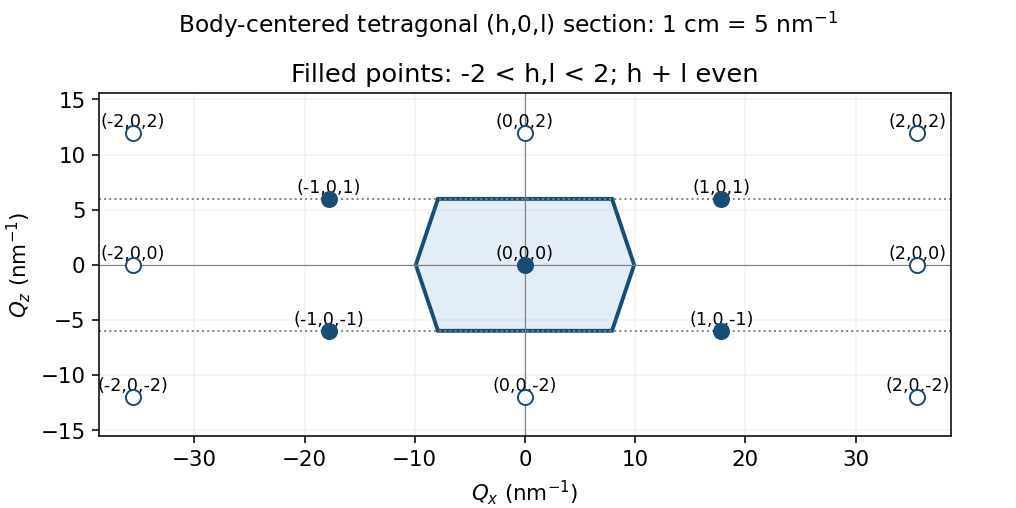
Construct the first Brillouin zone by the perpendicular bisectors between the origin and reciprocal lattice points. For a test point , the nearest relevant reciprocal points are and . Their inequalities areSet . The six vertices in conventional coordinates areNumerically these are and . The reciprocal lattice vectors must in principle be checked because the requested object is a section of a three-dimensional zone. For example gives the weaker bound , and gives a weaker vertical bound; neither clips this hexagon. Direct comparison with surrounding three-dimensional reciprocal lattice vectors confirms the displayed section. It is not the rectangular reciprocal conventional cell.
For the body-centered tetragonal direct lattice, conventional reciprocal labels are integer triples satisfying even. This follows because the extra translation must have phase one for a reciprocal lattice vector. In the section the condition is even. The reciprocal steps areWithin the strict index window , the reciprocal points are and . The neighboring and points lie on the excluded boundary but are useful for constructing the zone bisectors.
At the requested drawing scale, one conventional step in is cm and one step in is cm. Thus the four off-origin included points have drawing coordinates cm. Keeping these unequal physical scales avoids drawing a fictitious square reciprocal section.
One crystallographic inversion center isThe inversion maps to ; it exchanges both the Fe pair and the Se pair modulo lattice translations.
A axis passes along through the Fe site , and likewise through . A representative rotoinversion isIt leaves the first Fe site fixed, maps the other Fe onto a translationally equivalent site, and exchanges the Se height classes. The operation includes a vertical reversal, so it must not be replaced by a pure -degree rotation about an Fe site. Such a pure rotation would put a selenium atom at the wrong height.
At a point and its glide partner have equal scattering amplitudes and relative phase . Their joint contribution to the structure factor is proportional toIt vanishes for odd . Hence the allowed-condition statement isThis is a systematic absence: it follows independently of the numerical Fe and Se atomic scattering factors. Explicitly, the supplied basis givesand both braces vanish when is odd. When the sum is even a reflection is symmetry-allowed, but an accidental cancellation for particular scattering factors or experimental conditions can still make its intensity small. The glide alone does not promise that every allowed reflection has a nonzero measured intensity.
Reflection through interchanges the two Se height classes but, by itself, leaves their projected positions wrong. The required parallel translation isFor example, maps to , equivalent to the second Se site. The two Fe sites are also interchanged. This is a diagonal, or , glide; adding an integer lattice vector gives the same fractional translation class. Its translation is expressed in the conventional primitive tetragonal lattice coordinates, not in a smaller Fe-only cell that would discard the selenium height pattern.
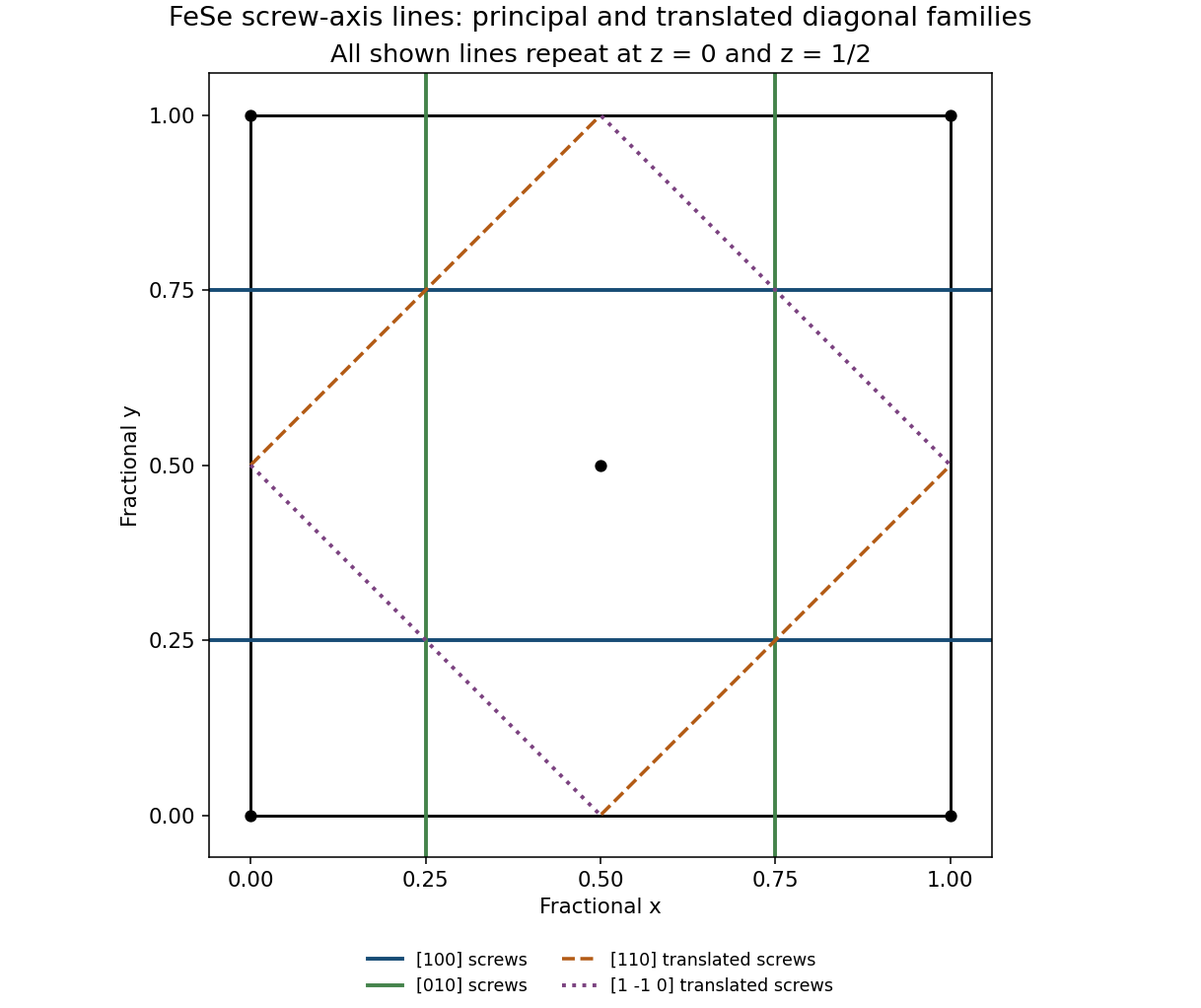
A representative half-turn-plus-translation operation about an axis parallel to isIt rotates about the line and translates by along . It exchanges the two Fe sites, and maps onto modulo a lattice translation. Likewise,is a screw about . Including translated equivalents gives the principal-axis screw linesThus the cell contains lines at the quarter and three-quarter coordinates, in both the and levels.
For completeness, translated diagonal twofold operations also produce diagonal screw lines. The operations and preserve the same basis. Their axial translations are and , half the primitive repeats along the corresponding diagonal directions. Their lines areDiagonal lines with integer instead support pure twofold rotations. Listing only rotational parts modulo primitive translations would hide these shifted screw lines. There is no fractional screw advance along : every Fe site has integer , so a symmetry taking the Fe layer into itself requires an integer vertical translation. Proper fourfold axes parallel to are therefore not , , or screws in this structure. All these statements can be checked directly on the four supplied coordinates without choosing an alternative tabulated origin.[ref]
Symmetry relations for space group 129 by International Union of Crystallography. P4/nmm, full Hermann-Mauguin symbol and origin-setting information; coordinate operations here are derived in the supplied origin


Past exam of the condensed matter physics course of the University of Oxford 2022 4 d ii Solution 2026-10-25
With , the measured effective paramagnetic moment gives the Landé g-factorFor the free-ion Hund's rules values , , , the stated formula yieldsThusThe source fit is consistent with the unquenched orbital magnetic moment of the free praseodymium ion, within graphical accuracy. Small deviations need not indicate a change of electron configuration: crystal field splitting, interactions and the fit range can affect a measured magnetic susceptibility.
Past exam of the condensed matter physics course of the University of Oxford 2022 4 d i Solution 2026-10-25
The given electron configuration has an inert closed core and two electrons. The Aufbau principle identifies the occupied subshells; the free-ion term within the open configuration is then selected by Hund's rules. A closed core contributes .
Each electron has orbital angular momentum quantum number . Place the two spins parallel, so . The Pauli exclusion principle then requires distinct orbital projections. The largest allowed total projection is , obtained from and , giving the maximum allowed . A larger would place two parallel-spin electrons in the same atomic orbital and is forbidden.
The subshell holds fourteen electrons; is less than half filled. The third of Hund's rules therefore selects . HenceThe term symbol uses and the spectroscopic letter for . The praseodymium ion retains an orbital contribution, so a spin-only estimate would be inappropriate.
Past exam of the condensed matter physics course of the University of Oxford 2022 4 b iii Solution 2026-10-25
The Weiss temperature is the extrapolated zero of in a Curie–Weiss law fit. It summarizes the leading high-temperature effect of interactions between magnetic moments. For the sign conventionwhere are dimensionless angular momentum operators, mean-field theory givesThus positive net exchange interaction in this convention favours parallel magnetic moments, giving and tendencies towards ferromagnetism; negative net exchange interaction favours antiparallel magnetic moments, giving and antiferromagnetic tendencies. Competing interactions can partially cancel in this sum. The Weiss temperature need not equal the actual ordering temperature, and its sign alone is not a complete determination of the low-temperature ordered structure.
There are unlisted articles, also show them or only show them.