
For , its squared projection onto the long axis of every valley is . All six valleys therefore have the same cyclotron effective mass:At the fixed photon energy,Thus the two-peak spectrum is replaced by one peak near . The source does not determine the linewidth or absolute oscillator strength for the new direction; the sketch below shows only a normalized illustrative line at the computed position.
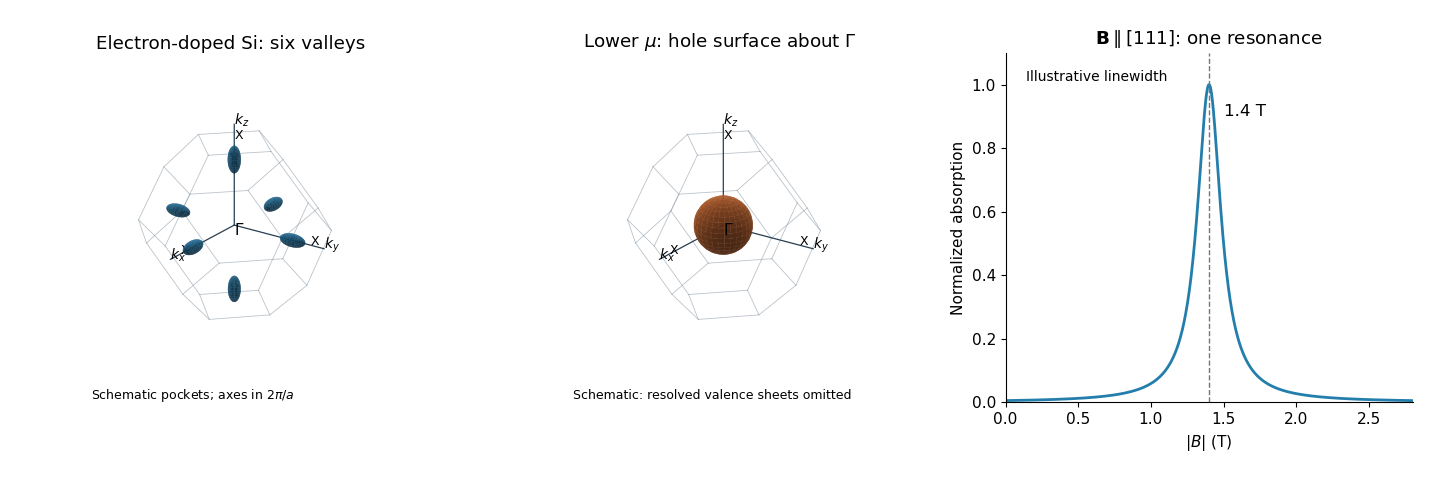

The photon energy fixes the resonant cyclotron frequency by . ConsequentlyRead the two absorption maxima as approximately -- and . For , the two valleys whose long axis is along have , whereas the other four have . HenceFor the representative reading , the values are and . The graph does not warrant additional precision. The larger longitudinal effective mass means flatter dispersion and a longer constant-energy ellipsoid along the valley axis.
has primitive coordinates and therefore fails the first-order optical momentum condition; its local pattern also has zero dipole derivative. is a zone-centre mode with the dipole-active pattern, so its molecular dipole changes add coherently.The allowed absorption for uses an polarization of an electromagnetic wave with an out-of-plane component. At normal incidence on an ideal free-standing layer the electric field is in the plane, so that specific measurement geometry would suppress it despite the mode's intrinsic vibrational infrared activity.
For ordinary one-phonon infrared optical absorption, both an energy and a momentum selection rule must hold. The optical photon has negligible crystal momentum on the scale of the Brillouin zone, so crystal momentum conservation selects modulo a genuine reciprocal lattice vector. In addition, the mode must change the macroscopic electric polarization, with a component along the incident polarization of an electromagnetic wave.
In terms of atomic displacements and Born effective charge tensors , the relevant derivative is proportional to per primitive unit cell. Thus an optical phonon at is not automatically infrared active: its dipole contributions may cancel. Disorder-assisted and multiphonon processes relax these simple first-order selection rules.
Apply the same change of reciprocal lattice coordinates to the phonon wave vectors:Although is an integer coordinate of the rectangular reciprocal grid, it is not a reciprocal lattice vector of the actual primitive crystal. Thus is not equivalent to the Brillouin zone centre.
Comparing the two coefficients in the reciprocal-coordinate transformation givesThe inverse transformation is , . This provides an independent check on the signs associated with the two primitive arrows in the source.
Let the reciprocal lattice vector be , with each dual pair obeying and zero cross products. Its coefficients are obtained by dotting with the corresponding direct-space primitive lattice translation vectors:HenceFor actual integer-indexed reciprocal lattice vectors, this also explains the centred-rectangular condition that and have the same parity. General phonon wave vectors need not have integer coefficients.
The primitive translations connect the two centred-rectangular sublattices. In the orientations marked in the source, points right and down, whereas points right and up. ThusTheir parallelogram has half the area of the rectangular cell, confirming that the latter contains two primitive unit cells.
There are six atoms in the nonlinear oxalate ion, hence positional degrees of freedom. Subtract three rigid translations and three rigid rotations to obtain vibrational normal modes. Planarity does not remove out-of-plane motions. Since three modes have been displayed,
Use the indicated out-of-plane displacements and the equivalence of the four oxygen sites and of the two carbon sites in the isolated planar oxalate ion. In , the two oxygen atoms on one side move oppositely to those on the other side, and the two carbon atoms also move oppositely. Their dipole changes cancel. The mode is even under molecular inversion symmetry, which independently forbids an electric-dipole transition.
In , all four oxygen atoms move together out of the plane while both carbon atoms move in the opposite direction. The positive and negative charge distributions acquire a relative out-of-plane displacement, producing a nonzero derivative of the molecular electric dipole moment.
In , two oxygen atoms move out and two move in, in a checkerboard arrangement, while the carbon atoms are stationary. The equivalent oxygen contributions cancel. This mode illustrates that being odd under inversion symmetry is necessary but not sufficient for vibrational infrared activity: its full symmetry does not transform like any component of an electric dipole moment.These conclusions concern the isolated-molecule displacements drawn in the source; a different crystal environment can alter selection rules through additional symmetry breaking.
Infrared spectroscopy measures absorption as the incident photon frequency is swept through molecular normal mode frequencies. In the electric-dipole approximation the interaction is . Expanding the molecular electric dipole moment in a normal coordinate givesThe fundamental one-quantum vibrational transition dipole moment is proportional to the derivative multiplying . Thusis the criterion for vibrational infrared activity; the derivative must also have a component along the incident polarization of an electromagnetic wave. A permanent molecular electric dipole moment is not necessary. Absorption occurs near , with broadened lines reflecting finite lifetimes and the molecular environment.
At ,The cyclotron spacing is , smaller than at 10 T, and each resolved level's degeneracy per area is also reduced by . Thus the same carrier density occupies more levels. This ratio is determined without the missing graph, but it does not specify whether the chemical potential lies in a localized tail or an extended-state centre.
TODO — missing density/plateau assignment: a numerical index and chemical-potential marker at 8 T require the unavailable density information. For example the first illustrative density in part (i) gives , while instead gives . These produce different schematic placements even though both satisfy every surviving sample parameter. Unresolved spin degeneracy and disorder add further qualifications; no unique 8 T label should be invented.
At , the nominal filling isA labelled density-of-states picture has disorder-broadened peaks at these orbital and spin energies, localized tails and extended states near their centres. A chemical potential in the localized region corresponds to a Hall plateau and small longitudinal resistivity; passing through an extended-state centre corresponds to a transition.
TODO — missing density/plateau assignment: there is no basis for choosing one of those positions at 10 T without the missing Hall graph. For example gives nominal , whereas gives . In an ideal resolved-level picture the first can put the chemical potential between filled levels, while the second leaves a level partly filled. Both are compatible with the surviving current and width, demonstrating why the requested placement is undetermined.
For , . The scattering triangle givesTo state signed sample angles without an implicit axis convention, take the incident beam along , positive angular rotation counterclockwise, and at choose along and along . ThenThe positive- condition is the vector equation . PutThe two detector sides then give, modulo full rotations,These pairs obey the stated same-sense sign convention and transfer momentum along . The lower-right panel below illustrates the first choice. If the initial direction is chosen on the opposite side of , a commonly used positive-angle pair is . Merely taking absolute values without fixing that crystal-axis convention can exchange and . The measurable scattering angle and the vector-triangle construction are invariant.
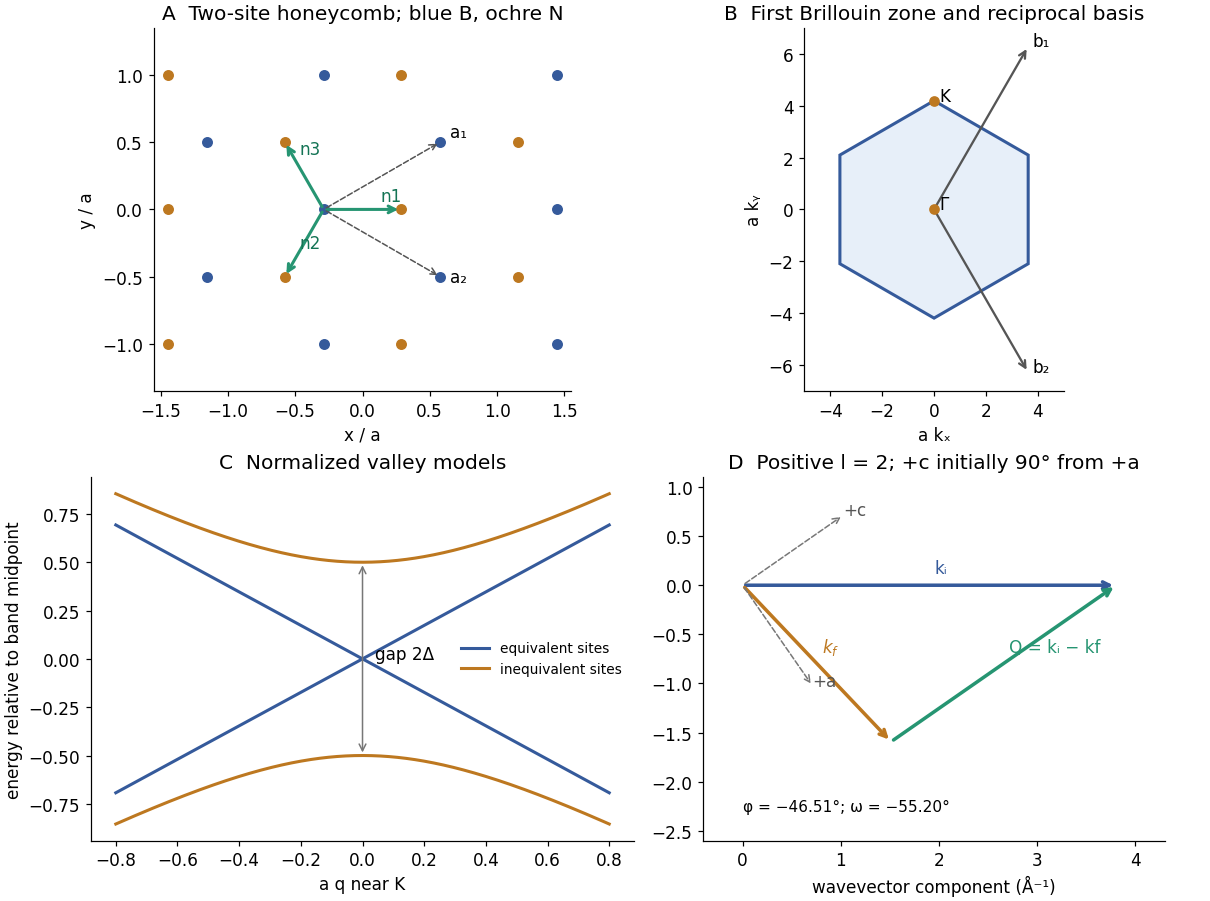
Honeycomb geometry, reciprocal-space hexagon, sublattice band gap and a signed neutron-scattering triangle
. Original calculations and schematic geometry. Lattice panels use ; the band panel compares normalized two-sublattice models. The neutron panel uses the explicit signed-axis convention of Question 1(c)(ii). Details.
For neutron energy loss, . Write . The neutron dispersion , or , givesA triangle of these wavevectors exists ifWith , the requested momentum transfers have . ConsequentlyFor example is too small even for forward scattering at these unequal neutron energies, and exceeds the backscattering maximum. This identifies accessible reciprocal lattice points, not guaranteed nonzero intensity: a one-phonon structure factor contains the atomic scattering lengths, eigenvectors and factors . A transverse eigenvector perpendicular to may be invisible, and basis interference can cause extinctions. The supplied geometry and cell constants do not specify that full intensity selection rule.
At the zone centre, the dynamical matrix commutes with the point-group representation on displacements. An irreducible representation of dimension two enforces a doublet; distinct one-dimensional representations need not have equal frequencies. The tetragonal point group has two-dimensional and representations, so optical modes transforming that way are doubly degenerate at the centre. Atomic positions and the displacement representation would be needed to assign every optical branch to a particular representation; the point-group label alone is not a complete mode decomposition.
For propagation along the tetragonal fourfold axis, the two transverse acoustic polarizations transform together and have equal sound speeds and frequencies. For example , whereas the longitudinal speed is independent. An optical doublet may split away from the centre along a direction whose little group has only one-dimensional representations. It need not remain degenerate at every nearby wavevector.
All irreducible representations of are one-dimensional, so the orthorhombic point group enforces no analogous optical doublet or equality of transverse sound speeds. The three acoustic frequencies are nevertheless all zero at the exact centre in both crystals, because of translations; that common zero is not evidence that their slopes are equal. Accidental equalities remain possible. For a polar crystal, a direction-dependent macroscopic electric field also distinguishes longitudinal from transverse infrared-active limits; an analytic zone-centre symmetry classification alone does not remove LO–TO splitting.
To obtain a crystal's point group, discard the translation parts of its space-group operations. A screw becomes a rotation and a glide becomes a mirror. Thus the tetragonal group's , and operations giveFor the orthorhombic structure the three perpendicular twofold/glide or screw/mirror directions giveThe primitive Bravais lattice symbol does not itself add a point operation; the fractional translations matter for the space group but disappear from this point-group reduction.
Each atom supplies three displacement coordinates. Translational invariance gives three acoustic branches for either structure, leavingThese count branches at a general wavevector; a doubly degenerate pair still counts as two modes. The stated atom counts refer to primitive cells, so no additional centring factor is needed.
For a partially filled shell, the outer and shells shield the localized orbitals from the ligands. Coulomb interactions establish through Hund's rules, and spin-orbit coupling usually exceeds the much smaller crystal field splitting. First form a ground multiplet using , then split that multiplet by the crystal environment. The orbital contribution is therefore generally retained, and the g-factor is a multiplet Landé factor rather than an almost spin-only value. Weak external Zeeman and hyperfine interactions can subsequently resolve the remaining states. Exceptions with or unusual valence require separate treatment.
For a partially filled shell, electron–electron Coulomb repulsion and Hund's rules first favour particular total spin and orbital terms. The crystal field splitting is substantial because these orbitals overlap the ligand environment; it normally exceeds the spin-orbit coupling and often quenches the orbital moment. Competition between the splitting and the electron pairing energy determines high-spin versus low-spin filling. A common hierarchy is Coulomb term energies, then crystal-field and Hund-exchange scales, then spin–orbit and weak-field Zeeman energies; the relative sizes of crystal-field splitting and pairing are material-dependent. Hyperfine coupling, if the nucleus carries spin, adds a smaller splitting. An isolated ion has no inter-ion exchange ordering field.
There are unlisted articles, also show them or only show them.