
Past exam of the condensed matter physics course of the University of Oxford 2022 1 b i Solution 2026-10-25
The primitive cubic lattice has . Combining this with Bragg's law gives the Bragg angleUsing and yieldsThese are the full scattering angles; the Bragg angles themselves are half as large.
Past exam of the condensed matter physics course of the University of Oxford 2022 1 a iii Solution 2026-10-25
In elastic scattering, the incoming and outgoing wave vectors have equal magnitude . Their mutual angle is . The scattering vector therefore has magnitudeThe elastic Bragg scattering condition is , givingEquivalently, turns this relation into Bragg's law, , with the reflection order incorporated into the Miller indices.
Past exam of the condensed matter physics course of the University of Oxford 2022 1 a ii Solution 2026-10-25
For the reciprocal lattice vector , sum the atomic scattering factors with the atomic basis phase factors. Taking the positive phase convention gives the structure factorChanging the phase convention complex-conjugates the structure factor and leaves the diffraction wave intensity unchanged. Since the Miller indices are integers,If all three Miller indices have the same integer parity, all pairwise sums are even. Otherwise exactly one pairwise sum is even and two are odd. ConsequentlyThe corresponding structure factors are and . Reflections with mixed integer parity are superlattice reflections that reveal chemical ordering in alloys.
Past exam of the condensed matter physics course of the University of Oxford 2022 1 a i Solution 2026-10-25
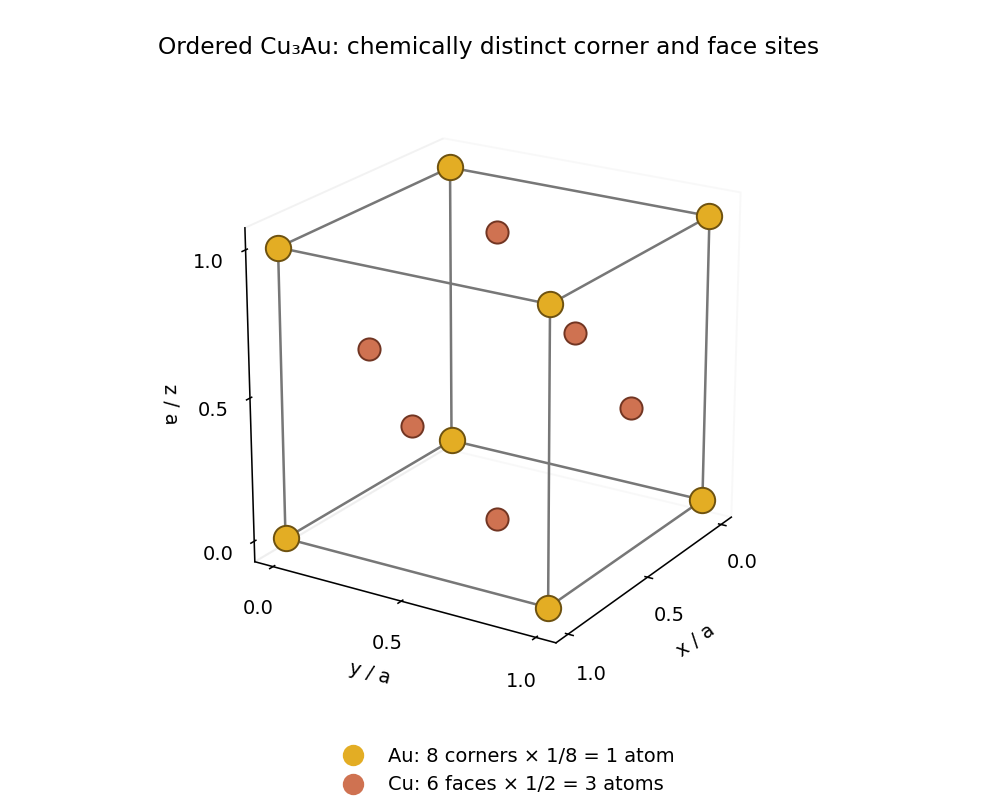
The ordered crystal structure consists of a primitive cubic lattice with the four-site atomic basisin fractional crystal coordinates. The drawing shows all boundary representatives of these sites. Eight corner gold chemical atoms, shared among eight unit cells each, contribute one gold chemical atom. Six face-centred copper chemical atoms, shared between two unit cells each, contribute three copper chemical atoms. Thuswhich gives the required stoichiometry. Although the unlabelled positions form a face-centered cubic lattice, a face-centering lattice translation exchanges gold and copper and therefore fails to preserve the ordered crystal structure. Its Bravais lattice is primitive cubic lattice.

Past exam of the condensed matter physics course of the University of Oxford 2021 2 c ii Solution 2026-10-25
Subtracting the three acoustic phonon branches from the six displacement normal modes leavesAt small wavevector, these involve relative motion of the two atomic basis sites rather than a rigid translation of the primitive unit cell. Their angular frequencies remain nonzero at the zone centre. The count uses the primitive unit cell; using all eight chemical atoms in the conventional unit cell would spuriously multiply the number of distinct branches in the first Brillouin zone.
Past exam of the condensed matter physics course of the University of Oxford 2021 2 c i Solution 2026-10-25
There are two chemical atoms in the primitive unit cell, hence six displacement coordinates and six phonon branches at each wavevector. Three rigid translations cost no restoring potential energy in the long-wavelength limit. ConsequentlyFor propagation along , one acoustic phonon has longitudinal polarization along and two have transverse polarization along . The cubic crystal symmetry makes those two transverse directions equivalent. In terms of the elastic stiffness tensor and the mass density,Thus there are two distinct acoustic velocities in general, one longitudinal and a doubly degenerate transverse value. This degeneracy of normal modes concerns the two transverse polarizations; it does not imply equality with the longitudinal speed of sound.
Past exam of the condensed matter physics course of the University of Oxford 2018 3 e ii Solution 2026-10-25
Quantum statistics matter when thermal energy is comparable with a characteristic vibrational level spacing. The chain's natural angular frequency is , givingFactors of order unity depend on which vibrational scale is used. The largest chain phonon angular frequency is , corresponding to . An isolated two-atom bond has reduced mass and angular frequency , corresponding to . Thus quantum corrections become appreciable on the scale of several tens of kelvin, and all modes are classical only when is comfortably above the largest relevant vibrational scale. Below it, high-frequency phonons are progressively frozen out and equipartition fails.
For the isolated bond, the zero-temperature root-mean-square relative displacement isIt is small enough for a local bond expansion. The classical weakly anharmonic estimate in part d therefore has a useful parametric windowwhere the lower condition means comfortably above the vibrational scale, rather than a sharp threshold. The model's upper bound concerns local anharmonicity and binding, not a prediction of the melting temperature.
Past exam of the condensed matter physics course of the University of Oxford 2018 3 e i Solution 2026-10-25
The small parameter controlling the local Taylor expansion is the typical bond displacement divided by . In the classical regime, the root-mean-square displacement is . ThusFor example, the magnitude of the cubic term divided by the quadratic term is , and subsequent terms carry further powers of this ratio. A physically safe bound-bond regime also has , or . These are the same parametric scale, differing only by a factor two. The inequalities are strong: they do not imply that a truncated local expansion is accurate close to several thousand kelvin.
At very low temperature, replace the classical fluctuation estimate by the zero-point motion as discussed in part ii. Its bond displacement is small compared with for the supplied parameters, so low temperature does not itself invalidate the local expansion. Actual melting, other neighbours and bond breaking are outside this one-dimensional bond model.
Past exam of the condensed matter physics course of the University of Oxford 2017 4 d ii Solution 2026-10-25
Take uncompensated donor impurities and initially approximate them as ionized. Charge neutrality then gives , while the semiconductor mass-action law gives . Solving the quadratic without prematurely discarding minority carriers,Since , the hole density isUse the conduction population to locate the chemical potential:It moves toward the conduction band but remains about below it, so the mobile electrons are nondegenerate. Despite the donor binding energy being comparable with , the large number of available conduction states makes ionization almost complete at this dilute doping. For a singly occupied two-spin donor, , with . The inferred value is , confirming the approximation to much better than one percent. Including this small correction raises the hole density only to about .
Past exam of the condensed matter physics course of the University of Oxford 2017 4 d i Solution 2026-10-25
At , . With the scalar effective masses and two-spin convention of a, the effective density of states values areThe intrinsic carrier concentration follows from :From b, . Taking as a reference,It lies above the middle of the band gap, because the hole effective density of states is larger. Both band edges are more than twenty away, validating the nondegenerate semiconductor approximation.
Past exam of the condensed matter physics course of the University of Oxford 2017 1 c ii Solution 2026-10-25
The normal vector is . Its normalized dot product with is , soThis is the acute angle between the lattice planes, rather than the complementary angle between a plane and the other plane's normal.
Past exam of the condensed matter physics course of the University of Oxford 2017 1 c i Solution 2026-10-25
Use the angle between two planes defined as the acute angle between their normal vectors. The normals and have dot product one and lengths . ThusChoosing an oriented rather than an acute interplanar angle could give the supplementary ; it describes the same unoriented pair of lattice planes.
Past exam of the condensed matter physics course of the University of Oxford 2016 4 c iv Solution 2026-10-25
At fixed chain length, each harmonic mode contributes a Bose–Einstein thermal occupation and a temperature-independent zero-point energy. The latter contributes no heat capacity. With ,At low temperature only the approximately linear part of the acoustic dispersion is excited, so . Using givesIt is linear in temperature, rather than the three-dimensional Debye law. At high temperature every scalar oscillator tends to , henceThe cutoff temperature is K. The curve rises smoothly from zero toward this plateau; sets a crossover scale, not a sharp transition. In normalized variables its initial slope is . The low-temperature continuum limit also requires temperature above the finite-size level spacing; uniform center-of-mass translation is treated separately. Below the lowest nonzero mode energy a finite chain does not retain a continuum linear law down to arbitrary temperature.
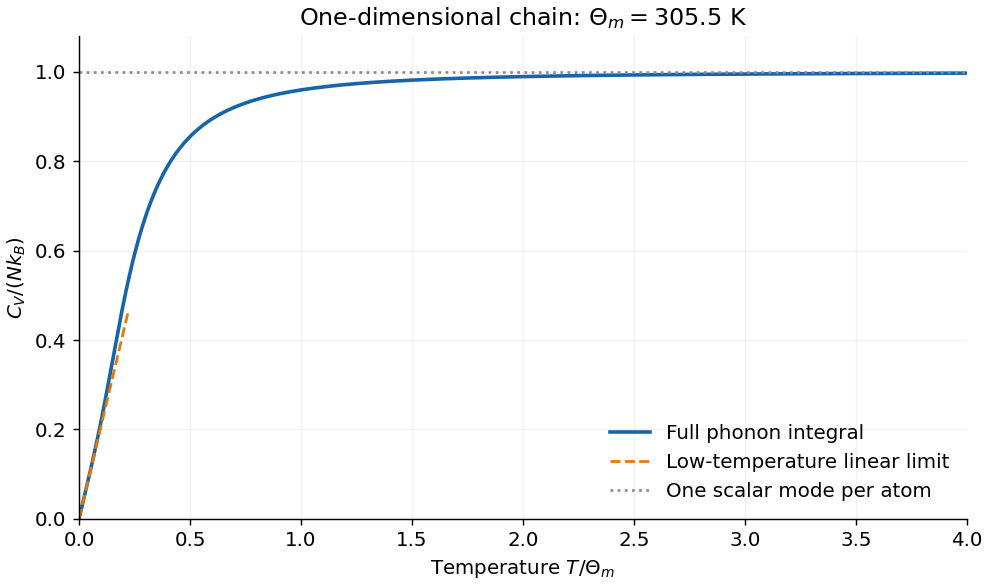
Single-branch chain heat capacity and its low- and high-temperature limits
. Original numerical Bose–Einstein mode integral. The dashed line is the low-temperature linear asymptote; the plateau is one Boltzmann constant per atom for this scalar model. Details.
Past exam of the condensed matter physics course of the University of Oxford 2016 4 c iii Solution 2026-10-25
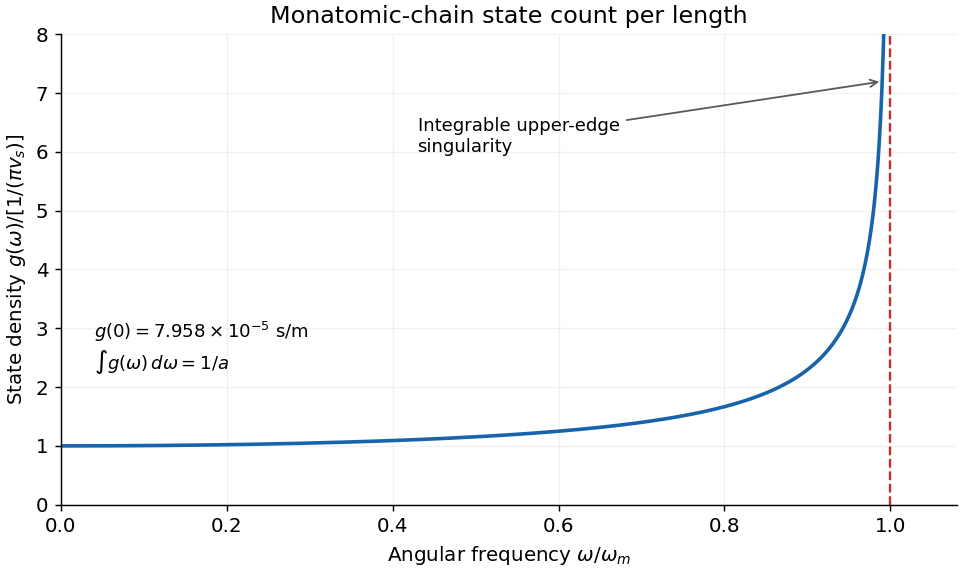
For a long periodic chain of length , neighboring allowed signed wavevectors differ by . Counting both signs once gives a state density per length on the positive half-zone. Therefore the density per angular-frequency interval and per length isIt is zero outside this band, starts at s/m and has an integrable inverse-square-root Van Hove singularity as . The state-count normalization isThus the scalar chain has one vibrational mode per atom, with no extra factor of two for the already counted propagation directions. If the horizontal variable were ordinary frequency , the density would be . A finite chain has discrete lines instead of an actual infinite peak; the smooth divergent curve is the large-chain continuum description.

Past exam of the condensed matter physics course of the University of Oxford 2016 4 c ii Solution 2026-10-25
Differentiate the positive-frequency branch on either side of the origin:It tends to km/s as and to km/s as , and vanishes at either zone boundary. A positive- wavepacket therefore transports energy to the right, while a negative- one transports it to the left. At the zone edge, neighboring atoms oscillate out of phase and the dispersion is flat, giving zero group velocity even though the frequency is nonzero.
The graph has separate one-sided limits at zero because has a cusp there. Assigning one differentiable slope at exactly would erase the distinction between the two propagation directions; a precisely uniform translation has no preferred propagation direction. Plotting only is also legitimate if the missing negative branch is stated. Group velocity and phase velocity are different except in the long-wavelength linear limit.
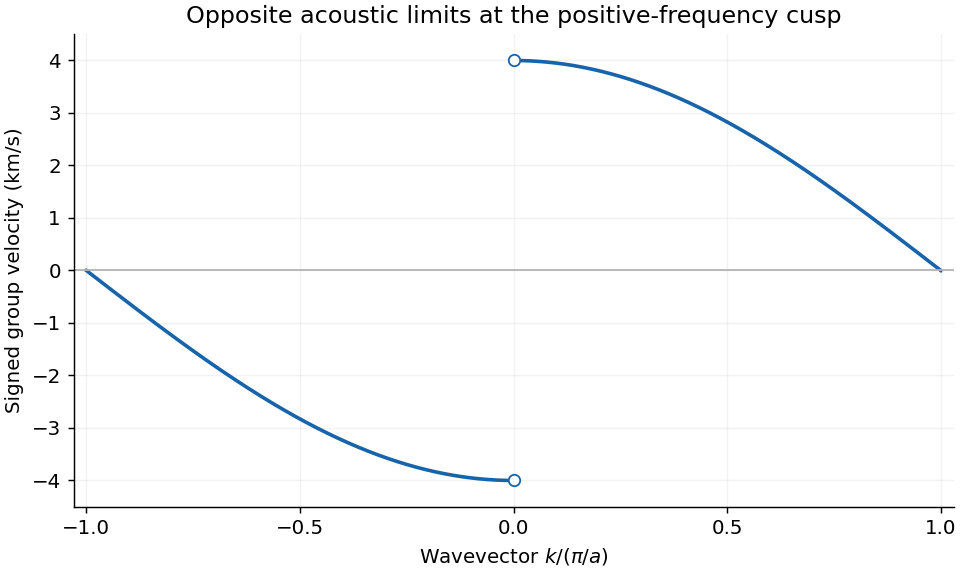
Signed group velocity across the first Brillouin zone
. Original derivative of the positive-frequency acoustic branch. Open markers show the distinct limits at zero wavevector; the derivative is not defined at the cusp itself. Details.
Past exam of the condensed matter physics course of the University of Oxford 2016 4 c i Solution 2026-10-25
The supplied sound speed determines the spring-to-mass ratio without needing either parameter separately:ConsequentlyThe curve is even in , rises linearly from the origin with one-sided slopes km/s, and flattens at both zone edges. Its maximum is rad/s, or ordinary frequency THz. Keeping angular frequency distinct from cycles per second avoids a factor-of- error. Repeating the curve outside the first zone is a representation of equivalent crystal momenta, not the discovery of additional modes.
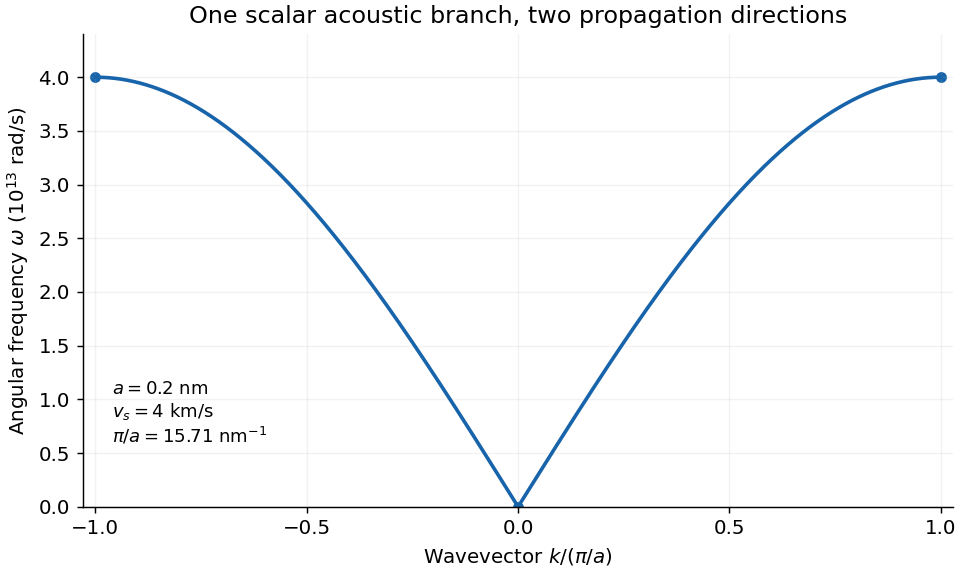
Positive-frequency acoustic dispersion of the specified monatomic chain
. Original nearest-neighbor harmonic-chain calculation, with both propagation directions in one first Brillouin zone. The plotted vertical frequency is angular frequency. Details.
Past exam of the condensed matter physics course of the University of Oxford 2016 3 b ii Solution 2026-10-25
For T, the same spin-only two-state probabilities apply, but the low-temperature argument is no longer small. At 300 K, ; at 2 K, . HenceThe 2 K sample is about of its saturation magnetization, with about of the moments in the aligned state. The two percentages describe different observables. A linear extrapolation would predict , exceeding saturation and therefore contradicting the bounded two-state population.
For completeness, at this 2 K, 5 T bias the dimensionless secant susceptibility is approximately , while the differential susceptibility is under the same prescribed-field approximation. Neither equals the zero-field Curie slope . Thus saturation reduces the incremental response even while the magnetization itself is large.
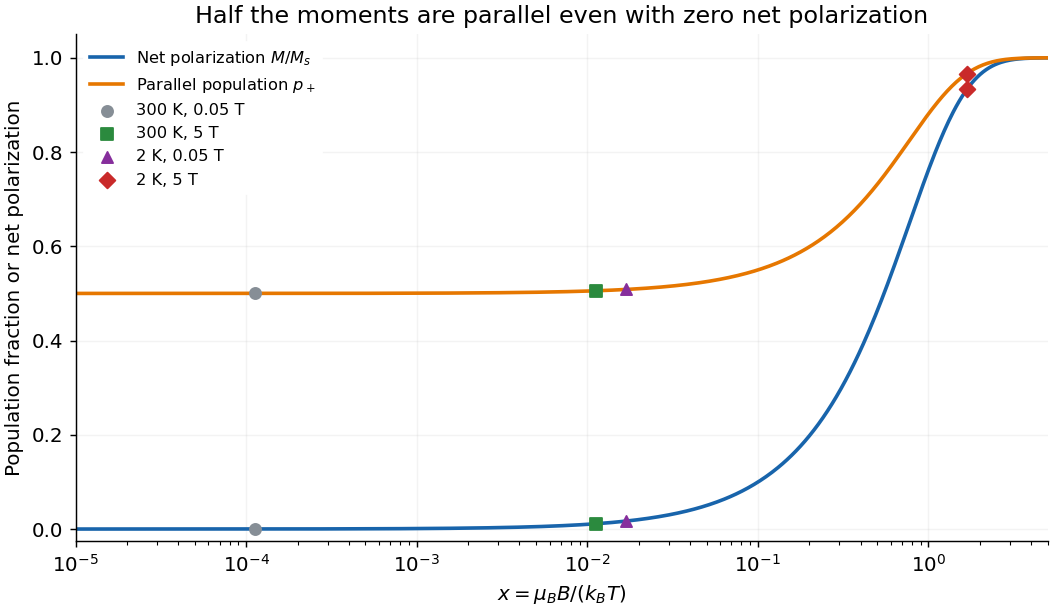
Parallel-state population and net spin polarization
. Original independent-spin calculation. At zero field the parallel-state population is one half and net polarization is zero; the four specified field and temperature combinations are marked. Details.
Past exam of the condensed matter physics course of the University of Oxford 2016 3 b i Solution 2026-10-25
For T, use the two spin-only moment states. Their probabilities and normalized magnetization areAt 300 K, ; at 2 K, . ThereforeThe phrase “fraction aligned” is ambiguous if it is used to mean net alignment. Half the moments are already in the parallel state at zero field, but the net magnetization is then zero because the antiparallel half cancels them. The table reports both the literal parallel-state population and the imbalance that produces magnetization. At this weak field even the 2 K sample is far from saturation, so the Curie approximation is accurate within this independent-spin model.
Past exam of the condensed matter physics course of the University of Oxford 2016 2 c ii Solution 2026-10-25
For one spin-degenerate parabolic two-dimensional band, m. The free-electron model with givesThe given is a sheet resistivity, not a bulk resistivity in ohm-metres. The two-dimensional Drude sheet conductance is , soThus m/s andThe sample temperature is not given. This is specifically the Fermi-surface mean free path, appropriate in the degenerate regime K for the bare-mass model. At higher temperatures the characteristic thermal speed should replace for a thermal transport distance. If a real two-dimensional band has mass , the stated results scale as , and ; the inferred is mass independent under these same Drude assumptions. No semiconductor effective mass or valley degeneracy is silently introduced.
Past exam of the condensed matter physics course of the University of Oxford 2016 2 c i Solution 2026-10-25
A conventional face-centered cubic cell contains four atoms. With three conduction electrons per atom,Using the bare electron mass,The Drude transport relation is , givingFor a degenerate electron gas, transport samples electrons near the Fermi surface, so use m/s:This is a transport relaxation time and associated transport mean free path inferred from the specified resistivity. It need not equal a single-particle quantum lifetime when scattering is strongly angle dependent. The free-electron valence count also neglects the detailed band structure of aluminium, as the stipulated model requires. A classical thermal speed is not the appropriate velocity scale for this strongly degenerate metal.
There are unlisted articles, also show them or only show them.