
Interpret the ordered Iterated Itô integral recursively as andThe diagonal boundary of the ordered region does not affect this recursive definition. For , . For , part (a)(iii) gives . For , use parts (b)(ii) and (b)(iii):Thus the three Probabilists' Hermite polynomials giveThe right sides are interpreted as their polynomial extensions at . These space-time Hermite polynomials arise here directly from ordered Iterated Itô integrals.
Put . It is an adapted process and is integrable at every finite time, because normal random variables have finite absolute moments of every order. Fix and let . Then is independent of , has mean zero, variance , and third moment zero. Expanding the cube inside the conditional expectation givesAlso . ThereforeThese are exactly the defining conditions for a martingale.
Summing the exact cubic increment identity givesThe first sum tends to zero in L2 space. Indeed, odd moments of centered normal random variables vanish, a centered normal random variable of variance has sixth moment , and independence of the Brownian increments givesThe second sum converges in L2 space to by (i).
For the last sum, first note that , so is a square-integrable stochastic integrand. If and , then is independent of , with . HenceIt follows thatThe Itô isometry therefore makes converge in L2 space to , with bounded truncations supplying the initial simple predictable processes if needed. Taking limits in the cubic identity provesThe proof uses only increment algebra, moments of normal random variables and the definition of the Itô integral.
Apply the exact discrete product identityand sum over the deterministic partition of an interval. Since ,The left side converges in L2 space to by the definition and Itô isometry, sinceThe right-endpoint Riemann sum converges in L2 space to : its squared error is at mostConsequently,As in (a)(iii), continuity extends fixed-time equality to equality of the continuous processes.
To establish the Brownian weighted quadratic variation in L2 for the deterministic partition of an interval, decomposewhere and .
The summands in are martingale differences: is -measurable, and the following Brownian increment is independent of . Their conditional means are zero, so distinct summands are orthogonal in L2 space. Since and ,For the Riemann sum error, the Cauchy-Schwarz inequality givesThus the triangle inequality in L2 space provesThe time integration variable is .
Fix , a deterministic partition of an interval , and write on . Its mesh is . The Brownian increment variance givesThus the left-endpoint sums converge in L2 space to the Itô integral. Although these step coefficients are unbounded, clipping them at finite levels first makes them bounded simple predictable processes; the Itô isometry and their finite second moments remove the clipping.
The elementary identity givesThe squared Brownian increments are independent, with means and variances , since a centered normal random variable of variance has fourth moment . ThereforePassing to the convergence in L2 limits yieldsThis holds for each fixed ; continuous sample paths of both sides extend equality from rational times to all on one event of probability one.
For a bounded simple predictable process and a continuous martingale , the Itô isometry statesHere is the predictable quadratic variation, equal to for a continuous martingale. On the whole half-line, the terminal form isThe Itô integral starts at zero even when . For Brownian motion, .
For completeness, cross terms of the finite increment sum have expectation zero by conditioning on the earlier endpoint of the later increment. Also is a martingale, so the remaining terms satisfyThis proves the displayed identity without a change-of-variables formula. Completing bounded simple predictable processes in the norm defines the Itô integral of every square-integrable stochastic integrand. This completion will justify the unbounded Brownian integrands below.
Let and let be bounded -measurable random variables. For the bounded simple predictable processthe Itô integral against a continuous martingale is defined by the increment sumThe same definition applies to elementary predictable processes with stopping-time intervals, replacing by ordered stopping times and taking bounded -measurable coefficients. Refinement of the intervals leaves the increment sum unchanged. The initial value of the integral is zero, and its martingale property follows from the conditional expectation identity for subsequent increments of .
Write as an element of L2 space. Parts (iii) and (iv) show that is a centered Gaussian process with covariance functionIn particular . The fourth moment of a centered normal random variable of variance is , soThe Kolmogorov continuity theorem, with moment exponent and time exponent , provides a continuous modification . At each finite set of times this modification of a stochastic process has the same joint law as .
For , the successive increments are Jointly Gaussian. The covariance of two increments on disjoint intervals equals the inner product of their disjoint interval indicators and is zero. Zero cross-covariances of Jointly Gaussian variables imply independence, and each increment has variance . Finally in L2 space, so almost surely. ThereforeIndependence from the whole past in its natural Brownian filtration follows by extending finite-dimensional independence to the generated sigma-algebra.
Use the same finite truncation for and . Since by independence, zero means and unit variances,Here is the Kronecker delta. The Cauchy-Schwarz inequality and convergence in L2 justify passing to the limit in the product's expectation. The Parseval identity for a Hilbertian basis now givesBecause each has mean zero, this is also its covariance identity. Thus is an isonormal Gaussian process over .
For any and real , linearity of the finite partial sums and convergence in L2 giveBy part (ii), this random variable has the normal distributionA finite family is Jointly Gaussian precisely when every real linear combination has a possibly degenerate normal distribution. Thus every finite subfamily of is Jointly Gaussian, which is the meaning of joint Gaussianity for this collection.
Enumerate the orthonormal basis consisting of and the Haar wavelets as , and enumerate the corresponding independent standard normal random variables as . Set . The Parseval identity for a Hilbertian basis givesThe partial sums form a martingale for , since the next summand is independent of the past and has mean zero. Moreover,The martingale convergence theorem for a martingale bounded in L2 space proves convergence almost surely and convergence in L2. Equivalently one may apply the Kolmogorov convergence theorem to the summable variances .
A finite linear combination of independent normal random variables is normal. Its characteristic function is . Passing to the limit identifiesFor this is the constant zero random variable. Each fixed has its own permissible null set; simultaneous pathwise convergence for all is unnecessary.
Let . The assumed orthonormality of the Haar wavelets givesEnumerate the coefficients level by level as . They are independent and identically distributed standard normal random variables, so the squares have mean one. The strong law of large numbers impliesConsequently,A convergent sequence in a Hilbert space must be bounded in norm. Hence this random Haar wavelet series diverges in almost surely.
In the Lévy construction of Brownian motion, start with and , where has the standard normal distribution. Suppose values are defined at the endpoints and . Setusing fresh independent standard normal random variables , also independent of everything previously used. Join the values by straight segments to obtain a continuous piecewise linear process on the dyadic grid.
To verify the Brownian increments, write and . The two new increments are and . If , their variances are and their covariance is zero. They are Jointly Gaussian, so they are independent. Induction proves the required Brownian increments on every dyadic grid.
For convergence, successive interpolants differ by tents of disjoint interiors, soThe Gaussian tail bound and the union bound giveThese probabilities are summable. The First Borel-Cantelli lemma and therefore prove uniform convergence of the interpolants almost surely. Their limit has continuous sample paths. Approximating any finite set of times by dyadic times passes the Jointly Gaussian increment laws to the limit, giving a standard Brownian motion on .
On a probability space , a standard one-dimensional Brownian motion is a real-valued stochastic process with almost surely, continuous sample paths almost surely, and independent increments, such thatHere the second parameter is the variance. Thus its Brownian increments have the normal distribution with mean zero and variance equal to elapsed time. Equivalently, relative to a specified filtration , require to be an adapted process and to be independent of with this normal distribution. Taking the natural Brownian filtration recovers the first definition.
Complete the square:The minimum is stable because . HenceHere the Jahn-Teller stabilization energy is the positive magnitude of the energy reduction.
The term is the leading electronic energy gain from splitting the initially degenerate orbitals and occupying the lower levels. Its negative sign expresses the lowering of the occupied-electron energy for the chosen elongation branch of the Jahn-Teller effect. The positive coefficient is a linear electron-lattice coupling in this reduced model.
The term is the harmonic elastic cost of moving the ligands away from the undistorted reference structure. Mechanical stability requires . The competition between linear gain and quadratic cost produces a finite equilibrium distortion rather than indefinite elongation.
For axial compression along , the ordering is reversed: lies below the doublet, and lies below within . One electron occupies and the other occupies either or , with parallel spins in the weak-distortion regime. The orbital degeneracy is therefore two, with .
The retained orbital degeneracy allows further symmetry lowering and explains why this compressed arrangement does not provide the fully quenched equilibrium of the elongated case in the specified simple model.
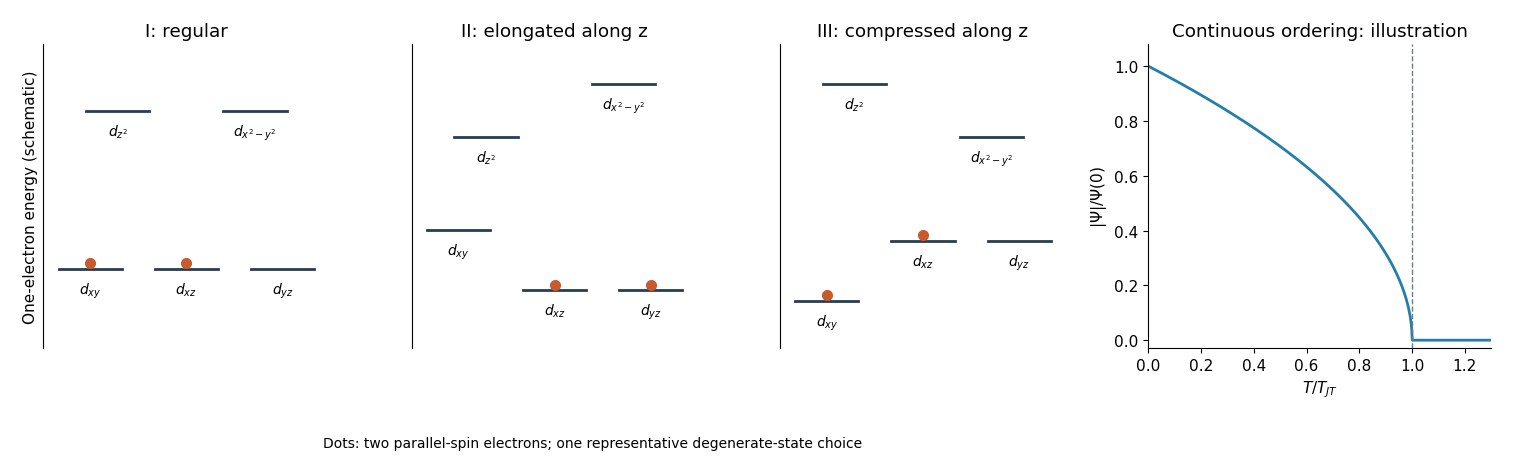

Take the elongation axis as . The axial oxygen ligands move farther away while the equatorial ones move closer, at fixed mean bond length. Orbitals containing are stabilized relative to their in-plane partners. Thus move below within , while moves below within . The schematic level ordering appears in the figure below; the octahedral gap remains open for a small distortion.
The two parallel-spin electrons occupy and , one each. Filling the entire lower doublet gives a unique orbital configuration, so its orbital degeneracy is one and the spin is still . This is the orbitally quenched configuration relevant to the later spin Hamiltonian.
The energetic preference can be made explicit in a traceless linear splitting model. For an elongation coordinate , write the levels relative to their barycentre as with . Their two-electron ground energy decreases by . For an equal-magnitude compression, the levels are and the two-electron energy decreases only by . With the same quadratic elastic cost, minimizing gives four times the stabilization of minimizing . Thus the small-distortion Jahn-Teller effect favors elongation for this high-spin filling. The argument assumes the linear coupling and harmonic elastic model, rather than claiming that symmetry alone fixes all real-material distortions.
For the regular octahedron, repulsion from the six oxygen ligands raises the two orbitals, and , above the three orbitals, . The latter point between the metal-ligand axes and experience less direct repulsion. The crystal field splitting is therefore a lower triplet and an upper doublet.
For the V ion, Hund's rules put the two electrons into different orbitals with parallel spins, giving . There are three choices for the unoccupied orbital, so the orbital ground state is triply degenerate. Its spin degeneracy is separate. This orbital degeneracy makes a symmetry-lowering Jahn-Teller effect possible.
There are unlisted articles, also show them or only show them.