
Let . If , the matrix is zero and the identity is immediate. Otherwise choose the rank factorization from part b. The column space of is the image of .
An idempotent matrix acts as the identity on its image: if , then . Applying this to each column of gives . Substituting yields . Since has full column rank, the represented map is injective, so each column of is zero. Thus .
Now the rectangular cyclic property of the trace givesThis proves that the trace of an idempotent equals its rank using the supplied factorization method. Orthogonality of the projection is unnecessary: the argument applies to every real idempotent matrix.
The two square products can have different sizes, but their matrix traces are both the same finite double sum:Interchanging two finite sums and commuting their scalar factors is valid over the real numbers. No commutation of the matrix products themselves is asserted. This proves the cyclic property of the trace in the rectangular-factor case.
For the first matrix choose its single independent column:Their product has every column equal to , and both factors have rank one.
For the second matrix, the first and third columns are independent and the second equals the first, givingMultiplication reconstructs the stated matrix. The first factor has independent columns and the second has independent rows, so both have matrix rank two, as required for a rank factorization.
True for these square matrices. The determinant multiplication identity gives . Since is invertible, its determinant is nonzero; both factors are therefore nonzero, so both matrices have matrix inverses.
Equivalently, must be injective and must be surjective, and either property implies invertibility for an endomorphism of a finite-dimensional vector space. The equal square dimensions matter: a rectangular matrix and a right inverse can have identity product without being mutually invertible square matrices.
Subtract the first vertex from the other two, giving side vectors and . Their determinant is , the signed area of the corresponding parallelogram. The triangle occupies half that area, hence its area is . Taking the absolute value would remove any sign change caused by reversing the vertex order. This is the determinant formula for triangle area.
Let be the input sampled at clock edge . The desired registered output after that edge is . Only the last two high samples matter: a longer high run still has two high samples immediately before its first low sample.
A direct synchronous 110 detector uses three D flip-flops, holding , with a common clock and initial state zero. Use the following next-state equations, all evaluated from the old state and the input at the active clock edge:After an edge, records the latest sample and records whether the latest two samples were high. The final equation consequently produces the required pulse from the preceding two-high state and the new low sample. A synchronous reset sets all three state bits to zero. The output is the stored
z flip-flop value, so it changes only after clock edges; exposing the unregistered expression would let input transitions between edges alter the output.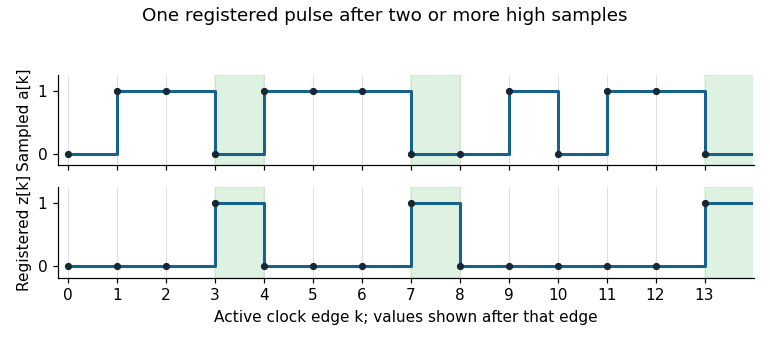
Original sampled-input and registered-output trace for a synchronous 110 detector
. Details. 
An equivalent finite-state machine has states
R (no current high run), H (one high), HH (at least two highs), and P (the pulse state). Its output is one only in P:The pulse cannot last two cycles: after the low input that creates it, is zero, so the next output is zero regardless of the next input. The detector rearms without a global stop and handles repeated patterns indefinitely. The three-flip-flop construction is deliberately direct; minimum storage was not required.
There are unlisted articles, also show them or only show them.