
By implicit differentiation of the ellipse equation,The tangent line through is thereforeIts normal vector is , parallel to the gradient of at that point.
Apply the chain rule twice: once to the square and once to the argument of the sine. The inner derivative is . ThereforeThe original PDF has , rather than the cube of .
The first term is , so the finite geometric series is . Subtracting cancels the interior terms and gives . ThereforeThe rational expression holds for every real and every real , including ; the same algebra works for complex numbers. No restriction is needed for a finite geometric series. The exceptional case follows by adding one hundred equal terms, or by taking the limit as .
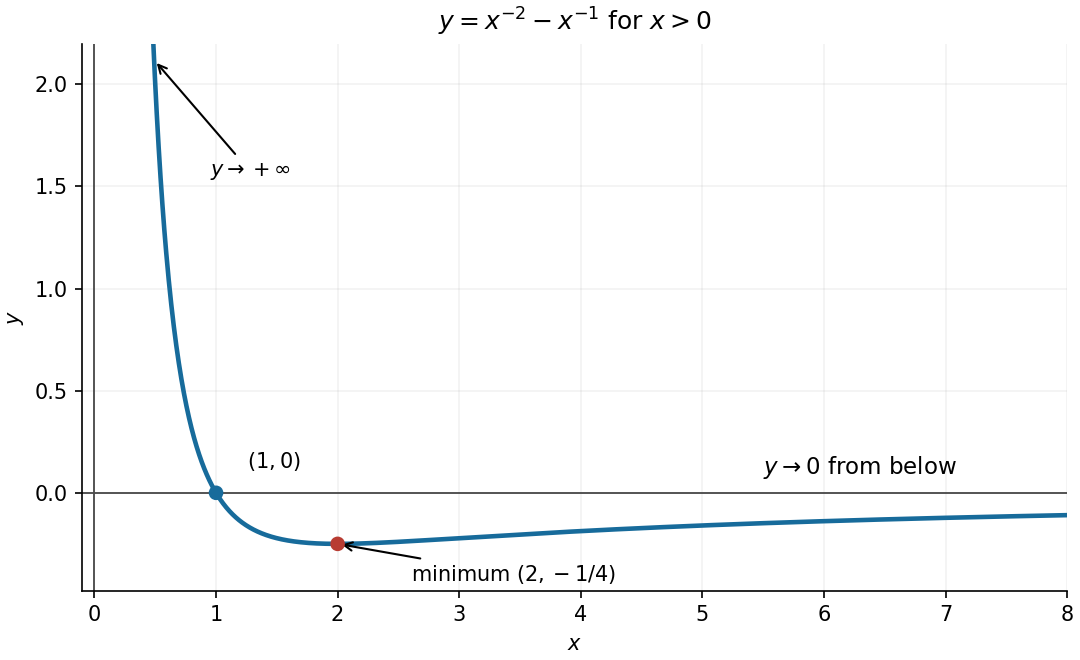
Differentiate the two powers to locate the stationary point:For , this is negative before and positive afterwards, so the global minimum isThe curve crosses the horizontal axis at . Its limits are as and from below as , giving the vertical asymptote and horizontal asymptote . These features determine the required sketch.

The two directed segments have vectors and . Their dot product is and both norms equal . HenceThe common starting point fixes the obtuse angle between these segments.
Use integration by substitution with , so and . The indefinite integral becomesThus, with an arbitrary constant of integration,This real antiderivative applies for and extends continuously to the stated endpoint. Its left derivative there agrees with the limiting integrand, zero.
Set and in the two conic sections. A real intersection requires . Solving the resulting linear equations givesFor the denominator and are positive, so intersections exist exactly when . At they are ; for both choices of sign for each square root give intersections. Consequently
The Pythagorean trigonometric identity makes the second factor , which is strictly positive. It is therefore enough to solve . The sine addition formula givesThe shifted angle lies between and . On this interval the sine is nonpositive precisely from onwards. Restoring the original angle and retaining its strict upper bound gives
There are unlisted articles, also show them or only show them.