
The repeated factor in the differential operator suggests . Direct differentiation gives , so andThe first value gives . The second gives , hence and . Therefore
Under the same independence assumption, inclusion-exclusion givesOn ,There is one interior inflection point, where the curvature changes from positive to negative:At the graph reaches one with zero slope and then stays constant. There is no further change from one sign of curvature to the opposite sign there.
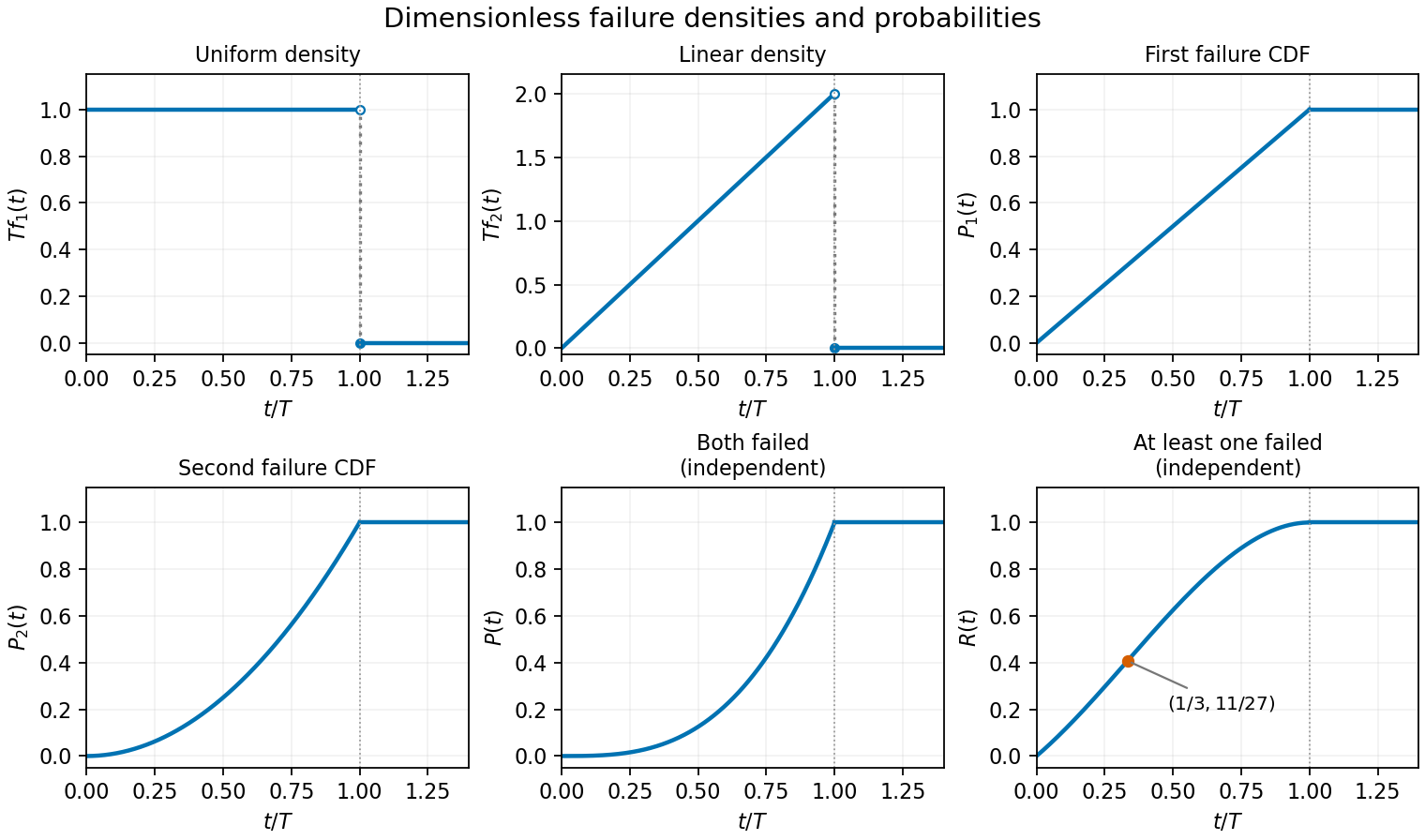
Without independence, still holds, but only is forced by the marginals. Its inflection behaviour is then not determined. The shared- construction in (e), for example, gives before the plateau.
The product formula requires independent failure times. This assumption is not stated in the original PDF. Under that intended assumption, put and use the failure probabilities for two independent lifetimes:Its graph is a cubic increasing from to , convex before reaching its plateau.
Without independence, the marginal distributions do not determine . The Fréchet inequalities give the sharp pointwise boundsFor example, taking and with the same uniform random variable preserves both prescribed marginals but gives , rather than .
Integrating the first probability density function gives the cumulative distribution functionIts graph is a straight ramp from to , followed by a horizontal plateau.
A uniform distribution has constant density on its support, fixed by normalization. ThusThe density's assigned values at the endpoints do not affect probabilities.
On the first straight segment, and only is nonzero, so both integrals vanish. On the second segment, and only is nonzero; each integrand is one, contributing . On the last segment, and only is nonzero; each integrand is , contributing . ThusThe second result also follows from the fundamental theorem for line integrals, using the potential found in (a). Agreement on this one path does not make conservative.
The curl of the first vector field iswhich is not identically zero. Thus is not conservative on and cannot equal a negative gradient there.
For the second field, direct differentiation showsTherefore is conservative, and the requested negative-gradient potential isIts curl vanishes, consistently with the curl of a gradient identity.
Use the same axes as in (a) and choose the outward orientation. On the curved spherical lune, and . Its vector area isThe and components cancel. The component is , henceHere points along the azimuthal bisector; another coordinate choice rotates this vector accordingly. Its magnitude is the signed projected area, not the scalar curved area . Reversing the orientation reverses its sign.
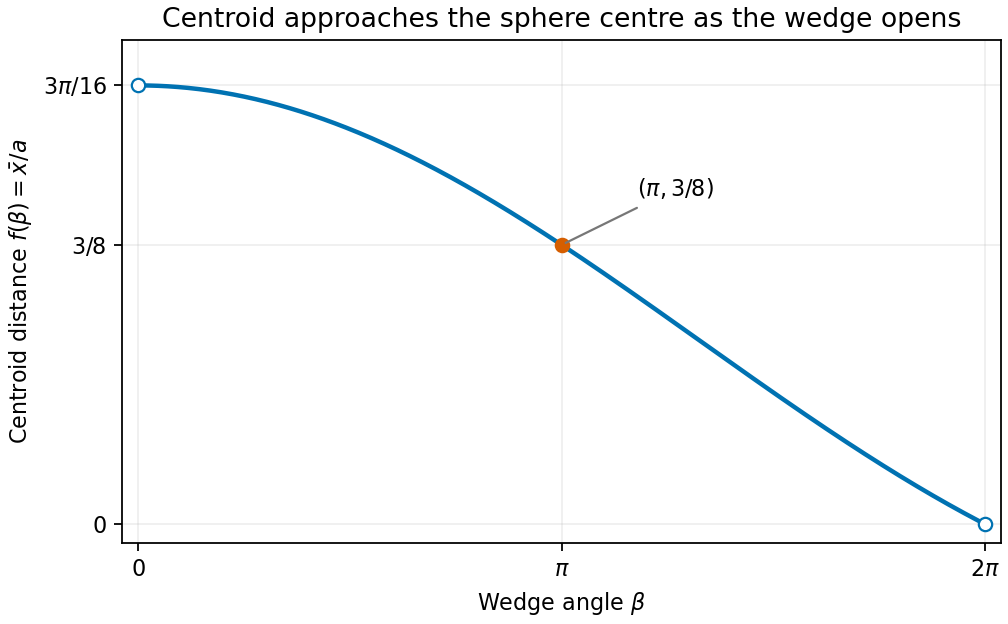
Orient the common axis of the wedge faces along and its azimuthal bisector along positive . Reflection symmetries give . In spherical coordinates, use , , and . The volume isSince , the first moment isDividing by the volume locates the centre of mass:This is the centroid formula for a spherical wedge.
For the sketch, is positive and decreases from to , with . Indeed, on putting , the sign of is the sign of . The negative of this expression has derivative for and starts at zero, proving strict decrease.


The number of tails has a binomial distribution. The complement of at least two tails consists of zero tails or exactly one tail. Therefore
There are unlisted articles, also show them or only show them.