
Group the polynomial into two pairs, then use the difference of two squares:Thus is a double polynomial root and is a simple polynomial root.
The parameter derivative of the integrand is , whose absolute value is bounded by one on . This integrable bound justifies differentiation under the integral sign, givingThe original integral also exists: , and its apparent singularity at is removable. Set to evaluate the derivative:ConsequentlySince , integration in the parameter fixes the constant and gives the logarithmic sine integral identity
The integrand and both limits depend on , so use the Leibniz integral rule. The upper and lower endpoint contributions and the interior derivative giveFor , an antiderivative in is . Evaluating it and collecting terms givesAt the original Leibniz expression has zero endpoint terms and an integral over a zero-length interval, giving . The displayed quotient has a removable singularity and the same limiting value.
Assume real square-integrable functions on the same integration domain. Put , , and . If , then almost everywhere, so and the claim follows. If , nonnegativity of a square givesMultiplying by proves the integral form of the Cauchy-Schwarz inequality:For nonzero functions, equality holds exactly when they are proportional almost everywhere. The zero-function cases also give equality.
Substitution first makes the square-root branch transparent:On the given interval this is exactly , so direct differentiation givesin agreement with the chain-rule calculation. Outside this interval one must retain the absolute value; there are cusps at integer multiples of .
For the composite square root, throughout the restricted interval. Differentiate with respect to :The second expression comes from differentiating both and . The endpoints where are excluded here.
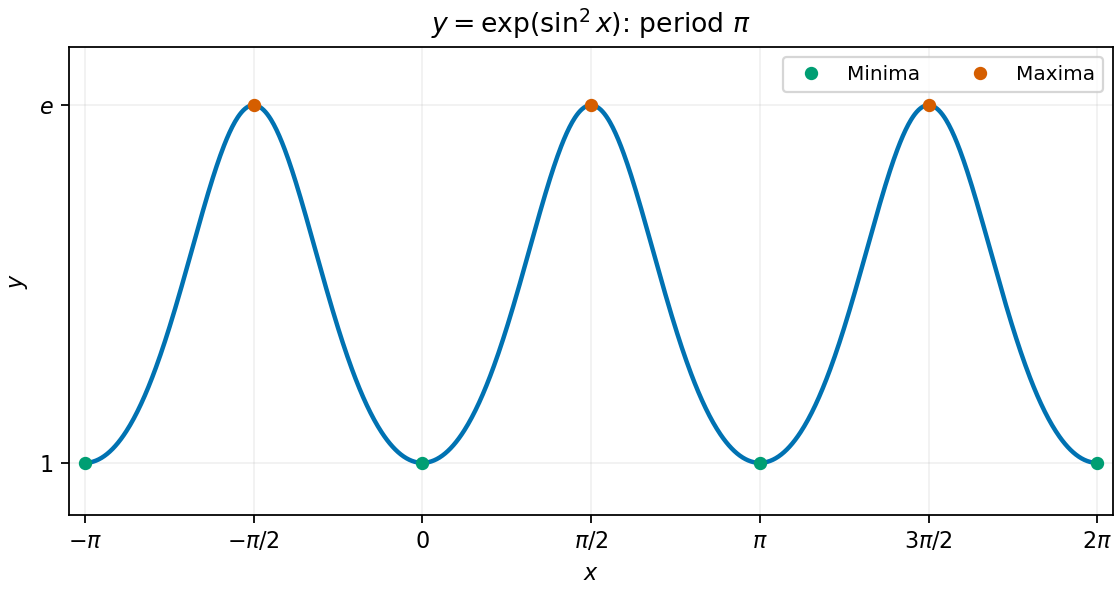

Differentiating givesThe exponential never vanishes, so all stationary points have . At , and ; at , and . ThusThese are global minima and maxima because . None of the stationary points is an inflection point.
For , the multivariable chain rule gives , with the corresponding expressions for . Thus the gradient of a radial function isThe origin needs a separate check because is undefined there. If the one-variable function has a finite right derivative at zero, the radial composite is differentiable at the origin exactly when , in which case its gradient is zero. A nonzero radial slope gives incompatible opposite-direction derivatives.
Treat and as constants and use the total differential in the independent variables :Each coefficient differentiates with respect to its displayed variable while holding the other two fixed; the formula applies where .
There are unlisted articles, also show them or only show them.