
The normal line to a plane curve is perpendicular to the tangent line, so its slope is the negative reciprocal . The required equation isThe normal direction also agrees with the gradient of the defining level function.
The positive horizontal coordinate is . By implicit differentiation,At the selected point this gives .
The usual interior condition for the binomial series is , giving as its open interval of convergence. In this particular square-root case the full series also converges absolutely at both endpoints, so the maximal real range on which its sum equals the original function isFor an endpoint check, write , where and . Then by telescoping, establishing absolute convergence at . The square-root binomial series at its endpoints proves continuity of the sum there. The endpoint values are at and at . Outside this range the power-series terms do not tend to zero. A three-term truncation remains an approximation, rather than an exact formula throughout the interval.
For this parametric curve, the chain rule givesThe quotient is a finite slope when . At and , the horizontal component of the tangent vanishes while the vertical component does not; these have vertical tangent lines, rather than missing finite values of the displayed quotient.
Within the requested interval, the function is symmetric about because . Its derivative is positive before , zero there, and negative afterwards. The negative second derivative shows that this is a strictly concave function. Consequently its unique maximum is . It tends to at both ends, giving vertical asymptotes and .
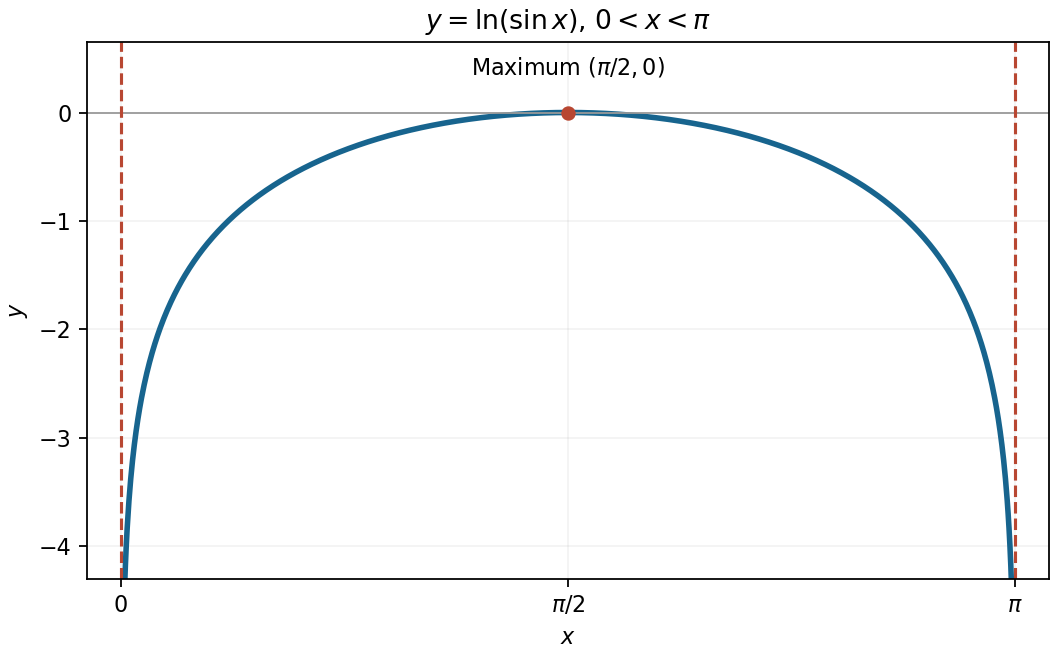
On any interval where , the chain rule gives . Differentiating again,The domain condition is necessary because the real natural logarithm requires a positive argument.
For an oriented surface with compatible boundary direction, the Stokes theorem statesLet denote the removed patch and the remaining cylinder. Keep the outward orientation inherited from the closed cylinder. Everywhere on the removed curved patch, the normal curl component is , so its flux is , where is its actual curved area. Part (d) then givesConsequently the circulation around a hole in an oriented surface isThe positive direction here is induced by the remaining outward-oriented surface; locally it runs clockwise around the hole when viewed from outside. If the edge is instead traversed positively around the removed patch, the direction reverses and the answer is . The question does not specify an edge direction, so the sign must be accompanied by this convention. The result depends only on the removed curved area, not on its shape. If the patch has several boundary components, use the sum of their induced line integrals. Since , the result has the units of a velocity line integral, length squared per time.
Separate the closed cylinder into its curved side and its two end disks, all with outward normal vectors. On the side, and , soAt the top, and , giving . At the bottom, both and the axial normal vector change sign, so the same positive value results. Each disk therefore contributes . Adding all three surface integrals,This explicit cancellation is consistent with the fact that the divergence of a curl is zero. The two disk contributions add rather than cancel.
The curl gives the vorticity:Since , the requested form isAt the axis the radial unit vector is undefined, but its coefficient vanishes and the Cartesian expression remains smooth. The radial vorticity reflects the change in rotation rate with height.
For a sufficiently smooth vector field on a volume and its closed boundary , the divergence theorem stateswith the unit normal directed outwards. HereHence the net volume flux through every closed surface in the liquid is zero. This verifies incompressible flow directly. It does not require the velocity to vanish pointwise on an arbitrary closed surface; inward and outward contributions can cancel.
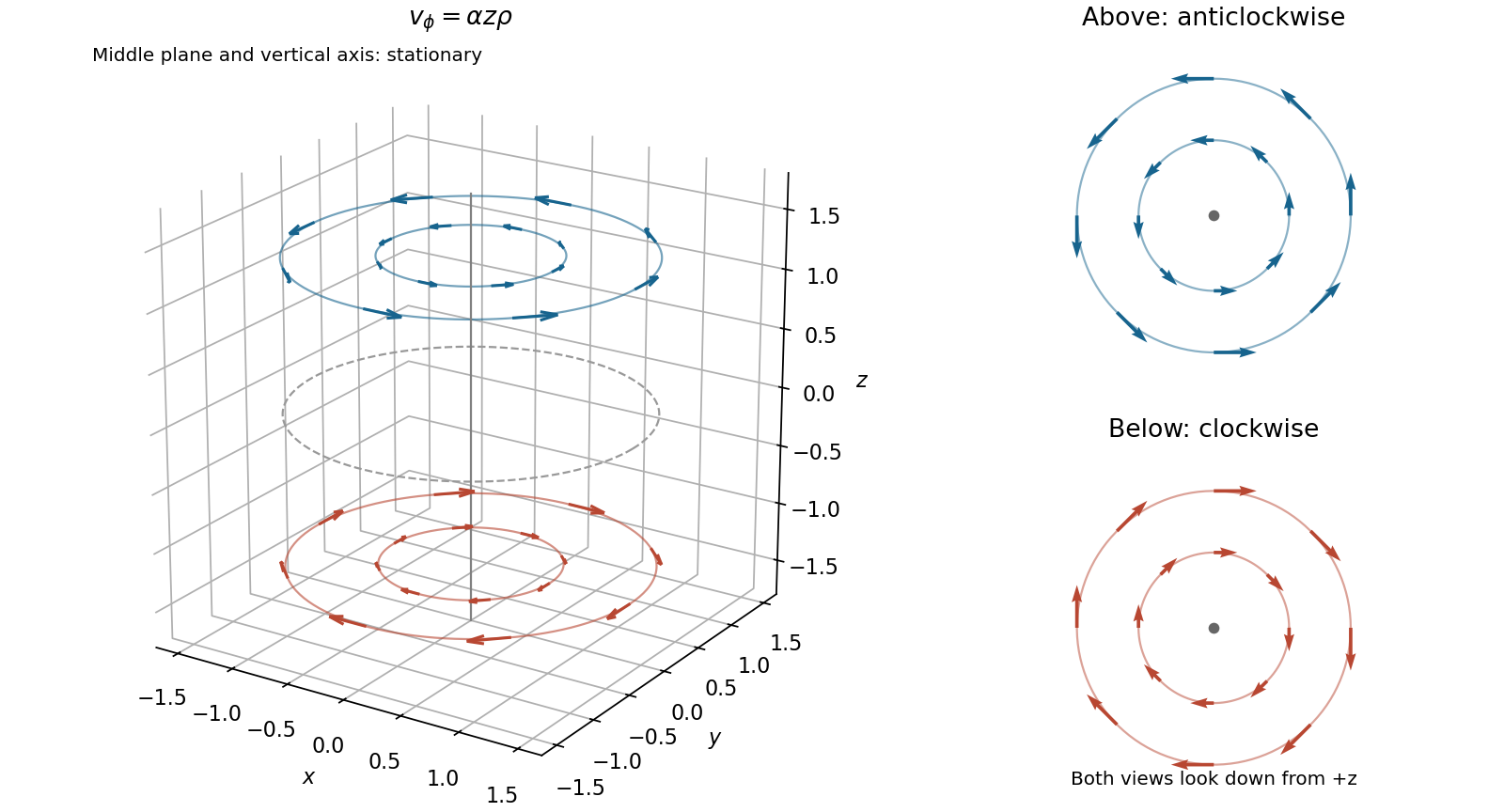
Use cylindrical coordinates , . The velocity field becomesFor each fixed height, particles follow concentric circular streamlines around the vertical axis. At the motion is anticlockwise viewed from above, while at it is clockwise. Within a horizontal plane the angular velocity is , independent of radius, and the speed is . Both the plane and the vertical axis are stationary. The rotation rate varies with height, so the entire liquid is not one rigidly rotating body.


At a single point of contact the line is a tangent line, so its slope equals the derivative of the exponential function. At the contact coordinate ,Since , dividing gives , hence . To verify uniqueness, the difference has positive second derivative everywhere and its unique minimum is zero at . Thus this line touches the curve once.
Let and . Consecutive even and odd terms cancel exactly:ThusBoth parity subsequences have the same limit, so the full sequence of partial sums converges and the sum is zero. This check is necessary: cancellation in fixed pairs alone does not always prove convergence of the original series.
For absolute convergence, each pair instead contributesThe inequality follows from . The lower-bound series diverges by comparison with the harmonic series. Therefore the paired logarithmic series with zero sum has
By De Moivre's theorem, . The complex sum whose real part is wanted is therefore a finite geometric series:Use in the numerator and denominator. This yieldsTaking its real part proves the finite trigonometric sumWhen , the printed quotient is undefined; the original sum is directly , also the limiting value of the displayed identity. The denominator restriction cannot be omitted from a literal use of the quotient.
For , differentiate the finite geometric series and multiply by :The required terms are with . The finite weighted geometric sum therefore givesSince , the correction tends to zero, proving convergence and yieldingIn fact the ratio test also proves absolute convergence, since the ratio of consecutive absolute terms tends to .
Use the common eigenvectors of and . For each ,Thus, without constructing explicitly, its eigenvalues areThe eigenvalue has direction . The repeated eigenvalue has a real eigenspace consisting of vectors whose coordinates sum to zero. This is the general rule for the symmetric part of an orthogonal matrix. Adding unrelated lists of eigenvalues would not suffice; here the shared eigenvectors justify the pairing.
There are unlisted articles, also show them or only show them.