
Past exam of the mathematics course of the University of Cambridge 2008 iii Paper 44 1 i Solution 2026-10-14
Consistent independent replications should strengthen confidence; contradictory results can weaken it. The change depends on the actual evidence. If of studies are positive and all labels are available, the posterior odds areFor the normal model, retaining the full independent statistics instead givesEach study multiplies the existing odds by its own Bayes factor. Reading a complete synthesis is therefore different from learning only that somebody obtained a positive result. Publication bias, dependence between studies and changes in study design must be accounted for before applying the independent-product formula.
Past exam of the mathematics course of the University of Cambridge 2008 iii Paper 44 1 h Solution 2026-10-14
For , both event probabilities tend to one, so the posterior odds tend to . If , the event's Bayes factor decreases toward one. To see monotonicity, put and writeThe last quotient is a weighted average of the decreasing values , with weights . Adding the next, smaller value decreases the average.
Thus the selection rule becomes less informative as more teams try: eventually a positive study is almost certain even under the null. This explains the hotter-field interpretation in Ioannidis's model. It describes evidence retained by this particular selection event, rather than proving that every individual study becomes less reliable or that the full accumulated evidence gets weaker.
Past exam of the mathematics course of the University of Cambridge 2008 iii Paper 44 1 g Solution 2026-10-14
Let denote the event that at least one study is positive. Conditional independence gives and . Updating the prior odds by this event's Bayes factor givesThese are the odds under at-least-one-positive selection, not the odds using every study's actual result.
Past exam of the mathematics course of the University of Cambridge 2008 iii Paper 44 1 f Solution 2026-10-14
Conditional on a false relationship, the independent studies are each negative with probability . The complement of at least one positive is that all are negative. Hence the familywise error rate is .
Past exam of the mathematics course of the University of Cambridge 2008 iii Paper 44 1 e Solution 2026-10-14
Yes: replacing the observed statistic by a significance label loses information. The binary positive event has Bayes factor , but the observed-statistic Bayes factor varies continuously with . A result just at the threshold has , while . Both would receive the same positive label.
The binary calculation is correct for that deliberately coarsened observation; its problem is treating it as the whole evidence when the statistic is available. This is the point developed in Goodman and Greenland's response.
Past exam of the mathematics course of the University of Cambridge 2008 iii Paper 41 2 iv Solution 2026-10-14
By balanced factorial orthogonality, omitting A adds to the additive residual: . This model has parameters and residual degrees of freedom.
Past exam of the mathematics course of the University of Cambridge 2008 iii Paper 41 2 iii Solution 2026-10-14
By balanced factorial orthogonality, omitting B adds to the full additive residual: . This model has parameters and residual degrees of freedom.
Past exam of the mathematics course of the University of Cambridge 2008 iii Paper 41 2 ii Solution 2026-10-14
The additive-model residual sum of squares is the reported residual entry: , with residual degrees of freedom.
Past exam of the mathematics course of the University of Cambridge 2008 iii Paper 21 2 ii Solution 2026-10-14
Parametrize the line as and set , a polynomial of degree at most three. The Jacobian criterion at a singular point of a hypersurface gives vanishing of its equation and all first derivatives. ConsequentlyThus and both divide . They are coprime in every characteristic, so their degree-four product divides a polynomial of degree at most three. It follows that , provingThis is the secant line through singular points of a cubic hypersurface argument. If the given defining polynomial has repeated factors, use its square-free part for the reduced variety's Jacobian criterion: vanishing of that polynomial and its gradient at a singular point implies vanishing of the original polynomial's gradient there as well, by the product rule. The same restriction argument therefore still applies.
Past exam of the mathematics course of the University of Cambridge 2008 iii Paper 21 2 i Solution 2026-10-14
Any isomorphism would permute irreducible components and preserve their intersections. In each configuration, the origin is the unique point lying on all three components, so an isomorphism must take origin to origin.
The coordinate ring of the spatial configuration isThe displayed ideal is indeed the intersection of the three coordinate-axis ideals. Its generators have no linear parts, so at the origin the residue classes of form a basis of . Hence its algebraic cotangent space and Zariski tangent space have dimension three.
For the plane configuration, the coordinate ring is . The three linear factors are distinct in every characteristic, so this principal ideal is radical. It likewise has no linear part, but now has basis and dimension two. An isomorphism of local rings induces an isomorphism of these cotangent spaces, which is impossible:Thus the varieties are not isomorphic. This is embedding dimension distinguishes three-branch curves: matching incidence of branches does not determine their local algebra.
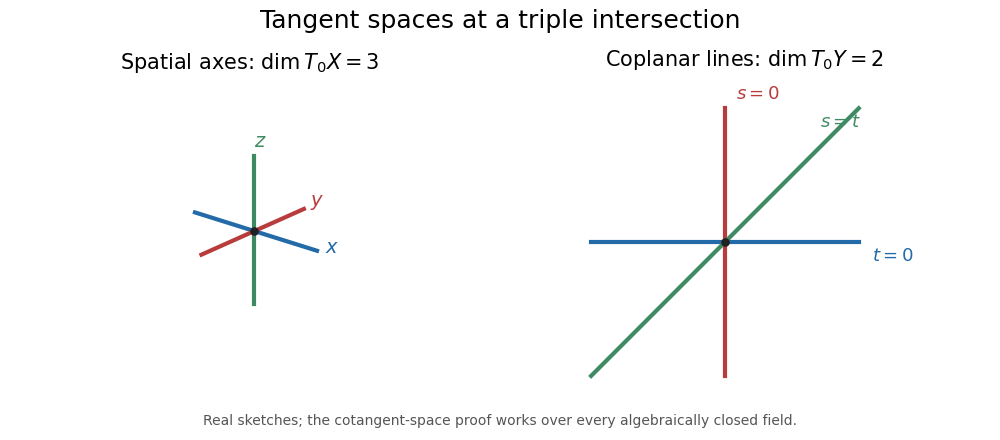
Three spatial axes and three coplanar lines have different tangent-space dimensions at their common point
. Details. 
Past exam of the mathematics course of the University of Cambridge 2008 ii Paper 3 7A iii Solution 2026-10-14
For a supercritical pitchfork bifurcation, use . The symmetric stable branches appear for as the origin becomes unstable. Replacing the cubic minus sign by plus gives a subcritical pitchfork bifurcation.
Past exam of the mathematics course of the University of Cambridge 2008 ii Paper 3 7A ii Solution 2026-10-14
Past exam of the mathematics course of the University of Cambridge 2008 ii Paper 3 7A i Solution 2026-10-14
A representative normal form for a saddle-node bifurcation of a map is . Two fixed points appear for ; near the bifurcation the positive branch is stable and the negative branch unstable.
Past exam of the mathematics course of the University of Cambridge 2008 ii Paper 2 26I c Solution 2026-10-14
Use the equation at level to express in terms of the preceding level, then substitute it into the equation at level . This yieldsThe standard eigenpair is . Each row sums to one because constant functions are harmonic for every Markov generator. This recurrence matrix need not have nonnegative entries; it encodes a harmonic equation, rather than a transition matrix. The superscript labels the level vector and is not an additional printed subpart.
Past exam of the mathematics course of the University of Cambridge 2008 ii Paper 1 7A ii Solution 2026-10-14
For general , the same energy gives . For the eigenvalues at the origin are , so it is a stable focus. At they are , so it remains a saddle equilibrium. The vector field has constant divergence : there are no periodic orbits, by the planar divergence criterion. Nor can the former homoclinic orbit survive, since strictly decreases along every nonconstant orbit except at isolated crossings of .
The stable manifold of the saddle separates escape to positive from convergence to the origin. Its two branches approach the saddle in forward time with tangent slope . The left unstable branch spirals into the origin, whereas the right unstable branch escapes. The shaded component on the origin's side of the stable manifold in the right panel is the basin of attraction. The boundary itself is excluded: its trajectories converge to the saddle. This boundary is the damped stable manifold, rather than the conservative energy contour. energy decrease prevents bounded recurrent motion, and every bounded orbit off the saddle's stable manifold consequently converges to the origin. The plotted manifold was obtained by integrating backwards from the saddle's stable eigendirection.
Past exam of the mathematics course of the University of Cambridge 2008 ii Paper 1 18H iv Solution 2026-10-14
Irreducibility modulo two implies irreducibility over by Gauss lemma for polynomials, so the Galois group embeds transitively in . The discriminant is , hence primes two and three are unramified. The factor-degree theorem says that square-free reduction with factor degrees provides an element of the Galois group with cycle lengths . The reductions already found therefore give a 4-cycle and a 3-cycle.
The group order divides 24 and is divisible by four and three, so is 12 or 24. An order-12 subgroup of has index two and must be : in its quotient every transposition has the same nontrivial image, since transpositions are conjugate and generate , making the quotient map the sign. But a 4-cycle is odd. Therefore the order is 24 andThe discriminant can also be obtained from and the resultant, giving .
Past exam of the mathematics course of the University of Cambridge 2008 ii Paper 1 18H ii Solution 2026-10-14
Direct division gives over . The cubic takes values at , so is irreducible. Finite-field extensions are cyclic Galois extensions, and the splitting field degree is the least common multiple of these factor degrees, namely three. Hence
Past exam of the mathematics course of the University of Cambridge 2008 ib Paper 4 20H ii Solution 2026-10-14
Capital and labour are nonnegative inputs. On the budget line, and . Both endpoints give zero output, whereas every interior point has positive output, so the maximum is interior. The Lagrangian with the sign convention of part (i) isIts stationarity equations are and . Dividing by the positive output gives and , hence . Together with the budget constraint this yieldsTo verify the unique global maximum, maximize the logarithm of the Cobb–Douglas production function along the budget line:Its unique stationary point is therefore the unique maximum, including comparison with the zero-output boundary points.
Writing and , the optimal output is . The Lagrange multiplier obtained from the first stationarity equation is . Direct differentiation verifies the envelope theorem identity:For clarity, the global dual-supremum premise of part (i) need not hold for every exponent pair allowed here. If , along the unrestricted Lagrangian is , which tends to infinity for every finite . Thus the verification above is by constrained stationarity and direct differentiation, and remains valid even when that stronger global Lagrangian duality representation fails.
Past exam of the mathematics course of the University of Cambridge 2008 ib Paper 3 5C b Solution 2026-10-14
Take the branch of the complex logarithm with and write . Deform the Bromwich contour into a Hankel contour about the negative real axis. The small circle at zero contributes and vanishes; the large closing arcs vanish by the exponential estimates for . On the upper lip , , while on the lower lip it is . Keeping the lip orientations in the Bromwich inversion with a square-root branch cut givesWith , the supplied Gaussian integral evaluates this as . HenceThe inverse is singular but locally integrable at zero, which is compatible with existence of its Laplace transform.
Past exam of the mathematics course of the University of Cambridge 2008 ia Paper 1 5B a Solution 2026-10-14
In suffix notation, repeated indices are summed from one to three. The Levi-Civita symbol and Kronecker delta contraction isFor distinct free index pairs this follows from the two possible matching permutations and their signs; if either pair repeats an index both sides vanish. ThereforeRecognizing the dot products proves the vector triple product identity:
There are unlisted articles, also show them or only show them.