
Past exam of the mathematics course of the University of Cambridge 2007 iii Paper 47 4 b Solution 2026-10-14
A metric dissimilarity must satisfy, for all , the four propertiesThey are nonnegativity, identity of indiscernibles, symmetry and the triangle inequality. The following two transformations of the simple matching coefficient behave differently at the identity.
Past exam of the mathematics course of the University of Cambridge 2007 iii Paper 32 1 iii Solution 2026-10-14
Euclidean Lipschitz continuity does not imply Carnot-Carathéodory Lipschitz continuity. In the exponential coordinates above take the vertical path . It is Euclidean Lipschitz continuous, butIndeed left invariance reduces to the central increment, graded dilation gives the square-root factor, and reversal changes the sign without changing the distance.
One can also see the scale directly. A horizontal curve starting at the identity satisfies . If it ends on the vertical axis, its planar projection is a closed loop andFor a projection of length starting at zero, , so . Thus reaching a central displacement requires length at least , while a square loop with the appropriate signed area gives length at most . In particular is unbounded as . Vertical displacement records area, which scales quadratically with horizontal length.
Past exam of the mathematics course of the University of Cambridge 2007 iii Paper 32 1 ii Solution 2026-10-14
For with basis , the step-two Lie algebra has basis and its last element is central. WriteIts first level is and its second level isThe step-two multiplication givesConsequently the mapis an isomorphism onto the real Heisenberg group. The shift by converts exponential coordinates into the matrix coordinates used for that group. In exponential coordinates the left-invariant horizontal vector fields areTaking orthonormal gives exactly the Carnot-Carathéodory distance inherited from .
Past exam of the mathematics course of the University of Cambridge 2007 iii Paper 32 1 i Solution 2026-10-14
In the truncated tensor algebra, let be the linear span of all iterated Lie brackets of elements of of length at most , with bracket . Brackets of length greater than vanish. The free step-N nilpotent Lie group isThe exponential and logarithm are the finite seriesIts multiplication is the tensor multiplication above, its identity is , and its inverse isThe truncated Baker--Campbell--Hausdorff formula shows that this multiplication stays in the exponential of the Lie algebra. This is the connected simply connected Lie group of the free step- nilpotent Lie algebra, rather than a discrete free nilpotent group.
Give the first layer its usual Euclidean norm. An absolutely continuous curve in is horizontal iffor an absolutely continuous control in . In the truncated tensor algebra this equation is , truncated at degree . Its horizontal length is . The Carnot-Carathéodory distance isThe first-layer Lie brackets span the full Lie algebra, so horizontal curves reach every endpoint. Thus this infimum is finite; it is a left-invariant distance inducing the usual manifold topology. Dilations give for . Equivalently is the least length of a bounded variation control whose step- path signature is .
For set . A weak geometric p-rough path is a continuous path , usually based at , withIts increments obey . Equivalently their degree- tensor components have finite -variation and satisfy the path signature algebraic constraints. This is a group-valued definition; being a limit of smooth path signatures in the same -variation topology is the stronger definition of a geometric p-rough path.
Past exam of the mathematics course of the University of Cambridge 2007 iii Paper 29 6 c Solution 2026-10-14
For positive integer , the equivalence is the bounded invariant norm characterization of cusp forms. The three conditions below work together: meromorphicity and the bound remove interior poles; the transformation law produces a periodic local function at every modular cusp; the same bound makes that function tend to zero at the modular cusp. Conversely a cusp form has exponentially decaying Fourier expansions of a modular form, and finitely many compact core regions control its invariant norm everywhere. These implications are proved under the corresponding labelled items.
Without a positive-weight convention, weight zero is a genuine exception. The function satisfies all three printed conditions at for every congruence subgroup, but is not a cusp form. Indeed a weight-zero cusp form would descend to a holomorphic function on the compact curve and hence be constant, and vanishing at a modular cusp would make it zero. Thus the literal unrestricted claim needs the qualification .
If negative integer weights are included, both sides contain only the zero function. To check the bounded side, each modular cusp translate has at most power growth in , hence at most a power of . For a negative Laurent coefficient of order , Cauchy's coefficient estimate bounds its absolute value by , so there is no negative coefficient and every modular cusp is holomorphic. If such a nonzero negative-weight form existed, the product of its slash translates over would be a nonzero holomorphic level-one modular form of negative weight. Right multiplication permutes the translates, and all modular cusp factors are bounded, so that product really is a level-one form. Its existence contradicts the valence formula. This also excludes negative-weight modular cusp forms. The nonzero counterexample is specifically weight zero.
Past exam of the mathematics course of the University of Cambridge 2007 iii Paper 2 2 b Solution 2026-10-14
Use the comultiplication , , of the quantum enveloping algebra of sl2. Choose a basis for with , , and . Choose a basis for withand all terminal raising or lowering actions zero. This is one of the corrected bases from part (a).
In the tensor product of modules, putThe vector is killed by and has eigenvalue . Direct application of the comultiplication givesand the string formula gives , , . Also . Thus is a submodule isomorphic to .
The other highest vector and its lowered partner areIndeed , , , and . Therefore is a submodule isomorphic to .
To verify that this is a direct sum, in the weight space the determinant of the coefficients of is . In the weight space, the coefficient determinant of is . The extreme weight spaces are spanned by . Hence these six vectors form a basis of the entire tensor product of modules. Each summand is a simple module: projecting a nonzero vector onto one of its distinct weight spaces and applying the nonzero raising and lowering coefficients recovers its entire basis. Consequently
Past exam of the mathematics course of the University of Cambridge 2007 ii Paper 2 30A i Solution 2026-10-14
Use the Fourier convention , with inverse . For a tempered distribution , define its Fourier transform by duality:The Fourier transform maps the Schwartz space continuously onto itself, making the right side a continuous linear functional there. The use of the same negative exponential in the test-function transform is consistent with bilinear distributional pairing; other unitary or sign conventions change the normalization accordingly.
Past exam of the mathematics course of the University of Cambridge 2007 ib Paper 1 14D ii Solution 2026-10-14
The interval indicator has transformwith continuous value at . By the convolution theorem, has transform . Fourier inversion therefore expresses the requested integral asFor , , so . Symmetry gives the same expression with for . For , splitting the integral at givesConsequently the value for every real isThe two expressions agree at . This is the exponential kernel convolved with an interval indicator. The spectral integral is absolutely convergent: its apparent singularity at zero is removable, and the tail decays as .
Past exam of the mathematics course of the University of Cambridge 2007 ia Paper 2 7B ii Solution 2026-10-14
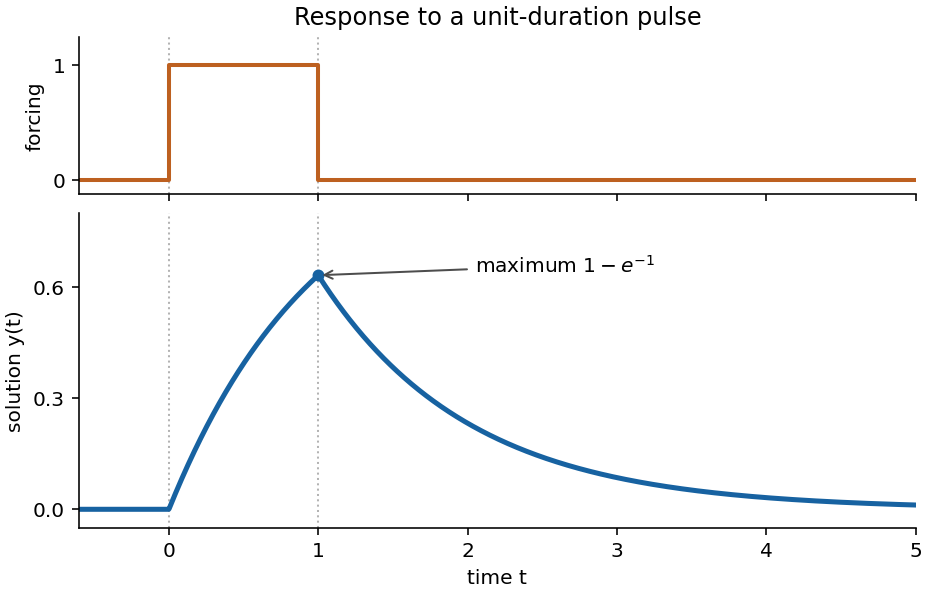
The forcing is a unit pulse on . For , the homogeneous equation and continuity with give . On , integration with gives . At the end of the pulse its value is , and the subsequent homogeneous decay must start at that value. ThusEquivalently it is the difference of two translated step responses, . The solution is continuous, rises concavely to its maximum at , and then decays exponentially to zero. Its derivative has jumps at the pulse edges; those are permitted because the right-hand side has step discontinuities.

Past exam of the mathematics course of the University of Cambridge 2007 ia Paper 1 5B ii Solution 2026-10-14
The sphere-plane intersection is governed by the orthogonal projection of the sphere's centre onto the plane. Since has unit length, let , the signed distance from to the plane along . The following parts determine the centre and radius and retain this sign; the radii alone cannot distinguish the two possible sides of the oriented plane.
Past exam of the mathematics course of the University of Cambridge 2006 iii Paper 86 3 c Solution 2026-10-14
First resolve the orientation sign in quadrant harmonic spectral inversion. The printed spectral definitions traverse the physical boundary clockwise, whereas both reconstruction rays run outward from zero. Integrating first in gives the kernel . The resulting clockwise Cauchy integral is the negative of the desired holomorphic function. Thus, with exactly the spectral definitions used above, the consistent reconstruction isThe printed plus sign would reconstruct . For a concrete nonzero example, is real, harmonic, smooth on the closed quadrant and decays along both axes. With , it has and . The printed orientation returns the negative of this derivative, so the issue persists even under the stated corner condition.
Let . In the expressions from the preceding part, the coefficient of on the imaginary ray is , and the coefficient on the real ray is . For each of the three allowed sums, . The unknown part is therefore proportional toIndeed, close the first spectral quadrant. For with , , so the large-arc contribution vanishes for bounded . The Cauchy integral theorem proves the equality and eliminates the single unknown function.
Substituting only the known pieces leavesThis already determines the answer from alone. Evaluating the elementary ray kernels gives the more direct rational-angle oblique derivative problem on a quadrant formulaNo denominator vanishes for an interior point of the first quadrant.
There is also a necessary corner compatibility for collinear oblique derivative data. When , the two prescribed derivative directions are opposites, so a continuous corner gradient requires . Together with the stipulated equality, this forces in that case. Existence was assumed, so admissible data must satisfy this additional consequence. Smoothness at the corner and decay at infinity also exclude the homogeneous corner ambiguity in a quadrant Laplace problem; no extra singular or growing term is permitted in the boxed reconstruction.
Past exam of the mathematics course of the University of Cambridge 2006 iii Paper 86 3 b Solution 2026-10-14
Since is harmonic, is holomorphic and the one-form is closed. Closing the physical quadrant at infinity gives the global relationIn this third spectral quadrant the exponential decays on both boundary axes. Set . The relation becomes
All four boundary functions are real. Consequently their transforms obeyand the same identities for . Complex conjugation of the global relation therefore gives its upper-left consequenceIntroduce just one unknown function,It is holomorphic in the upper half-plane. Under the transform-admissible decay assumptions, , so it is bounded there.
For on the positive real ray, use both consequences of the global relation at . Adding them removes and givesFor on the positive imaginary ray, use the upper-left relation and . The resulting single-function spectral elimination for a rational-angle quadrant isBoundary limits from the appropriate transform domains are understood. Every remaining unknown boundary derivative is contained in the one bounded upper-half-plane function .
Past exam of the mathematics course of the University of Cambridge 2006 iii Paper 86 3 a Solution 2026-10-14
Let , . Inverting the two orthogonal derivative systems gives, on the vertical axis,and, on the horizontal axis,Using the Wirtinger derivative , these become
Define the appropriate boundary transforms byThe first pair is holomorphic for ; the second pair consists of Half-range Fourier transforms, holomorphic for . Parametrizing the vertical boundary by gives , which must be retained. Substitution yields the quarter-plane oblique boundary spectral functions:Their signs follow from the stated clockwise boundary orientations: upward on the left and inward on the bottom.
There are unlisted articles, also show them or only show them.