
Past exam of the mathematics course of the University of Cambridge 2006 iii Paper 72 2 ii Solution 2026-10-14
For fixed cosmological density parameters, the redshift drift has the form . Multiplying the Hubble constant changes the vertical scale of all three sketches but leaves their zeros unchanged. Thus the drift-zero redshift is independent of at fixed density fractions. Every model has the trivial zero; only the specified mixed model has a further positive zero, . If instead physical matter and vacuum densities are held fixed while changes, their density fractions change too, so that is a different family of models.
Past exam of the mathematics course of the University of Cambridge 2006 iii Paper 67 6 c Solution 2026-10-14
We first derive the recurrence needed for the partition of unity. Denote an order- partition-normalized spline by . For , set , so . The elementary product identities for divided differences areThey follow from the Leibniz rule for divided differences because the divided differences of the linear factor vanish above first order. Use the first identity on and the second on . Subtracting cancels the common middle-block term. The defining divided-difference recurrence for then givesThis is the Cox-de Boor recurrence, derived here from the specified normalization rather than assumed as a partition theorem.
Extend the distinct knot sequence in both directions to a strictly increasing sequence tending to . For order one, , so the full sum equals one. All higher-order splines are supported on , making the following sums locally finite. Reindexing the second term of the recurrence yieldsInduction proves that the full sum is one for every order. The same recurrence gives nonnegativity: each coefficient is nonnegative wherever its associated lower-order spline is nonzero. Removing splines therefore gives the subpartition of unity for B-splines on the whole line.
For , a spline with index ends no later than , and one with starts no earlier than . They all vanish, leaving exactly the indices . For the splines are continuous and vanish at their support endpoints, so the equality extends to the closed basic knot interval:If order one is allowed, the standard half-open indicator convention gives equality on ; to include its final endpoint literally, assign the left-limit value there. This harmless endpoint convention does not change integrals or norms. For the continuous splines of order at least two no such convention is necessary.
Past exam of the mathematics course of the University of Cambridge 2006 iii Paper 62 2 c Solution 2026-10-14
With spatial flatness, the scalar as the only source, and , the Friedmann equation isThe scalar equation gives , which is the energy-conservation equation . Differentiating the Friedmann equation on the expanding branch yields , so . Combining this with gives the Friedmann acceleration equation:Thus cosmic inflation occurs exactly when in this canonical scalar model. Equivalently , or the first Hubble slow-roll parameter is smaller than one.
Past exam of the mathematics course of the University of Cambridge 2006 iii Paper 50 2 iii Solution 2026-10-14
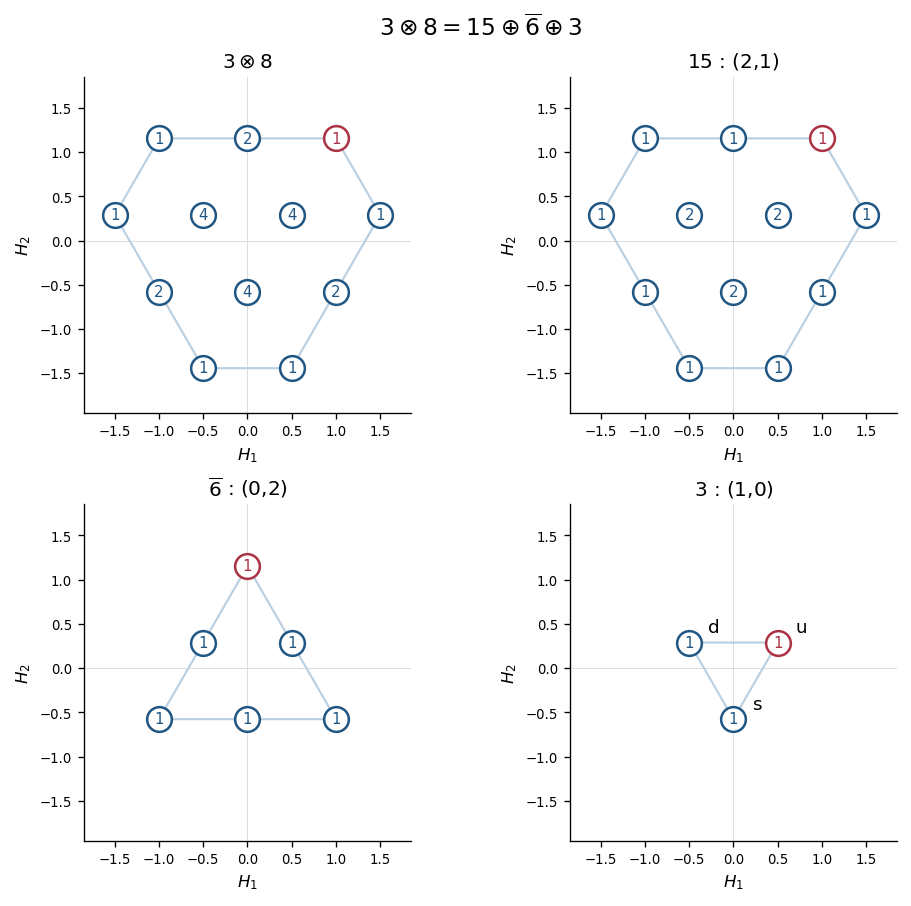
Construct the tensor-product weight diagram by placing one octet diagram at each triplet representation weight and adding multiplicities where the shifted diagrams overlap. Its highest weight isso remove the diagram by highest-weight character subtraction. Its unequal-sided hexagon has nine boundary representation weights of multiplicity one and three interior representation weights of multiplicity two, giving dimension .
To see the remainder explicitly, measure diagram coordinates by . After subtracting this , the residual representation weights areThe next highest weight is , with Dynkin labels . The conjugate sextet is a triangular weight diagram containing each of these six representation weights once. Subtracting it leaves once each in the integer coordinates: precisely the triplet. The SU(3) triplet-octet decomposition is thereforeThe dimensions add to , and the figure below verifies the equality at every representation weight, including overlapping interior representation weights.

Past exam of the mathematics course of the University of Cambridge 2006 iii Paper 47 5 a Solution 2026-10-14
For the Metropolis–Hastings algorithm, start at a state with positive target density, propose from , and generate an independent uniform draw. Accept the proposal with probabilityOn rejection retain , including repeated states in the chain; removing repeats would generally change its stationary law. The accepted-flow density satisfieswhich is symmetric in its two states. This proves detailed balance and hence invariance of the target distribution, including the holding probabilities on the diagonal. Unknown common normalization constants cancel in the ratio. Invariance alone does not establish convergence from arbitrary initial states. Choosing proposals that yield a positive Harris recurrent Markov chain with aperiodicity supplies the usual convergence guarantee, and the resulting sample is dependent. Use burn-in and account for autocorrelation when assessing Monte Carlo precision.
Past exam of the mathematics course of the University of Cambridge 2006 iii Paper 33 5 a Solution 2026-10-14
Use base-two logarithms, so the Von Neumann entropy is , with . The quantum mutual information is ; this is the quantity denoted by in the question, using the given joint state.
Strong subadditivity of Von Neumann entropy states that for every tripartite density operator,Equivalently the conditional quantum mutual information is nonnegative. We apply this property to the original state or to a dilation of the relevant quantum channel.
Past exam of the mathematics course of the University of Cambridge 2006 iii Paper 3 3 b Solution 2026-10-14
For the replacement condition, interpret “every element has order ” in the usual exponent- sense: every nonidentity element has order , while the identity has order one. ConsiderEvery nonzero element has order . It is infinite, but no finite collection generates it: the supports of finitely many group generators cover only finitely many coordinates, so a unit vector outside those coordinates is missing from their generated subgroup. Also is abelian, and one coordinate subgroup is a proper nontrivial normal subgroup. ThereforeThe stronger restriction on all proper subgroups, rather than just individual element orders, is what forces the conclusions in parts (i) and (ii).
Past exam of the mathematics course of the University of Cambridge 2006 ii Paper 2 15D b Solution 2026-10-14
The two scalings give . Flatness and the Friedmann equation give , with . ThusOn the expanding branch, putting the Big Bang at zero, separation givesIts positive square root is the required solution. If , its early behaviour is , as for radiation. The values and giveFor there is only the string component, with linear expansion and no radiation era.
Past exam of the mathematics course of the University of Cambridge 2006 ia Paper 1 2A ii Solution 2026-10-14
In spherical coordinates, and , so the elliptic paraboloid has equationAway from the origin this is , with . The undivided equation also includes the origin, where angular coordinates are not unique.
Past exam of the mathematics course of the University of Cambridge 2006 ia Paper 1 2A i Solution 2026-10-14
Past exam of the mathematics course of the University of Cambridge 2005 iii Paper 85 6 c Solution 2026-10-14
For the contrapositive of , suppose . ConsiderLet act by multiplication and by formal differentiation. Differentiation preserves the defining ideal, since in characteristic . The relations hold before quotienting and hence hold on . Its basis consists of the monomials with , so . This is the explicit finite-dimensional module for the Weyl algebra in positive characteristic.
Therefore condition (b) fails in positive characteristic and implies characteristic zero. Combining this with the preceding two implications proves . The same representation also has nonzero proper kernel, since the infinite-dimensional Weyl algebra cannot inject into a finite-dimensional endomorphism algebra, confirming its failure of simplicity in positive characteristic.
Past exam of the mathematics course of the University of Cambridge 2005 iii Paper 85 6 b Solution 2026-10-14
This part proves . If were a finite-dimensional unital module, its action would give a homomorphismThe kernel is a two-sided ideal and is proper because the identity acts as the identity on . A simple ring therefore makes the homomorphism injective. This is impossible: has the infinitely many linearly independent ordered monomials established in part (a), whereas the endomorphism algebra has dimension . Thus simplicity excludes every nonzero finite-dimensional module.
There is also a direct characteristic-zero check: the relation acts as a matrix identity. Taking its trace gives in . In characteristic zero this forces . This agrees with the Weyl algebra has no nonzero finite-dimensional modules criterion, but the injectivity argument proves the requested implication without presupposing characteristic zero.
Past exam of the mathematics course of the University of Cambridge 2005 iii Paper 85 6 a Solution 2026-10-14
This part proves . Write the Weyl algebra generators as , with and the other generator commutators zero. The ordered monomials form a basis over any field: one may construct the algebra by successively adjoining the commuting derivations to , with multiplication , obtaining unique ordered forms. This also makes infinite-dimensional for .
Assume and let be a nonzero two-sided ideal. Choose a nonzero element , and a nonzero term of maximal total degree, say . The relations giveApply to . Every lower-degree term vanishes. A term of the same degree survives only if all its exponents dominate , which forces equality. Thus the resulting element of isThe factorials are nonzero in characteristic zero. This is a nonzero scalar, so and . Therefore is simple in characteristic zero. This scalar extraction by iterated Weyl commutators supplies the full simplicity proof.
Past exam of the mathematics course of the University of Cambridge 2005 iii Paper 85 4 c Solution 2026-10-14
Maximal right ideals of correspond to maximal right ideals of , all of which contain . Their intersection in the quotient is zero. Hence is a right Artinian ring with zero Jacobson radical, and part (a) makes it semisimple.
Part (b) gives the finite radical filtrationEach factor is annihilated by , so it is a right module over . Every module over a semisimple ring is semisimple: a free module is a direct sum of simple summands of copies of the regular module, and a quotient of a semisimple module is again semisimple, because the images of its simple summands are either zero or simple and span the quotient. A maximal independent family of these simple images spans: any simple image not contained in the sum intersects it trivially and could be added. Each factor is also Artinian, as a subquotient of . A semisimple Artinian module has only finitely many simple summands, since an infinite direct sum would give a descending chain by successively deleting summands. Consequently every factor has finite module length.
Concatenating composition series of these finitely many factors makes a module of finite module length. Such a module satisfies both chain conditions, since every strict change consumes a positive amount of length. Therefore is right Noetherian. This is the Hopkins-Levitzki theorem, obtained from the two preceding results rather than invoked in their proofs.
Past exam of the mathematics course of the University of Cambridge 2005 iii Paper 85 4 b Solution 2026-10-14
Suppose . Among the right ideals such that , choose a minimal one; the set is nonempty since . The right ideal lies in , and , so minimality forces . Choose with . Then , and , so the same minimality gives .
Since and , its generator satisfies for an element . Thus . The unit criterion for the Jacobson radical makes invertible, implying , contrary to . Therefore , andThe minimal-right-ideal proof of radical nilpotence is important here: one cannot apply the finite-generator form of Nakayama lemma directly to before proving it finitely generated. We made a suitable auxiliary right ideal cyclic before using the unit argument.
Past exam of the mathematics course of the University of Cambridge 2005 iii Paper 85 4 a Solution 2026-10-14
Use the descending chain condition on the finite intersections of maximal right ideals. It gives a minimal such intersection . Intersecting with any other maximal right ideal cannot decrease it, by minimality. Thus lies in every maximal right ideal, and . When , the diagonal mapis injective, and each summand on the right is a simple module.
For completeness, a submodule of a finite direct sum of simple modules is semisimple. Induct on the number of summands. For with simple, is either or . In the first case projection into identifies with a submodule of , so induction applies. In the second case subtracting the coordinate shows , and induction again applies. This also shows finite module length. Apply it to the image of the diagonal map to obtainThis is the semisimplicity of a right Artinian ring with zero radical. It does not assume right Noetherianity in order to prove it.
Past exam of the mathematics course of the University of Cambridge 2005 iii Paper 82 2 a Solution 2026-10-14
Assume the coefficients are sufficiently differentiable in the region considered, with no material discontinuity or caustic at the front. Let describe arrival time, the slowness vector, and the unit elastic wave propagation normal. For any field, its jump is the value immediately behind the front minus that immediately ahead. If the first nonzero jump occurs in the kth time derivative, , writeA smooth background may be added without changing these leading jumps. Since , differentiation expresses spatial jumps in terms of and time-derivative jumps. The restriction lets displacement field and its first time derivative remain continuous and avoids an imposed impulsive source at the front.
Insert this local expansion in . The coefficient of isFor isotropic elasticity the slowness acoustic matrix is . Its longitudinal eigenvalue is . The P branch therefore gives the eikonal equation and polarizationThe next coefficient, , isThe matrix on the left is symmetric and annihilates . Project onto to obtain its solvability condition. Put . The two projected terms can be evaluated without dropping gradients of mass density or moduli:These identities use , hence , and . Their curvature terms cancel, leavingMultiplying by proves the requested P-wavefront discontinuity transport law,The wave amplitude here is real for a real jump; a complex wave amplitude uses the corresponding modulus-squared law. An elastic ray follows , with arclength and . If is the infinitesimal cross-sectional area of a neighboring ray tube, . Thus is constant along that tube, the ray-tube conservation for a P-wave jump. This defines the geometrical spreading and shows why the wave amplitude changes with material properties even before attenuation is considered. At a caustic the simple ray-tube wave amplitude is singular and a uniform local description is needed.
There are unlisted articles, also show them or only show them.