
Original public paper: Physical PDF pages 826–828. All three questions and all alternatives in question 2 are answered. Optical amplitudes and quadratures use the normalization printed in the paper; factors of two depend on that convention.
Original paper: 22 April 2015, physical PDF pages 751–754.
Original paper: 23 April 2014, physical PDF pages 678–680.
At the stated threshold the idealized system admits a self-sustaining neutron mode. Production and losses balance without the external source. A nonzero continuing source then makes the assumed linear, time-independent response singular rather than selecting a finite equilibrium amplitude.
An apparent infinite steady flux is therefore a failure of that steady linear approximation at the threshold, not a physical prediction that an actual neutron population instantly becomes infinite. Time dependence and feedback must be considered to discuss subsequent behaviour.
Write and apply the stated constant-coefficient boundary value problem. A constant particular solution is . Regularity at the origin removes , soThe outer boundary condition gives , henceAt , use the limit rather than substitute into the apparent . The result satisfies both the differential equation and provided . This is the ideal extrapolated-boundary model specified in the question; a separately resolved outer transport layer would need its own matching conditions.
This part is a radial differential-equation identity. Expanding the spherical derivative givesPut . Since , multiplication of the equation by yields . Its real solution isFor a regular field at the centre, the cosine-over-radius contribution must vanish. The sine-over-radius term is regular because as .
With no delayed neutrons, set and omit the precursor equation. The source-free model reduces to , givingThe delayed-neutron model's dominant e-folding time is about times larger. This comparison illustrates why a small delayed neutron fraction strongly alters the kinetics. It is a comparison of the supplied idealized models at the same imposed positive reactivity, not a control prescription or a claim that every transient has the same timescale.
The precursor exponential from part (e) has inverse period . HenceThis is approximately shorter than the exact dominant period, so it slightly overestimates growth for these stipulated constants. Neglecting the small contribution is more accurate here than replacing the complete frequency dependence by its tangent at the origin.
Differentiating the supplied relation givesThus the tangent approximation is andIt is about longer than and therefore predicts slower growth. For this positive step it is not conservative as a growth-rate estimate. The local expansion needs ; here the actual ratio is approximately , so its error is appreciable.
The idealized isotope mass is , about . Both the alpha particle and daughter recoil energy are recovered in the stipulated heat balance. Thus the recovered energy per transformation isand the nuclear decay constant isWith , thermal power is . ConsequentlyThe conversion of to is essential. This is an isotope-only energy-accounting result under the paper's prescribed branch and perfect heat-recovery assumptions; it is not the mass or design of a complete generator.
After three half-lives, . Therefore the minimum initial thermal power isEquality gives the stated terminal power exactly in the idealized exponential decay model. The associated duration is days. No thermal-to-electrical efficiency is needed because both specified powers are thermal.
The approximate population peaks about after flux removal. Differentiate the preceding difference of exponentials. The stationary condition isso for distinct nuclear decay constants,Using hours consistently,and thereforeThe approximate population is positive for , starts at zero, tends back to zero and has only this one stationary point, so it is a maximum.
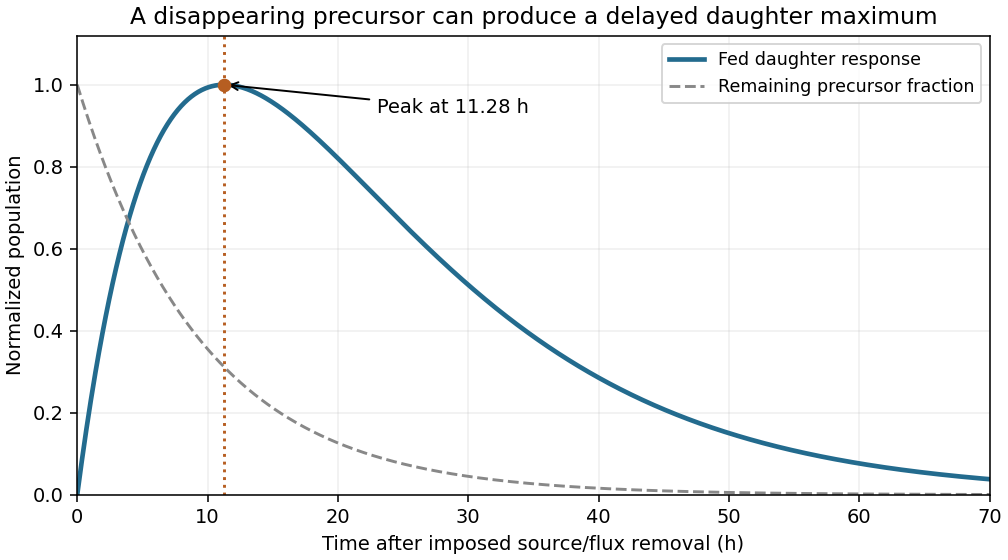

The delayed maximum corresponds to a delayed maximum in the magnitude of the absorber's negative contribution to reactor reactivity, within the fixed model. It does not determine a permissible restart time, which would require information absent here. The estimate also inherits the high-flux initial-population approximation of part (ii); the exact solution can peak at a different time when that approximation is unsuitable.
The general solution contains both decay of the initial xenon and continued feeding from the initial iodine. Use for removal of the flux, and retain as the pre-shutdown value in the initial conditions. Neglect post-shutdown nuclear fission and neutron capture. ThenMultiply this first-order linear differential equation by the integrating factor and integrate:With the preceding steady initial conditions, and , this isIf , the coefficient of the first exponential term is small compared with the coefficients of the feeding term, yieldingThis approximation neglects the finite initial xenon population and is consequently not a small relative error at , where its value is zero while the exact is positive. The exact expression supplies the initial value and satisfies . For equal nuclear decay constants, the continuous limit of the exact solution is .
Let be the constant precursor production rate per volume. Here is the precursor yield per nuclear fission, and and are number densities. At a steady state,For fixed homogeneous coefficients and spatial shape, the reactivity contribution of an added absorption coefficient is . Thus the model givesWhen capture removal dominates xenon radioactive decay, , and henceThe limit is independent of the xenon neutron absorption cross section: at high neutron flux, nearly every xenon atom supplied by the precursor ultimately consumes a neutron. The assumptions include constant pre-shutdown neutron flux, sufficient time for precursor and xenon equilibrium, the supplied single-precursor model with no direct xenon fission source, and fixed parameters for translating absorption into reactor reactivity.
The average moderator temperature is . First the mean coolant temperature in the lumped thermal model isAt a steady state, the same thermal power crosses both thermal resistances. If , thenThusIn particular at the specified state.
The coolant mass flow rate is approximately . All thermal power leaves in the steady coolant energy rise:With the stated constant specific heat capacity,The difference equals a difference. Thermal power is used directly; no electrical conversion efficiency enters.
Substitute the separated solution into the one-group neutron diffusion equation. The radial and axial Laplacian contributions are and . A nonzero solution therefore requiresThe left side is the geometric buckling; the right side is fixed by the stipulated homogeneous material. Their equality is the model's nuclear criticality condition, expressing the balance of production, absorption and leakage. Both sides have inverse-length-squared units.
The fundamental nonnegative mode is . Put the origin at the centre of the cylinder, so . Neglecting extrapolation imposes zero neutron flux at and . WriteFor an axisymmetric field, separation of variables in cylindrical coordinates givesChoose the axial separation constant so . Midplane symmetry and the lowest positive axial mode give , withThe radial equation isThe solution regular on the axis is the zero-order Bessel function of the first kind, ; the independent second-kind solution is singular there. The first radial zero gives . Higher zeros would introduce sign changes and do not describe the fundamental nonnegative neutron flux. Normalize by the central value, using :The printed is a rounded Bessel function zero, rather than an exact root.
Define , and as the solid-vapor, solid-liquid and liquid-vapor interfacial free energies per actual area. For the corresponding planar material, Young's contact-angle equation isConsider advancing the macroscopic liquid footprint over projected area , while retaining the specified wetting only to each sphere's equator. The newly wetted upper hemispheres have actual area . The gaps occupy projected area , across which a liquid-vapor interface remains instead of solid-liquid contact.
The microscopic free-energy change, apart from the outer macroscopic droplet surface, isEquating this with , the macroscopic wetting contribution, yieldsThe factor comes from the curved hemisphere area; the negative gap term is the trapped liquid-vapor interface. This combines Wenzel roughness on the wetted solid fraction with Cassie-type air gaps. It differs from both homogeneous Wenzel wetting and a Cassie formula that treats the solid contacts as flat.
For and , this gives and . The hybrid state is less wettable than the fully penetrated hemispherical model, but still not hydrophobic. The result is conditional on the assumed equatorial meniscus and retained air: pinning or metastability may be required, and allowing further penetration can change the equilibrium geometry.
Let be projected area. Close-packed circular footprints cover and the exposed flat substrate covers . A hemisphere's curved area is twice its circular footprint, so the actual wetted solid area isThe Wenzel roughness factor is therefore , not or .
Using the Wenzel wetting relation,The nanostructure makes this surface more wettable, because planar PMMA already has . Under complete Wenzel wetting, roughening amplifies the underlying hydrophilic character; it does not turn this material hydrophobic.
The calculation assumes identical chemistry on spheres and substrate, complete liquid penetration, ideal hemispheres, a macroscopic contact angle and negligible pinning/line-tension effects. Actual dried particles may have different contact geometry, deformation, contamination or trapped air. A hydrophobic coating with planar angle above would make roughness increase the angle instead. Designing a texture that retains air in a Cassie–Baxter state is another route, but its stability against liquid penetration must be checked.
There are unlisted articles, also show them or only show them.