
One mole of CF consumes one mole of electrons, so the equilibrium electrical work givesInterpreting the measured OCV as assumes an equilibrated cell and the appropriate standard-state activities; pure solid reactants and products make the ideal activity correction simple. A nonequilibrium or composition-dependent OCV would instead determine the corresponding reaction free energy under those conditions.
The temperature coefficient isThe net reaction involves condensed phases and no gas, so one expects a more modest entropy-driven voltage change than for a reaction creating or consuming substantial gas. However, it is not exactly zero, and its magnitude or sign cannot be calculated from the single OCV value without entropy or temperature-dependent data. This should be separated from potentially strong temperature effects on loaded-cell kinetics and resistance.
On discharge, lithium is oxidized at the negative electrode:At the positive electrode, carbon monofluoride is reduced:The net conversion reaction is thereforeFor general , replace Li, lithium ions, electrons and LiF by equivalents per carbon atom. The carbon–fluorine bonds are consumed in forming different solid phases, rather than lithium simply intercalating reversibly into an unchanged host.
The hydrogen fuel cell is the more likely high-power choice at low temperature, for otherwise comparable electrodes, oxidant supply and device design. Similar equilibrium oxidation potentials imply similar thermodynamic voltage opportunities; they do not imply similar current densities.
Hydrogen oxidation on an appropriate catalyst is relatively facile. Ammonia oxidation requires multiple bond-breaking and nitrogen-coupling steps; adsorbed intermediates can occupy catalytic sites and inhibit continued reaction. A larger anodic activation overpotential and slower turnover reduce the useful current and operating voltage of a low-temperature ammonia cell.
Since areal power is , a cell retaining substantial voltage at a larger current density can deliver more power even when its equilibrium voltage is similar. Ammonia's favorable storage characteristics are a separate system-level consideration; a comparison of power cannot be made by counting the electrons per fuel molecule alone. This is a kinetic expectation, not a universal numerical ranking independent of catalysts, temperature and transport.
At fixed discharge current, delivered voltage can be represented aswhere is discharged charge and the terms denote distinct physical losses. A typical trace has an initial drop from open circuit, an approximately flat useful region and a final decline toward cutoff. Its exact shape depends on the cell chemistry and current; not every battery has an equally flat plateau.
Four distinguishable contributions are:
- Ohmic polarization: electronic, ionic and contact resistance cause a rapid drop on applying current. This need not wait for a concentration gradient to develop.
- Activation overpotential: finite electrode-reaction kinetics require a departure from equilibrium to sustain charge transfer. It is important when the exchange current is small.
- Concentration overpotential: electrolyte transport and diffusion within active particles can deplete reactants or accumulate products near reaction sites. These losses often grow near the end of discharge or at high current.
- Phase-transformation polarization: nucleation and growth of a new phase can require extra driving force, produce an initial voltage dip or cause hysteresis. It is especially relevant to conversion and two-phase electrodes, rather than a universal independent loss in every chemistry.
Terminology sometimes groups solid-state transport or phase-change effects differently. The important distinction is the mechanism, not counting the same diffusion loss under two names. A falling equilibrium voltage as composition changes is also not, by itself, polarization.
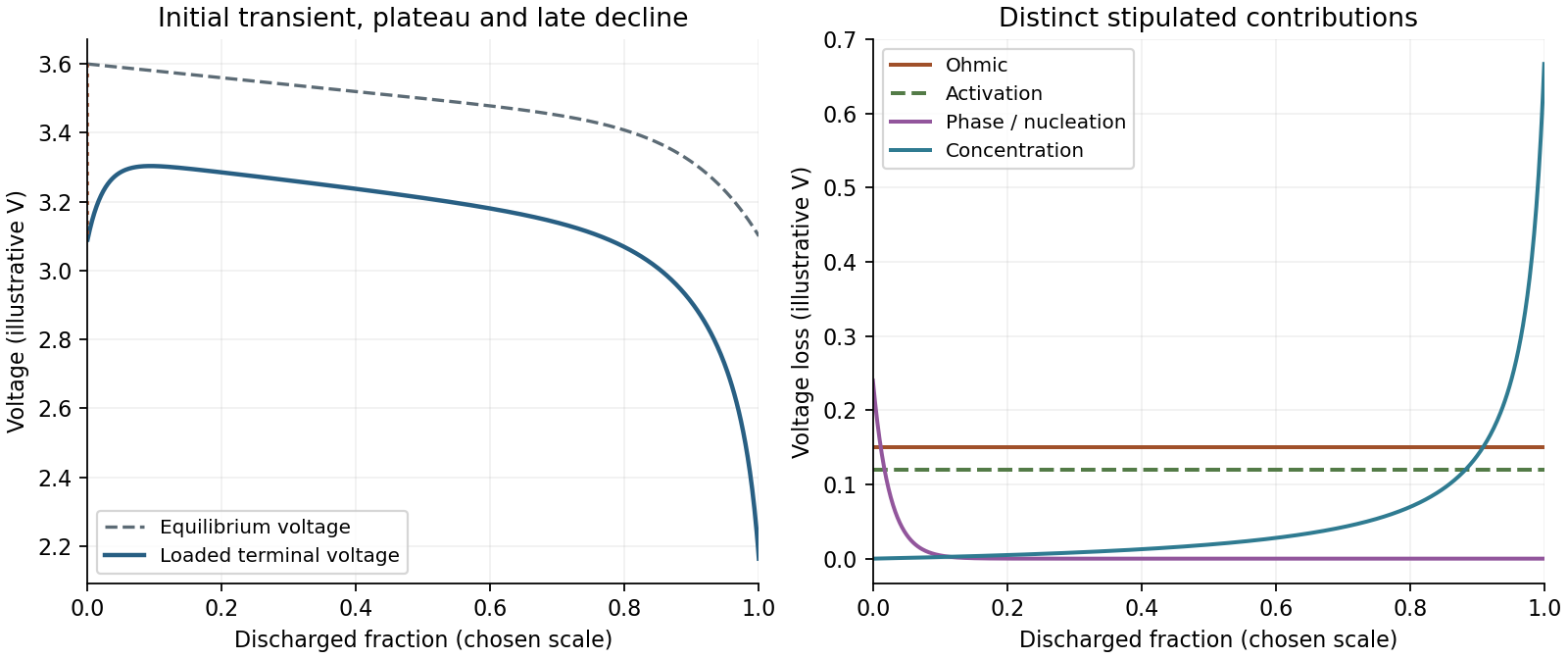
An illustrative discharge voltage combines equilibrium changes and distinct losses
. Original stipulated model, not battery measurements. The loss components show an instantaneous resistive contribution, activation loss, a transient nucleation-related contribution and increasing late-discharge transport loss. The equilibrium curve is plotted separately. Details.The equilibrium written in the reduction direction isWith pure-solid activities set to one, the Nernst equation givesMaintaining sulfate activity fixes the reference potential; protonation to bisulfate in strongly acidic filling solutions must be included in specifying that activity.
Calibrate against, or use a reliable tabulated potential relative to, the standard hydrogen electrode for the same filling solution and temperature. With the voltmeter sign specified above and a corrected or negligible junction potential,There is no universal numerical offset for every silver reference: silver/silver-chloride, silver/silver-sulfate and different sulfate filling solutions define different potentials.
Use a silver wire or strip in contact with excess solid silver sulfate, immersed in a sulfate filling solution of known, stable activity. A porous frit connects the filling solution ionically to the sample while limiting bulk mixing. The reference housing should maintain the salt/electrolyte composition rather than letting the sample directly determine it.
Connect the unknown working electrode to the positive input and the silver reference to the negative input of a high-input-impedance voltmeter. The frit or sulfate-compatible salt bridge completes the ionic circuit. At negligible measuring current,A stable, small junction contribution is desirable. The reference electrode should not carry the counterelectrode current in a driven experiment: a separate counterelectrode is used when current is passed.
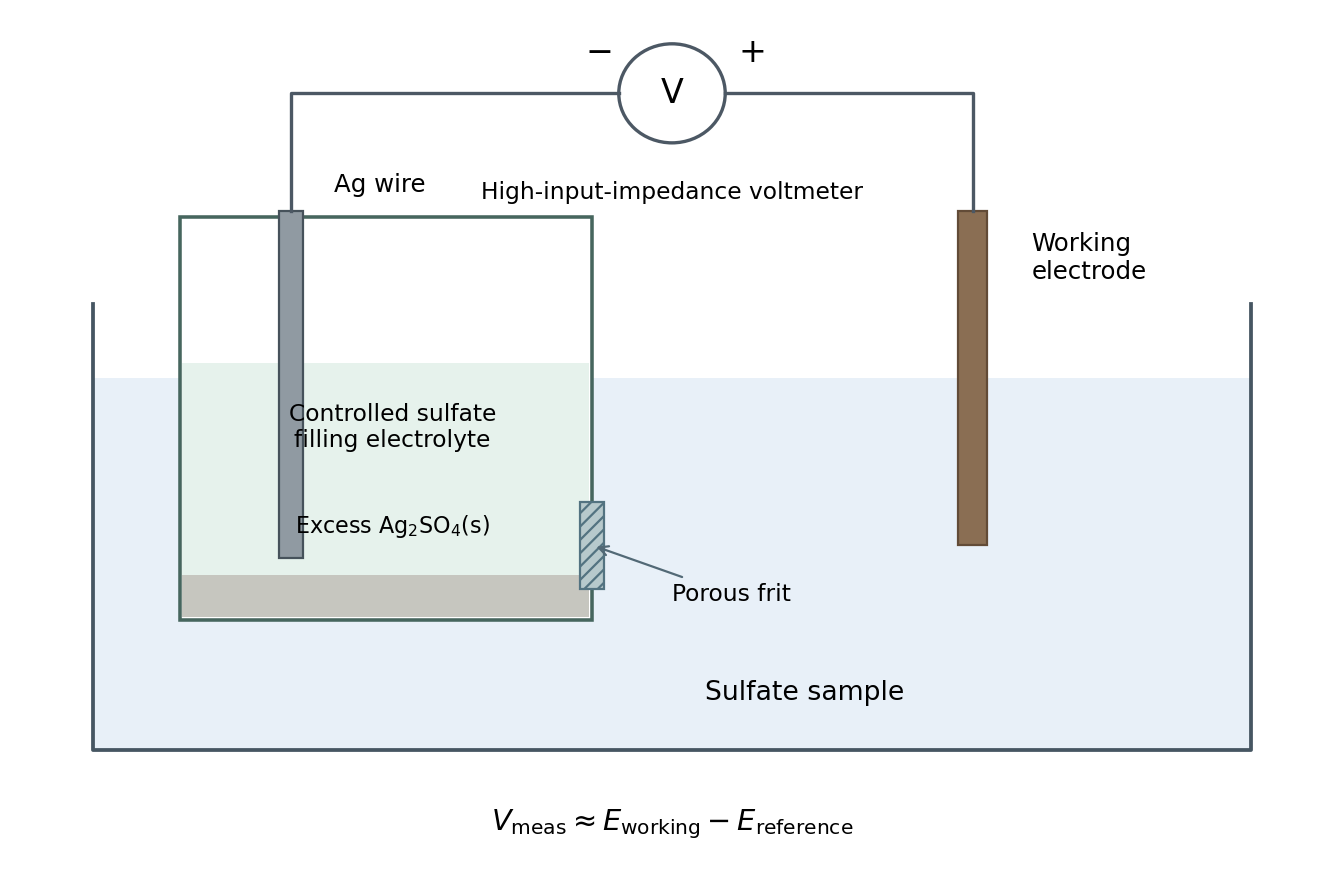


A reference electrode should provide a stable, reproducible potential from a well-defined reversible equilibrium, with fixed relevant activities. It should pass negligible measuring current, resist contamination and drift, and avoid changing the sulfate sample through incompatible ions or reactions.
Silver is suitable when coupled to a sparingly soluble silver salt and a controlled filling electrolyte; a silver sulfate reference electrode avoids introducing chloride into a sulfate system. Mercury is also electrochemically suitable in a mercury/mercurous-sulfate reference system, although its toxicity and handling requirements make silver attractive where practical.
Sodium is unsuitable because it reacts with water rather than maintaining a quiet metal/ion reference equilibrium. Calcium and strontium are likewise too reactive in water. Magnesium is not a dependable reference simply because it sometimes reacts slowly: corrosion, oxide/hydroxide films and mixed potentials make its open-circuit potential dependent on surface history and solution conditions. A relatively inert-looking surface is not equivalent to a reproducible reversible electrode.
The left-hand open quinoid dianion is pink/purple; the right-hand closed lactone is colorless. In the colored form, a longer conjugated electronic system extends through the quinoid framework. The resulting lower-energy electronic transitions can absorb visible light, producing the observed complementary color.
The closed lactone contains a tetrahedral central carbon that interrupts conjugation between the aromatic fragments. Its remaining electronic transitions are mainly at higher energy, so the molecule does not strongly absorb visible wavelengths. It still absorbs ultraviolet light: colorless does not mean absence of electronic transitions.
The explanation concerns the two drawn forms of phenolphthalein. It does not assert that a single colored form remains dominant at arbitrarily high pH; additional equilibria can alter the spectrum outside the usual indicator range.
Zero step coverage means that a sidewall or hidden surface receives essentially no film even though a horizontal reference surface is coated. Deposition shadowing occurs when an upper edge intercepts trajectories that would otherwise reach a lower region. A directional high-vacuum evaporant flux can therefore coat a feature top while leaving vertical or reentrant walls uncoated.
Sputtering generally releases material from an extended target with a broad angular distribution; gas collisions can further redistribute arrival directions. More oblique trajectories can reach sidewalls, so the extreme zero-coverage behavior of an ideal collimated evaporant beam is reduced.
The absolute claim that these effects never occur in sputtering is too strong. Low-pressure directional sputtering and high-aspect-ratio or reentrant features can still exhibit shadowing and poor coverage. Broader incidence improves access; it does not make a physical deposition process universally conformal.
There are unlisted articles, also show them or only show them.