
Different materials have different frequency-dependent polarization and conduction. For an convention, a useful relative complex permittivity is . Substituting the particle and medium responses into determines whether each population undergoes positive or negative dielectrophoresis and with what magnitude.
Choose a frequency at which one population has and another has . A nonuniform electrode field then sends them towards different regions, allowing collection in separate channels or trapping one while the other passes. Alternatively, different positive-force magnitudes can produce different deflections in a flowing suspension. A crossover where can selectively suppress the force on one material.
The useful frequency depends on the surrounding medium as well as the particle. An unchanging, real-permittivity model would not by itself give frequency-selective separation; dielectric dispersion or conductivity contrast is needed. Particle size affects force magnitude, and heating, electro-osmotic flow and surface polarization can complicate a real separation.
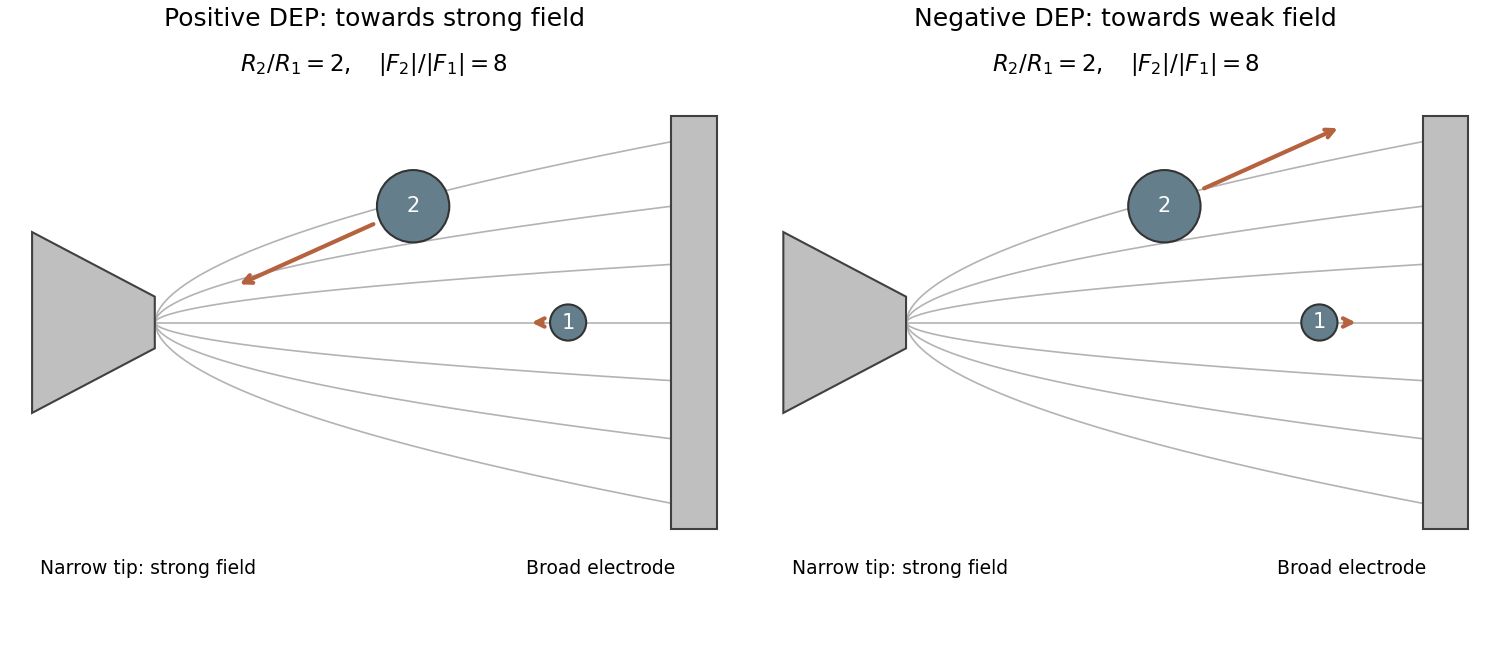
The narrow electrode tip concentrates field lines and produces the strong-field region. For positive dielectrophoresis, both particles move towards that region; for negative dielectrophoresis, both move away. Particle 1 is approximately on the central symmetry line, so its arrow is approximately horizontal. Particle 2 lies above it, so a qualitative gradient arrow points towards or away from the high-field tip rather than simply following its local field line.
The source drawing makes particle 2 approximately twice the radius of particle 1. With the explicitly stipulated equal gradient magnitudes and identical material,Accordingly, the second force arrow should be much longer in either sign case. The exact ratio should remain expressed through the drawn radius ratio because the figure supplies no calibrated particle dimensions. Exact off-axis force directions would require solving the electrode boundary-value problem; the drawing supports a qualitative strong-field/weak-field distinction.

An asymmetric film with a B-preferring substrate must have an A-preferring atmosphere interface. A parallel stack with half-integer thickness can terminate correctly at both surfaces. For equal block widths, one explicit sequence from bottom to top isThe thicknesses add to , with of each block. B contacts the substrate and A contacts the atmosphere, as shown in the accompanying schematic. The alternating widths in the interior reflect half-period domains, while the terminal domains are half of an interior domain in this idealized construction.
Symmetric wetting and an A-preferring substrate imply an A-preferring free surface as well. Parallel lamellae satisfy both preferences. For equal-width A and B domains, a thickness contains two repeats, with terminal A half-domains:The sequence is written from substrate to atmosphere. Its total thickness is , the total A and B thicknesses are each , and both interfaces contact A. A diagram using five full half-period domains would instead give and would not match the stated thickness.
The quarter-period end domains place an A-domain centre at each boundary in this ideal symmetric-lamella model. Real surface reconstruction and non-equal block fractions can change their detailed widths without changing the key requirement of identical terminations.
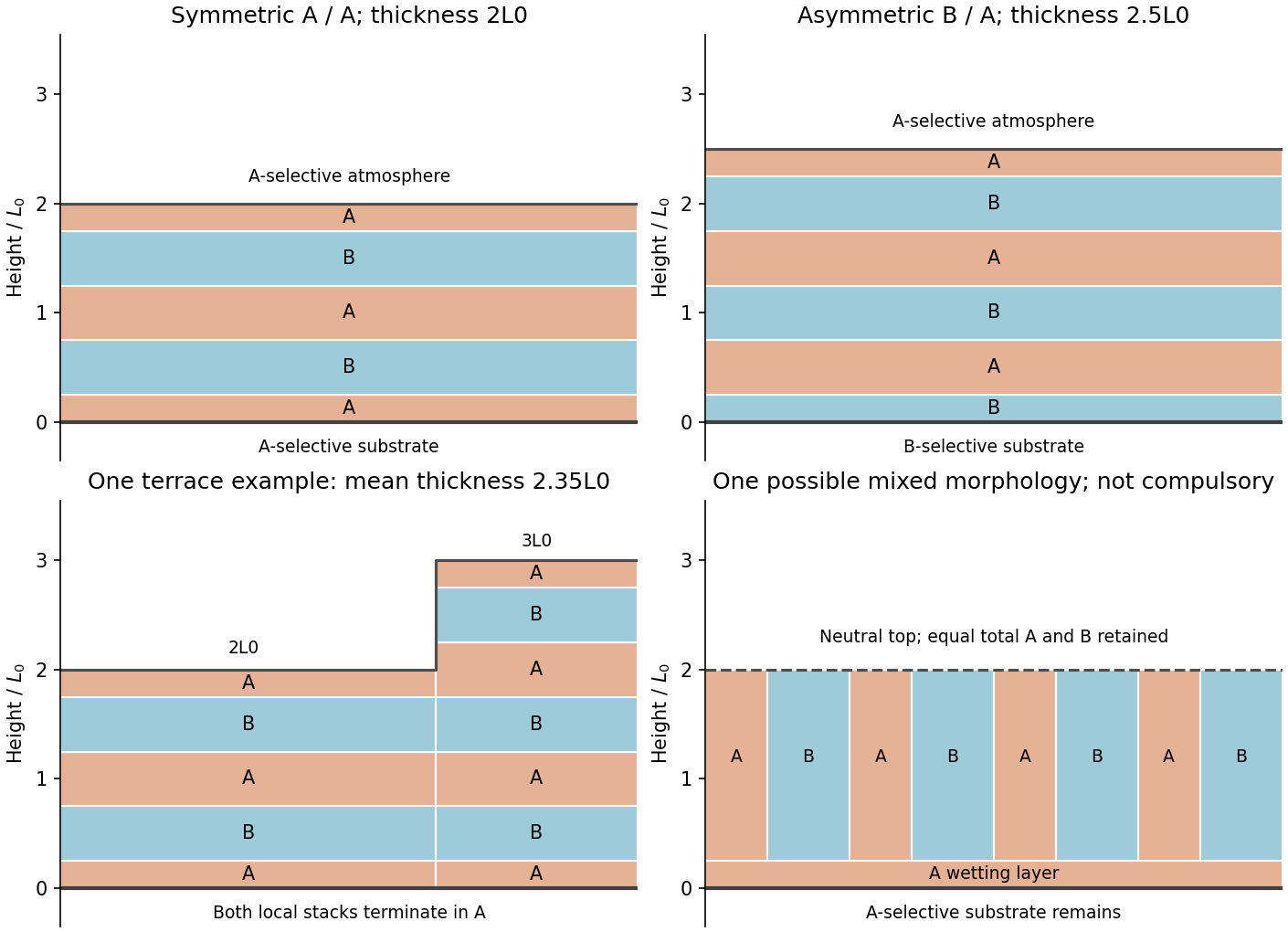
Lamellar terminations, thickness terraces and a single neutral boundary
. Original idealized equal-block diagrams. The neutral-top panel is one admissible mixed arrangement, not a unique prediction; the bottom surface still prefers A. Details.
Symmetric wetting means that both film boundaries prefer the same block: A at both, or B at both. Asymmetric wetting means opposite preferences, such as A at the substrate and B at the free surface. A neutral boundary has approximately equal interfacial free energies against A and B and therefore imposes no first-order preference between them.
These terms compare the substrate–polymer and atmosphere–polymer interfaces, not the volume fractions or molecular weights of the two blocks. A film can have one neutral boundary and one selective boundary; saying only that its top surface is neutral does not make both interfaces neutral. Surface preference competes with chain stretching and the energetic cost of A/B contacts in selecting a block copolymer morphology.
Treat the metal gate and conducting electron sheet as a parallel-plate capacitor separated by a uniform GaAs-like dielectric. Its capacitance per area isA gate-voltage change gives an electron-number change of magnitudeFor the ordinary accumulation convention, a more positive gate voltage attracts more electrons, while a more negative gate depletes them. The magnitude is about of the preceding sheet density.
This neglects depletion, trapped charge, finite well width and quantum capacitance. The occupied-subband quantum capacitance is , much larger than here; putting the two in series would reduce the estimate by only about within this simple model.
Interpret the stated Fermi energy as measured above the bottom of the occupied subband, and take a degenerate, nearly zero-temperature gas. ThenFor a filling energy,A Fermi energy referenced instead to an unspecified bulk conduction-band edge would not determine this number without the subband offset. The assumption that only one subband is occupied is imposed by the question; at this comparatively large density, an actual confinement potential should be checked before applying it to a device.
For an in-plane parabolic band , one state occupies area in two-dimensional wave-vector space. Including spin degeneracy two and the single GaAs conduction-band valley,Differentiation gives the constant two-dimensional density of statesUsing the supplied and effective mass givesThis counts available one-electron states, not the number actually occupied at arbitrary temperature. Occupation requires the Fermi-Dirac distribution; each additional subband would add another step above its own threshold.
A gallium arsenide/aluminium gallium arsenide heterojunction has a conduction-band offset that can confine electrons on the GaAs side. Donors in the wider-gap AlGaAs supply electrons; band bending produces a narrow interfacial potential well. Motion normal to the interface is quantized into subbands, while motion within the plane remains approximately free with GaAs effective mass. Occupying the lowest confinement subband creates a two-dimensional electron gas.
Modulation doping spatially separates the ionized donors from the mobile electrons. An undoped spacer between the donor layer and the channel reduces Coulomb scattering from donor ions while still allowing charge transfer. This can produce higher mobility than doping the conducting channel itself. The spacer thickness balances lower scattering against weaker carrier supply and electrostatic control; interface roughness, alloy disorder, phonons and background impurities can still limit mobility. The channel is a finite-width quantum wavefunction, not a mathematically zero-thickness sheet.
In current-perpendicular-to-plane magnetoresistance, the resistance difference between parallel and antiparallel ferromagnetic layers relies on spin-dependent transmission and retention of spin information. Here, an electron traversing the stack must pass a platinum layer between the two Co films. Strong spin-orbit coupling and associated spin relaxation in Pt, together with spin-memory loss at interfaces, can reduce the polarization reaching the second Co layer and weaken giant magnetoresistance. This is more relevant to the stated perpendicular current than an in-plane shunting explanation.
First, redesign the spacer path so a low-spin-relaxation conductor such as Cu directly separates the two ferromagnets, while retaining perpendicular anisotropy through other interfaces or a different layer sequence. Minimize unnecessary Pt traversal and improve interface sharpness. Merely thinning the Cu layer is not sufficient if it reintroduces magnetic coupling or leaves the Pt spin-relaxation bottleneck unchanged.
Second, replace the metallic spin-transport section with a suitable thin insulating tunnel barrier, for example an engineered MgO-based magnetic tunnel junction, and choose compatible magnetic electrodes. Spin-selective tunnelling can give a much larger resistance contrast, but pinholes, disorder and a poorly matched barrier defeat it. Retaining distinct switching fields and a stable antiparallel configuration remains essential in either design.
Let the two layers have equal magnetic moments and coercive-field magnitudes . Assume they are exchange-decoupled, both easy axes are perpendicular, each switches sharply, and dipolar coupling, thermal activation and domain distributions do not smear or offset reversal.
Starting from positive saturation and reducing the perpendicular field, the total moment changes asat and . Between the switches, the moments are antiparallel and cancel. On the return sweep the corresponding transitions occur at and . The plotted normalized loop therefore has two reversal steps and an antiparallel plateau on each sweep, as in the accompanying figure.
Equal magnetization densities do not alone guarantee an exactly zero plateau if the two Co thicknesses or active areas differ: cancellation requires equal moments . The source allows Co thickness variation, so this is an additional assumption worth stating. A real unpatterned millimetre-scale film may reverse by domain processes rather than coherent rotation, producing rounded steps and reduced remanence.
There are unlisted articles, also show them or only show them.