
Nanowires can increase by reducing lattice heat conduction more strongly than they degrade useful electronic transport. A wire diameter comparable to important phonon mean free paths introduces boundary scattering and reduces the lattice part of thermal conductivity. Interfaces, surface roughness and suitable nanostructure can suppress long-mean-free-path phonons while preserving shorter-mean-free-path carrier transport.
Electronic confinement or energy-dependent scattering can also change the Seebeck coefficient and thermoelectric power factor, but neither improvement is automatic. Surface depletion, disorder and contact resistance may instead reduce electrical conductivity; a smaller wire is not necessarily better. The necessary comparison is the complete ratio over the operating temperature range. The experimentally established benefit of nanostructuring is especially clear when it suppresses phonon heat conduction while retaining a useful power factor.[ref]
High-Thermoelectric Performance of Nanostructured Bismuth Antimony Telluride Bulk Alloys by Bed Poudel and others. 2008, nanostructured-alloy thermal-conductivity and figure-of-merit measurements
A generator couple has a p-type and an n-type thermoelement joined electrically at the hot face, with their other ends connected through a load at the cold face. The legs are electrically in series and thermally in parallel. Electrically insulating, thermally conducting plates couple them to the hot source and cold sink; metal interconnects carry current. The Seebeck effect provides an open-circuit electromotive force , where the magnitude of is the difference between the two leg Seebeck coefficients.
For fixed junction temperatures, constant properties and internal resistance ,Differentiate with respect to load resistance:The derivative changes from positive to negative at , soThe load voltage is then half the open-circuit voltage. The heat source and sink must sustain the temperature difference; an isolated hot object cools as energy is extracted. Maximum power and maximum conversion efficiency are different operating points: the efficiency-optimal load is generally larger than .
For one homogeneous thermoelectric material, the dimensional thermoelectric figure of merit isThe dimensionless quantity is . The Seebeck coefficient measures the open-circuit voltage response to a temperature difference and reflects the energy asymmetry of charge-carrier transport. The electrical conductivity depends on carrier density and mobility and sets electrical loss; . The thermal conductivity is , with contributions from carriers and phonons, and represents unwanted heat leakage.
Increasing carrier concentration usually raises while reducing once transport becomes strongly degenerate. The electronic part of also tends to rise, approximately through the Wiedemann-Franz law where applicable. This competition produces an intermediate optimum, commonly in heavily doped semiconductors, rather than in a very resistive insulator or an ordinary high-carrier-density metal. The optimum depends on band structure and scattering; the schematic is not a universal measured concentration curve.
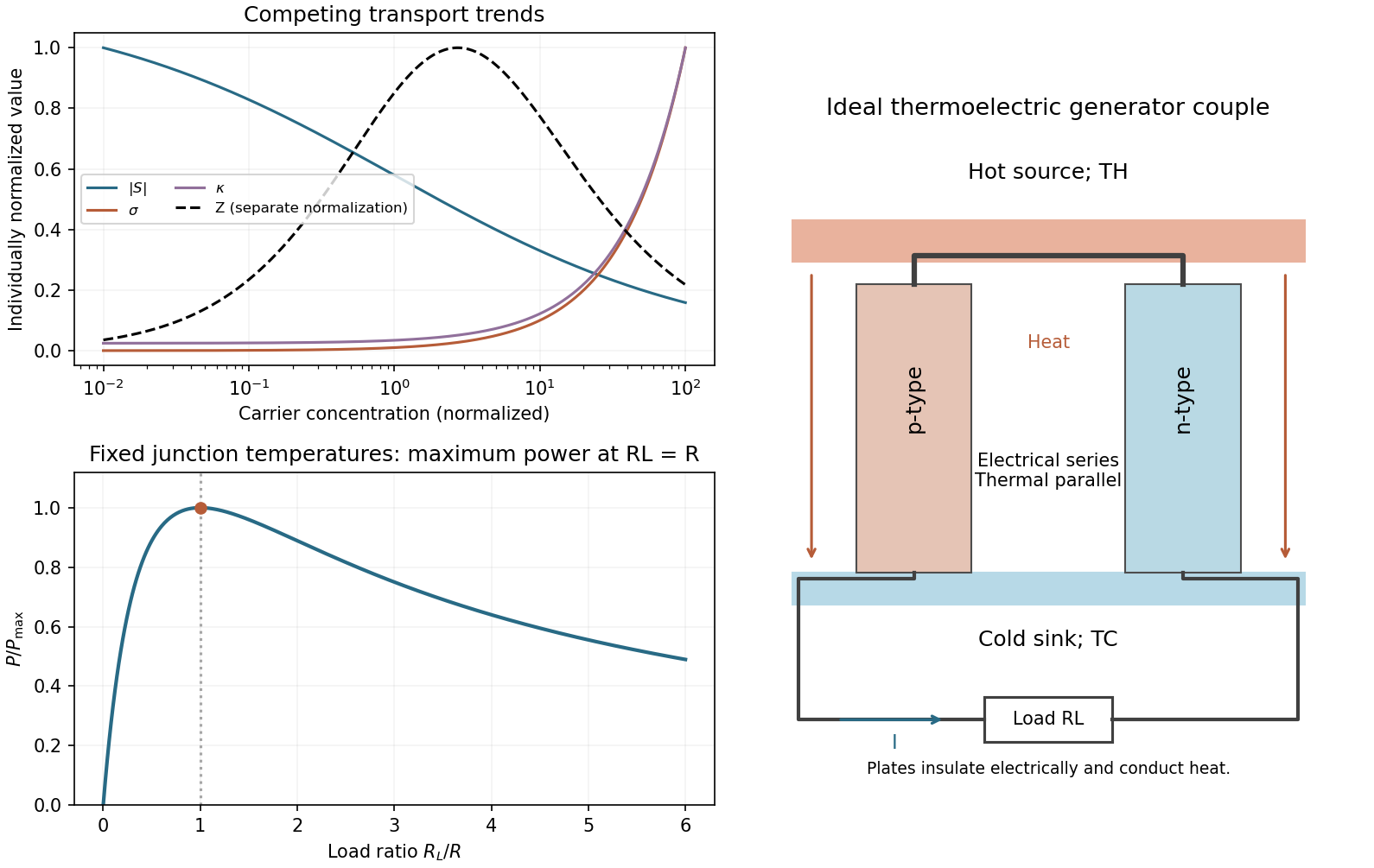
Thermoelectric carrier trade-offs, a generator couple and load matching
. Original normalized carrier-property curves, a circuit schematic and the calculated dimensionless load-power curve. The carrier curves illustrate competing trends and do not assert material-specific measurements. Details.
A lithium–oxygen system can have much greater theoretical active-material specific energy because it avoids the heavy transition-metal host and carbon host of the preceding insertion cell. Oxygen can be taken from the surroundings, but a mass comparison must say whether that oxygen is counted.
The peroxide reaction transfers two electrons per unit. If oxygen is counted, the reactant mass per two electrons iscompared with for two electrons in the idealized lithium-ion reaction. At the same average voltage, the active-material specific energy would therefore be larger by . If only stored lithium is counted, the ideal mass advantage is larger still, but this excludes the oxygen and is not a like-for-like closed-cell mass basis.
The source supplies no lithium-peroxide formation free energy or oxygen-electrode potential, so it does not determine an absolute lithium–oxygen voltage or specific energy. Real devices require an oxygen electrode, gas-management and electrolyte; insulating discharge products, parasitic reactions, charging overpotential and mass transport reduce the practical advantage. The question's reaction is chemical oxygen reduction, not a biological energy pathway.
The chemically supported assignment isThe four oxygen donors can converge around the small lithium ion to organize the alkene ends efficiently. The larger sodium and potassium ions are less well matched to this particular folded four-oxygen binding environment, with potassium giving the weakest enhancement in the stated comparison. This is a match between donor geometry, solvation and cation size, not a universal rule that lithium templates every crown ether best.
The primary chemical record supports the identity assignment: the inventors' Table 1 reports a strong lithium enhancement for the 14-membered product, with much smaller effects from sodium and potassium. It lists the potassium yield as , whereas this examination gives ; that discrepancy should not be hidden by treating the exam numbers as a verbatim reproduction. The ion assignment follows the structure and the documented templating comparison, rather than the numerical yield alone.[ref]
Template-directed metathesis patent by Robert H. Grubbs and others. US6080826A, Table 1 and discussion of the 14-membered ring: Li, Na and K comparison
The cation acts as a noncovalent template. Coordination to the ether oxygens folds the open chain into conformations with its two alkene ends close together. This increases their effective local concentration and reduces the conformational search needed for ring-closing metathesis. The bound cyclic product is also stabilized relative to unbound alternatives, which can favour it in a reversible reaction network.
A well-matched ion therefore suppresses competing intermolecular connections and increases the isolated or analytical macrocycle yield. It need not become covalently incorporated into Z; it can be removed by changing the binding conditions during work-up. Nor is it necessarily the metathesis catalyst: the ruthenium complex performs bond reorganization, whereas the cation primarily changes preorganization and relative stability. A yield increase alone does not separate a kinetic templating effect from a thermodynamic one, and both can contribute.
There are unlisted articles, also show them or only show them.