
For a uniformly magnetized bilayer that relaxes to one of its easy directions after a saturating in-plane field, the in-plane remanent component isIt is therefore approximately zero when the easy axis is perpendicular at the thin-Co end, and increases towards as the easy axis rotates into the plane. The graph should show an increasing crossover between about and , but the source does not specify its exact shape. A straight line is not a consequence of the two endpoint orientations.
The trend reflects competition between interface-driven perpendicular magnetic anisotropy and volume or demagnetizing contributions favouring in-plane magnetization. An illustrative effective anisotropy is , with sign convention chosen so positive favours the normal. A continuous rotation can require higher-order anisotropy terms; the simple sign change alone need not produce a smooth canting interval.
The relation assumes a well-defined remanent direction and no complete cancellation by domains. A vibrating-sample magnetometer measures total moment: if the result is reported without dividing by magnetic volume, the moment per area additionally scales as .
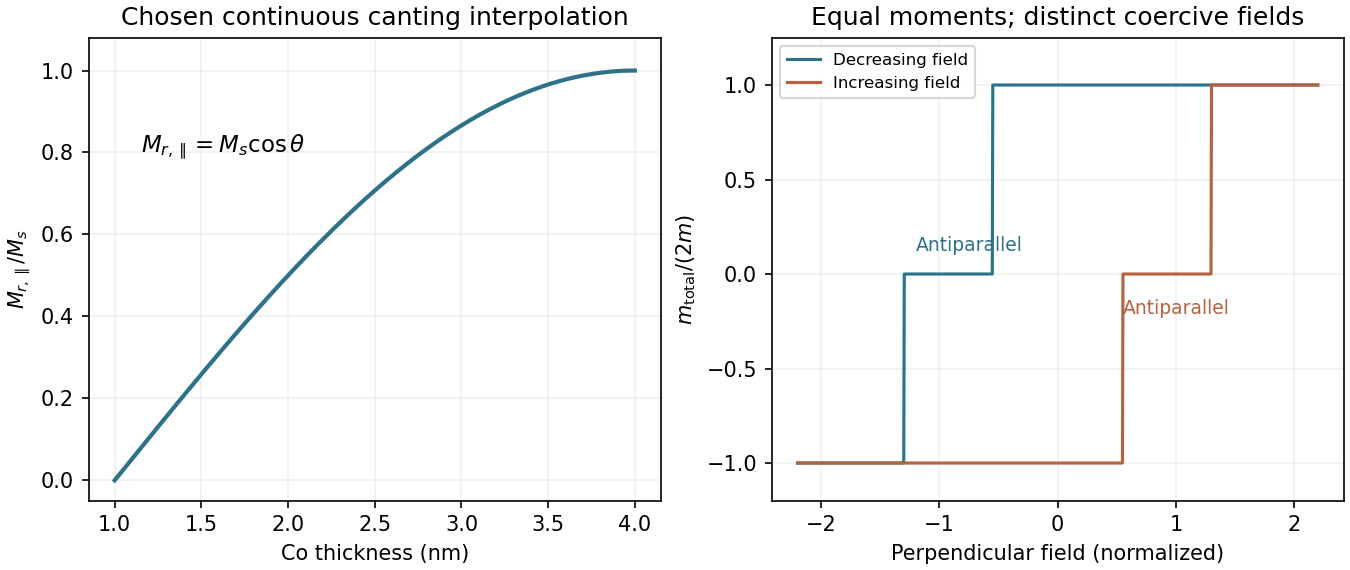
Illustrative remanence crossover and independent two-layer magnetic switching
. The remanence interpolation is a chosen schematic, not fitted data. The hysteresis loop assumes equal magnetic moments, distinct coercivities and independent abrupt reversal. Details.Use a thin, continuous cap of hexagonal boron nitride, preferably assembled without exposing the cleaned MoS surface to ambient contamination. It is chemically inert and relatively transparent in the visible range, and can isolate the film from adsorbing water, oxygen and hydrocarbons during optical measurements. A transferred sheet avoids depositing a strongly reactive precursor directly on the monolayer.
The cap must cover the illuminated region and overlap its edges; pinholes, wrinkles and unsealed edges can allow ingress. Trapped residues or bubbles can themselves change the optical response. Record the capped background and account for optical interference and dielectric-environment shifts rather than assuming that encapsulation leaves every spectral peak unchanged. A thin oxide or polymer coating may also provide protection, but deposition damage, optical background and permeability require checking. An atomically thin sheet with a perfect basal plane is not proof that the whole assembled enclosure is sealed.
The pressure is . The molecular arrival flux from an ideal gas isBecause the residual-gas composition, temperature and sticking probability are not specified, the answer is an order-of-magnitude monolayer-equivalent exposure time, not a unique coverage prediction. Take , a nitrogen-like molecular mass , and unit sticking probability. ThenUse the given molecular-layer scale as an approximate intermolecular spacing, giving . ThusFor , this is a few minutes; assuming instead sites gives about , the same rough scale. A clean-looking vacuum pressure does not imply a contamination-free surface. Desorption and a small sticking probability can greatly lengthen net accumulation, while residual water or hydrocarbons can dominate the chemistry. Full saturation in a site-blocking adsorption model is not exactly the same as one monolayer-equivalent incident fluence.
In surface-enhanced Raman spectroscopy, electromagnetic SERS enhancement comes from the strong local optical field near a plasmonic metal nanostructure. A localized surface plasmon resonance in gold or silver can increase both the field driving a molecular Raman transition and the coupling of its emitted light to the far field. A common estimate isoften summarized as an enhancement when pump and Stokes frequencies see similar responses. Sharp tips and narrow interparticle gaps can produce intense hot spots.
Chemical SERS enhancement changes the molecule's Raman polarizability through adsorption, electronic hybridization or a metal–molecule charge-transfer resonance. It is more sensitive to molecular identity and binding geometry than a purely electromagnetic field enhancement, and generally requires close contact.
Tune particle size, shape and gap geometry so that a plasmon resonance overlaps the excitation and Raman frequencies, and bring the target into the enhanced-field region. Reproducible adsorption sites, low fluorescence background and clean reference spectra are as important as a large local enhancement. A hot spot does not guarantee that a dilute sample occupies it; a detection limit cannot be computed from concentration alone. Au or Ag improve the signal per suitably located molecule, while sampling and background determine the practical limit.
Symmetry breaking in nanocrystal growth makes growth rates along initially equivalent crystallographic directions unequal, so the final shape has lower symmetry than an unperturbed seed. It need not change the underlying face-centered cubic lattice. A cubic lattice does not require a cubic external shape.
Anisotropy can originate in a twin or stacking fault, unequal ligand coverage of nominally equivalent sites, selective adsorption or etching, a substrate or external field, or a local fluctuation amplified because newly deposited material changes subsequent growth. Facet-selective binding suppresses some normal growth rates; concentration and reduction kinetics determine whether atoms can redistribute towards a near-equilibrium shape or remain in a kinetically selected one. A facet with slow normal growth tends to remain exposed, while a fast-growing facet can disappear.
For a one-dimensional silver example, begin with a small seed with multiple regions related by crystal twinning containing five sectors around a common axis. Ligand-protected lateral faces and more active ends favour axial addition, producing an elongated pentagonal rod and then a wire. The defect geometry and surface kinetics jointly distinguish the axial direction. Fivefold twinning is a composite structure with strain accommodation, not a perfect single fcc crystal with forbidden fivefold lattice symmetry.
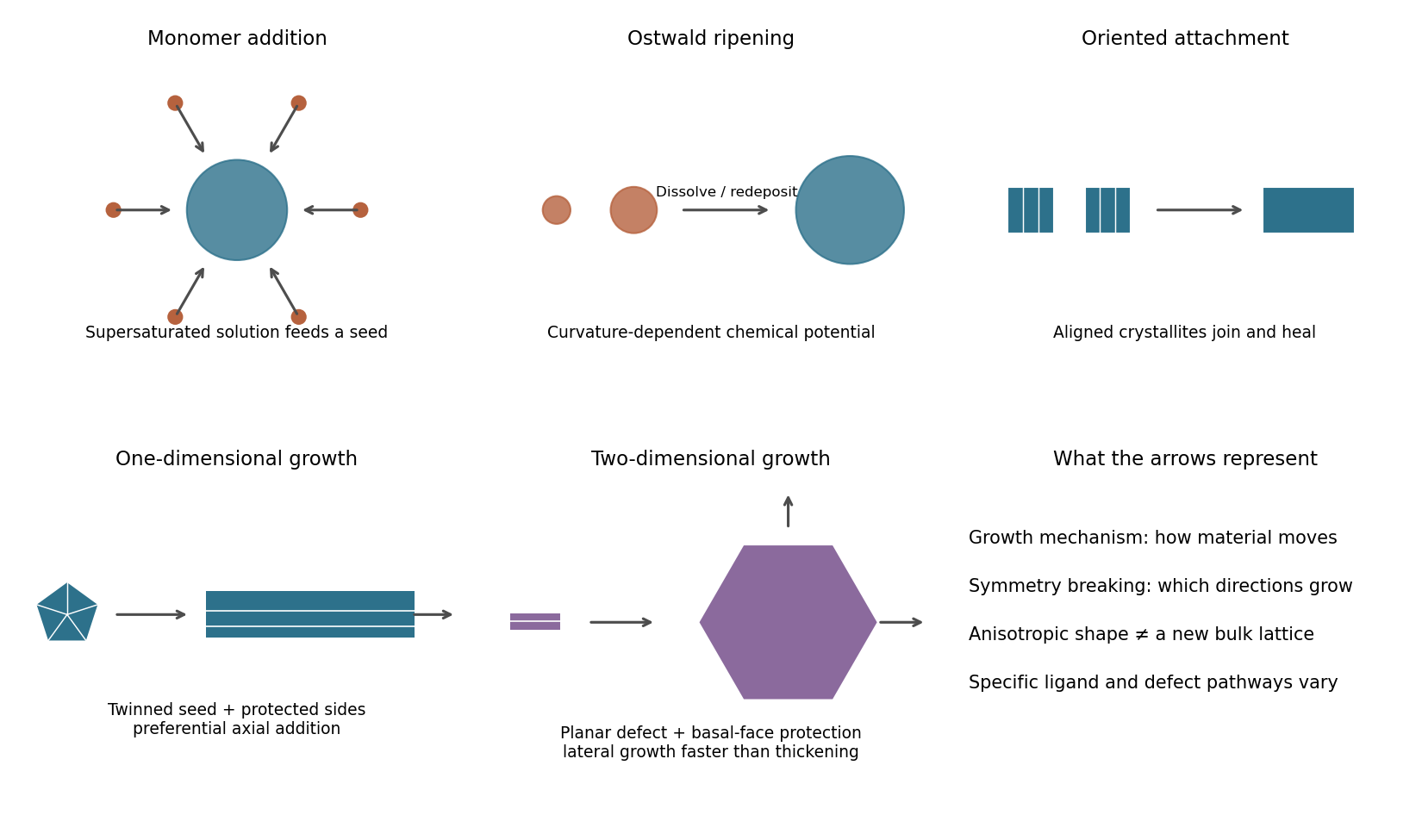
For a two-dimensional example, begin with a seed containing a planar twin or stacking fault. Basal-face protection and enhanced incorporation at suitable edges favour lateral extension over thickening, producing a thin triangular or hexagonal plate. The accompanying schematic emphasizes seed, symmetry-breaking event and anisotropic growth stages. These are representative routes, not universal requirements for every rod or plate. Experimentally, silver-seed growth can also be redirected into lower-symmetry forms by controlling reduction kinetics.[ref]
Symmetry Breaking during Seeded Growth of Nanocrystals by Xiaohu Xia and Younan Xia. 2012, seeded-silver growth and kinetic symmetry breaking
Three useful growth mechanisms are monomer addition, Ostwald ripening and oriented attachment. They can occur sequentially or compete; they are not necessarily three distinct experimental recipes.
In monomer-addition crystal growth, dissolved atoms, ions or molecular growth units attach to an existing nanocrystal. Supersaturation provides a chemical-potential driving force, approximately for an ideal solution. Transport through solution and incorporation at steps or facets determine the rate. Growth consumes the excess solute without requiring collisions between whole crystals.
In Ostwald ripening, smaller crystals dissolve while larger ones grow through solution. Curvature raises the surface contribution to chemical potential, approximately for a sphere with surface free energy and atomic volume . Dissolved material therefore moves from high-curvature particles to lower-curvature ones, reducing total interfacial free energy.
In oriented attachment, whole crystallites align compatible lattice planes and join. Removing exposed surface and forming a coherent interface lowers free energy; rotation, ligand removal and interface healing can be rate limiting. Misalignment can leave twins or other defects. Simple aggregation without crystallographic registration is related particle attachment, but is not necessarily oriented attachment.


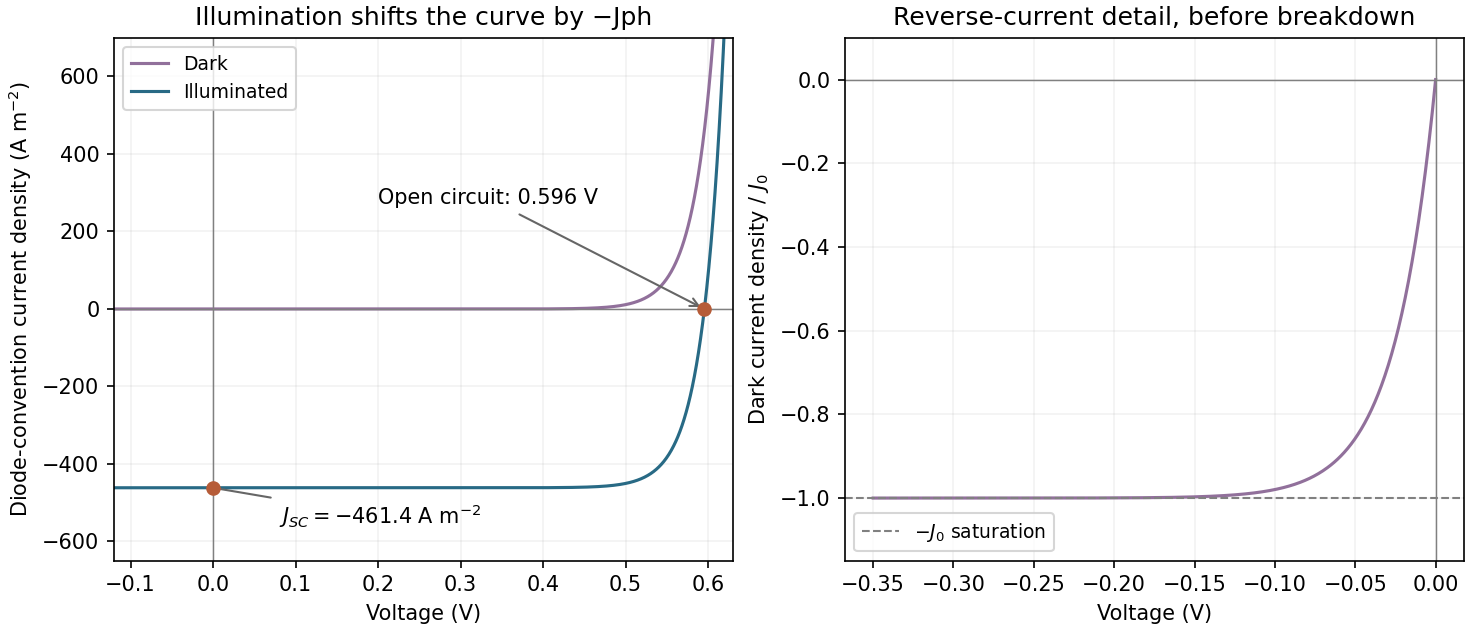
Assume one collected electron per absorbed photon, ideality factor one and . The question does not specify temperature, so the result should also be understood through its temperature-dependent formula. The photocurrent density isAt open circuit the diode current balances that photocurrent:Using gives approximately . These are current densities, so no device area is needed. Incomplete collection would replace by the collected current and reduce this estimate.
Without texturing, more incident photons generally escape by reflection, so the absorbed flux and decrease. Holding and temperature fixed, the voltage falls logarithmically: if absorption is multiplied by and , then . A real texture also changes surface area and recombination, so an unchanged is an assumption rather than a guarantee.
Choose conventional diode current as positive in forward bias. The ideal dark and illuminated current densities areThe dark reverse-bias asymptote is before breakdown. Illumination shifts the curve down by : the short-circuit point is , and the open-circuit point is . The power-generating region has positive voltage and negative diode-convention current. A plot using positive delivered current would flip the vertical sign; its physical intercepts are the same.

In physical vapor deposition, material is physically released from a source and transported to the substrate, where it condenses. Three examples are thermal evaporative deposition, electron-beam evaporation and sputtering. Their angular distributions, source heating and energetic bombardment differ, even though all belong to the physical-deposition family.
In chemical vapor deposition, volatile reactants undergo chemical reactions that produce a solid film at or near the substrate, with gaseous products removed. Examples are atmospheric-pressure thermal CVD, low-pressure CVD and plasma-enhanced chemical vapor deposition. These are three established process variants, distinguished by pressure and activation method. Surface chemistry, precursor delivery and temperature determine growth, rather than condensation alone.
Atomic layer deposition is a related cyclic surface-reaction method, but need not be counted as a separate conventional CVD example to satisfy the requested three. Reactive sputtering can involve chemistry, so the boundary is best explained by the dominant source and transport mechanism rather than by claiming that a PVD chamber can contain no chemical reactions.
X is an aluminium-doped back surface field region. Annealing alloys the rear aluminium with silicon; on cooling, silicon regrowth adjacent to the contact incorporates aluminium as an acceptor. This creates a more heavily p-type region between the p-type base and rear metal contact.
The resulting doping gradient creates a field that reduces the minority-electron population near the recombination-active rear metal interface. It therefore reduces rear-surface recombination and improves collection of photogenerated carriers. Heavy doping also helps form a low-resistance majority-carrier contact. This is a rear isotype doping transition, not the front n–p junction and not an electrically insulating blocking layer.
There are unlisted articles, also show them or only show them.