
N. M. Nathanson 2026-10-13
Martin Raff Created 2026-10-13 Updated 2026-11-05
Coauthor of Molecular Biology of the Cell, 4th edition by Bruce Alberts and others, a textbook connecting molecular mechanisms with the structure and behavior of biological cells. The author credit is a bibliographic identification, without assuming responsibility for a particular chapter.[ref]
Molecular Biology of the Cell, 4th edition by Bruce Alberts and others. Verified author or editor credit
Keith Roberts Created 2026-10-13 Updated 2026-11-05
Coauthor of Molecular Biology of the Cell, 4th edition by Bruce Alberts and others, a textbook connecting molecular mechanisms with the structure and behavior of biological cells. The author credit is a bibliographic identification, without assuming responsibility for a particular chapter.[ref]
Molecular Biology of the Cell, 4th edition by Bruce Alberts and others. Verified author or editor credit
Julian Lewis Created 2026-10-13 Updated 2026-11-05
Coauthor of Molecular Biology of the Cell, 4th edition by Bruce Alberts and others, a textbook connecting molecular mechanisms with the structure and behavior of biological cells. The author credit is a bibliographic identification, without assuming responsibility for a particular chapter.[ref]
Molecular Biology of the Cell, 4th edition by Bruce Alberts and others. Verified author or editor credit
J. M. Martin 2026-10-13
I. Ito 2026-10-13
H. Sugiyama 2026-10-13
Geoffrey M. Cooper Created 2026-10-13 Updated 2026-11-05
Author of The Cell: A Molecular Approach, 2nd edition by Geoffrey M. Cooper, which explains cellular organization through molecular mechanisms. The textbook connects experimentally studied components with the coordinated behavior of a living cell.[ref]
The Cell: A Molecular Approach, 2nd edition by Geoffrey M. Cooper. Verified author or editor credit
G. J. Augustine 2026-10-13
D. W. Tank 2026-10-13
D. Purves 2026-10-13
D. Fitzpatrick 2026-10-13
D. D. Hunter 2026-10-13
C. Hirono 2026-10-13
Bruce Alberts Created 2026-10-13 Updated 2026-11-05
Coauthor of Molecular Biology of the Cell, 4th edition by Bruce Alberts and others, a textbook connecting molecular mechanisms with the structure and behavior of biological cells. The author credit is a bibliographic identification, without assuming responsibility for a particular chapter.[ref]
Molecular Biology of the Cell, 4th edition by Bruce Alberts and others. Verified author or editor credit

Portrait of Bruce Alberts
. Photograph by Tom Kochel, courtesy of the Department of Biochemistry and Biophysics, The University of California San Francisco. CC BY 2.5, via Wikimedia Commons. Source.
Bert Sakmann Created 2026-10-13 Updated 2026-10-24

Portrait of Bert Sakmann
. Yuriy Kolodin; existing crop by TDKR Chicago 101. Public-domain release by the author, with unconditional-use fallback (Commons PD-user), via Wikimedia Commons. Source.

B. Hille 2026-10-13
Alexander Johnson Created 2026-10-13 Updated 2026-11-05
Coauthor of Molecular Biology of the Cell, 4th edition by Bruce Alberts and others, a textbook connecting molecular mechanisms with the structure and behavior of biological cells. The author credit is a bibliographic identification, without assuming responsibility for a particular chapter.[ref]
Molecular Biology of the Cell, 4th edition by Bruce Alberts and others. Verified author or editor credit
Membrane potential Created 2026-10-13 Updated 2026-10-18
A membrane potential is an electric potential difference across a cell membrane. We use the conventionTaking the external electric potential as zero makes mean that the inside is at lower electric potential. “Negative inside” describes a difference, not an absolute electric potential, and does not imply that the entire cytosol has a large net negative electric charge.
Consider a cell membrane permeable only to potassium ions, with higher potassium concentration inside. Diffusion initially favors outward transport. If balancing negative ions cannot follow, that loss of positive electric charge produces a small inner excess of negative electric charge and an outer positive excess. The resulting electric field favors inward potassium transport. At the Nernst equilibrium potential, chemical and electrical contributions to electrochemical potential balance; ions still cross both ways, with zero net transport.[ref]
Ion Channels and the Electrical Properties of Membranes. Molecular Biology of the Cell, 4th edition by Bruce Alberts and others; The Resting Membrane Potential Is Determined Mainly by K+ Leak Channels in Most Animal Cells: selective potassium passage and opposing electrical influence
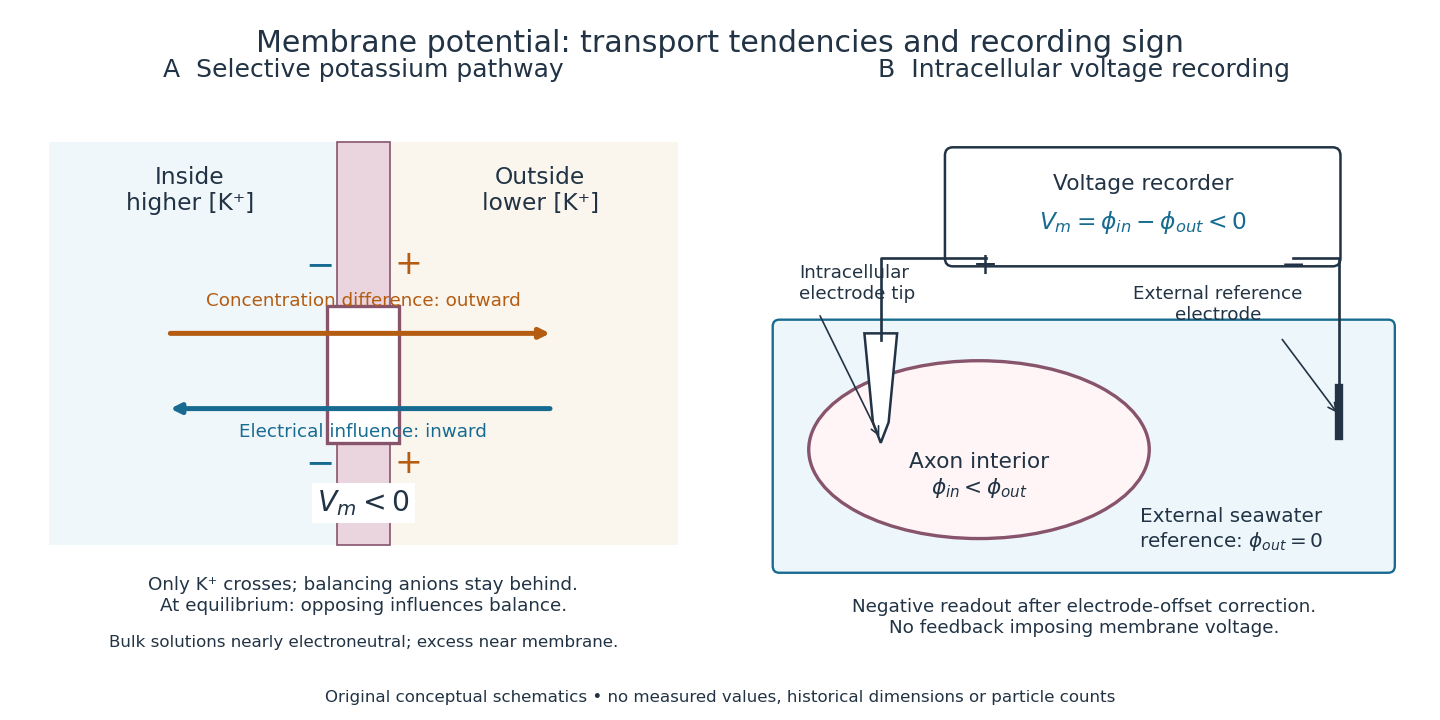

In living biological cells, several ions can permeate and pumps maintain their concentration differences through active transport. Pumps transporting net electric charge also contribute electric current. Thus is a special limit, not a universal rule; membrane potential need not always be negative.[ref]
Ion Channels and the Electrical Properties of Membranes. Molecular Biology of the Cell, 4th edition by Bruce Alberts and others; K+ leak-channel discussion; The Resting Potential Decays Only Slowly When the Na+-K+ Pump Is Stopped; action-potential discussion
The existing reversal potential example shows how opposing electric currents can balance without each ion reaching thermodynamic equilibrium. This makes selective permeability a way to convert chemical differences into electrical signals: changing the available ion channels changes which electrochemical gradients influence the voltage. Red blood cell Created 2026-10-13 Updated 2026-11-05
A red blood cell is a specialized biological cell that transports oxygen in blood. Its deformability lets it pass through vessels narrower than its unstressed size. A compliant-body lubrication model isolates the coupling between its deformation, the surrounding viscous film and a driving pressure difference; it is an idealization rather than a complete membrane or cytoplasm model.
There are unlisted articles, also show them or only show them.