
Glyph Created 2026-10-13 Updated 2026-11-05
A glyph is a visual form used to display written content. A text character is the encoded abstract item; a glyph is the shape chosen for its presentation. One text character can have several glyphs, such as contextual forms in Arabic, while several text characters can be displayed by one typographic ligature.
For example, the two text characters “f” and “i” may be drawn separately or replaced by an “fi” typographic ligature. The underlying text can remain the same in both cases. A glyph index identifies a form within a particular computer font; it is not a portable Unicode code point.[ref]
Branches of physics Created 2026-10-13 Updated 2026-10-18
Experimental apparatus Created 2026-10-13 Updated 2026-11-05
An experimental apparatus is the physical arrangement used to prepare, control and observe a system. A useful account identifies the source, sample, controllable settings, detector and calibration procedure, because each affects the inference drawn from the data.
For a resistance measurement, the current source prepares the drive, the specimen provides the response, and voltage and current measurements enter a measurement model. Reversing current or using a reference specimen can test offsets and unwanted contributions. Describing the apparatus makes an experiment's assumptions and reproducibility assessable.
Time evolution 2026-10-13
Time evolution describes the change of a physical system's state with time. A closed quantum system has unitary time evolution; dissipative dynamics need not be unitary.
Symmetry (physics) 2026-10-13
Philosophy of physics Created 2026-10-13 Updated 2026-10-18
Philosophy of physics studies the interpretation and explanatory structure of physical theories, including the relation between mathematical models, observable phenomena and claims about what exists. Its questions include theoretical reduction, emergence and competing formulations of physical locality.
Physical quantity Created 2026-10-13 Updated 2026-11-05
A physical quantity is a property of a phenomenon, body or substance whose magnitude can be expressed by a number and a reference, usually a unit of measurement. For example, the length and the same length have different numerical values but represent the same physical quantity. The numerical value alone is therefore incomplete.
A physical quantity must also be specified physically. A gas's pressure at a stated position and temperature, the mass of a specimen, and a detector's electric current are different measurands even if an instrument happens to display the same number for them. Dimensional analysis constrains which quantities can be added or compared, while a system of units supplies a consistent convention for expressing them.[ref]
System of units Created 2026-10-13 Updated 2026-11-05
A system of units chooses reference units of measurement for a set of base physical quantities and specifies how other units of measurement are derived. In the International System of Units, length, mass and time are expressed using the metre, kilogram and second; a velocity has derived unit .
A consistent system allows an equation to connect numerical values without hidden unit-conversion factors. It does not change the underlying physical relation: the same speed may be written as or . The familiar formulas for electromagnetism can nevertheless contain different constants in SI and Gaussian conventions, because the definitions of the electrical quantities differ as well as their numerical scales.[ref]
Plasma (physics) Created 2026-10-13 Updated 2026-10-20
A plasma is a gas of mobile charged particles whose collective electromagnetic response is important to its dynamics. It commonly contains ions and electrons, and may also contain a neutral component: complete ionization is not required. A multi-species fluid description has current density . The relative motion of the species can matter even when a single-fluid magnetohydrodynamics approximation describes the large-scale dynamics.
Physicist Created 2026-10-13 Updated 2026-11-05
A physicist investigates physical phenomena through experiments, observations, mathematical models and computation. Quantitative predictions connect a physical theory's assumptions with measurements, while discrepancies can expose missing effects or a failed mathematical model.
Experimental and theoretical work often interact: a new measurement can motivate a new description, and a physical theory can suggest which quantities to measure or which background effects must be excluded. The specialized lists organize individual contributions by their main subject.
Gravity 2026-10-13
Gravity governs falling bodies and orbits. Newtonian gravity describes it through a gravitational field acting on masses; general relativity instead relates matter and radiation to the geometry of spacetime through the Einstein field equations.
Physical law 2026-10-13
A physical law expresses a reproducible relation used to describe or predict physical phenomena within its domain of applicability. Applying it requires a model specifying the system and conditions: Newton's second law, together with a force model, predicts a body's acceleration; conservation of energy constrains exchanges within a specified system. Its predictions must be compared with physical observations.
Vacuum Created 2026-10-13 Updated 2026-11-05
A laboratory vacuum is a region with substantially reduced gas pressure, rather than an experimentally perfect absence of matter. Lowering the number density increases the mean free path, allowing a molecular beam to travel with fewer collisions. In molecular flow, the mean free path exceeds the apparatus dimensions, so wall encounters dominate.
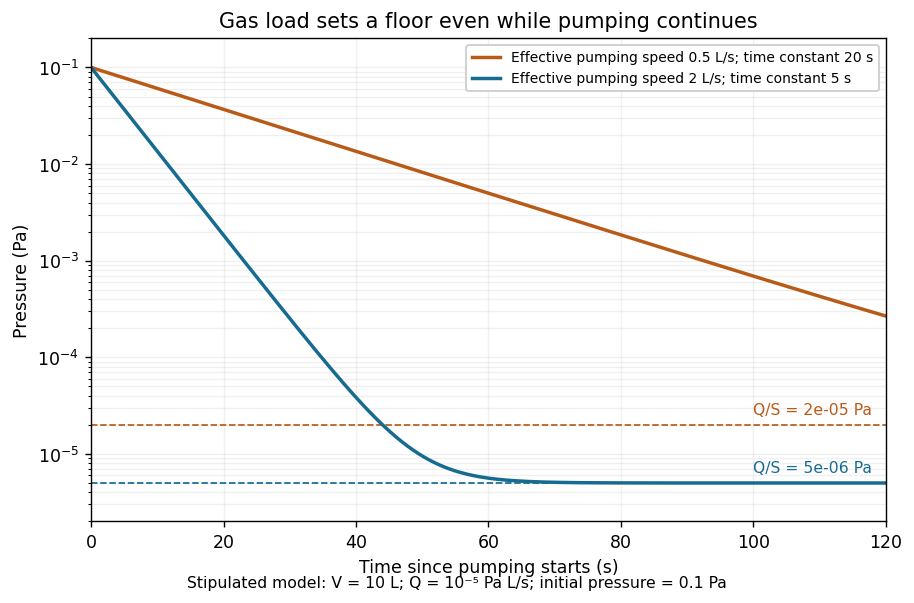
A vacuum pump competes with leaks and outgassing. For an isothermal vessel of volume , constant gas load in pressure-volume per unit time, and effective pumping speed , gas balance givesThis ideal model predicts a pump-down time constant and a limiting pressure . A restricted connecting pipe reduces the effective pumping speed; a larger pump alone need not fix it. Measuring the pressure transient tests the model, while deviations can reveal changing outgassing or pumping speed.[ref]

Physics bibliography 2026-10-13
Physics author 2026-10-13
Mathematician Created 2026-10-13 Updated 2026-11-05
A mathematician develops and studies mathematical structures, formulates conjectures, constructs mathematical proofs and designs methods for solving problems. Work can emphasize foundational theory, computational methods or applications to scientific models; these activities often interact.
For example, a question about stable numerical methods may require a theorem in functional analysis, while a geometric example can reveal the right algebraic definition. The list of mathematicians connects individual contributions with the reusable mathematical ideas they helped establish.
Invariant (mathematics) Created 2026-10-13 Updated 2026-10-20
An invariant is a property or quantity unchanged by a specified class of transformations. The transformations are part of the definition: an invariant of a group action and an invariant set of a measure-preserving transformation concern different transformation classes.
Mathematical economics Created 2026-10-13 Updated 2026-10-20
Mathematical economics uses mathematical optimization, game theory and analysis to study allocation, choice and market coordination.
Mathematics bibliography 2026-10-13
Mathematics author 2026-10-13
There are unlisted articles, also show them or only show them.