
Electron-positron thermal pair abundance Created 2026-10-06 Updated 2026-10-20
Thermal electron-positron pairs in chemical equilibrium with photons have opposite chemical potentials when the one-particle energy includes rest energy. For negligible degeneracy and , the zero-chemical-potential density per charge species is . In that nondegenerate limit, charge neutrality and the classical equilibrium product give , with net electron density . Pairs are important when . At arbitrary temperature the zero-chemical-potential marker uses the integral . Its ultrarelativistic limit is . A nonzero net chemical potential shifts the exact abundance boundary; the zero-potential curve is an approximate crossover marker.
Canonical feature space of a positive-semidefinite kernel Created 2026-10-06 Updated 2026-10-14
On the finite formal span of symbols , define and extend bilinearly. For a positive-semidefinite kernel, the null vectors of this positive semidefinite bilinear form form its radical of a bilinear form. Quotienting by that linear subspace gives an inner product space and feature map with . This construction works for degenerate and zero kernels.
Faddeev-Zamolodchikov algebra 2026-10-06
Particle operators obey a rapidity-dependent exchange rule , with repeated species indices summed. A consistent associative algebra must give the same coefficients when a triple product is brought to decreasing or increasing rapidity order by either sequence of adjacent exchanges. This is the Faddeev-Zamolodchikov associativity constraint. Rapidity ordering here is distinct from the creation/annihilation convention of ordinary normal ordering.
Yang-Baxter equation 2026-10-06
For a two-body operator acting on a tensor product of particle species spaces, the spectral equation is . It guarantees agreement between the two ways to reorder three particles in factorized scattering. A Yang–Baxter operator is a related braid-form operator; multiplying by the permutation operator converts between the braided and unbraided conventions.
O(N)-invariant S-matrix 2026-10-06
For particles in the vector representation of the orthogonal group, the two-body S-matrix is a linear combination of the identity , permutation and trace contraction : . Here , , and . The orthogonal-invariant scattering channels diagonalize these three operators simultaneously.
Bound-state fusion of factorized S-matrices Created 2026-10-06 Updated 2026-10-07
For an equal-mass bound pair at fusion rapidity , scatter a third particle off its two constituents with shifted rapidities and project onto the bound-state residue. Scalar amplitudes give the displayed product. With internal indices, bound-state coupling tensors perform the projection. The Yang-Baxter equation makes different scattering orders consistent; factorization eliminates independent many-body scattering contributions.
For an odd integer having at least two distinct prime divisors, choose a uniform unit . The Chinese remainder theorem for unit groups makes its odd-prime-power components independent cyclic groups. Failure of factor extraction from an even modular order requires all components to have equal 2-primary order exponents. For any component each possible exponent has probability at most , so conditioning on another component bounds failure by . Excluding the identity unit only improves the success proportion.
Generalized Pareto distribution 2026-10-06
For scale and shape , the generalized Pareto distribution on nonnegative excesses has cumulative distribution functionThe case is the continuous limit . Positive gives a power-law tail, zero gives an exponential distribution, and negative gives a finite upper endpoint . Its role in modelling high-threshold excesses is explained by the Pickands-Balkema-de Haan theorem.
Return period Created 2026-10-06 Updated 2026-10-14
A return period expresses how rare a threshold exceedance is in a specified time block. Let be the sample maximum in block , fix a threshold , and suppose is the same for every block. The conventional return period is blocks; blocks of duration give a time of . Thus an annual exceedance probability means a 100-year return period. This names a frequency scale, not a schedule or a guarantee of one exceedance in each century. The annual convention and the misleading “once every 100 years” interpretation are discussed in USGS: the 100-year flood.
To derive a waiting-time interpretation, assume the exceedance indicators are independent and identically distributed random variables with the Bernoulli distribution of parameter . Define , counting the successful block as well as all preceding blocks. The first Bernoulli trials must fail and the th must succeed, so independence gives the geometric distributionThe expected value can also be read directly from the geometric series: . This counts blocks from the starting boundary, not the exact time of an exceedance within its block. Counting only failed blocks instead would give expected value . The waiting law and its memorylessness of the geometric distribution are developed in Kyle Siegrist, Random Services: the geometric distribution.
For a horizon of complete years, at least one exceedance is the complement of no exceedances. Under the same independence and constant- assumptions,For the toy choice , this gives in 10 years, in 30 years, in 50 years, and in 100 years. Even after 100 years there is a chance of no exceedance. These numbers are exact model calculations rounded to one decimal place, not measured frequencies. The median waiting count is 69 years, since ; the expected value is 100 years. A mean and a median answer different questions.
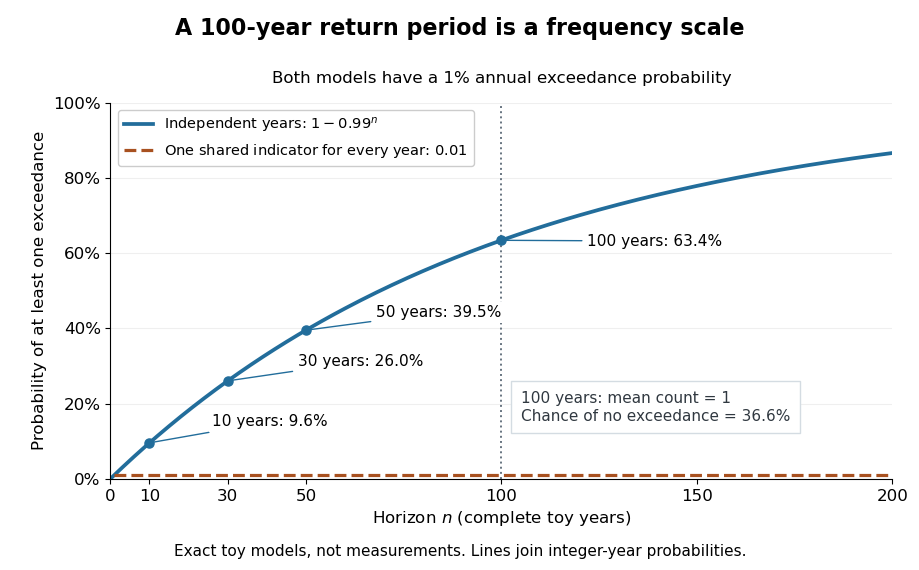

The exceedance count has the binomial distribution under independence, with expected value . Thus has expected value one, although its probability of being at least one is only : some realizations contribute several exceedances. For , the memorylessness of the geometric distribution gives . A long quiet spell does not make the next independent year's exceedance overdue, and an exceedance this year does not force a quiet interval. Two specified consecutive years both exceed with probability in this toy model.
A reproducible tabletop experiment makes the assumptions tangible. Put 100 identical slips numbered 1 to 100 in a bag; after thoroughly mixing, draw one and record whether it is 100. Replace the slip and mix again before every draw. Treat each draw as one toy year, so the exceedance indicator is a Bernoulli random variable with , provided the sampling is uniform and successive draws are independent. Repeat complete 30-draw runs and record the fraction containing at least one 100; separately repeat runs stopped at the first 100 and record their waiting counts. The first fraction targets ; the waiting-count histogram targets . Replacement keeps fixed, mixing is intended to support independence, and repeated runs expose sampling variation. This is a proposed demonstration of the toy model; no experimental results are asserted here.
Stationarity supports a time-invariant annual probability distribution, but does not imply independence. For an extreme counterexample, draw just one Bernoulli random variable of parameter and set for every year. This is a stationary process, yet the probability of any exceedance in every finite horizon is ; from an arbitrary starting boundary the wait is infinite with probability . The reciprocal marginal frequency therefore need not equal that forward waiting expected value. With equal marginal probabilities and arbitrary dependence, only the general bounds follow, the upper bound being the union bound. Linearity of expectation still gives without independence. Mere zero correlation does not restore the product formula; even pairwise independence does not imply joint independence. If annual probabilities change to , independence instead gives , and one fixed return period no longer describes all years.
Max-stable distribution 2026-10-06
A non-degenerate distribution function is max-stable when every sample maximum of independent and identically distributed random variables can be positively scaled and centered to have the original law. Thus for every integer there are with . The extremal types theorem classifies these laws, up to affine changes, as the Gumbel distribution, Fréchet distribution, and negative Weibull distribution.
Extremal types theorem 2026-10-06
Every non-degenerate limit in convergence in distribution of positively scaled and centered sample maxima is a max-stable distribution. Up to positive affine transformations its law is the Gumbel distribution, a Fréchet distribution with positive shape parameter, or a negative Weibull distribution with positive shape parameter. This classifies possible limits, without asserting that every distribution function admits a limiting normalization.
Hill estimator Created 2026-10-06 Updated 2026-10-14
For and a positive threshold , the Hill estimator averages the logarithmic ratios of the top order statistics to . For a Fréchet distribution domain with shape , it estimates the reciprocal tail index . At an untied threshold it equals the empirical distribution function plug-in tail integral . At a tied threshold the plug-in denominator counts strictly larger observations and the identity needs adjustment. Fixed does not by itself yield a consistent tail-index estimate.
The extreme value theorem requires continuity on the entire closed interval. A bounded function can have values tending to an endpoint envelope without ever reaching that envelope, while its defined endpoint value is smaller. To prove nonattainment, establish a strict pointwise upper bound and construct a sequence approaching that bound. An oscillatory factor can supply the approaching sequence by selecting phases where it equals .
Interior-value criterion for an attained maximum Created 2026-10-06 Updated 2026-10-31
Let be continuous on , bounded above, and suppose its limit superior at from the right is at most . If some has , then attains its maximum on . A sufficiently short initial interval has all values below . On the remaining closed interval, the extreme value theorem supplies a maximum, which is consequently global. This can prove attainment despite an oscillatory discontinuity at one endpoint.
Extreme-point criterion for the L-infinity unit ball Created 2026-10-06 Updated 2026-10-07
For real scalars the extremes are the almost-everywhere sign-valued functions. A positive-measure region uniformly inside permits opposite nontrivial bounded perturbations, proving necessity. Equality at either endpoint forces both members of a convex decomposition to agree, proving sufficiency. For complex scalars the same criterion uses unit-modulus functions and the strict convexity of the complex unit disk.
Supersaturation 2026-10-06
Supersaturation strengthens an extremal existence theorem by forcing many copies of a forbidden graph when the edge count exceeds its extremal threshold by a fixed density. For a fixed clique, the Erdős-Stone theorem and averaging over bounded-size random vertex subsets give a positive multiple of copies.
Uniqueness of the exterior derivative from its axioms Created 2026-10-06 Updated 2026-10-20
An -linear degree-one graded derivation of the exterior algebra of smooth differential forms that equals the differential on functions and squares to zero is unique. A smooth bump function and the graded Leibniz rule first establish locality. Then , and applying the graded Leibniz rule to gives the displayed coordinate formula. The chain rule makes that formula coordinate-independent.
Hyperoperation Created 2026-10-06 Updated 2026-10-14
The hyperoperation hierarchy successively iterates basic arithmetic operations. In the usual indexing, successor is followed by addition, multiplication, exponentiation and their higher iterates. A sequence beginning with addition shifts this index by one. Each fixed rank is a primitive recursive function; this does not imply that the evaluator taking the rank as an additional variable is primitive recursive.
Cancellation in an exponential sum 2026-10-06
Cancellation occurs when different complex numbers in an exponential sum have directions that reduce the absolute value of their sum. For example, the orthogonality of roots of unity makes for every integer , despite all terms having absolute value one.
Van der Corput sum-integral lemma 2026-10-06
For a real phase with continuous monotone derivative and , the sum-integral discrepancy has the displayed uniform bound. Periodization and the Dirichlet-Jordan convergence theorem express it as symmetric nonzero Fourier modes. Integration by parts gives endpoint terms and reciprocal-derivative variations. Monotonicity bounds their total variation by . Pairing the leading endpoint terms reduces them to the uniformly bounded sine series. The exclusion of integer nonzero frequencies is essential.
There are unlisted articles, also show them or only show them.