
Past exam of the mathematics course of the University of Cambridge 2020 ii Paper 4 6B i Solution Created 2026-09-24 Updated 2026-10-03
This is a Yule process, a pure birth process with state-dependent birth rate . Probability flows into state from and leaves it for , so the master equation is
Past exam of the mathematics course of the University of Cambridge 2020 ii Paper 4 5J b Solution Created 2026-09-24 Updated 2026-09-29
The intercept-only model has residual degrees of freedom, so the sample size is . The one-covariate model and full model therefore have respectively and residual degrees of freedom. The completed sequential analysis of variance table hasThus the missing sums of squares are and , and the corresponding F-statistics are approximately and . The first p-value is below ; the second is approximately . The tiny second increment is consistent with the reported t-test because, for one added coefficient, the partial F-statistic equals the squared t-statistic up to displayed rounding.
Past exam of the mathematics course of the University of Cambridge 2020 ii Paper 4 5J a iii Created 2026-09-24 Updated 2026-09-24
Past exam of the mathematics course of the University of Cambridge 2020 ii Paper 4 5J a ii Created 2026-09-24 Updated 2026-09-24
Past exam of the mathematics course of the University of Cambridge 2020 ii Paper 4 5J a i Created 2026-09-24 Updated 2026-09-24
Past exam of the mathematics course of the University of Cambridge 2020 ii Paper 4 40E c Solution Created 2026-09-24 Updated 2026-09-29
Here the only nonzero coefficients of areTherefore, for each , the truncated system iswhere a coefficient is omitted when its index is outside or equals .
For wavevectors and , the matrix entry isBecause , , so the matrix is symmetric. Its diagonal entry is . The sum of absolute off-diagonal entries is at mostbecause for nonzero integer ; truncation can only reduce the sum. Hence is strictly diagonally dominant with positive diagonal. The Gershgorin circle theorem places every eigenvalue in the positive intervalfor at least one row. Since the symmetric matrix has only real eigenvalues, all are positive, and is a positive-definite matrix. Any one-dimensional ordering merely conjugates by a permutation matrix, preserving symmetry and positive definiteness.
Past exam of the mathematics course of the University of Cambridge 2020 ii Paper 4 40E b Solution Created 2026-09-24 Updated 2026-09-29
Expand in the two-dimensional Fourier basis. Applying the derivative and product rules from part (a), the coefficient of the equation isThe normalization and compatibility conditions areThus, on , the infinite Fourier spectral method system isFor a square spectral truncation, chooseretain equations and unknowns indexed by , and set omitted coefficients to zero. This is the Fourier–Galerkin method: it projects the residual onto the retained Fourier modes. Other finite mode sets may be used in the same way.
Past exam of the mathematics course of the University of Cambridge 2020 ii Paper 4 40E a Solution Created 2026-09-24 Updated 2026-09-29
Termwise differentiation of a Fourier series multiplies a mode by its wavenumber, soThe convolution theorem turns pointwise multiplication into discrete convolution:soThe assumed real analyticity justifies these termwise operations through rapid decay of the Fourier coefficients.
Past exam of the mathematics course of the University of Cambridge 2020 ii Paper 4 3I b Solution Created 2026-09-24 Updated 2026-09-29
Perform every addition in the finite field . From the two transmitted strings and one obtainsChoosing one candidate value of recursively determines , and hence determines the candidate plaintext . There are only two candidates: changing complements every recovered key bit and every plaintext bit. The information that the message makes sense normally selects the intended candidate.
Once this ambiguity is resolved, any other ciphertext positions encrypted with the recovered segment can be decrypted. Key bits outside that segment remain independent and uniformly distributed, so this mistake gives no information about messages using only those bits. This is the two-time pad attack: reusing related one-time-pad key material destroys perfect secrecy.
Past exam of the mathematics course of the University of Cambridge 2020 ii Paper 4 3I a Solution Created 2026-09-24 Updated 2026-10-14
A cipher has perfect secrecy when the conditional probability of every plaintext given a ciphertext equals its prior probability: whenever . Equivalently, the plaintext and ciphertext are independent random variables.
Fix a ciphertext that can occur. Perfect secrecy requires every possible plaintext to remain possible after observing . For a deterministic decryption rule, two different plaintexts producing require two different keys, so the key space has cardinality at least that of the message space.
In a one-time pad, the message and key belong to the same finite additive group, the key is uniform and independent of the message, and encryption is . For every there is exactly one key , soindependent of . Bayes' theorem then gives , proving perfect secrecy.
Past exam of the mathematics course of the University of Cambridge 2020 ii Paper 4 39B b ii Created 2026-09-24 Updated 2026-09-24
Past exam of the mathematics course of the University of Cambridge 2020 ii Paper 4 39B b i Created 2026-09-24 Updated 2026-09-24
Past exam of the mathematics course of the University of Cambridge 2020 ii Paper 4 39B a Solution Created 2026-09-24 Updated 2026-10-14
The one-dimensional Isentropic Euler equations areDefine the Riemann invariants for one-dimensional isentropic flowCombining the two equations directly givesso is constant on the corresponding characteristic curve .
Initially both invariant disturbances are supported in . Once the two characteristic families have separated, the left-moving packet is a simple wave with at its equilibrium value, while the right-moving packet is a simple wave with at equilibrium. Between and outside them, both invariants retain their equilibrium values. The schematic spacetime diagram below uses the equilibrium slopes and shows separation after .
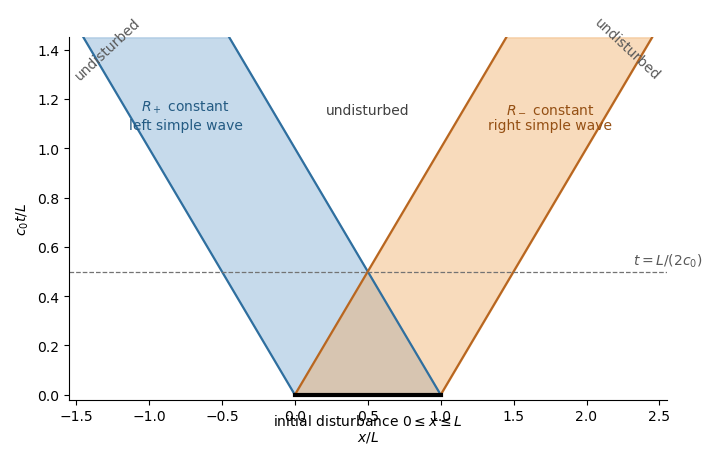
Characteristic curves and simple-wave separation
. Details. 
Past exam of the mathematics course of the University of Cambridge 2020 ii Paper 4 38B iii Solution Created 2026-09-24 Updated 2026-09-29
If the lower density exceeds the upper density , stable density stratification adds a gravitational restoring term. Including surface tension , the same calculation has the schematic dispersion relationThe gravity term dominates the shear term as and therefore suppresses sufficiently long waves. The capillary term dominates as and suppresses sufficiently short waves. Together they reduce the Kelvin-Helmholtz instability growth rate and can leave only a finite unstable band, or eliminate instability if the restoring effects are strong enough.
Past exam of the mathematics course of the University of Cambridge 2020 ii Paper 4 38B ii Solution Created 2026-09-24 Updated 2026-10-03
The unstable branch has temporal growth rate and phase velocityFor short waves, , soFor long waves, , soThus the growth-rate curve starts at the origin with zero slope, rises like , and approaches the straight-line asymptote . The inviscid zero-thickness model consequently has no short-wave cutoff.
Past exam of the mathematics course of the University of Cambridge 2020 ii Paper 4 38B i Solution Created 2026-09-24 Updated 2026-09-29
Let the disturbed sheet be and take a normal mode proportional to , with . Irrotational flow and the rigid-wall condition at give perturbation velocity potentialsThe two linearized kinematic boundary conditions at areThe Unsteady Bernoulli equation gives and . Continuity of pressure therefore yields the finite-depth vortex-sheet dispersion relationor, with ,For its two roots areOne root has positive temporal growth for every , so every finite wavelength is subject to the Kelvin-Helmholtz instability.
Past exam of the mathematics course of the University of Cambridge 2020 ii Paper 4 37D iv Solution Created 2026-09-24 Updated 2026-09-29
Move the positive cosmological constant to the source side and defineTo first order about Minkowski spacetime, . Its contribution to the trace-reversed source isRepeating the Newtonian limit of general relativity calculation givesFor a point mass, , soThe radial acceleration isThus positive supplies an outward acceleration and balances the point-mass attraction at the static radiusThe weak-field approximation requires both and , giving parametrically
Past exam of the mathematics course of the University of Cambridge 2020 ii Paper 4 37D iii Solution Created 2026-09-24 Updated 2026-09-29
For the Dirac delta distribution source , the stated Green function of the Laplacian givesThis is the Newtonian potential of a point mass; its negative gradient gives the inverse-square gravitational acceleration .
Past exam of the mathematics course of the University of Cambridge 2020 ii Paper 4 37D ii Solution Created 2026-09-24 Updated 2026-09-29
In the Newtonian limit of general relativity, time derivatives are negligible and is the only leading component. With signature ,The component of the trace-reversed equation becomesIdentifying therefore gives the Poisson equation of Newtonian gravity:
Past exam of the mathematics course of the University of Cambridge 2020 ii Paper 4 37D i Solution Created 2026-09-24 Updated 2026-09-29
The Einstein tensor is . Taking the metric trace of the Einstein field equations in four dimensions givesand substitution back gives the Trace-reversed Einstein field equations in D dimensions specialized to :For linearized gravity, the given equation and implySince , its trace is . Using then yields
There are unlisted articles, also show them or only show them.