
Past exam of the mathematics course of the University of Cambridge 2020 ii Paper 3 25I b Solution Created 2026-09-24 Updated 2026-09-29
Choose an orthonormal basis of and write . On a punctured disc on which the exponential map is a diffeomorphism, the mapdefines geodesic polar coordinates centred at . The curves are unit-speed geodesics, so the first coefficient of the first fundamental form isThe Gauss lemma says that radial and angular coordinate vectors are orthogonal, hence
The angular variation is a Jacobi field along each radial geodesic, with initial dataSince , smooth dependence of the geodesic flow givesConsequentlyas required.
Past exam of the mathematics course of the University of Cambridge 2020 ii Paper 3 25I a Solution Created 2026-09-24 Updated 2026-09-29
Suppose lies in the closed ball of radius centred at . By compactness, the continuous function attains its maximum at some . The sphere of radius about is a supporting sphere tangent to at .
Put . For any unit vector , choose a surface curve with and . Since has a local maximum at zero,The scalar is the normal curvature in direction , so every normal curvature is at most with this choice of unit normal. Applying this to principal directions shows that both principal curvatures satisfy . ThereforeThis proves both assertions, including the existence of an elliptic point on every compact regular surface.
Past exam of the mathematics course of the University of Cambridge 2020 ii Paper 3 24F iv Solution Created 2026-09-24 Updated 2026-10-03
Choose a point and project from to a line not containing . Every line through meets the quartic in four points counted with intersection multiplicity by Bézout theorem; removing the fixed intersection at leaves a generic fibre of three points. This projection from a point on a plane curve therefore defines a nonconstant morphismof degree three, so the gonality is at most three.
It cannot be one, because a degree-one morphism between smooth projective curves is an isomorphism of algebraic varieties, whereas has genus three and the projective line has genus zero. It cannot be two either: that would make a hyperelliptic curve. The canonical map of a hyperelliptic curve is not a closed embedding, but for a smooth plane quartic the canonical map of a smooth plane curve is exactly its given embedding , since . This contradiction proves
Past exam of the mathematics course of the University of Cambridge 2020 ii Paper 3 24F iii Solution Created 2026-09-24 Updated 2026-10-14
The intersection with a line is a hyperplane section:The canonical bundle of a smooth projective hypersurface formula, obtained from the adjunction formula, gives for a smooth degree-four curve in Thus , so the divisor class of is the canonical divisor class. Therefore is a canonical divisor. Its degree is also , consistently with .
Past exam of the mathematics course of the University of Cambridge 2020 ii Paper 3 24F ii Solution Created 2026-09-24 Updated 2026-09-29
PutBy the Jacobian criterion, a projective plane curve is singular only at a common projective zero of and all its partial derivatives. HereTheir simultaneous vanishing forces , which is not a point of projective space. Hence the Fermat quartic is nonsingular. In particular it is a smooth plane quartic and has geometric genus .
Past exam of the mathematics course of the University of Cambridge 2020 ii Paper 3 24F i Solution Created 2026-09-24 Updated 2026-10-14
Let the smooth projective curve be the projective completion of , of degree , and suppose after interchanging and if necessary that is nonzero. A basis of its holomorphic differential forms isEquivalently one may use . These expressions agree on their common domain because differentiating gives . The allowed monomials are precisely the homogeneous polynomials of degree at most , in accordance with the adjunction formula .
Past exam of the mathematics course of the University of Cambridge 2020 ii Paper 3 22I c Solution Created 2026-09-24 Updated 2026-09-29
On equipped with the norm, point evaluation is linear and satisfieswith equality for a compactly supported function equal to one near zero. Thus . The Hahn-Banach theorem extends it, without increasing its norm, to a continuous functional on .
This extension cannot be represented by an function. If satisfied , choose continuous functions with and support in the ball of radius . Thenby the absolute continuity of the Lebesgue integral, a contradiction. Therefore strictly contains the functionals represented by ; this is a singular functional on L infinity.
Past exam of the mathematics course of the University of Cambridge 2020 ii Paper 3 22I b iii Created 2026-09-24 Updated 2026-09-29
Past exam of the mathematics course of the University of Cambridge 2020 ii Paper 3 22I a Solution Created 2026-09-24 Updated 2026-09-29
The continuous dual space consists of all bounded linear maps , withIf with and is the conjugate exponent, then duality of Lp spaces identifies isometrically with , including when . Every functional has the formand .
Past exam of the mathematics course of the University of Cambridge 2020 ii Paper 3 21I d Solution Created 2026-09-24 Updated 2026-09-29
Write . We first prove that is dense. Otherwise some nonzero lies in its orthogonal complement, soBy part (b), choose finite-dimensional spaces containing such that in operator norm. Sincethe operator is not injective. Therefore is not surjective; the contrapositive of part (c) makes an eigenvalue of . Choose unit vectors with . ThenCompactness gives a subsequence for which converges. Since , the displayed relation makes converge to a unit vector , and continuity gives , contradicting the hypothesis. Thus is dense.
Next suppose were not bounded below, or equivalently that its lower norm were zero. There would be unit vectors with , henceAgain a convergent subsequence of forces the corresponding to converge to a unit vector satisfying , another contradiction. Therefore some satisfies
This lower bound makes closed: if converges, then is Cauchy and its limit maps to the same limit. Since the image is both dense and closed, it is all of . We have proved the Fredholm alternative for a compact operator: every nonzero spectral value of a compact operator is an eigenvalue.
Past exam of the mathematics course of the University of Cambridge 2020 ii Paper 3 21I c Solution Created 2026-09-24 Updated 2026-09-29
Put , a finite-dimensional subspace, and decompose . The restrictionis injective, because a nonzero vector in its kernel would be a -eigenvector of . By finite-dimensionality it is therefore surjective.
Given , first put . Then , so choose such thatFor we obtain . Hence is surjective. This is the finite-rank Fredholm alternative.
Past exam of the mathematics course of the University of Cambridge 2020 ii Paper 3 21I b Solution Created 2026-09-24 Updated 2026-10-03
Compactness gives a stronger statement than the one requested. Since has compact closure, finitely many open balls of radius cover it. Choose their centres from and let be their finite-dimensional linear span. ThenFor the orthogonal projection , best approximation in a Hilbert space givesIn particular this holds for every vector in the given orthonormal basis.
The operator has image in and hence has finite rank, whileThus every compact operator is an operator norm limit of finite-rank operators. This is the finite-rank approximation theorem for compact operators on a Hilbert space.
Past exam of the mathematics course of the University of Cambridge 2020 ii Paper 3 21I a Solution Created 2026-09-24 Updated 2026-09-29
For a bounded linear operator , the spectrum iswhile the point spectrum is the set of eigenvalues, equivalently the for which is not injective.
A compact operator maps the unit ball to a relatively compact set. A self-adjoint operator satisfies , or for all . A finite-rank operator has finite-dimensional image.
Past exam of the mathematics course of the University of Cambridge 2020 ii Paper 3 20F c Solution Created 2026-09-24 Updated 2026-09-29
Define a simplicial map on vertices byThe image of every simplex is a simplex of , and . The maps and are contiguous simplicial maps, since the union of their images on every simplex is contained in a simplex of . Their realizations are therefore homotopic, so is a homotopy inverse of .
Here is an explicit chain homotopy. Put and use the orientations from part (b). DefineWe verifyIt is immediate on every vertex except , where . It is immediate on the fixed edges. For the remaining edges,because . Finally,since is degenerate and hence zero. Thus is the required chain homotopy.
Past exam of the mathematics course of the University of Cambridge 2020 ii Paper 3 20F b Solution Created 2026-09-24 Updated 2026-09-29
Use the orientationsThe simplicial chain complex haswithThe map is injective, so . The complex is connected, so and . Hence has rank ; quotienting by the rank-one primitive subgroup givesThere are no higher simplices. ThereforeThe result agrees with the Euler characteristic .
Past exam of the mathematics course of the University of Cambridge 2020 ii Paper 3 20F a Solution Created 2026-09-24 Updated 2026-10-14
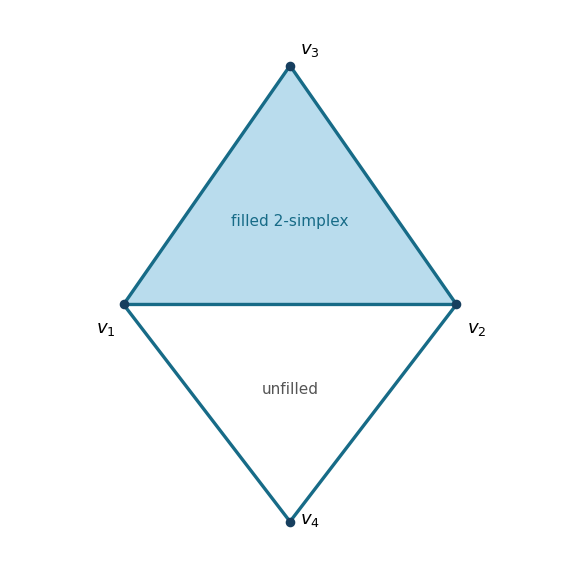
The geometric realization of a simplicial complex consists of the filled triangle together with the two extra edges and . Thus the triangle on has only its boundary:

Past exam of the mathematics course of the University of Cambridge 2020 ii Paper 3 18G b Solution Created 2026-09-24 Updated 2026-09-29
The eleventh cyclotomic field hasThe cyclic group has exactly one subgroup of each order . The Galois correspondence therefore gives exactly four subfields:The Quadratic Gaussian period in the eleventh cyclotomic field satisfies , while generates the maximal real subfield of the eleventh cyclotomic field. Every subgroup of the abelian Galois group is normal, so all four subfields are Galois over .
Each nontrivial proper subfield has prime degree, two or five. If , then , and the tower law forces . Thus every such element is a primitive element. The displayed and are the requested examples. Finally, itself is a primitive element for .
Past exam of the mathematics course of the University of Cambridge 2020 ii Paper 3 18G a Solution Created 2026-09-24 Updated 2026-09-29
Suppose the irreducible quadratic became reducible over . It would then have a root , and would be a quadratic intermediate extension. By the Fundamental theorem of Galois theory, would be a subgroup of index two in and hence a normal subgroup by the index-two subgroup is normal result. But the Simplicity of alternating groups says that is simple, while this subgroup would be proper and nontrivial. This contradiction proves that remains irreducible in .
Past exam of the mathematics course of the University of Cambridge 2020 ii Paper 3 17G iv Solution Created 2026-09-24 Updated 2026-09-29
If the edge lies in no triangle, no vertex can be adjacent to both endpoints; hence the neighbourhoods satisfy .
Suppose . The two disjoint neighbourhoods then partition . If both were independent, every edge would run between these two parts, so would be bipartite andcontrary to . Thus at least one neighbourhood contains an edge, and that edge forms a triangle with or .
We now prove by induction on the Triangle lower bound one edge above the Mantel threshold: every graph on vertices with at least edges has at least triangles. Part (ii) is the base case. For , if every edge lies in a triangle, part (iii) givesOtherwise choose an edge lying in no triangle and put . Deleting removes edges, so the graph hasIf , induction gives at least triangles in , while the nonindependence proved above supplies a further triangle through or .
Past exam of the mathematics course of the University of Cambridge 2020 ii Paper 3 17G iii Solution Created 2026-09-24 Updated 2026-09-29
Let be the number of triangles in a graph. Count incidences in which the edge lies in the triangle . Every edge contributes at least one incidence by hypothesis, while every triangle contributes exactly three. ThereforeThis is the edge-triangle incidence bound.
There are unlisted articles, also show them or only show them.