
Past exam of the mathematics course of the University of Cambridge 2020 ii Paper 2 30J d Solution Created 2026-09-24 Updated 2026-09-29
Past exam of the mathematics course of the University of Cambridge 2020 ii Paper 2 30J c Solution Created 2026-09-24 Updated 2026-09-29
If is shattered by , then all label vectors belong to the union of the label-vector sets generated by the individual classes. The shattering coefficient of a union and the Sauer-Shelah lemma therefore giveTaking base-two logarithms yieldsFor , apply the stated elementary bound with and :If , the assertion follows directly from . Taking the largest shattered sample size proves
Past exam of the mathematics course of the University of Cambridge 2020 ii Paper 2 30J b Solution Created 2026-09-24 Updated 2026-09-29
Past exam of the mathematics course of the University of Cambridge 2020 ii Paper 2 30J a Solution Created 2026-09-24 Updated 2026-09-29
A sample is shattered by when every binary labeling is realized:The shattering coefficient and VC dimension are
For the lower orthants in , the points are shattered: to realize a subset , choose for and otherwise. Conversely, among any points choose, for each coordinate, one point attaining the maximum in that coordinate. At most points have been chosen, so there is an unchosen point . Any lower orthant containing every chosen coordinate maximizer must contain every sample point, including . It cannot realize the labeling that includes all chosen points and excludes . This proves
Past exam of the mathematics course of the University of Cambridge 2020 ii Paper 2 29K v Solution Created 2026-09-24 Updated 2026-09-29
Suppose the claim , payable at time , were replicable. Holdings chosen at time zero are constants, so the time- value of any self-financing portfolio has the affine formBut has a continuous positive density on . No affine function of can equal the quadratic function almost surely. Therefore is not attainable and the market is not complete.
Past exam of the mathematics course of the University of Cambridge 2020 ii Paper 2 29K iv Solution Created 2026-09-24 Updated 2026-09-29
There is no arbitrage. Indeed, part (iii) supplies an equivalent martingale measure, so the fundamental theorem of asset pricing implies absence of arbitrage. Directly, the discounted terminal value of a zero-cost admissible self-financing strategy is a -martingale with mean zero; it cannot be nonnegative almost surely and positive with positive probability.
Past exam of the mathematics course of the University of Cambridge 2020 ii Paper 2 29K iii Solution Created 2026-09-24 Updated 2026-10-03
Set andDefine a probability measure by the positive densityThe density has expectation one and is strictly positive, so is equivalent to . By exponential tilting, the variables remain independent under and have distribution . Thus has a log-normal distribution andFor the discounted stock ,Hence is an equivalent martingale measure.
Past exam of the mathematics course of the University of Cambridge 2020 ii Paper 2 29K ii Solution Created 2026-09-24 Updated 2026-09-29
The model is a complete market when every contingent claim in the specified class, usually every -measurable payoff satisfying the required integrability condition, is the terminal value of some admissible self-financing portfolio.
Past exam of the mathematics course of the University of Cambridge 2020 ii Paper 2 29K i Solution Created 2026-09-24 Updated 2026-10-03
Past exam of the mathematics course of the University of Cambridge 2020 ii Paper 2 27K ii Solution Created 2026-09-24 Updated 2026-09-29
Here the total holding rate isand therefore the jump chain has state-independent transitionsIt is an upward biased random walk on . By the strong law of large numbers, almost surely, so . The jump chain, and hence , is transient.
Counting measure is invariant for this jump chain: for every , its incoming mass is . The invariant-measure transfer between a jump chain and a CTMC therefore gives an invariant measure proportional to . Sincethe normalized invariant distribution of a continuous-time Markov chain isThis does not contradict transience because an invariant distribution of an explosive chain need not imply positive recurrence.
It remains to verify explosion. Starting from zero, the probability that the biased walk ever reaches is . Once it reaches any state, its probability of returning after departure isso its expected total number of visits to that state, conditional on reaching it, is . If is the number of visits to , thenConsequently the expected sum of all holding times isThe nonnegative random variable is therefore finite almost surely. By explosion by summable holding times, makes infinitely many jumps by time , so it is explosive.
Past exam of the mathematics course of the University of Cambridge 2020 ii Paper 2 27K i Solution Created 2026-09-24 Updated 2026-09-29
Write for the total rate of leaving . The jump chain of a continuous-time Markov chain is the discrete-time chain recording the states occupied after successive jumps. Its transition probabilities arewhenever .
The chain is irreducible if every state can be reached from every other state with positive probability. A state is recurrent if, after leaving , the process returns to with probability one; an irreducible chain is recurrent when one, and hence every, state is recurrent.
The continuous-time Markov chain and its jump chain have exactly the same successive states. If is transient, it visits each state only finitely often, so is transient. If is recurrent, it visits a fixed state infinitely often. At those visits, has independent exponential holding times of rate . Their sum diverges almost surely, so explosion cannot occur before all those returns. Hence returns to infinitely often and is recurrent. Thus, for an irreducible chain,
Past exam of the mathematics course of the University of Cambridge 2020 ii Paper 2 26K c ii Created 2026-09-24 Updated 2026-09-24
Past exam of the mathematics course of the University of Cambridge 2020 ii Paper 2 26K c i Created 2026-09-24 Updated 2026-09-24
Past exam of the mathematics course of the University of Cambridge 2020 ii Paper 2 26K b Solution Created 2026-09-24 Updated 2026-09-29
The Caratheodory extension theorem states that a premeasure on an algebra of subsets of extends to a measure on the generated sigma-algebra. If is sigma-finite, this extension is unique. In particular, a finite premeasure has a unique extension.
Past exam of the mathematics course of the University of Cambridge 2020 ii Paper 2 26K a Solution Created 2026-09-24 Updated 2026-10-03
Past exam of the mathematics course of the University of Cambridge 2020 ii Paper 2 25I d Solution Created 2026-09-24 Updated 2026-09-29
LetThis is another unit-speed embedded curve. The assumed identities say that and have the same positive curvature and the same torsion. By the uniqueness part of the fundamental theorem of regular space curves, there is a proper Euclidean motion such thatSince is a bijection of , this motion preserves .
Past exam of the mathematics course of the University of Cambridge 2020 ii Paper 2 25I c Solution Created 2026-09-24 Updated 2026-10-14
For , the closed curveis embedded on a torus and satisfiesAfter arc-length parametrization, it meets all the requirements of part (b). Its bending and twisting vary around the two waves, so neither curvature nor torsion is constant.
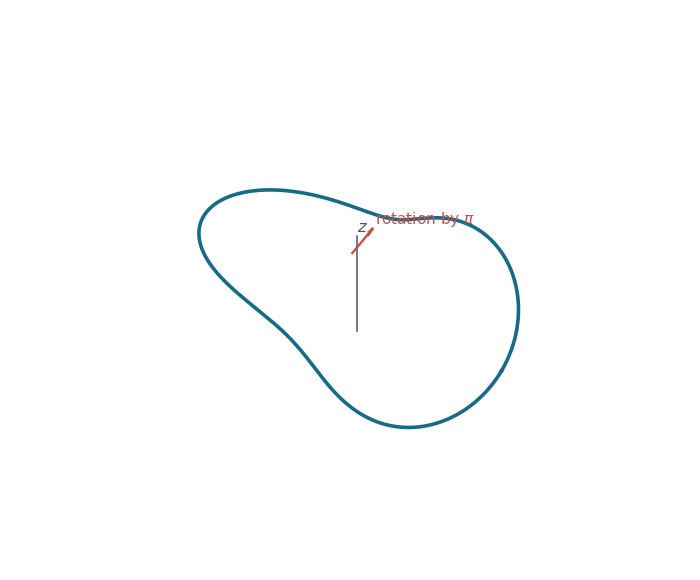
A symmetric closed curve and its reflections
. Details. 
Past exam of the mathematics course of the University of Cambridge 2020 ii Paper 2 25I b Solution Created 2026-09-24 Updated 2026-09-29
The map is a local arc-length coordinate and, when the image is closed, a covering parametrization. The restriction of to the one-dimensional submanifold therefore lifts to a map satisfyingBoth curves have unit speed and is an isometry, so . Continuity makes the sign constant on the connected domain, hence throughout andfor some constant .
A proper Euclidean motion of Euclidean three-space preserves both curvature and torsion. Reversal of an arc-length parameter also preserves them: in the determinant formula for torsion, both the first and third derivatives change sign. Comparing the two expressions for the transformed curve givesand, wherever ,
Past exam of the mathematics course of the University of Cambridge 2020 ii Paper 2 25I a Solution Created 2026-09-24 Updated 2026-09-29
The fundamental theorem of regular space curves states that smooth functions and determine a unit-speed regular curve in with that curvature and torsion, uniquely up to a proper Euclidean motion of Euclidean three-space. Existence follows by solving the Frenet-Serret formulas for an oriented orthonormal frame and then integrating its tangent vector.
Past exam of the mathematics course of the University of Cambridge 2020 ii Paper 2 24F c Solution Created 2026-09-24 Updated 2026-09-29
Suppose an affine line lies in . Parametrize it asThe defining equation would give the polynomial identityThe only units of are nonzero constants. Since a product is a unit only when every factor is a unit, all three linear polynomials must be constant, so . The alleged line is a point, a contradiction. Therefore
There are unlisted articles, also show them or only show them.