
Past exam of the mathematics course of the University of Cambridge 2015 ia Paper 1 3F a Solution Created 2026-09-24 Updated 2026-10-06
For , the usual unit-circle area comparison, with angles measured in radians, gives . HenceThe cosine is a continuous function at zero, so the squeeze theorem yields the right-hand limit of a function . The quotient is even, so the left-hand limit of a function is the same. Thus the limit is .
Past exam of the mathematics course of the University of Cambridge 2015 ia Paper 1 1B b Solution Created 2026-09-24 Updated 2026-10-06
Put . Since , the finite geometric series giveswhere the second equality multiplies numerator and denominator by . Taking imaginary parts gives the finite trigonometric sumTaking real parts of the same finite geometric series givesThe denominator is nonzero by the restriction on . Equivalently, these finite trigonometric sums are and , respectively.
Past exam of the mathematics course of the University of Cambridge 2015 ia Paper 1 1B a Solution Created 2026-09-24 Updated 2026-10-06
Write . Using the complex conjugate, the squared complex modulus on the left is . Squaring the equality and dividing by , which is nonzero, givesCompleting the square identifies the candidate circle:Its centre is on the real axis and its radius is in the complex plane.
It remains to exclude extraneous points introduced by squaring. On this circle, , so the original right-hand side satisfiesThus taking the nonnegative square root recovers the original equality at every point of the circle. This is a circle from an affine complex-modulus equation, with the sign check essential to the geometric conclusion.
Past exam of the mathematics course of the University of Cambridge 2015 ia Paper 1 11D ii Solution Created 2026-09-24 Updated 2026-10-06
For a chord of length , consider the continuous function on . Since ,An endpoint zero already supplies the chord. Otherwise the endpoint values have opposite signs, so the intermediate value theorem supplies at some . Thus a horizontal chord of length exists.
For each integer , define on . The sampled differences telescope:If any sampled value is zero, it gives the required chord. Otherwise there must be both a positive and a negative sampled value. The intermediate value theorem, applied between their sample points, then gives . Hence a horizontal chord of length exists for every positive integer ; for , the endpoint chord itself suffices. This proves the horizontal chord of reciprocal-integer length result, without restricting to powers of two.
Past exam of the mathematics course of the University of Cambridge 2015 ia Paper 1 11D i Solution Created 2026-09-24 Updated 2026-10-06
The intermediate value theorem says that if is a continuous function, then every value between and is attained at some point of .
Endpoint values are already attained. Suppose and define . It is nonempty and bounded above, so exists. Continuity at ensures that contains points to the right of , and continuity at ensures that no point sufficiently close to belongs to . Hence .
By the definition of the supremum, there are points of approaching . If , continuity would exclude all such nearby points from , a contradiction. If , continuity would put some point to the right of in , again a contradiction. Therefore . When , apply this argument to . This proves the intermediate value theorem in all cases.
Past exam of the mathematics course of the University of Cambridge 2015 ia Paper 1 10D b Solution Created 2026-09-24 Updated 2026-10-14
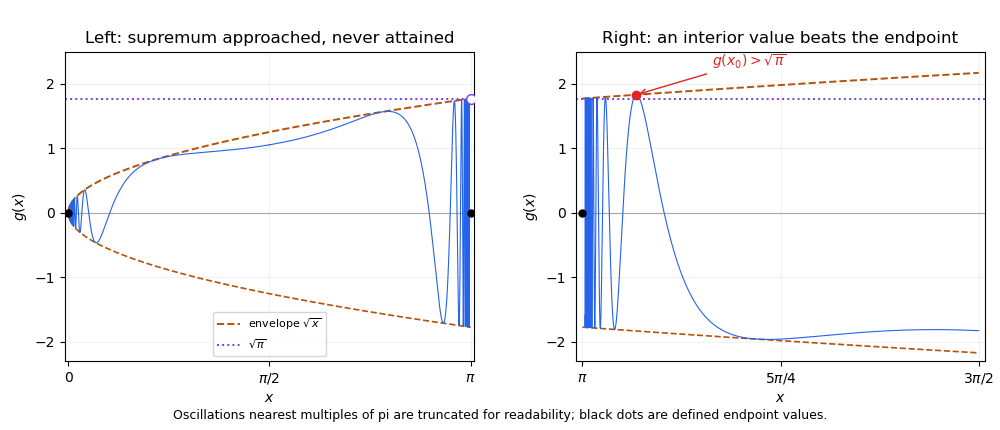
Away from integer multiples of , the function is a composition of continuous functions. At zero, the bound gives by the squeeze theorem. This is oscillation multiplied by a vanishing amplitude.
Fix and set and . Then , , andSo is discontinuous at every nonzero integer multiple of . Its set of continuity points is
On , for , while . With as above, . Consequently the supremum is and is not attained. This illustrates that supremum can fail to be attained at an oscillatory endpoint.
On , set . It lies strictly inside the interval, and , so . Choose . On ,On , is a continuous function, so the extreme value theorem gives a maximum there, at least . It exceeds every value on the discarded interval. Therefore does attain its supremum on . This is the interior-value criterion for an attained maximum.

Past exam of the mathematics course of the University of Cambridge 2015 ia Paper 1 10D a Solution Created 2026-09-24 Updated 2026-10-06
We use the Bolzano-Weierstrass theorem: every bounded real sequence has a convergent subsequence. If were unbounded on , there would be with . The Bolzano-Weierstrass theorem gives a subsequence , and the closed interval contains . Since is a continuous function, , contradicting . Thus is bounded.
Let . By the definition of the supremum, choose with . Again the Bolzano-Weierstrass theorem gives . Continuity yields . Applying the same argument to gives a point where attains its infimum. Therefore both the supremum and the infimum are attained. This proves the extreme value theorem for a closed bounded interval.
Past exam of the mathematics course of the University of Cambridge 2014 ib Paper 4 9H b ii Created 2026-09-24 Updated 2026-09-24
Past exam of the mathematics course of the University of Cambridge 2014 ib Paper 4 9H b i Created 2026-09-24 Updated 2026-09-24
Past exam of the mathematics course of the University of Cambridge 2014 ib Paper 4 9H a Solution Created 2026-09-24 Updated 2026-10-06
The Markov property and the Chapman-Kolmogorov equation giveFor each intermediate state, one first uses the next-step transition probability and then the following one; the sampled history adds no information once is known. Thus is a homogeneous Markov chain with transition matrix and initial law . In particular,If zero is not a state of , this probability is zero.
Past exam of the mathematics course of the University of Cambridge 2014 ib Paper 4 5D ii Solution Created 2026-09-24 Updated 2026-10-06
The sign of the Dirac delta distribution in the equation is positive after the outer minus sign is expanded. Integrating through zero, the nonsingular potential contributes a term tending to zero, whereas the delta term contributes . The jump condition for an impulse is thereforeContinuity at zero gives . The two one-sided derivatives are and , whose difference is exactly . Hence the matching condition introduces no further restriction on , and the globally bounded solution isThis continuous solution has precisely the derivative jump required for its second distributional derivative to cancel the delta term. Its amplitude remains arbitrary because no normalization has been imposed.
Past exam of the mathematics course of the University of Cambridge 2014 ib Paper 4 5D i Solution Created 2026-09-24 Updated 2026-10-06
Away from zero the Dirac delta distribution is absent. On either half-line, use and the power-law ansatz . The Euler-Cauchy equation becomesThe growing term is excluded by boundedness at either end. Thus the independently bounded half-line solutions are
Past exam of the mathematics course of the University of Cambridge 2014 ib Paper 4 17D v Solution Created 2026-09-24 Updated 2026-10-06
For real nonintegral , the Parseval identity and the coefficient formula giveSolving for the sum yieldsAt , the sine square is one and the cotangent is zero, giving .
Past exam of the mathematics course of the University of Cambridge 2014 ib Paper 4 17D iv Solution Created 2026-09-24 Updated 2026-10-06
Evaluate the absolutely convergent complex Fourier series at . The factors equal one, and the term is . Pairing positive and negative integers givesSince for nonintegral complex , rearranging provesThe last term means , so half-integer arguments are included by the finite cotangent value zero.
Past exam of the mathematics course of the University of Cambridge 2014 ib Paper 4 17D iii Solution Created 2026-09-24 Updated 2026-10-06
Integrate the two exponentials in against . For there are no zero denominators, andThus the complex Fourier series isThis is the periodic extension, not a globally nonperiodic cosine formula. For each fixed complex , the coefficients are , giving absolute and uniform convergence. The extension is continuous at the endpoints because the two endpoint values agree; piecewise smooth pointwise convergence of a piecewise smooth Fourier series identifies the sum with it, including those endpoints.
Past exam of the mathematics course of the University of Cambridge 2014 ib Paper 4 17D ii Solution Created 2026-09-24 Updated 2026-10-06
The Parseval identity for a complex Fourier series isIt holds for every square-integrable function, with complex conjugation expressed by the absolute squares. It is the Pythagorean theorem extended to the complete orthonormal system of complex exponentials.
Past exam of the mathematics course of the University of Cambridge 2014 ib Paper 4 17D i Solution Created 2026-09-24 Updated 2026-10-06
The complex Fourier series of a -periodic function isThe coefficient formula follows from orthogonality of the exponential functions. For an arbitrary square-integrable function, this representation means convergence in the norm. With appropriate additional regularity it also gives pointwise convergence, to the mean of the one-sided limits at a jump. No pointwise representation is asserted for an unrestricted function merely from periodicity.
Past exam of the mathematics course of the University of Cambridge 2014 ib Paper 4 13E iii Solution Created 2026-09-24 Updated 2026-10-06
Past exam of the mathematics course of the University of Cambridge 2014 ib Paper 4 13E ii Solution Created 2026-09-24 Updated 2026-10-06
In , takeThese are nonempty descending sets of diameter , with empty intersection. They are not closed sets, so there is no contradiction with the Cantor intersection theorem for the complete metric space .
Past exam of the mathematics course of the University of Cambridge 2014 ib Paper 4 13E i Solution Created 2026-09-24 Updated 2026-10-06
Take the incomplete metric space with its usual distance, andEach is nonempty and closed relative to : it is . The sequence is strictly descending and its diameters are . Its intersection is empty, since every positive point exceeds for sufficiently large . The excluded limiting point is zero.
There are unlisted articles, also show them or only show them.