
Past exam of the mathematics course of the University of Cambridge 2014 ib Paper 4 11E b Solution Created 2026-09-24 Updated 2026-10-06
The set is the ideal quotient . It contains zero. If , then , since is an subgroup. If and , then because is an ideal. Thus is an ideal.
Write and . Because , each has the form . Then , so , and . Conversely by the definition of . Thereforeso is a principal ideal. This argument uses only the commutative ring convention, not cancellation or an integral domain hypothesis.
Past exam of the mathematics course of the University of Cambridge 2014 ib Paper 4 11E a Solution Created 2026-09-24 Updated 2026-10-06
With the usual commutative, unital conventions, the chain isA field is an integral domain, and every nonzero ideal contains an invertible element and is consequently the whole ring. Its only ideals are and , so it is a principal ideal domain.
To prove the middle implication, first show that a principal ideal domain has the ascending chain condition on ideals. The union of an ascending chain is an ideal, hence is ; its generator belongs to one member of the chain, and all later members equal . Now suppose a nonzero nonunit admitted no factorization into irreducible elements. It would factor into two nonunits, at least one of which again has no such factorization. Repeating would produce a strictly increasing chain of principal ideals: if with a nonunit, , since equality and cancellation would make invertible. This contradicts the ascending chain condition. Existence of factorization follows. By the permitted fact that every irreducible element is a prime element in a principal ideal domain, any irreducible factor in one factorization divides a factor in the other; cancellation then proves uniqueness up to units and order. This is a unique factorization domain. The final implication is part of the definition of a unique factorization domain.
None of the adjacent implications reverses. The principal ideal domain is not a field, since is not invertible. The polynomial ring is a unique factorization domain, by applying the polynomial extension theorem for unique factorization domains twice, but its ideal is not principal: a generator would divide both and , so would be a unit, whereas every member of this ideal vanishes at the origin. Finally, is an integral domain as a subring of , but is not a unique factorization domain. Its multiplicative norm is . There is no element of norm or . Hence , of norms , are all irreducible: a nontrivial factorization would require one of those missing norms. The only units have norm one and are . The two factorizationsare therefore not related by associates and reordering.
Past exam of the mathematics course of the University of Cambridge 2014 ib Paper 2 7B iii Solution Created 2026-09-24 Updated 2026-10-14
Here . The streamlines are , straight lines parallel to . The entire line is stationary. On the side the motion is northeast, and on the side it is southwest. In orthonormal coordinates , , the velocities are , : this is simple shear flow. The right panel shows both moving families and the stationary line.
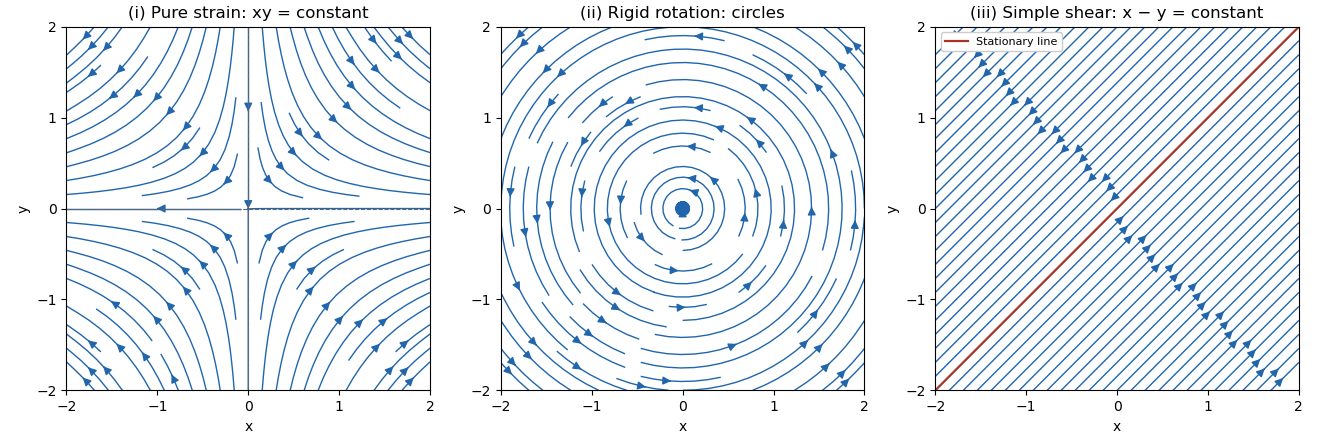
Planar strain, counterclockwise rigid rotation and diagonal simple shear, with arrows showing the three streamline directions
. Details. 
Past exam of the mathematics course of the University of Cambridge 2014 ib Paper 2 7B ii Solution Created 2026-09-24 Updated 2026-10-06
Here , . The streamlines are . This is rigid rotation counterclockwise with angular velocity one; the origin is a stagnation point and all other trajectories are circles. The middle panel shows their orientation.
Past exam of the mathematics course of the University of Cambridge 2014 ib Paper 2 7B i Solution Created 2026-09-24 Updated 2026-10-06
Here , . The streamlines are , rectangular hyperbolas, together with the coordinate axes as separatrices. Particles satisfy , : the flow stretches along the axis and compresses along the axis, with a saddle stagnation point at the origin. The left panel shows the flow directions.
Past exam of the mathematics course of the University of Cambridge 2014 ib Paper 2 5D iii Solution Created 2026-09-24 Updated 2026-10-06
Every sine term vanishes at zero, so . The one-sided values of the periodic extension of are and . The Fourier series converges at this jump to their midpoint,This midpoint need not equal the arbitrarily assigned value of the periodic derivative at the endpoint.
Past exam of the mathematics course of the University of Cambridge 2014 ib Paper 2 5D ii Solution Created 2026-09-24 Updated 2026-10-06
The endpoint agreement makes the boundary terms vanish when integrating the Fourier coefficients of by parts. If denote these coefficients, thenThese are exactly the coefficients obtained by differentiating the preceding Fourier series:On every compact subinterval of the differentiated series converges uniformly by the Dirichlet test, since partial sums of the sine factors are uniformly bounded there. The Termwise differentiation of a Fourier series is therefore valid away from integers and gives on . At an integer the periodic original has a corner, so the differentiated series is not asserting the existence of an ordinary derivative there.
Past exam of the mathematics course of the University of Cambridge 2014 ib Paper 2 5D i Solution Created 2026-09-24 Updated 2026-10-06
Use the real Fourier series conventionThe constant coefficient is . Reflection about changes the sine factor's sign and preserves the quadratic, giving . Two integrations by parts, with , giveConsequently the Fourier series of a periodically extended quadratic arch isThe periodic function is continuous, including at integers where its value is zero. Its piecewise smoothness gives pointwise Fourier series convergence everywhere, and the summable coefficient bound gives uniform and absolute convergence.
Past exam of the mathematics course of the University of Cambridge 2014 ib Paper 2 4E iii Solution Created 2026-09-24 Updated 2026-10-06
True. Let . For every open ,which is open in because is an open map. Thus is continuous. Together with the given continuity and bijectivity of , this establishes a homeomorphism. This is inverse continuity from an open bijection.
Past exam of the mathematics course of the University of Cambridge 2014 ib Paper 2 4E ii Solution Created 2026-09-24 Updated 2026-10-06
False. Give the discrete topology and its usual topology. The identity bijection is continuous because every inverse image is a subset of the discrete space and hence is open. But is not continuous: the open set of has inverse image , not open in . Thus a continuous bijection need not be a homeomorphism.
Past exam of the mathematics course of the University of Cambridge 2014 ib Paper 2 4E i Solution Created 2026-09-24 Updated 2026-10-06
False. The constant continuous function , , sends the open set to , which is not open. Therefore continuity alone does not imply an open map.
Past exam of the mathematics course of the University of Cambridge 2014 ib Paper 2 17A ii Solution Created 2026-09-24 Updated 2026-10-06
For the near-origin probability in a maximal-angular-momentum hydrogen state, integrate the normalized radial probability density:Throughout this small interval the exponential is for fixed . HenceUsing the normalization above,The high power of the small radius reflects the near-origin behavior of the hydrogen atom state.
Past exam of the mathematics course of the University of Cambridge 2014 ib Paper 2 17A i Solution Created 2026-09-24 Updated 2026-10-06
The normalized spherical harmonics separate the angular variables. The Radial Schrodinger equation for the hydrogen atom isWrite . ThenSubstitution separates a constant term and a term. The latter vanishes precisely when . With this determines the Bohr radiusThe constant term determinesThese are the maximal-angular-momentum hydrogen states, with principal quantum number .
Past exam of the mathematics course of the University of Cambridge 2014 ib Paper 2 16D b Solution Created 2026-09-24 Updated 2026-10-06
The Duhamel principle superposes the response to source impulses:This expression uses the source at the origin, is causal, and has zero initial data in the distributional sense. Its integral over the plane is , consistent with the injected total amount.
For the finite-duration source and , set . The causal diffusion from a finite-duration planar point source becomesWith , or by differentiating the supplied exponential integral, this isIf , both arguments are small. Their logarithmic constants and cancel, leavingAt the origin this logarithmic expression is exact for , obtained as the limit . The leading spatial correction is . If also , the leading value is .
Past exam of the mathematics course of the University of Cambridge 2014 ib Paper 2 16D a Solution Created 2026-09-24 Updated 2026-10-06
Take the Fourier transform in . The transform of the source is , so the Green function equation becomesChoose the causal Green function, zero for . Away from the solution is a decaying exponential, and integrating across gives the jump . ThereforeThe phase shifts the kernel's centre to . Applying the inverse Fourier transform and the Fourier transform of a Gaussian with givesFor positive elapsed time this heat kernel solves the homogeneous diffusion equation and has unit integral; as elapsed time tends to zero it approaches the spatial delta distribution, supplying the required impulse.
Past exam of the mathematics course of the University of Cambridge 2014 ib Paper 2 12F iv Solution Created 2026-09-24 Updated 2026-10-06
True, and the closedness assumption on is unnecessary. The Minkowski sum has the representationEach translate of the open set is open, and an arbitrary union of open sets is open. If is empty the union is empty, which is also open.
Past exam of the mathematics course of the University of Cambridge 2014 ib Paper 2 12F iii Solution Created 2026-09-24 Updated 2026-10-06
False. In , letEach is closed: its distinct points escape to infinity, so it has no finite accumulation point. Their Minkowski sum contains , tending to zero. However zero is not in the sum. If with positive integers , then . For the right side is strictly between zero and one, while the left side is an integer; for the equation would require . Thus the sum of two closed sets need not be closed. The same counterexample embeds along a coordinate axis in .
Past exam of the mathematics course of the University of Cambridge 2014 ib Paper 2 12F ii Solution Created 2026-09-24 Updated 2026-10-06
True. The same subsequence argument applies to the sum of a compact set and a closed set. For a convergent sequence , boundedness of provides a convergent subsequence of , with limit . Then along that subsequence. Consequently . No boundedness of is needed.
Past exam of the mathematics course of the University of Cambridge 2014 ib Paper 2 12F i Solution Created 2026-09-24 Updated 2026-10-06
True. Boundedness follows from . To prove closedness of the Minkowski sum, let converge to . By the Bolzano-Weierstrass theorem, the bounded sequence has a subsequence converging to . Closedness gives . Along that subsequence, , which belongs to by closedness. Thus . This proves that the sum is bounded and closed.
Past exam of the mathematics course of the University of Cambridge 2014 ib Paper 2 10G ii Solution Created 2026-09-24 Updated 2026-10-06
For the determinant of a complex block representation, putThe change-of-basis matrix is invertible, and direct block multiplication givesThus is block diagonal. Using multiplicativity of the determinant and the preceding block formula,The identity follows from this constant change of basis for arbitrary complex .
There are unlisted articles, also show them or only show them.