
Vector triple product Created 2026-09-24 Updated 2026-10-14
Contracting two Levi-Civita symbols gives
Lagrange identity for the cross product Created 2026-09-24 Updated 2026-10-03
Contraction of two Levi-Civita symbols Created 2026-09-24 Updated 2026-10-06
Contracting one index gives
Critical threshold for level-set percolation Created 2026-09-24 Updated 2026-09-24
The critical threshold is the boundary between levels at which an unbounded superlevel component can occur and levels at which every superlevel component is almost surely finite.
Legendre polynomial Created 2026-09-24 Updated 2026-10-06
Generalized Laguerre polynomial Created 2026-09-24 Updated 2026-09-24
Bias of a kernel density estimator Created 2026-09-24 Updated 2026-09-28
Uniformly most powerful upper-tail test for a logistic location Created 2026-09-24 Updated 2026-09-24
Hodge decomposition theorem for compact Kähler manifolds Created 2026-09-24 Updated 2026-10-14
This is the compact Kähler specialization of Hodge theory.
Fubini-Study form Created 2026-09-24 Updated 2026-10-14
The Fubini-Study form is the standard Kähler form on complex projective space. With the integral normalization, .
The two-form is associated with the Fubini-Study metric.
Lefschetz operator of a Kähler manifold Created 2026-09-24 Updated 2026-10-14
The Lefschetz operator of a Kähler manifold is exterior multiplication by its Kähler form,Its formal adjoint is denoted by and lowers the bidegree of a differential form by .
This wedge operator participates in the Kähler identities; the theorem on integral classes is a different result.
Hecke parameter of a BN-pair Created 2026-09-24 Updated 2026-09-24
For a representative , the Hecke parameter isThe Iwahori-Hecke algebra of a BN-pair is obtained from the generic algebra by .
Implicit function theorem Created 2026-09-24 Updated 2026-10-14
An equation can define a function without giving an explicit formula for it. The implicit function theorem tells us when the constraint determines uniquely from nearby , and makes the resulting function continuously differentiable. It is useful when solving an equation explicitly is cumbersome or impossible: the partial derivatives already reveal whether local recovery is possible.
Let be a continuously differentiable map from an open subset of to . Suppose and the partial derivative is an invertible linear map. There are open neighbourhoods of and of and a unique continuously differentiable function such that, for ,Thus the nearby level set is a graph of a function. The derivative of this graph isThe matrix inverse acts on the left; the order matters in several dimensions.
For example, take the unit circle, written as the level set . At , , so the local upper branch is . Implicit differentiation givesThis tangent line slope is available directly from the constraint. The negative square root branch is elsewhere on the same circle; it does not destroy uniqueness near the selected upper point.
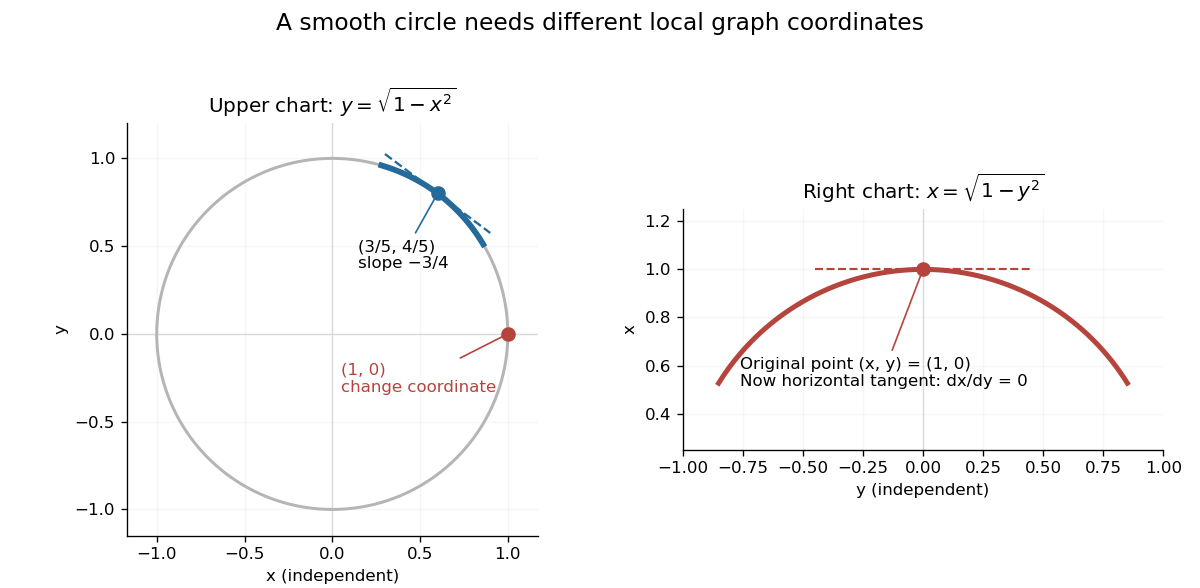
The same circle uses y as a function of x near its upper arc and x as a function of y near its rightmost point
. Details. 
At , however, and the circle cannot be represented locally as one function : just to the left of there are two nearby values of . The circle is still smooth there. Since , use the other coordinate instead: , with . A failed coordinate choice is different from a geometric singularity.
The derivative condition is sufficient, not necessary for every possible implicit graph. For , the entire zero set is the smooth graph , even though vanishes there. In this case the defining equation itself has a degenerate derivative; the theorem's test gives no conclusion.
The connection to the inverse function theorem is particularly elegant. Augment the constraint to the map , whose Jacobian matrix isIts determinant is . When this is nonzero, locally invert and set its second output to zero. The recovered second input is . In this way an implicit constraint becomes an ordinary inverse function problem. [ref]
https://www.math.utoronto.ca/courses/mat237y1/20199/notes/Chapter3/S3.3.html. University of Toronto MAT237: the implicit theorem as a corollary of the inverse theorem
Local diffeomorphism Created 2026-09-24 Updated 2026-10-14
A local diffeomorphism is a differentiable map that restricts near every point to a diffeomorphism onto an open subset of its target. The local inverse functions need not combine into a single global inverse function: different parts of the domain of a function can map onto the same output region.
For continuously differentiable maps between open subsets of , being a local diffeomorphism is equivalent to having an invertible derivative at every point. The inverse function theorem proves one direction. For the other, the chain rule for each local inverse function gives two inverse linear maps. The periodic angle example under the inverse function theorem has this property everywhere, even though it has infinitely many inputs for every point of the punctured plane. The noninjective map with constant Jacobian determinant gives another useful distinction: even a constant nonzero Jacobian determinant need not give global injectivity.
Every local diffeomorphism is an open map. To see this, take an open subset of the source and intersect it with the neighbourhoods where the map is a diffeomorphism. Each local image is open, and their union is the full image. Thus nearby outputs remain available locally, despite the possible global ambiguity.
Fast holding rates create continuous-time positive recurrence Created 2026-09-24 Updated 2026-09-24
A recurrent jump chain with infinite invariant measure can yield a positive-recurrent continuous-time chain when .
Slow holding rates destroy positive recurrence Created 2026-09-24 Updated 2026-09-24
Even when the jump chain has invariant probability , the continuous-time invariant measure may have infinite mass if holding rates become too small, producing infinite mean return time.
Continuous bijection of the real line is monotone Created 2026-09-24 Updated 2026-09-24
Every continuous injective function from a real interval to the real line is strictly monotone. A continuous bijection therefore has a continuous inverse.
Telescoping increment lemma Created 2026-09-24 Updated 2026-09-24
Zero on a line segment Created 2026-09-24 Updated 2026-10-06
If a continuous real-valued function on a real or complex vector space has opposite signs at two points, restricting it to the line segment between them and applying the intermediate value theorem gives a zero.
Wild inertia group Created 2026-09-24 Updated 2026-09-24
The wild inertia group is the first ramification group . It is the unique Sylow subgroup of the inertia group for the residue characteristic.
There are unlisted articles, also show them or only show them.