
A null geodesic congruence is a smooth family of null geodesics filling a region without intersections there. For affine tangent , the null expansion is the trace of the optical tensor: for an infinitesimal pencil's area. Positive expansion means spreading; negative expansion means focusing.
For hypersurface-orthogonal generators in four dimensions, the Null Raychaudhuri equation readsThe null twist vanishes. The null energy condition implies through the Einstein field equations. An initial would force a focal point within affine distance at most . A future-complete generator cannot develop such a point while remaining on an achronal event horizon. Thus under the energy and global predictability/future-completeness hypotheses of Hawking's area theorem. Quantum energy-condition violations or failure of those global assumptions remove the conclusion.
The event horizon is the global boundary and depends on the whole future. An apparent horizon on a chosen spacelike slice is the outermost marginally outer trapped surface, ordinarily , . It is quasi-local and slice-dependent; its tube need not be null.
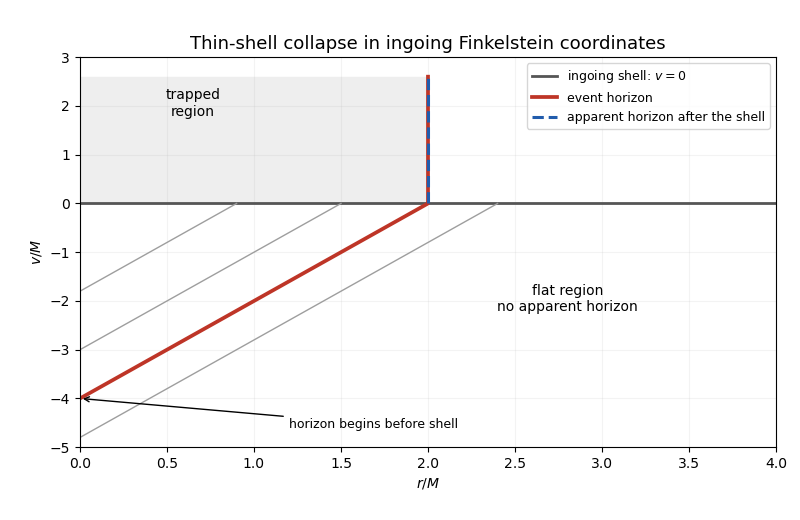
For a shell arriving at , the final horizon is . Before arrival, outgoing flat-space rays obey . Tracing this horizon backward gives until its beginning at , . No apparent horizon exists in that earlier flat region, explicitly illustrating the event horizon's dependence on future collapse.
The future domain of dependence consists of points through which every past-inextendible causal curve meets the partial Cauchy hypersurface . Data on determine evolution there for suitable hyperbolic equations. Its future boundary is the Cauchy horizon ; one precise definition is .
For a nonextremal Reissner-Nordstrom spacetime, , the metric function is , with . The outer event horizon lies at . The future trapped region leads toward the inner null surface , a future Cauchy horizon for bridge data on the illustrated . Beyond it some past causal curves arrive from other analytic blocks or timelike singularities without meeting . The CP diagram repeats these analytic blocks; is a timelike curvature singularity.
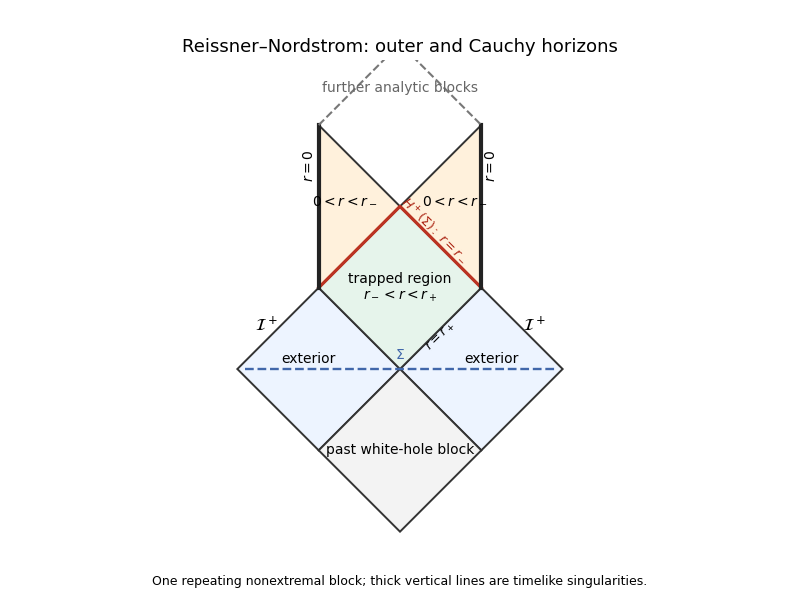
Reissner-Nordstrom conformal block with bridge data and future Cauchy horizons
. Near the inner horizon, arbitrarily late exterior radiation is compressed into finite infaller proper time. Its frequency is exponentially blueshifted, with scale , so even a decaying flux can have diverging measured stress. Generic ingoing and outgoing perturbations produce mass inflation, growing internal mass and curvature. The smooth RN Cauchy horizon is expected to be unstable to back-reaction. This is a generic instability argument, not a universal theorem from every specially tuned test trajectory; the approximation of a harmless test particle becomes inconsistent.
Locally write the null hypersurface as , , with normal , . A vector is tangent exactly when . Nullness gives on the hypersurface. Hence : its normal direction lies inside its tangent space.
Put and . Torsion freedom gives . Since vanishes on , all tangential derivatives vanish there and there for a scalar . ConsequentlyThis is the unparametrized null geodesic equation. The integral curves are therefore generators of . An affine rescaling of a null normal removes the proportionality coefficient locally: if , set with .
Use metric signature and a future-oriented worldline. Variation of the worldline einbein gives the mass-shell condition; variation of momentum givesEliminating first leaves . Its equation is . Choose the positive lapse branch ; substituting gives . Thus , the proper time action. The lapse branch fixes the sign convention. Eliminating auxiliary variables on their algebraic equations preserves the worldline equations, which are timelike geodesics up to parametrization.
Past exam of the mathematics course of the University of Cambridge 2012 iii Paper 43 5 iii Solution 2026-10-07
A strictly increasing differentiable concave utility function on all of has everywhere. Otherwise monotonicity and the decreasing derivative would make it constant on a right half-line. Its tangent at zero also shows as .
If has only one sign, the stated second alternative already holds. Otherwise both and are positive. As , tends to infinity on ; as , it does so on . Since , Fatou lemma implies at both ends. Continuity gives a finite maximizer , and differentiability gives .
For optimal marginal utility as a one-period pricing density, put . It is strictly positive. On it is bounded by , whose expectation is finite by part ii. On continuity bounds on the compact interval . Thus is integrable and is absolutely integrable. Consequently . Normalizing by its positive expectation, if desired, makes it a probability density with the same zero pricing expectation.
Past exam of the mathematics course of the University of Cambridge 2012 iii Paper 30 2 b Solution 2026-10-07
For bond percolation, let be the percolation cluster of the origin. Its percolation probability isWe prove by alternating arms at the self-dual parameter, using the uniqueness of the infinite percolation cluster proved in Question 4. Suppose instead that .
At , declaring a dual edge open exactly when its crossing primal edge is closed produces independent dual bond percolation with the same parameter on . It therefore also has an infinite percolation cluster almost surely, and at most one. The two preliminary arguments below imply that, for a sufficiently large square, the probability of two primal infinite exterior arms starting through its top and bottom sides exceeds . Applying the same arguments to the dual lattice gives probability greater than for dual infinite exterior arms starting through the left and right sides. Thus all four arms occur together with positive probability, by the union bound.
Here are precise boundary conventions for the alternating exterior-arm separation lemma. Use the primal graph vertex box , the dual graph vertex box , and the common continuous square with sides at . The primal arms first cross its top and bottom; the dual arms first cross its left and right. Subsequent graph vertices of every arm lie outside this continuous square. Large gives the required probabilities for both boxes, by the same rotational symmetry and boundary-side estimate. Primal open paths and dual open paths cannot cross, since the two states of a crossing edge are complementary.
The two primal arms cannot meet in the exterior. If they did, a finite simple primal crosscut in the exterior would join the top and bottom entry points. Together with one of the two arcs of the square boundary it would enclose a bounded region containing one of the dual entry points. That dual exterior arm could not reach infinity without crossing the primal crosscut or the forbidden square interior. This is the alternating exterior-arm separation lemma. Thus the two primal arms are disjoint.
Now modify only the primal edges with both endpoints in , making them open. Their grid supplies a simple interior path joining the two primal arm roots. The unchanged exterior arms and this connector form a proper doubly infinite simple primal path. Such a path separates the plane into two sides, by the Jordan curve theorem applied to its one-point compactification in the sphere. The left and right dual arms lie on opposite sides. Preserve their tails from their first exterior dual graph vertices; none of those tails crosses a modified edge. Their original boundary attachment edges may be destroyed, but the infinite exterior tails themselves remain. They now belong to two distinct infinite dual clusters, since any dual connection between them would have to cross the doubly infinite primal path.
This modification has positive probability by the finite-energy property of Bernoulli percolation: condition on the exterior configuration and open the finitely many interior edges. The exterior projections of the four-arm event have positive probability. The resulting positive-probability event with two infinite dual clusters contradicts uniqueness of the infinite percolation cluster on the dual lattice. Therefore
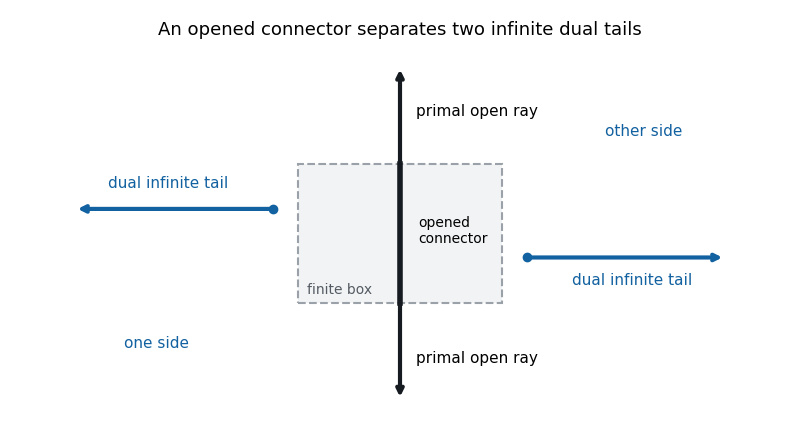
An opened connector separates two infinite dual tails
. Only the selected paths are drawn. The black connector lies in the finitely modified box; the two blue infinite dual tails remain outside and on opposite sides.
The proof uses self-duality, symmetry, positive association, finite-energy property of Bernoulli percolation and uniqueness; it does not assume the Harris-Kesten theorem as a black box. The boundary language means an infinite ray whose first graph vertex is on the side and all later graph vertices are outside the graph vertex box. It cannot mean literal intersection of two disjoint sets, a closed box boundary and its strict complement.
Past exam of the mathematics course of the University of Cambridge 2012 iii Paper 21 1 5 Solution 2026-10-07
Put , choose a -basis of , and let be its reduced norm polynomial. For , considerThis has degree and variables. The property gives a nontrivial zero . Necessarily : otherwise forces in the division algebra, making the whole coordinate vector zero. Homogeneity now gives . The value zero is achieved by the zero element. HenceThis is the surjectivity of reduced norms over C2 fields, and the proof also gives the multiplicative surjection . The argument works for degree one as well.
Past exam of the mathematics course of the University of Cambridge 2012 iii Paper 21 1 4 Solution 2026-10-07
Let be the full constant field of . It is a finite extension of the given finite field, hence is itself finite. Since is perfect and algebraically closed in , the one-variable extension is regular. In a common algebraic closure, put . Then is the function field of a geometrically integral curve over the algebraically closed field .
The Tsen theorem makes a field, and the preceding argument gives . Thus is a matrix algebra. A splitting isomorphism and its inverse involve only finitely many coefficients in . All these coefficients lie in for some finite extension , since is the union of these finite constant extensions. The two isomorphism identities consequently already hold over , so splits there.
Finite extensions of a finite field are cyclic, and regularity gives and preserves their degree under this scalar extension. Thereforeis cyclic. A finite cyclic extension of constants splits . This is cyclic splitting by extension of constants. The argument does not assert that the splitting extension has degree exactly the index of ; a larger cyclic constant extension is sufficient for the requested conclusion.
Past exam of the mathematics course of the University of Cambridge 2012 iii Paper 21 1 3 Solution 2026-10-07
Every Brauer class has a central division algebra representative , and every central simple algebra is a matrix algebra over such a . Put ; its reduced norm is a homogeneous degree- polynomial on the -dimensional vector space .
If , then , so the property supplies a nonzero with . But every nonzero element of a division algebra is invertible, and its reduced norm cannot be zero. Thus , and a central division algebra of degree one is itself. Every central simple algebra over is therefore a matrix algebra over , givingThis proves the trivial Brauer group of a C1 field. The essential ingredient is the anisotropy of a division algebra's reduced norm, not the norm polynomial of an arbitrary matrix algebra, which certainly can vanish on nonzero singular matrices.
Past exam of the mathematics course of the University of Cambridge 2012 iii Paper 21 1 2 Solution 2026-10-07
For a nonnegative integer , a Cr field is a field over which every homogeneous polynomial of positive degree in variables has a nontrivial zero. Thus a C1 field uses the bound , and a C2 field uses .
The required field theorems are as follows. The Chevalley-Warning theorem implies that every finite field is : the number of zeros of a polynomial with degree smaller than its number of variables is divisible by the characteristic, and for a homogeneous polynomial the origin is already a zero. The Lang-Nagata theorem for Ci fields states that a finitely generated extension of transcendence degree of a field is . The Tsen theorem states that the function field of a curve over an algebraically closed field is . In particular, finite fields, algebraically closed fields and fields such as are examples of fields. A function field of one variable over a finite field is by the Lang theorem. These are statements of the theorems; no theorem proof is needed here.
For the requested finite extension stability of C1 fields, let and choose a -basis of . Given a homogeneous of degree with , substitute and take the field norm:The field norm is the determinant of multiplication on the -dimensional -space , hence a homogeneous polynomial of degree in its coordinates. Consequently is homogeneous of degree in variables over . The property gives a nonzero coordinate vector with . Its corresponding vector is nonzero, since the are a basis. The norm of a field element vanishes only for the zero element, so . Every finite extension of a field is . This proof includes inseparable finite extensions, because the determinant definition of the field norm requires no separability.
Past exam of the mathematics course of the University of Cambridge 2012 iii Paper 17 2 4 Solution 2026-10-07
Let . The preceding invariant formula for the exterior derivative identifies the expression in the question withIts vanishing for every pair of global vector fields is equivalent to : global fields with arbitrary prescribed tangent values are available by bump-function extension. Thus it is exactly the condition that be a closed differential one-form.
By definition, the first de Rham cohomology is closed one-forms modulo exact differential forms. The hypothesis makes every closed one-form exact. Hence gives a globally smooth function with , andConversely, if , thenby the definition of the Lie bracket of vector fields. Equivalently, . The bracket compatibility condition is necessary and, when , sufficient for a global potential. The potential is unique up to a constant on each connected component, since the difference of two potentials has zero differential.
Past exam of the mathematics course of the University of Cambridge 2012 iii Paper 17 2 3 Solution 2026-10-07
Define the pointwise representation of one-forms by vector-field functionals byIt is -linear, its value is a smooth function, and implies . Moreoverso it is a map of -modules. This is the properly typed scalar-multiplication property: the same symbol for a form and its associated functional is understood through .
To construct its inverse, let and . Choose a global smooth vector field with ; a local coordinate field multiplied by a smooth bump function supplies such an extension. SetThis is well-defined: if , then vanishes at , so . Real linearity of makes a covector. In fact the pointwise vanishing assumption also forcesbecause vanishes at . Thus for every smooth , even though only real linearity was initially imposed.
It remains to prove smoothness, rather than assume continuity of an abstract linear map. Near a fixed point, choose global fields equal to the coordinate basis on a smaller neighborhood, using a bump function equal to one there. On that neighborhood,All coefficients are smooth by the definition of , so is a smooth differential one-form. The construction holds near every point, hence gives with globally.
Every tangent vector can be realized by a global field, so forces . The inverse just constructed gives surjectivity. The evaluation map is a natural -module isomorphism . No auxiliary metric or connection was chosen.
Past exam of the mathematics course of the University of Cambridge 2012 iii Paper 17 1 2 Solution 2026-10-07
The local flow of is the smooth map , where is the maximal open domain of initial-point/time pairs, whose curve is the maximal integral curve of a vector field through , with . Smooth dependence in the ordinary differential equation theorem gives joint smoothness and openness of . Each time slice is a diffeomorphism between its domain and image, with inverse .
Here is the group law, including its domain qualification. Fix where the relevant trajectories exist. Both curvessolve the same autonomous ordinary differential equation and have value at . The uniqueness from the first part therefore giveson their common interval. These are local identities; neither the vector field nor its local flow has been assumed complete.
For the commuting local flows and , differentiate with respect to at zero. The chain rule givesThus the pushforward of a vector field by the flow equals . Interchanging the two fields gives the analogous identity for under .
Now let . Pointwise linear independence makes this a rank-two smooth distribution. The identity just proved implies : in coordinates, differentiating at gives , precisely the vanishing Lie bracket of vector fields. The bracket of two local sections is also in , sinceand the analogous terms for and remain in the same span. Therefore is an involutive distribution.
The Frobenius theorem says that a smooth constant-rank involutive distribution has local coordinates in which it is spanned by , and has unique maximal connected integral manifolds through its points. These are the leaves of a regular foliation. Let be the maximal leaf through . The global confinement to an immersed leaf gives the answer: is a two-dimensional immersed integral manifold and every smooth -tangent curve starting at stays in .
For the curve assertion, in each Frobenius chart the transverse coordinate functions have zero derivative along such a curve. Hence its segment in that chart stays in one plaque. On any compact subinterval of the curve's parameter interval, a finite chain of overlapping such segments connects the initial plaque to the last; all belong to the same maximal leaf. Exhausting the parameter interval proves the assertion for every time.
The two commuting local flows also give the leaf parametrization directly near :Its partial derivatives are and , by the pushforward identity. Its differential has rank two. The constant rank theorem makes a sufficiently small image an embedded local plaque with tangent plane . This is a concrete local construction of the integral manifold.
There is a global distinction in the word “submanifold”. If it is required to mean an embedded submanifold, the assertion for all times is not valid in general. On the three-dimensional torus , takeThe fields are independent and commute, and their dense immersed cylinder in a three-dimensional torus through zero isIt is an injectively immersed cylinder and is dense in the torus. Indeed, fixing and varying by integers makes dense by an irrational rotation of the circle; is unrestricted. Every point of this leaf is reached by a tangent curve . An embedded surface containing it would, in a submanifold chart near one of its points, be a closed coordinate plane containing a dense subset of the ambient open chart, an impossibility. Thus the global conclusion uses an immersed leaf; the embedded conclusion is local, for curve segments remaining in a suitable chart.
There are unlisted articles, also show them or only show them.