
Complex projective space Created 2026-09-24 Updated 2026-09-24
Vector bundle Created 2026-09-24 Updated 2026-09-28
A rank- vector bundle is locally isomorphic over the base to the projection , with linear transition maps on fibers.
Cohomology Created 2026-09-24 Updated 2026-10-13
Cohomology is the contravariant counterpart of homology, formed from cochains and coboundaries. A coefficient ring equips it with the cup product and hence with a graded ring structure.
Simplicial cone Created 2026-09-24 Updated 2026-10-13
Realization of the simplicial construction produces the corresponding topological cone.
Simplicial complex Created 2026-09-24 Updated 2026-10-03
Snake lemma Created 2026-09-24 Updated 2026-09-24
Lefschetz fixed-point theorem Created 2026-09-24 Updated 2026-09-24
If , then has a fixed point. For a fixed-point-free map, sufficiently fine simplicial approximation has zero diagonal chain coefficients, hence zero Lefschetz number.
Lefschetz number Created 2026-09-24 Updated 2026-09-24
, equivalently the alternating trace on simplicial chains.
Topological group Created 2026-09-24 Updated 2026-10-13
A topological group is a group equipped with a topology for which both the group operation and taking an inverse element are continuous functions:Here has the product topology: continuity of multiplication concerns both inputs together. Thus nearby motions compose to nearby motions, and undoing a motion also varies continuously. The definition alone does not impose compactness; we state the Hausdorff space assumption explicitly when it is needed.
The additive group of real numbers, with its usual topology, is a topological group: and are continuous functions. Its identity element is . The circle group instead uses multiplication of complex numbers on the unit circle, with the subspace topology from the complex plane:Its identity element is , and its inverse element is the complex conjugate. Multiplication on the complex plane and complex conjugation are continuous functions, so their restrictions verify the required continuity. Angles add, but points multiply: a quarter-turn followed by another quarter-turn gives , and the next two quarter-turns return to . Ordinary addition would fail to stay on the unit circle, since .
For any fixed , the translations and are homeomorphisms, with inverses given by translation by . Consequently the neighbourhoods of the identity element determine the entire topology. This is why local information near one motion can control a whole family of symmetries. See Tornier, Haar Measures, section 1.1 for these basic properties of topological groups.
Covering space Created 2026-09-24 Updated 2026-10-03
A covering map is locally a disjoint union of homeomorphisms onto the same evenly covered open neighbourhood.
Fundamental group Created 2026-09-24 Updated 2026-10-13
The fundamental group consists of based loops modulo based homotopy. Multiplication follows one based loop and then the other; the constant based loop represents the identity, and path reversal gives the inverse. Passing to homotopy classes makes this operation associative, as explained by well-defined loop concatenation.
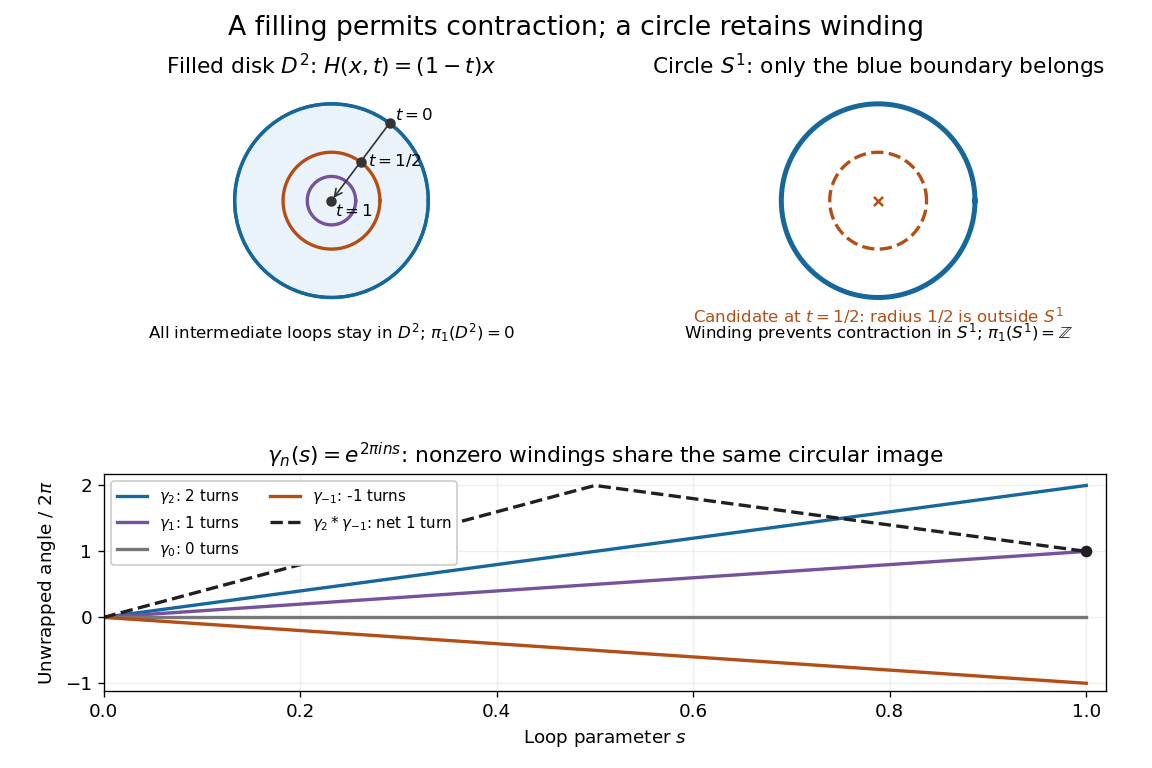
Identify the circle with and choose basepoint . Its based loopshave winding number : positive counts counterclockwise turns, negative counts clockwise turns, and gives the constant based loop. Every based loop on the circle is joined by a based homotopy to exactly one . ConsequentlyThis is Hatcher's Theorem 1.7 in Algebraic Topology, §1.1, pp. 29–30. For example, two counterclockwise turns followed by one clockwise turn represent , rather than three turns. The winding graph in the figure above makes the signed arithmetic visible.
A proof outline uses the covering map , . By the path lifting theorem, a based loop has a unique lift starting at zero and ending at an integer . Interpolating its lift to produces a based homotopy to . The homotopy lifting theorem for a covering map keeps that endpoint unchanged during a based homotopy, proving uniqueness.
In the filled disk, every based loop at has a based homotopy to the constant based loop:Both endpoints remain , and the convex set property of the disk keeps every intermediate point inside. Thus is the trivial group. Together with the deformation retraction above, this computes three concrete answers: the filled disk has trivial fundamental group, while the circle and the annulus have infinite cyclic groups.
Maps have computable algebraic shadows too. The continuous map , , fixes and sends to . Its induced group homomorphism is therefore , and its mapping degree is . For the image consists of even integers, so this map cannot be a homotopy equivalence. Composing with gives : map composition multiplies degrees, whereas concatenating based loops adds winding numbers. Distinct degrees distinguish these maps up to homotopy; this calculation does not classify arbitrary topological spaces.
Historically, Poincaré's 1895 Analysis Situs introduced the fundamental group; its original §12 explicitly names it. The CNRS transcription of Poincaré's §12, Groupe fondamental provides a direct view of this early formulation.
Based loop Created 2026-09-24 Updated 2026-10-14
Homotopy Created 2026-09-24 Updated 2026-10-13
A homotopy between continuous maps is a continuous map satisfying and . Think of as time: continuity is required jointly in position and time. The target specifies where every intermediate point is allowed to go. See Hatcher, Algebraic Topology, Chapter 0, pp. 3–4.
For the filled disk , the formulais a contraction of a topological space: it starts at the identity map and ends at the constant map to zero. The Euclidean norm obeys , so the formula never leaves the disk. For , the midpoint of the deformation is , whose Euclidean norm is .
On the circle , the same formula fails: at every image has Euclidean norm , so lies outside . This checks one failed candidate; the nonzero winding number of a once-around loop proves that no contraction within the circle exists. The distinction is between allowing the filling and requiring the deformation to stay on its boundary.

Homology (mathematics) Created 2026-09-24 Updated 2026-10-13
Real projective space Created 2026-09-24 Updated 2026-09-24
Smash product Created 2026-09-24 Updated 2026-09-24
For based spaces, the smash product iswhere the wedge consists of pairs having at least one basepoint coordinate.
Mapping cylinder Created 2026-09-24 Updated 2026-09-24
CW complex Created 2026-09-24 Updated 2026-09-24
Dedekind zeta function Created 2026-09-24 Updated 2026-09-24
Unique factorization of ideals in a number field Created 2026-09-24 Updated 2026-10-03
There are unlisted articles, also show them or only show them.