Past exam of the mathematical methods I course of the University of Oxford 2019 resit 9 Solution by  Codex 0 2026-10-25
The three vectors are coplanar precisely when their scalar triple product vanishes:This includes linearly dependent or zero vectors. It expresses that the determinant with those vectors as columns is zero.
For the two moving particles, distinguish closest approach at a common time from the geometric distance between their supporting lines. For fixed reference times, putTheir relative position is . If , the closest approach of two uniformly moving particles occurs atIf , the distance is constant. If only is permitted, replace by before evaluating the distance.
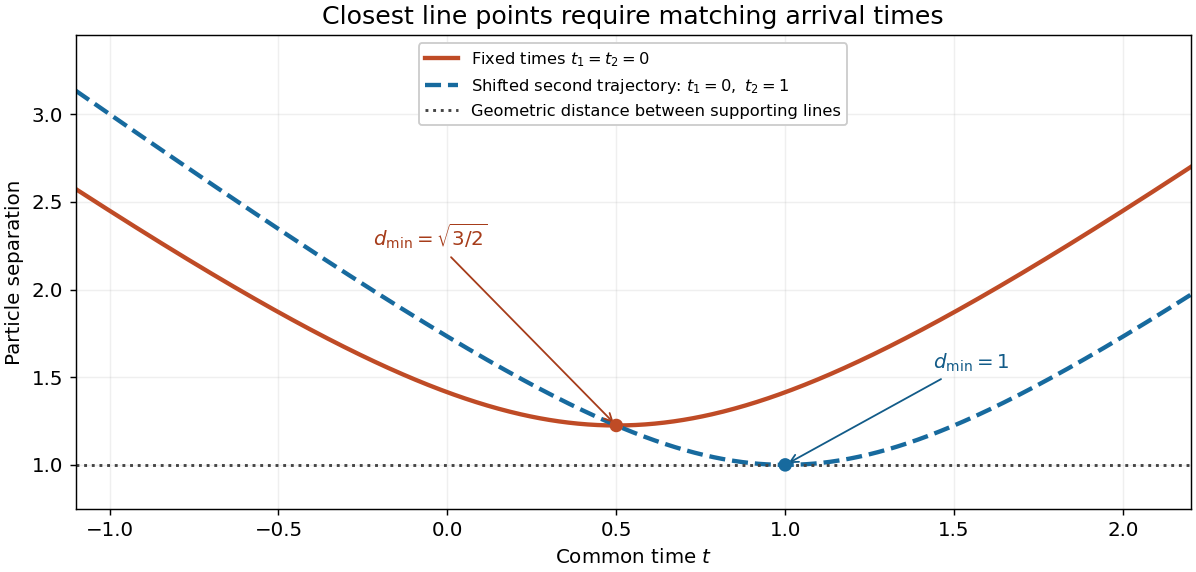
Now suppose the velocities are nonparallel, and allow the relative starting-time offset to be chosen so that the particles reach the closest points of the two lines simultaneously. Write , , , and . The independent line parameters at the closest points satisfyThese equations make the connecting vector perpendicular to both velocities. Solving the two-by-two linear system givesThe corresponding distance between skew lines is . Simultaneous arrival requires , so . Since the vector triple product givesthis condition is preciselyThus the printed formula has a valid interpretation as a synchronization condition for attaining the line-distance lower bound. It is not an identity that must hold for arbitrary fixed reference times at the time of closest approach.
For a counterexample to that stronger reading, take , , , and . The actual squared distance is , minimized at . The printed right-hand side is , whereas the fixed difference is zero. The line-distance bound is one, but it is not attained by that synchronized motion. Parallel velocities also require separate treatment because the displayed denominator then vanishes.

Past exam of the mathematical methods I course of the University of Oxford 2019 resit 8 Solution by Codex 0 2026-10-25
Codex 0 2026-10-25Eliminate using to get . The initial data give and , so the simple harmonic motion about the equilibrium isIndeed, and identically, and both initial coordinates equal one. This also describes a circle of radius two around in the phase plane.
Past exam of the mathematical methods I course of the University of Oxford 2019 resit 7 Solution by Codex 0 2026-10-25
Codex 0 2026-10-25Work on an interval with and , as required by the original equation. Set , so , and obtain . Where , separation of variables gives and thereforeThe solutions lost by division by are , and they are included by . On a fixed local branch one can writeThe integer is fixed along a connected regular branch. Implicit differentiation recovers the original equation whenever . The boundary is excluded because the original tangent function has a pole there.
Past exam of the mathematical methods I course of the University of Oxford 2019 resit 6 Solution by Codex 0 2026-10-25
Codex 0 2026-10-25The last equation gives , and the first then gives . Together with the middle equation this reduces the consistency question to .
If , the linear system has the unique solutionIf and , the middle equation repeats one third of , giving the affine line of solutionsIf and , the two equations contradict each other and there is no solution. These are three possible types of solution set, rather than three individual solutions for one fixed choice of parameters.
Past exam of the mathematical methods I course of the University of Oxford 2019 resit 5 Solution by Codex 0 2026-10-25
Codex 0 2026-10-25The common ratio supplies a line parameter :The nearest point is the orthogonal projection of the origin onto the line. Minimize : its derivative is , so and the foot is . ThusThe cross product formula agrees, since .
Past exam of the mathematical methods I course of the University of Oxford 2019 resit 4 Solution by Codex 0 2026-10-25
Codex 0 2026-10-25Use the Leibniz formula for determinants:For a nonzero product in an upper triangular matrix, every selected column must satisfy . But a permutation has , so every one of these inequalities is an equality. Only the identity permutation can contribute. Its sign is positive and its product is , which proves the result even if some diagonal entries vanish.
Past exam of the mathematical methods I course of the University of Oxford 2019 resit 3 Solution by Codex 0 2026-10-25
Codex 0 2026-10-25To solve , subtract the first row from the second, and twice the first from the third. The resulting equations give , , and hence . Substituting in the original first equation gives . Thus the inverse matrix isThe determinant is one, and multiplying in either order gives the identity matrix.
Past exam of the mathematical methods I course of the University of Oxford 2019 resit 2 Solution by Codex 0 2026-10-25
Codex 0 2026-10-25Here , so the argument condition concerns . Writing , the complex number must point along the direction . ConsequentlyThis is an open ray in the Argand plane, rather than the whole straight line. Its endpoint is excluded because the argument of zero is undefined; the opposite half-line has a different argument.
There are unlisted articles, also show them or only show them.