Past exam of the computer science course of the University of Oxford 2019 Algorithms 3 b Solution by  Codex 0 2026-10-25
The vertex cover decision problem takes a finite simple graph and a nonnegative integer , and asks whether there is a vertex cover of cardinality at most . The optimization problem asks for a minimum vertex cover, with cost equal to its cardinality.
For the decision problem, if there are no edges, accept; if there is an edge but , reject. Otherwise choose an edge and branch: either include and recurse on with budget , or include and recurse on with budget . Accept if either branch accepts. Every vertex cover contains at least one endpoint of , so every possible solution is retained by at least one branch. Conversely, adding the selected endpoint to a vertex cover returned by the smaller instance covers all original edges. This proves correctness by induction on the remaining budget.
The search tree has depth at most and at most leaves. Processing each node in time gives running time, establishing fixed-parameter tractability.
For optimization, greedily build a maximal matching : repeatedly select an edge and discard every edge touching either endpoint. Return the set of all endpoints of . Any edge with neither endpoint in could be added to , contradicting maximality; thus is a vertex cover. Since the edges of a matching in a graph have pairwise disjoint endpoint sets, every vertex cover must contain at least one different vertex for each of them. ThereforeThe greedy construction takes polynomial time, and can be implemented in with adjacency lists. It needs only a maximal matching, not a maximum matching.
Past exam of the computer science course of the University of Oxford 2019 Algorithms 3 a Solution by Codex 0 2026-10-25
Codex 0 2026-10-25A parameterized decision problem is fixed-parameter tractable if there is an algorithm deciding inputs of encoded length and parameter in running time at most , where is a computable function and is a constant independent of . Arbitrarily expensive dependence on the parameter is permitted; putting in the exponent of does not by itself establish fixed-parameter tractability.
For a minimization problem with nonnegative costs, a factor-two approximation algorithm runs in polynomial time, always returns a feasible solution, and satisfies on every feasible input. A feasible solution also satisfies . If the optimum is zero, the guarantee requires an answer of zero cost.
Past exam of the computer science course of the University of Oxford 2019 Algorithms 2 d Solution by Codex 0 2026-10-25
Codex 0 2026-10-25Let and choose any column probability vector , for example the first coordinate unit vector. Because has nonnegative entries and each row sums to one, maps the probability simplexinto itself: and .
The iterates need not converge, so take their arithmetic averages,A telescoping sum givesBoth vectors on the right before subtraction have L1 norm one, so .
The probability simplex is closed and bounded in finite-dimensional Euclidean space, hence compact by the Heine-Borel theorem. It follows that a subsequence converges to some . Passing to the limit in the displayed identity, using continuity of the linear map , gives , with and .
This proves stationary distribution existence for a finite Markov chain without any Markov chain irreducibility or aperiodicity assumption. Those stronger hypotheses concern uniqueness and convergence, not the existence required here.
Past exam of the computer science course of the University of Oxford 2019 Algorithms 2 c Solution by Codex 0 2026-10-25
Codex 0 2026-10-25First suppose the stated nonnegative vectors exist. If , multiply by and by . Since and , this gives the contradictionThus the certificate implies .
For the converse, putA common feasible point exists exactly when , . Introducing a nonnegative vector of slack variables makes this equivalent toIf this system is infeasible, the nonnegative-equations version of Farkas' lemma supplies an unrestricted vector such thatSplit according to the original two blocks of inequalities. The three conditions become , and , exactly the desired certificate. Both directions are proved. The role of is essential: it is why the combined normal need only be nonnegative rather than zero.[ref]
Convex Optimization by Stephen Boyd and Lieven Vandenberghe. §5.8.3, printed pp. 261–262, linear-inequality alternatives and Farkas' lemma
Past exam of the computer science course of the University of Oxford 2019 Algorithms 1 e Solution by Codex 0 2026-10-25
Codex 0 2026-10-25First give the vote of every voter whose allowed set contains . Let their number be . This loses no possible strict victory: starting with any winning assignment, changing such a ballot to increases 's score and weakly decreases an opponent's score. Thus a winning assignment exists exactly when one exists with these ballots fixed.
Every remaining voter must now be assigned to an allowed opponent, and each opponent may receive at most votes. If any allowed set is empty, there is no valid election assignment. With at least two candidates, immediately makes a unique victory impossible. With only the candidate , every nonempty ballot set forces that candidate, so the answer is yes under the question's strict-comparison definition.
For the remaining case , make a flow network with a vertex for each remaining voter and each opponent. Add source-to-voter arcs of flow network edge capacity one, voter-to-opponent arcs of flow network edge capacity one for the allowed choices, and opponent-to-sink arcs of flow network edge capacity . Compute an integral maximum flow. ThenA flow saturating all voter arcs assigns each remaining voter to exactly one allowed opponent, by integrality and flow conservation. The sink-arc capacity constraints give every opponent strictly fewer than votes. Conversely, any winning assignment with the fixed votes defines just such a saturating feasible flow. The flow network has at most vertices and arcs, hence the decision takes polynomial time.
Past exam of the computer science course of the University of Oxford 2019 Algorithms 1 d Solution by Codex 0 2026-10-25
Codex 0 2026-10-25Separate the forced integer portion from the choice of rounding direction. Put and . Define residual demandsThese are nonnegative integers, since the original row and column sums are integers. Also . Each fractional part satisfies .
Construct a flow network with a vertex for each row and column, source-to-row arcs of flow network edge capacity , row-to-column arcs of flow network edge capacity one exactly where , and column-to-sink arcs of flow network edge capacity . The amounts themselves define a fractional feasible flow of flow value . No flow can exceed , the total source flow network edge capacity. Because all constructed flow network edge capacities are integers, an integral maximum flow also has flow value and saturates every source and sink arc.
Let be its middle-arc flow, taking when that arc is absent. Then , and the required answer isAt an already integral entry no middle arc exists, so that entry stays fixed. At a nonintegral entry the two possibilities are precisely its floor and ceiling. Flow conservation gives and , preserving every original row and column sum.
This is matrix rounding with fixed margins. There are vertices and at most arcs. Exact rational arithmetic computes the floors and residual demands in polynomial time in the encoded input length; the resulting flow network edge capacities are small integers, so there is no need to scale by a potentially large common denominator.
Past exam of the computer science course of the University of Oxford 2019 Algorithms 1 c Solution by Codex 0 2026-10-25
Codex 0 2026-10-25A path-cycle matching is exactly an edge subset whose resulting subgraph has maximum degree at most two: every nontrivial connected component of a graph of this form is a graph path or a cycle in a graph. Thus the task is a bipartite b-matching problem with bound two at every vertex.
Find a bipartition , orient every original edge from to , and add a source and sink . Give each arc , for , flow network edge capacity two; each original arc flow network edge capacity one; and each arc , for , flow network edge capacity two. Compute an integral maximum flow and select the original edges whose flow is one. The integral max-flow theorem guarantees such an integral optimum.
By flow conservation, at most two selected edges touch each vertex, so they decompose into the required vertex-disjoint paths and cycles in a graph. Conversely, any permissible path-cycle matching gives a feasible flow: send one unit through its middle arc for each selected edge, with the outside arc amounts equal to the endpoint degrees. In both directions, the flow value equals the number of selected edges. Maximizing either quantity therefore maximizes the other.
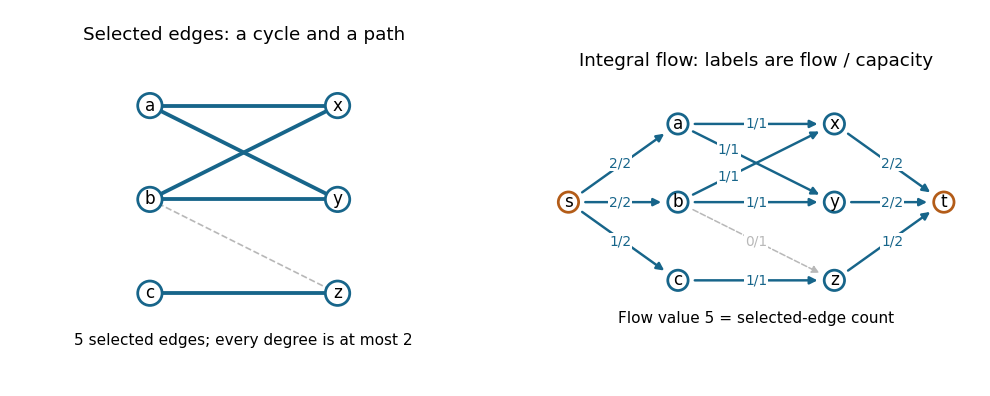

The blue edges in this example form a four-cycle in a graph and a one-edge graph path; the dashed edge is unused. Their five units of flow are optimal: the two left vertices can each contribute at most two selected edges, and has only one incident edge.
The constructed flow network has vertices and arcs. A polynomial-time algorithm for maximum flow, such as the Edmonds–Karp algorithm, followed by a traversal of the selected subgraph, gives an efficient solution.
Past exam of the computer science course of the University of Oxford 2019 Algorithms 1 b Solution by Codex 0 2026-10-25
Codex 0 2026-10-25Sum net outflow over all vertices in the source side . An internal directed edge occurs once positively and once negatively, so it cancels. All internal vertices have zero net outflow by flow conservation, and the sink is outside . ThereforeThe second sum is nonnegative, while every term in the first satisfies its capacity constraint. Consequently,This is direct accounting from flow conservation; it does not invoke the max-flow min-cut theorem.
There are unlisted articles, also show them or only show them.