Past exam of the cognitive neurology course of the University of Oxford 2022 6 Solution by  Codex 0 2026-10-25
Human disorders show that motivation depends on several distinguishable operations: initiating activity, translating incentive value into effort, evaluating outcomes and sustaining goal-directed behavior. A person may be able to execute an instructed movement yet fail to initiate useful action, or may respond differently to reward and effort without a global loss of intelligence. These dissociations argue against equating motivation with motor strength or with a single quantity of pleasure.
A striking starting point is auto-activation deficit. Dominique Laplane and colleagues described three people with marked reduction in spontaneous mental and behavioral activity after toxic encephalopathy and bilateral basal ganglia brain lesions, especially involving the globus pallidus on the available scans. Intellectual capacities were relatively preserved and motor impairment could be mild. External stimulation could reverse the apparent inactivity. This contrast suggested a problem in self-activation rather than inability to perform every relevant cognitive or motor operation.[ref]
Pure psychic akinesia with bilateral lesions of basal ganglia by Dominique Laplane and others. 1984, spontaneous versus externally elicited activity and CT findings
The cases were mechanistically informative but not anatomically pure experiments. Toxic injury can affect more than the structures visible on a scan, and reduced initiation can interact with executive, emotional and motor processes. The observation therefore implicates basal ganglia–frontal systems in internally generated activity without showing that one nucleus contains all motivation. It also motivates assessing spontaneous behavior separately from performance after repeated prompting.
Liane Schmidt and colleagues tested a more specific incentive-to-action hypothesis. They contrasted an instructed handgrip task, requiring specified force levels, with an incentive task where effort could earn money. Patients with basal ganglia damage and auto-activation difficulty could use external instructions to produce force but showed abnormal translation of incentives into effort. The apparatus makes the dissociation concrete: an available motor response does not ensure that anticipated reward will appropriately energize it.[ref]
Disconnecting force from money by Liane Schmidt and others. 2008, instructed versus incentive-driven handgrip tasks
This helps separate motor capacity from motivational use of that capacity. Nevertheless, monetary incentives also require understanding task contingencies, representing value and maintaining the goal. A reduced force response does not uniquely identify absence of pleasure. The strength of the design is the contrasting instruction condition; the remaining question is which valuation, activation or control operation prevents self-driven use of the preserved response.
Parkinson's disease offers converging evidence while introducing its own confounds. Campbell Le Heron and colleagues tested 39 patients, with and without clinical apathy, ON and OFF their usual dopaminergic medication, alongside 32 controls. Choices varied both monetary reward and required physical effort. Apathy and medication state were associated with different patterns across the reward–effort space, rather than one uniform decrease in willingness to act. This supports distinguishing clinical motivational difficulty from the complete set of effects produced by changing dopamine availability.[ref]
Distinct effects of apathy and dopamine on effort-based decision-making in Parkinson's disease by Campbell Le Heron and others. 2018, reward/effort choice, apathy groups and ON/OFF comparison
The design is stronger than comparing raw movement speed alone, but an ON/OFF contrast is not a selective perturbation of one psychological computation. Medication changes motor function and potentially learning, alertness and response vigor. Apathy groups are not randomly assigned, and comprehension, depression, fatigue and motor capacity can differ. Interpreting choice patterns therefore requires suitable calibration and comparison measures. Dopamine sensitivity does not justify the statement that dopamine is simply a pleasure signal.
A small statistical model illustrates why effort-based decision-making experiments must vary both benefits and costs. Suppose acceptance depends on , where is reward, effort, reward gain and effort cost. With a fixed logistic function as the choice rule, a lower reward gain and a higher effort cost can produce exactly the same acceptance probability at one offer. This single-offer reward-effort ambiguity motivates varying both dimensions to distinguish their predictions within the model. These are alternative explanations to test, not parameter estimates obtained merely by diagnosing apathy.
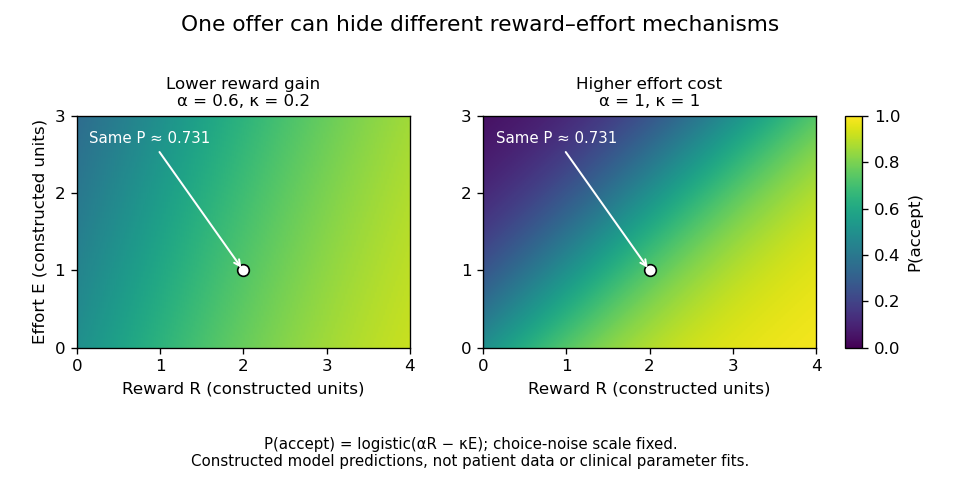
One offer cannot distinguish reduced reward gain from increased effort cost
. Original constructed logistic-choice illustration. The two parameter settings predict identical acceptance at the marked offer but different patterns elsewhere. The heatmaps are not patient responses, fitted clinical models or a reproduction of the Parkinson's study. Choice-noise scale is fixed for this illustration. Details.
Patients with prefrontal cortex damage reveal another component: evaluation of actions across outcomes and time. Antoine Bechara and colleagues introduced the procedure now called the Iowa gambling task, in which choices offered different short-term gains and longer-term consequences. Patients with ventromedial prefrontal cortex damage continued making disadvantageous choices despite relatively preserved conventional intellectual abilities. This linked real-world decision difficulty to experimentally observable valuation and learning demands.[ref]
Insensitivity to future consequences following damage to human prefrontal cortex by Antoine Bechara and others. 1994, gambling-task comparison and disadvantageous choices
The result supports a role in using consequences to guide behavior, but the task combines reward learning, loss sensitivity, reversal, uncertainty and human memory. It does not uniquely establish one bodily-feedback mechanism or prove that the patients have no emotional responses. Similarly, anhedonia, reduced initiation and willingness to expend effort should be measured separately rather than treated as synonyms. Several mechanisms can produce superficially similar inactivity, and a change in one response measure does not imply a change in every form of motivation.
Across these disorders, the most useful inference is computational and relational. Basal ganglia injury distinguishes instructed action from self-activation and incentive translation; Parkinsonian comparisons distinguish aspects of reward–effort choice from medication-related motor and motivational effects; prefrontal damage reveals difficulty applying future consequences. These operations interact through connected systems and need not map to one region each. Patient studies have transformed motivation from a vague explanation of behavior into separable hypotheses about initiation, valuation, effort and control, while demanding that the preserved capacities and competing explanations be tested explicitly.
Past exam of the cognitive neurology course of the University of Oxford 2022 5 Solution by Codex 0 2026-10-25
Codex 0 2026-10-25Associative visual agnosia concerns impaired recognition through vision despite relatively adequate perceptual processing, whereas semantic dementia involves progressive loss of conceptual knowledge that can affect several modalities. Both can impair picture naming and apparent object recognition, so diagnosis and theory cannot rest on those tasks alone. Their comparison separates visual construction, access to meaning, stored knowledge and retrieval of a spoken name.
In a traditional stage account, early vision supports a structured representation of an object, which can then be related to stored visual forms and conceptual knowledge. Apperceptive agnosia involves difficulty forming an adequate perceptual representation; associative visual agnosia places the dominant difficulty later, in recognizing the adequately represented object. This is a useful hypothesis about processing, not a guarantee that each patient has one cleanly damaged box.
Alan B. Rubens's classic report described a patient with severe visual recognition difficulties who could nevertheless copy drawings. The patient also had alexia, color-recognition and face-recognition problems, together with a visual-field defect. The copy–recognition contrast helped motivate an associative account, but the accompanying difficulties show why it would be inaccurate to call all vision completely normal. Brain lesion interpretation was also constrained by the anatomical evidence then available.[ref]
Associative Visual Agnosia by Alan B. Rubens and others. 1971, visual recognition, copying and associated deficits
Distinguishing this from apperceptive agnosia requires careful perceptual controls. Copying is useful but has an important limitation. It can demonstrate access to visual detail and an ability to reproduce relations, yet a laborious line-by-line strategy can succeed without normal integration or a stable whole-object representation. Recognition should therefore be compared with shape matching, unfamiliar-view judgments, overlapping or degraded figures, and other tests appropriate to the proposed perceptual impairment. The required motor response and visual-field availability should also be checked before interpreting a poor copy.
Cross-modal tests then distinguish possible later failures. If an object is recognized by touch or from its characteristic sound but not by sight, a visual-specific access problem is more plausible than complete loss of knowledge about it. If the person can demonstrate appropriate use or select a functional associate but cannot supply its name, a naming-access problem such as optic aphasia is different from agnosia. Conversely, failure across nonverbal knowledge tests makes a purely visual-to-word disconnection inadequate. The comparison should use matched items and consider cue richness rather than assuming every sensory modality supplies equally informative input.
Semantic dementia supplies a contrasting pattern. John R. Hodges and colleagues described five patients with progressive fluent language, severe naming and word-comprehension difficulties, impoverished conceptual knowledge and temporal lobe atrophy. Several other abilities, including aspects of syntax, phonology and episodic functioning, were relatively better early in the syndrome. The result was not simply loss of articulation or a global reduction in all cognitive capacities; it implicated knowledge of the meanings shared across words and objects.[ref]
Semantic dementia: Progressive fluent aphasia with temporal lobe atrophy by John R. Hodges and others. 1992, five-patient syndrome and relative preservation
Because early descriptions emphasized language, purely nonverbal evidence is crucial. Sasha Bozeat and colleagues investigated semantic dementia with assessments designed to minimize verbal input and output, finding nonverbal as well as verbal semantic impairment. This strengthens the claim of degraded conceptual knowledge rather than an isolated failure to understand words or name pictures. It does not mean that every modality and every item must deteriorate at exactly the same rate, or that one task is free of all demands on perception and control.[ref]
Non-verbal semantic impairment in semantic dementia by Sasha Bozeat and others. 2000, nonverbal assessment and cross-modal semantic deficits
The error pattern further constrains explanation. In the comparison by Elizabeth Jefferies and colleagues, semantic dementia patients showed relatively consistent impairment across tasks and repeated testing of items, with strong familiarity/frequency effects. Comprehension-impaired stroke patients could have similar overall scores but showed a different dependence on control demands and cues. This supports distinguishing degradation of representations from difficulty regulating access, rather than equating every semantic failure with destruction of the knowledge itself.[ref]
Anatomical and temporal course add converging information. Associative visual agnosia is a functional description often investigated after relatively focal acquired injury or disconnection. Semantic dementia is a progressive syndrome associated particularly with anterior temporal lobe degeneration. The latter pattern supports a role for temporal systems in integrating conceptual information, but progressive atrophy affects networks and changes over time; it does not prove that all semantic features are stored in one homogeneous location. A focal brain lesion similarly does not automatically reveal a single normal processing stage.
There can be overlap. A person with semantic dementia may fail to recognize a visually presented object because its meaning has degraded; another patient may have both visual-perceptual and semantic impairments. Labels should follow the pattern across input modalities, perceptual controls, conceptual tests and output tasks, together with the clinical course. Naming alone confounds several of those operations. A useful assessment distinguishes not knowing what the object is from not seeing its shape adequately or not retrieving the word for it.
The central contrast is between relatively visual-specific recognition/access difficulty and a broader progressive conceptual impairment, with mixed cases and task impurity treated explicitly. These conditions helped establish that successful perception, recognition, semantic knowledge and naming are distinguishable achievements. They also show why a serial diagram is a testable model rather than an automatic diagnosis: one must establish where information is available, when it fails and which alternative access routes remain effective.
Past exam of the cognitive neurology course of the University of Oxford 2022 4 Solution by Codex 0 2026-10-25
Codex 0 2026-10-25Set shifting, working-memory updating and inhibitory control are useful distinctions, but patient evidence does not establish them as three exhaustive, anatomically isolated components of executive function. They specify important demands on control: changing a currently relevant rule, replacing or manipulating maintained information, and suppressing an inappropriate action. A useful model must explain selective deficits and shared impairments, as well as failures to organize behavior outside a tightly instructed test.
The influential three-component framework drew support from work modeling latent variables in healthy participants, including Akira Miyake and colleagues' study. That evidence addresses covariance across tasks while reducing some executive task impurity. It is not itself a brain lesion experiment or proof that the same structure survives unchanged after brain injury. A factor identified in healthy performance need not correspond one-to-one with a cortical region, and two tasks sharing a deficit can share perceptual, human memory or general-demand requirements as well as an executive computation.[ref]
The unity and diversity of executive functions and their contributions to complex frontal lobe tasks by Akira Miyake and others. 2000, healthy-participant latent-variable framework
For task switching, paradigms compare performance when repeating a rule with performance when changing it. Tim Shallice and colleagues studied 41 patients with focal prefrontal cortex brain lesions and 38 controls, varying the interval between a task cue and the target. Brain lesion subgroups differed in general slowing, reaction time switch costs and errors. Superior medial damage produced both slowing and increased reaction time switch cost; the pattern across groups was not one uniform deficit shared by every frontal brain lesion.[ref]
Multiple effects of prefrontal lesions on task-switching by Tim Shallice and others. 2008, focal-lesion groups, cue intervals and distinct speed/error effects
This supports decomposing switching itself. A participant must perceive the cue, retrieve the rule, maintain readiness, resolve competing mappings and execute a response. A large switch-minus-repeat difference is evidence about the whole contrast, not a direct measurement of one indivisible shifting mechanism. General slowing can also affect raw difference scores. Patient comparisons that examine errors, cue preparation and baseline performance therefore constrain the interpretation more effectively than labeling every poor switching score a failure of flexibility.
For working-memory updating, it is essential to separate replacing obsolete information from simple maintenance and from rearranging retained material. Aron K. Barbey and colleagues compared patients with dorsolateral prefrontal cortex brain lesions, other brain lesions and healthy controls using span-related and N-back task measures. Their findings particularly implicated manipulation of verbal and spatial knowledge rather than supporting a universal loss of all working memory performance. This is evidence for differentiated control operations, but “manipulation” is not automatically identical to every operational definition of working-memory updating.[ref]
Dorsolateral prefrontal contributions to human working memory by Aron K. Barbey and others. 2013, focal-lesion comparison and maintenance/manipulation distinctions
For inhibitory control, Adam R. Aron and colleagues found impaired performance on the stop-signal task after damage to the right inferior frontal gyrus. In this task a frequent go response must occasionally be stopped following a signal. The stopping latency is inferred through a model rather than directly timed as an observable movement. The brain lesion result supports a contribution to successful stopping, while the paradigm also requires detecting the signal, maintaining its significance and coordinating competing responses. It consequently does not prove that the region is exclusively an inhibitory module or that every form of interference control is the same process.[ref]
Stop-signal inhibition disrupted by damage to right inferior frontal gyrus in humans by Adam R. Aron and others. 2003, focal-lesion evidence from the stop-signal paradigm
Broader patient findings challenge exhaustiveness. María Roca and colleagues examined how deficits after frontal brain lesions related to fluid intelligence. Some traditional executive-test deficits, including Wisconsin Card Sorting Test, were largely explained statistically by reduced fluid intelligence, whereas other tasks retained additional deficits. This favors distinguishing general-demand contributions from more specific processes. Statistical adjustment does not, however, prove that intelligence is a separate causal mechanism upstream of cognitive control: the measures can share neural and cognitive requirements.[ref]
Executive function and fluid intelligence after frontal lobe lesions by María Roca and others. 2010, task-specific differences after accounting for fluid intelligence
Everyday goal neglect provides a further problem for a simple three-label account. In a study led by Tim Shallice, three patients with traumatic injury to the prefrontal cortex struggled with open-ended multiple-subgoal tasks over extended periods, often spending too long on individual activities. Their perception, language and intelligence were relatively good, and two performed well on several conventional frontal tests. The authors argued for difficulty reactivating intentions when the situation did not directly cue them, rather than a general human memory or motivation failure.[ref]
Deficits in strategy application following frontal lobe damage in man by Tim Shallice and others. 1991, three-patient comparison and open-ended subgoal management
Such behavior may draw on shifting, working-memory updating and inhibitory control, but merely redescribing it as their combined failure does not explain why structured tests can be much better. A theory should specify how intentions are maintained, reactivated and applied over time, how effort is sustained and how progress is monitored. Additional levels of organization or interactions may be needed, even if some lower-level operations are captured by the three components.
Patient inference also has methodological limits. Brain lesions disrupt connections and neighboring processes; location covaries with etiology and severity. Apparent preservation can reflect low task sensitivity, and different brain lesion groups can differ in premorbid characteristics. Strong claims of separability need reliable tasks, matched nonexecutive requirements, convergent measures and formal comparisons, rather than one significant effect in one group and a nonsignificant effect in another.
The three components remain a productive framework for designing contrasts and interpreting some selective deficits, but they are a working decomposition rather than a complete inventory of cognitive control. Patient studies reveal differentiation within each category, shared demand-related effects, and additional problems of sustained goal application. The most informative account links these behavioral distinctions to interacting computations and networks while predicting when the distinctions should and should not dissociate.
Past exam of the cognitive neurology course of the University of Oxford 2022 3 Solution by Codex 0 2026-10-25
Codex 0 2026-10-25Right parietal damage can produce disturbances of attention, spatial representation, action, construction, body awareness and awareness of deficits. They cannot all be reduced to inaccurate visual localization. Some syndromes contain a localization component, but others concern competition, internally represented space or knowledge of one's own impairment. Brain lesion extent and disconnection also matter: not every syndrome occurs after every injury to the right parietal lobe, and a clinical right-hemisphere stroke is not necessarily an isolated parietal experiment.
A prominent syndrome is hemispatial neglect. Patients may fail to orient to or report contralesional events, omit items during cancellation, neglect one side of a drawing or attend disproportionately to one side of their body. Neglect differs from hemianopia: a primary visual-field defect concerns sensory availability, whereas neglect concerns the selection and use of information. The two can coexist, so visual-field testing and attention tests should be compared rather than allowing one diagnosis to explain every omission.
Visual extinction makes the competitive component especially clear. A contralesional event may be detected when presented alone but missed when an ipsilesional event appears simultaneously. A simple inability to assign a location to every contralesional stimulus is insufficient when single-stimulus performance is much better. Altered competition, salience and allocation of attention become relevant. Task control is essential, however, because stimulus strength, response demands and unequal sensory deficits can influence apparent extinction.
Neglect can also involve represented rather than currently viewed space. Edoardo Bisiach and colleagues asked two patients to describe familiar surroundings from imagined viewpoints. Left-sided details were omitted, while changing the imagined viewpoint changed which details were omitted. The Piazza del Duomo experiment is important because the relevant landmarks were not being viewed at that moment: a retinal localization deficit cannot by itself explain selective omission within an internally generated scene.[ref]
Unilateral Neglect of Representational Space by Edoardo Bisiach and others. 1978, familiar-scene imagery from different viewpoints
The result does not uniquely settle whether a spatial representation is absent or attention fails to access part of an available representation. The ability to mention a previously omitted landmark from another viewpoint is evidence that information can remain available. Reference frames also matter: a bias can relate to the body, current gaze, an object's own structure or the arrangement imagined in a task. A theory calling all these effects “localization” needs to specify its representations and selection operations; otherwise the label becomes too broad to explain the differences.
Right parietal damage can impair spatial construction and dressing. A person may misorganize components in copying or assembly, or struggle to relate clothing to the body. These problems can involve spatial relations, body representation, planning and neglect rather than merely estimating the coordinates of an isolated target. Weakness, sensory loss and failure to understand instructions must be separated from constructional apraxia or dressing apraxia. An inaccurate drawing alone does not distinguish these possible causes.
A related but distinct syndrome is optic ataxia: inaccurate visually guided reaching not adequately explained by elementary weakness or visual loss. Marie-Thérèse Perenin and colleagues studied arm movements in ten patients with unilateral parietal brain lesions, three of them right-sided, using filmed reaching behavior and comparisons across conditions. Their work characterized a disturbance of visuomotor transformation mechanisms. The relationship between target location, hand and gaze can matter, supporting a transformation from visual information into action rather than one general map of consciously perceived position.[ref]
Optic ataxia: a specific disruption in visuomotor mechanisms by Marie-Thérèse Perenin and others. 1988, unilateral-lesion series and visually directed arm movements
This distinction is not absolute proof of entirely separate vision-for-perception and vision-for-action systems: reaching also requires attention, calibration and adequate perception. It does show why simply asking whether a patient can say where a target is cannot characterize every visuomotor deficit. Moreover, the severe combination of restricted visual awareness, reaching difficulty and impaired voluntary gaze classically associated with bilateral parieto-occipital damage should not be indiscriminately attributed to a single right parietal brain lesion.
Awareness and body-related syndromes provide a still stronger challenge to a purely visual account. Patients can show anosognosia for hemiplegia, fail to acknowledge part of their body (asomatognosia), or misattribute limb ownership (somatoparaphrenia). These phenomena differ from failing to attend to the left side of a page. In a series of 97 right-brain-damaged patients, Edoardo Bisiach and colleagues found dissociations between unawareness of motor or visual-field defects, elementary deficits and personal or extrapersonal neglect. Thus motor incapacity, spatial inattention and awareness of incapacity cannot simply be equated.[ref]
Unawareness of disease following lesions of the right hemisphere by Edoardo Bisiach and others. 1986, anosognosia for hemiplegia/hemianopia and dissociations from neglect
Clinical interpretation should therefore compare cancellation and search, single versus double simultaneous stimulation, field testing, body awareness, copying and visually guided action. Auditory or tactile manifestations also challenge a visual-only account. A patient's report and behavior should be assessed separately, since an inability to perform an action does not imply unawareness of that inability, and a verbal denial can have several cognitive causes.
The syndromes point to partly dissociable operations within distributed right-hemisphere networks: selecting events, representing space and the body, converting information into action and monitoring one's condition. Visual localization explains some component demands, but extending it to every symptom would erase the informative dissociations. Brain lesion studies support the necessity of distinguishing those computations while leaving open exactly how parietal tissue and its connected systems implement them.
Past exam of the cognitive neurology course of the University of Oxford 2022 2 Solution by Codex 0 2026-10-25
Codex 0 2026-10-25The crossed profiles of medial temporal lobe amnesia and severe verbal short-term memory impairment argue against a single undifferentiated human memory store and against obligatory transfer through one verbal short-term buffer. They do not establish that all short- and long-term memory processes occupy two isolated anatomical boxes. The tasks, material and type of learning must be specified before converting a clinical dissociation into a theory.
Henry Molaison, originally reported as H.M., developed profound difficulty forming new lasting declarative memories after bilateral medial temporal lobe surgery. The classic report by William Beecher Scoville and Brenda Milner connected substantial new-learning impairment with the operation. Yet immediate retention within a limited span could remain much better than new long-term explicit learning. The contrast shows that retaining a small amount for immediate use and establishing enduring new declarative memories can be disrupted differently.[ref]
Loss of recent memory after bilateral hippocampal lesions by William Beecher Scoville and Brenda Milner. 1957, postoperative amnesia and relatively preserved immediate performance
The interpretation is more specific than “all long-term memory was lost.” Earlier knowledge could remain accessible, and different learning systems were affected differently. Suzanne Corkin tested motor-skill acquisition in Henry Molaison using rotary pursuit, bimanual tracking and tapping. Performance improved with practice, and retention could be tested after several days on rotary pursuit. The finding shows lasting learning despite severe amnesia; it does not imply normal performance on every motor task, because absolute performance could still be below that of comparison participants.[ref]
Acquisition of motor skill after bilateral medial temporal-lobe excision by Suzanne Corkin. 1968, practice across sessions and delayed rotary-pursuit retention
The complementary profile is exemplified by Patient K. F.. Elizabeth Warrington and Tim Shallice reported a very restricted span for auditory verbal short-term memory, and subsequent experiments examined free recall, interference, short-delay performance and recognition. Despite the short-term difficulty, long-term verbal learning was relatively good on the tests used. This matters because the impairment was investigated through several procedures rather than inferred from one failed digit span response.[ref]
The selective impairment of auditory verbal short-term memory by Elizabeth Warrington and Tim Shallice. 1969, selective auditory-verbal impairment
[ref]Independent Functioning of Verbal Memory Stores by Tim Shallice and Elizabeth Warrington. 1970, five experiments and preserved performance on long-term tasks
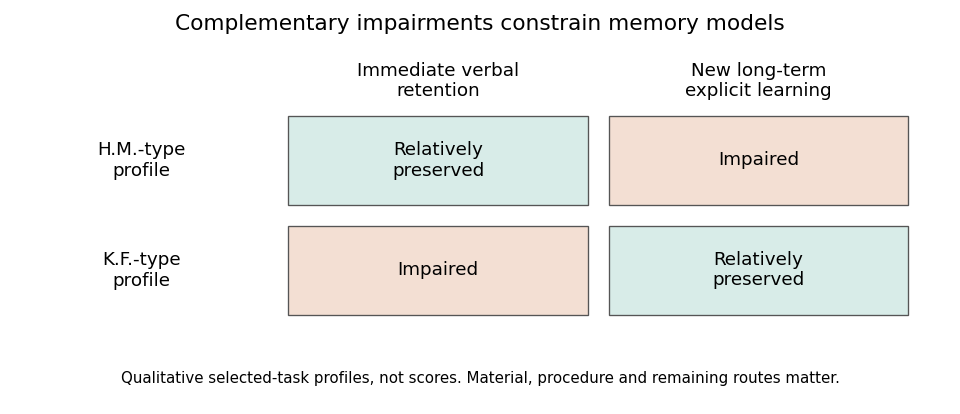
Two clinical profiles constrain a simple serial-store account
. Original qualitative schematic of relatively preserved versus impaired performance on selected tasks. The cells are not scores, prevalence estimates or a claim that either person performed normally on every task in a broad memory category. Material and procedural differences remain essential to the interpretation. Details.
Together, these profiles are stronger evidence than one patient who fails a difficult delayed test but passes an easier immediate one. A simple general reduction in ability can explain many single dissociations through differing task difficulty. With fixed tasks, crossed performance rejects a single monotone resource: both performances cannot be fixed nondecreasing functions of the same scalar. Nevertheless, clinical reports do not automatically provide such a perfectly matched experiment: different materials, floor and ceiling effects and measurement reliability can distort apparent crossings. Quantitative comparisons and adequate control data strengthen the inference.
The findings also challenge a strong serial two-store model of memory. If the particular verbal short-term store damaged in K.F. were the obligatory gateway for all new long-term encoding, severe impairment there should prevent the relatively preserved long-term learning. Parallel access or alternative routes become plausible. This conclusion does not show that no temporary representation is ever required for learning: visual, semantic or residual verbal processing might support encoding. The result targets a specified mandatory route, not the logical possibility of retaining information transiently by other means.
Later distinctions between working memory, episodic memory, semantic memory and procedural memory explain why delay alone is an inadequate taxonomy. Immediate span depends on perceptual coding, rehearsal and response requirements. New episodic learning depends on operations supporting binding and enduring retention. Motor skills can improve through systems not sufficient for explicit recollection. Such functional distinctions can coexist with interaction: prior knowledge helps immediate retention, and attention and temporary maintenance affect what is learned.
Anatomy similarly requires refinement. Henry Molaison's operation was not confined to one microscopic hippocampal computation; multiple medial temporal lobe structures were affected. Conversely, a selective verbal span deficit after a different injury does not locate all short-term storage in one cortical patch. More circumscribed brain lesion evidence and converging task manipulations are needed to separate structures, connections and computations. The duration of a test is not an anatomical label.
Evidence that medial temporal lobe regions can contribute to online processing of complex objects further qualifies a strict short-delay/long-delay border. Morgan D. Barense and colleagues found that human medial temporal lobe damage affected tasks involving complex object representations even when demands could not simply be described as conventional long-term learning. This supports examining representational requirements, such as feature conjunctions, rather than assuming every immediate judgment bypasses the medial temporal lobe.[ref]
The human medial temporal lobe processes online representations of complex objects by Morgan D. Barense and others. 2007, object-processing requirements and online performance
The lasting contribution of these cases is methodological as well as theoretical. Selective deficits motivate decomposing human memory into processes; complementary preservation constrains claims that one process is necessary for another. The resulting theory should predict transfer, interference, cueing and learning across matched tasks, rather than merely attach a store name to each time interval. Double dissociations establish important functional separability under the tested conditions, while the broader evidence favors interacting human memory systems and multiple routes to retention.
Past exam of the cognitive neurology course of the University of Oxford 2022 1 Solution by Codex 0 2026-10-25
Codex 0 2026-10-25Calling Wernicke's aphasia receptive identifies a prominent clinical difficulty, but is inadequate as a complete description or mechanism. Auditory comprehension is typically impaired, yet fluent output can contain errors in sound structure and meaning, neologisms and poor monitoring, while repetition is also impaired. Fluency describes the ease and quantity of speech, not its informational accuracy. The syndrome is therefore neither an isolated loss of receiving words nor a clean counterpart to an exclusively expressive disorder elsewhere.
The distinction between a syndrome and a computation is crucial. A comprehension failure could arise because the listener cannot analyze the sound pattern, cannot access relevant knowledge, cannot select the contextually relevant meaning, or cannot maintain the sentence and response alternatives. These processes can interact. A brain lesion label such as Wernicke's area, named after Carl Wernicke, does not specify which transformation failed, and clinical classifications group patients whose exact brain lesion extent and remaining abilities can differ.
Holly Robson and colleagues directly compared Wernicke-type patients with groups showing semantic dementia and semantic aphasia. Their case-series results supported combined acoustic and phonological analysis deficits together with semantic control impairment in Wernicke's aphasia. The Wernicke group had difficulties on nonverbal as well as verbal comprehension tests, while additional acoustic and phonological difficulties helped explain their particularly poor auditory performance. This is more informative than equating all poor comprehension with destruction of a single semantic store.[ref]
Wernicke's aphasia reflects a combination of acoustic-phonological and semantic control deficits by Holly Robson and others. 2012, direct case-series comparison and verbal/nonverbal comprehension
The experiment motivates a layered account. Spoken input requires analysis of rapidly changing acoustic structure and its relation to phonological representations. Meaning then depends on stored knowledge and control over its use. A disproportionately severe spoken-word deficit can therefore coexist with semantic difficulty that is also detectable in pictures. Conversely, comparatively better picture performance does not establish entirely intact conceptual knowledge: task difficulty, cue availability and the required decisions must be matched before drawing that conclusion.
Speech production is affected for related reasons. Selecting a word requires access to conceptual knowledge and lexical access, and producing its sound pattern requires organization of phonological representations. Fluent but inaccurate output, including paraphasia, cannot simply be classified as preserved expression. Repetition also requires auditory analysis, temporary retention and a mapping to output; it does not supply an independent test of a single receptive faculty. The mechanisms impairing understanding can consequently affect speech without producing the effortful, reduced output associated with some other aphasic presentations.
Evidence from semantic disorders further separates damaged knowledge from difficulty controlling access. Elizabeth Jefferies and colleagues compared comprehension-impaired stroke patients with semantic dementia patients at broadly matched overall impairment. The dementia group showed stronger cross-task/item consistency and familiarity effects; stroke patients were more sensitive to task demands and benefited from cues in ways consistent with impaired semantic control. These were not interchangeable forms of “receptive aphasia.” Nor were all stroke patients in that study necessarily Wernicke cases, so the result provides a comparison framework rather than a license to assign one mechanism to every Wernicke patient.[ref]
Semantic impairment in stroke aphasia versus semantic dementia by Elizabeth Jefferies and others. 2006, matched case-series comparison, consistency, familiarity and control demands
Anatomical evidence also resists a one-area account. Nina F. Dronkers and colleagues studied sentence comprehension in 64 chronic left-hemisphere stroke patients, with comparison groups, and related performance to brain lesions. The task required choosing the drawing matching an auditory sentence. Multiple temporal, parietal and frontal regions were implicated rather than a single posterior temporal center explaining all comprehension. Because the task also required sentence retention, visual selection and interpretation, its brain lesion associations should not be read as a pure map of word meaning.[ref]
Lesion analysis of the brain areas involved in language comprehension by Nina F. Dronkers and others. 2004, CYCLE-R sentence–picture selection and lesion analyses
The distinction from auditory verbal agnosia is useful. A relatively input-specific spoken-language impairment can leave reading and other access to knowledge much better preserved. By contrast, multimodal semantic impairment cannot be explained solely by failure to hear phonological distinctions. A careful assessment should therefore compare auditory discrimination, spoken and written language comprehension, nonverbal semantic matching, naming and repetition, while checking hearing, vision and general task demands. Anomia alone is not proof that the object or concept is unknown, and a naming failure is not equivalent to failed comprehension.
There are limits to both behavioral and anatomical inference. Stroke affects vascularly linked tissue and connections, making neighboring regions difficult to separate statistically. Chronic patients may have reorganized, while case-series samples can omit people unable to complete the tests. An association between brain lesion location and test failure supports a network contribution under those conditions, not a complete computational explanation. Likewise, introducing “semantic control” is useful only if it predicts sensitivity to cues, competition and task demands rather than merely renaming every inconsistent answer.
The receptive label is defensible as shorthand for a dominant presenting impairment, but false if it implies preserved production or a unitary input-only brain lesion. The stronger explanation distinguishes acoustic analysis, phonological analysis, representations and control within a connected language system. This preserves what the clinical syndrome tells us while using patient comparisons to explain why comprehension, repetition and fluent speech can fail together in different proportions.
Past exam of the cognition course of the year 2 of the psychology (experimental) course of the University of Oxford 2022 5 Solution by Codex 0 2026-10-25
Codex 0 2026-10-25People often underweight base rates when a vivid case description competes with them, but the extent of neglect depends on representation, relevance and task. The normative benchmark is conditional on a known sampling process. If a case is randomly drawn from a population, a prior class proportion must combine with the case evidence's likelihood ratio. In Bayes' theorem,Changing prior odds while holding diagnostic evidence fixed should ordinarily change posterior odds. A judgment driven only by resemblance to a class violates that benchmark when the stated premises apply.
In Daniel Kahneman and Amos Tversky's prediction experiments, descriptions of people were paired with different proportions of engineers and lawyers in the source group. Judgments based on an occupationally suggestive description were surprisingly insensitive to those proportions despite their relevance to a random draw. Without the individualized description, participants could use the stated proportions. This contrast is especially informative: the issue was not simply inability to read a base rate, but the way case-specific evidence displaced it. Similarity and probability can agree in ordinary situations, which helps explain why the substitution is tempting.[ref]
On the psychology of prediction by Daniel Kahneman and Amos Tversky. 1973, category prediction and engineer–lawyer base-rate manipulation
The first account is the representativeness heuristic, potentially supplemented by dual-process theory. An occupational description quickly evokes similarity to a stereotypical engineer or lawyer. That judgment does not inherently encode class prevalence or evidential reliability, so it can dominate the probability estimate. More controlled reasoning can integrate the base rate, but may fail to engage, misunderstand the statistical structure or fail to override the compelling response. This account predicts errors especially when representativeness and prior probability conflict, with possible improvement when people deliberately compare alternative hypotheses and their frequencies.
It is too strong to infer from a biased answer that no statistical information was processed. Wim De Neys and colleagues contrasted problems where descriptions and base rates conflicted with control problems where they agreed. Although verbal reports often emphasized the description, measures including decision time, later memory for the base rates and reconsideration behavior indicated sensitivity to the conflict. Statistical information can therefore influence processing without determining the final answer. This challenges a simple account in which analytic monitoring is always absent; it is compatible with incomplete integration or unsuccessful correction.[ref]
Conflict monitoring in dual process theories of thinking by Wim De Neys and others. 2008, conflict versus control problems; implicit and verbal measures
The second account emphasizes ecological rationality and information format. Gerd Gigerenzer and Ulrich Hoffrage argued that algorithms adapted to natural frequencies can perform Bayesian updating more easily than algorithms given separately normalized probabilities. Natural sampling represents the relevant nested sets directly: how many cases belong to each class, and how many within each class produce the evidence. The denominator can then be the whole set of evidence-positive cases, without reconstructing joint counts by multiplying conditional probabilities.
Their 1995 experiments compared probability and frequency versions of Bayesian problems while also varying the information menu. Frequency formats substantially increased the use of Bayesian solutions across the problem set, assessed using solution processes as well as final answers. This supports a representational contribution to apparently poor reasoning; it does not show that everyone is spontaneously Bayesian or that every frequency phrasing helps. The preserved nesting and common reference population matter. Normalizing both classes to independent “out of one hundred” samples can remove precisely the base-rate information the natural-frequency representation was meant to preserve.[ref]
How to Improve Bayesian Reasoning Without Instruction: Frequency Formats by Gerd Gigerenzer and Ulrich Hoffrage. 1995, Study 1 factorial format/menu comparison and algorithm scoring
An original numerical illustration makes the distinction explicit. Suppose a randomly sampled population contains category- cases and non- cases. A cue occurs in of the first class and of the second. There are then cue-positive cases and cue-positive non- cases, so , approximately . Reporting would confuse the cue's conditional rate in class with the probability of class given the cue. These are constructed teaching counts, not results from a cited experiment.
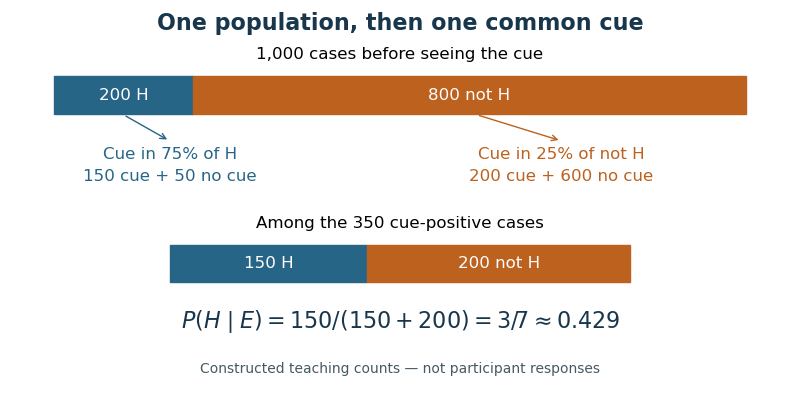

The two accounts agree that the task representation matters and that naïve answers need not obey the normative model. They disagree in emphasis: the heuristic account highlights substitution and control, while the ecological account highlights a mismatch between the supplied representation and an available inference algorithm. Frequency success alone cannot decide between them, because a clearer nested-set display can also make deliberate correction easier. Conversely, conflict sensitivity constrains an absolute “base rates were never noticed” story without proving successful Bayesian computation.
A discriminating design would cross numerical format with description–base-rate conflict, preserve the sampling assumptions and information content, and measure answers together with process indicators. It should distinguish a failure to encode prevalence, a failure to combine encoded evidence and a rational belief that the stated reference group is irrelevant. Verbal descriptions seldom specify a likelihood ratio, so prior-insensitivity is easier to diagnose than a unique numerical Bayesian answer for every description. If descriptions were selectively rather than randomly sampled, or a base rate were not applicable to the individual, the simple benchmark would change. Accordingly, base-rate neglect is a reproducible conditional pattern, not evidence that people invariably ignore statistics or possess no Bayesian competence; both heuristic competition and representational structure help explain when it occurs.
Past exam of the cognition course of the year 2 of the psychology (experimental) course of the University of Oxford 2022 4 Solution by Codex 0 2026-10-25
Codex 0 2026-10-25Human categories show robust category typicality gradients, but those gradients do not uniquely demonstrate that knowledge is stored as a single concept prototype. A concept prototype is a central or especially representative category representation. In prototype theory, new cases are judged through their similarity to that summary. This challenges a simple classical theory of concepts in which every familiar category is represented solely by equally necessary defining features. The crucial distinction is between evidence that members are psychologically unequal and evidence for the particular representation producing that inequality.
Eleanor Rosch's studies showed that category members are not interchangeable in judgments and processing. People agree that some examples are better representatives than others, and a category name can differentially prepare the processing of good and poor members. Her semantic priming experiments went beyond explicit category typicality ratings: a category-name cue preceded judgments on example pairs, and even physically identical pairs were processed differently depending on their representativeness. Convergence across ratings and performance is important because it reduces the chance that category typicality is only an artifact of being asked to rate goodness.[ref]
The family resemblance account explains what can make an example representative. In Eleanor Rosch and colleagues' work, participants listed attributes of members of natural categories. More prototypical examples tended to share many attributes with other members of their category while sharing fewer with contrasting categories. Thus an item's usefulness as a representative depends on distributions of features both within and across categories, rather than on one feature occurring in every member. Such structure can support efficient generalization from incomplete evidence. But a descriptive relation between feature overlap and category typicality is not itself an algorithm for learning or storing a concept prototype.[ref]
Family resemblances: Studies in the internal structure of categories by Eleanor Rosch and others. 1975, attribute-listing experiments and General Discussion
Artificial-category experiments make the abstraction claim more testable. In Michael I. Posner and colleagues' 1968 study, participants learned to classify distortions of dot patterns without seeing the underlying prototypes. They subsequently classified the unseen prototypes especially well relative to control patterns from the learned categories, and training variability influenced generalization to new distortions. The result is striking because direct familiarity with the test concept prototype cannot explain its advantage. A summary preserving the regularities among training examples supplies a natural explanation.[ref]
On the genesis of abstract ideas by Michael I. Posner and others. 1968, training on pattern distortions and transfer to unseen prototypes
It is not, however, a unique explanation. In exemplar theory, a new object is compared with stored examples. A central unseen item can resemble many stored examples at once and therefore receive greater summed support than a less central old item. Robert M. Nosofsky's identification–categorization experiments used multidimensional perceptual stimuli and linked classification to stored instances and selective attention to diagnostic dimensions. This provides an explicit alternative to treating every concept prototype advantage as proof of an abstract average. Theories must be distinguished by predictions across learning, transfer and individual trials, not merely by whether they can generate a category typicality effect.[ref]
Attention, similarity, and the identification-categorization relationship by Robert M. Nosofsky. 1986, perceptual identification, categorization and exemplar-based modeling
A second challenge concerns the difference between identification and membership. Sharon Lee Armstrong and colleagues applied category typicality-rating and verification-time methods to categories including mathematically well-defined ones. Even these categories produced graded judgments and processing differences: an example can seem more representative while being no more genuinely a member. All odd integers, for example, meet the same parity criterion, irrespective of their familiarity or apparent category typicality. Category typicality can therefore reflect an identification heuristic, accessible examples or feature salience rather than the full constitutive content of a concept.[ref]
What some concepts might not be by Sharon Lee Armstrong and others. 1983, Experiments I–II and discussion of well-defined categories
This observation limits, rather than abolishes, concept prototype explanations. It remains possible that many everyday categories have probabilistic feature structure while some concepts require rules or deeper knowledge. It also creates a challenge of conceptual combination: a theory should explain how familiar concepts combine into a new one, including cases where the combination's typical instances are not predicted by simply averaging the separate prototypes. If category typicality is all that a representation contains, logical and compositional inference may become difficult to explain.
Context and goals provide a further constraint. Lawrence W. Barsalou compared common taxonomic categories with goal-derived categories. Central tendency, ideals associated with a goal and frequency of encountering an item could make different contributions to category typicality; central tendency was not a sufficient general account of the goal-derived cases. A food may be a good member of a goal-defined category because it is especially suited to the goal, rather than because it is statistically average. This makes a permanently fixed, context-free central representation implausible as a complete account.[ref]
Ideals, Central Tendency, and Frequency of Instantiation as Determinants of Graded Structure in Categories by Lawrence W. Barsalou. 1985, Experiment 1 and comparison of taxonomic and goal-derived categories
The theoretical implication is a distinction among levels of explanation. Category typicality gradients and family-resemblance structure are phenomena to explain; concept prototype, exemplar, rule-based and knowledge-sensitive models propose mechanisms that can overlap in their predictions. Strong tests manipulate the distribution of training cases, diagnostic features, goals and novelty, then evaluate predicted generalization and errors while controlling familiarity and task demands. A hybrid or flexible system is plausible, but should earn its flexibility by predicting when different information will guide behavior.
The evidence decisively rejects the idea that familiar category members are psychologically equivalent; it does not establish a universal concept prototype-only architecture. Prototypes can organize efficient recognition and generalization, while instance memory, explicit criteria and goal-dependent knowledge constrain how that organization is used. Confusing graded category typicality with graded truth of membership would overstate what the experiments show.
Past exam of the cognition course of the year 2 of the psychology (experimental) course of the University of Oxford 2022 3 Solution by Codex 0 2026-10-25
Codex 0 2026-10-25Broca's area contributes to sentence processing, but the evidence does not justify identifying it with a single necessary-and-sufficient syntax processor. “Syntax” includes representing hierarchical relations, combining words, maintaining unresolved dependencies and using structure in interpretation or production. A region can support one of these operations, or the memory and control demands accompanying it, without implementing all of them. The anatomical label itself usually refers to parts of the left inferior frontal gyrus, especially regions corresponding approximately to areas 44 and 45; it is not a functionally homogeneous unit.
The historical association is important but logically limited. Paul Broca's 1861 observations linked severe impairment of articulate speech with left frontal injury. Loss of fluent output is not a selective test of syntactic knowledge, and a large lesion cannot localize every component of its resulting syndrome to the surface region that is most visible. In 2007, Nina F. Dronkers and colleagues used high-resolution magnetic resonance imaging to re-examine the preserved brains from the historic cases and found damage extending substantially beyond the traditionally identified superficial region. This undermines a simple inference from a broad historical syndrome to a small isolated syntax center; it does not invalidate the importance of left frontal language mechanisms.[ref]
Paul Broca's historic cases by Nina F. Dronkers and others. 2007, MRI of preserved historical brains and lesion extent
There is positive experimental evidence for frontal sensitivity to syntax. David Embick and colleagues contrasted visually presented sentences containing grammatical word-order errors with sentences containing spelling errors, asking participants to identify the number of errors. The grammatical condition elicited greater activity in Broca's area, with a larger grammatical–spelling difference there than in comparison language regions. Matching lexical material and requiring error detection in both conditions make this more informative than comparing difficult sentences with an unrelated baseline. It supports a contribution to syntactic processing beyond merely seeing words.[ref]
A syntactic specialization for Broca's area by David Embick and others. 2000, grammatical versus spelling-error conditions; Methods and Discussion
Nevertheless, grammatical violations require detection, reanalysis, conflict resolution and response selection. Matching overt task format does not necessarily equate these internal demands. A greater functional magnetic resonance imaging response therefore does not establish that the region stores grammar rules, is syntax-exclusive or is necessary for ordinary successful comprehension. Those stronger claims would require converging tests separating syntactic computation from accompanying processes. This is the problem of reverse inference: activation associated with a task component does not uniquely identify the process generating it.
Corianne Rogalsky and colleagues directly tested one alternative mechanism. Participants comprehended subject-relative and more demanding object-relative sentences while performing concurrent speech articulation, a manual control task, or no secondary task. Articulation selectively interfered behaviorally with the harder sentence condition. In imaging, concurrent articulation eliminated the complexity effect in pars opercularis, whereas the manual task did not; pars triangularis showed a different secondary-task profile. These results support an articulatory rehearsal contribution to maintaining information during demanding comprehension and show that the frontal anatomical region contains distinguishable operations.[ref]
Broca's area, sentence comprehension, and working memory by Corianne Rogalsky and others. 2008, behavioral and fMRI experiments; articulation versus finger tapping
This is evidence against treating every complexity-related frontal response as syntax-specific, not evidence that syntax is entirely reducible to rehearsal. Articulation may alter strategies and general task demands, and absence of a difference under dual-task conditions can have several causes. Conversely, a syntactic account must explain why an independently motivated memory manipulation changes the response. A satisfactory theory should predict when syntactic dependencies need rehearsal or control and when successful structure building proceeds without those extra demands.
Individual functional anatomy supplies another constraint. Evelina Fedorenko and colleagues identified language-selective and domain-general subregions side by side within the broad anatomical Broca's area. They then tested responses across linguistic and nonlinguistic tasks, including harder and easier memory and control conditions. The distinct profiles were detectable within individuals and did not simply align with the traditional 44/45 boundary. Group averaging across anatomically variable people can therefore merge adjacent populations and produce an apparent multifunctional center. Importantly, language selectivity does not equal syntax selectivity: a region responding to sentences may support lexical–semantic combinations as well as structure.[ref]
Language-Selective and Domain-General Regions Lie Side by Side within Broca's Area by Evelina Fedorenko and others. 2012, individual functional localization and task profiles
Lesion evidence challenges strict necessity claims. In their 2018 study, Corianne Rogalsky and colleagues tested patients using sentence–picture matching and plausibility judgments, including canonical and noncanonical constructions. Analyses implicated superior temporal and inferior-parietal regions in impaired comprehension; patients with frontal damage did not uniformly show the predicted agrammatic comprehension pattern. A traditional diagnostic label and damage to Broca's area cannot therefore be substituted for an independently measured syntactic deficit.[ref]
The Neurobiology of Agrammatic Sentence Comprehension by Corianne Rogalsky and others. 2018, Broca-area analyses and whole-brain lesion–symptom mapping
Yet preserved performance after a chronic lesion does not prove that the region never contributes in an intact brain: spared tissue, compensation, task sensitivity and unequal lesion coverage matter. Likewise, comprehension findings should not automatically settle the neural implementation of syntactic production, where planning and sequencing impose different demands. The strongest interpretation combines these limitations rather than choosing imaging or lesions as universally decisive.
Broca's area is a heterogeneous participant in a distributed language network. The evidence supports frontal contributions to syntactic and sentence-level processing, with some responses attributable to rehearsal and control and others belonging to language-selective tissue. It weighs against both an exclusive syntax organ and a claim of no language-specific frontal contribution. Progress requires explicit computational hypotheses, individual localization, matched comparison conditions and convergent perturbation or lesion evidence, while distinguishing representations from the processes that operate on them.
Past exam of the cognition course of the year 2 of the psychology (experimental) course of the University of Oxford 2022 2 Solution by Codex 0 2026-10-25
Codex 0 2026-10-25Converging evidence supports partially distinct, interacting dorsal and ventral language pathways; it does not support two isolated, universally mapped cables. The central computational distinction is between mapping heard speech onto articulatory plans and mapping it onto meaning. Gregory Hickok and David Poeppel's dual-stream framework assigns a stronger leftward bias to the dorsal sensorimotor route and a more bilateral organization to ventral speech-comprehension processes. “Parallel” means that an acoustic input can engage both transformations rather than passing through a single obligatory serial chain. It does not mean identical timing, complete independence or that each linguistic operation belongs to only one route.[ref]
The cortical organization of speech processing by Gregory Hickok and David Poeppel. 2007, dual-stream framework and lateralization claims
The dorsal language pathway connects posterior auditory–temporal and temporoparietal processing with frontal articulatory systems, using pathways that include the arcuate fasciculus and superior longitudinal system. It is particularly useful when sound must guide an unfamiliar articulatory sequence, as in nonword repetition, and for auditory–motor interaction. The ventral language pathway links temporal representations with systems supporting lexical and conceptual interpretation, with temporofrontal connections through ventral white-matter systems including the extreme capsule. These labels name functional–anatomical families. They should not be equated without qualification with particular textbook stream diagrams from vision, or with a claim that language has only one dorsal and one ventral anatomical connection.
An informative test must connect differences in task demands with differences in connectivity. Dorothee Saur and colleagues combined functional magnetic resonance imaging with diffusion-based tractography. They used sublexical repetition and higher-level comprehension tasks to identify functionally relevant regions, then estimated connections among those regions. Repetition-linked temporal and premotor regions were connected dorsally through the arcuate/superior longitudinal system; comprehension-linked temporal and ventrolateral frontal regions were connected by a ventral route through the extreme-capsule region. The study therefore supplied anatomical evidence for the proposed computational distinction rather than inferring pathways from activation maps alone.[ref]
Ventral and dorsal pathways for language by Dorothee Saur and others. 2008, task contrasts and diffusion-based pathway reconstruction
This design also has limitations. Nonword repetition places demands on phonological working memory and overt motor output, whereas a comprehension task adds lexical, semantic and decision demands. An activation difference could reflect any correlated component. Moreover, diffusion-based tractography estimates plausible paths from water diffusion; it does not directly observe axons, synaptic direction, information flow or a pathway's functional necessity. Crossing fibers, seed selection and modeling assumptions affect reconstructions. Thus the evidence is stronger when task effects and anatomy converge, but the labels “sound-to-articulation” and “sound-to-meaning” remain hypotheses to test with other methods.
Lesion studies offer a complementary test because intact performance after damage can challenge claims of necessity and selective deficits can identify vulnerable transformations. Dorothee Kümmerer and colleagues studied one hundred patients with acute left-hemisphere aphasia, deriving repetition and comprehension measures from language tests and relating them to damage. Repetition deficits were associated more strongly with dorsal temporoparietal connections, while comprehension deficits implicated ventral temporal–frontal connections. This convergence with healthy-participant imaging supports a functionally differentiated network. Studying patients soon after injury limits some effects of long-term reorganization, although it introduces sensitivity to acute physiological dysfunction.[ref]
Damage to ventral and dorsal language pathways in acute aphasia by Dorothee Kümmerer and others. 2013, patient sample, repetition/comprehension measures and pathway lesion associations
The relevant dissociation is stronger than the observation that two tasks activate different places, but it is not an experiment that cuts one tract in isolation. Stroke lesions follow vascular territories; nearby cerebral cortex and several fiber systems can be damaged together. General severity, incomplete lesion coverage and disconnection can affect apparent associations. A patient's conduction aphasia, with disproportionately poor repetition, is consequently consistent with dorsal network dysfunction without proving that all such cases arise from an isolated arcuate lesion. Nor does relatively preserved repetition imply completely normal comprehension or vice versa.
Lateralization further qualifies the claim. The ventral framework includes bilateral auditory–speech analysis, whereas detailed lexical, sentence-level and semantic operations can show stronger leftward biases. Evidence for a left ventral temporofrontal connection is not evidence that all ventral processing is left-only. Conversely, a strongly left-biased dorsal network does not imply that the right hemisphere never contributes to speech. The roles of stimulus type, noise, task and level of representation should be specified before assigning a function to a hemisphere or stream.
The same logic prevents “dorsal equals syntax, ventral equals semantics” from becoming an unsupported substitute theory. A sentence requires recognition, retention, structure building and interpretation. Corianne Rogalsky and colleagues' lesion study associated sentence-comprehension difficulties particularly with temporal and inferior-parietal damage, while damage to Broca's area alone did not produce the predicted obligatory comprehension pattern. That finding is compatible with distributed and connected language processing; it is not a direct assignment of every syntactic computation to one ventral tract.[ref]
The Neurobiology of Agrammatic Sentence Comprehension by Corianne Rogalsky and others. 2018, sentence–picture matching, plausibility judgments and lesion analyses
The most persuasive evidence is therefore the convergence of computational distinctions, task-linked structural connections and differential lesion associations, with each method controlling different weaknesses. Stronger tests would match task difficulty, separate auditory recognition from repetition and rehearsal, combine individual functional localization with connectivity, and examine whether damage predicts the relevant computation beyond general impairment. Parallel dorsal and ventral processing is a useful network-level explanation of speech and language, provided it remains a graded division of labor with interaction, rather than an exclusive anatomical partition.
Past exam of the cognition course of the year 2 of the psychology (experimental) course of the University of Oxford 2022 1 Solution by Codex 0 2026-10-25
Codex 0 2026-10-25Delay-period activity explains important properties of working memory when its information content and dynamics predict behavior; elevated activity alone is not a complete storage mechanism. An explanation must account for maintaining an absent stimulus, limited working memory capacity, variable precision, interference and flexible prioritization. Different measurements reveal different aspects: extracellular single-unit recording measures individual neurons, electroencephalography measures aggregated electrical signals, and functional magnetic resonance imaging measures a slower hemodynamic response. None directly reads a unitary store.
The classic case for persistent neural activity came from delayed-response tasks. In Shintaro Funahashi and colleagues' 1989 experiment, monkeys maintained fixation after a briefly presented peripheral cue and later made a memory-guided saccade. Dorsolateral prefrontal cortex neurons could maintain location-selective firing during the intervening blank interval; delay-period activity was reduced or absent on some error trials. This connects a maintained code to a remembered location rather than merely to stimulus presence. It also supplies a plausible bridge between a short-lived sensory event and a later response. However, the remembered location and intended eye movement covaried, so the experiment does not isolate human mnemonic storage from prospective action coding.[ref]
Mnemonic Coding of Visual Space in the Monkey's Dorsolateral Prefrontal Cortex by Shintaro Funahashi and others. 1989, Summary and Conclusions; oculomotor delayed-response task
More explanatory leverage comes from linking population dynamics to the pattern of errors. A bump attractor maintains a localized pattern through recurrent excitation and inhibition. Noise can move its center while leaving a memory trace present, predicting increasing uncertainty and trial-specific directional errors. Klaus Wimmer and colleagues tested such predictions against monkey prefrontal recordings and memory-guided eye movements: neural variability was related to fine-grained response errors in ways predicted by a diffusing representation. This is stronger than a generic activation–accuracy association because competing models need to explain that structured relationship. Nevertheless, it is evidence from a trained spatial task in monkeys; it does not by itself explain verbal rehearsal, binding errors or every source of human forgetting.[ref]
Bump attractor dynamics in prefrontal cortex explains behavioral precision in spatial working memory by Klaus Wimmer and others. 2014, abstract and tests of model-predicted neural–behavioral relationships
Human recordings link delay signals to working memory capacity. In Edward K. Vogel and colleagues' visual-memory experiments, people remembered arrays on one side of fixation while ignoring the other. The contralateral delay activity increased with memory load and approached an asymptote associated with each person's behavioral working memory capacity. Its usefulness is the relation between a physiological load function and an independently estimated behavioral limit. It does not prove that the brain has exactly a fixed number of universal slots: stimulus complexity, filtering, allocation and the measurement's sensitivity can influence the signal. A plateau is evidence constraining a working memory capacity mechanism, not the mechanism itself.[ref]
Neural activity predicts individual differences in visual working memory capacity by Edward K. Vogel and others. 2004, load-dependent electrophysiology and individual capacity differences
Delay-period activity also contains specific sensory information. Stephenie A. Harrison and Frank Tong presented oriented patterns and cued which orientation to remember. Multivariate pattern analysis of early visual cortex functional magnetic resonance imaging could identify the remembered orientation during the delay, even when mean activation was weak. This supports sensory recruitment and helps explain why visual memories retain feature-specific detail and may compete with new sensory input. Decoding establishes accessible information, however, not necessarily a local storage site: top-down feedback, attention or task preparation could generate a decodable pattern. Its slow hemodynamics cannot establish uninterrupted moment-to-moment firing.[ref]
Decoding reveals the contents of visual working memory in early visual areas by Stephenie A. Harrison and Frank Tong. 2009, orientation-memory task and delay-period decoding
The temporal and priority structure of working memory challenges an exclusively tonic account. Mikael Lundqvist and colleagues recorded monkey prefrontal spiking and local field potentials and found brief gamma oscillation and beta oscillation bursts rather than uniformly sustained oscillatory activity. A smooth trial average can conceal intermittent events. This finding qualifies the interpretation of averaged persistence; it does not show that every neuron becomes silent between bursts, or that recurrent activity is irrelevant.[ref]
Gamma and Beta Bursts Underlie Working Memory by Mikael Lundqvist and others. 2016, abstract; trial-level prefrontal bursts and sensory reactivation
Human perturbation experiments distinguish current priority from continued retention. In Nathan S. Rose and colleagues' task, a temporarily unattended item could cease to be decodable yet remain relevant for a later probe. A transcranial magnetic stimulation pulse reinstated a detectable representation under appropriate relevance conditions. In Michael J. Wolff and colleagues' experiment, a neutral visual impulse during the delay evoked an electroencephalography response carrying information about remembered items, including temporarily unattended ones; instructed forgetting and temporary inattention had different consequences, and the hidden-state measure related to working memory precision. These results explain how an item may remain available without occupying the same active state as the current focus of attention.[ref]
Reactivation of latent working memories with transcranial magnetic stimulation by Nathan S. Rose and others. 2016, retrocue and perturbation experiments
[ref]Dynamic hidden states underlying working-memory-guided behavior by Michael J. Wolff and others. 2017, impulse-response decoding, instructed forgetting and behavioral precision
An activity-silent working memory interpretation proposes temporarily altered network responsiveness, potentially involving short-term synaptic plasticity. Neither an absent decoding result nor a successful perturbation identifies that molecular mechanism uniquely: weak or recoded activity can evade a particular measurement, and perturbation can recruit distributed networks. The strongest conclusion is therefore pluralistic. Persistent neural activity offers a plausible mechanism for some maintenance and precision effects, while intermittent and latent states help explain prioritization and retained but unattended information. A successful theory must jointly predict errors, load effects and perturbation consequences at the appropriate time scale. Delay-period activity provides substantial mechanistic constraints, but human working memory is better explained by interacting representations and control states than by equating storage with continuously elevated firing.
Past exam of the clinical social cognitive neuroscience course of the University of Oxford 2022 6 Solution by Codex 0 2026-10-25
Codex 0 2026-10-25The strongest explanation is a heterogeneous developmental account in which specific cognitive and sensory differences interact with co-occurring conditions and the social environment. No single deficit adequately explains all psychological difficulties experienced by autistic people. For particular emotional difficulties, alexithymia is a well-motivated candidate mechanism; for interpersonal difficulties, mismatched communication and exclusion are important competing or interacting causes. A useful explanation must say which outcome it explains and distinguish evidence from a broad label.
The outcome itself needs clarification. Differences in social communication, distress during unpredictable or sensory-demanding situations, difficulty identifying emotions and anxiety are not one psychological variable. An autistic person may show one without another, and outwardly similar avoidance can reflect different causes. Diagnostic criteria describe a pattern; they do not identify a single neural lesion, establish an absence of empathy or determine an individual’s quality of life. A theory should predict a specified process and explain variation within the autistic population as well as average differences from a comparison group.
A global theory-of-mind deficit is therefore insufficient. Mental-state reasoning can be difficult in some situations, and language, executive demands or spontaneous use can influence performance. Yet explicit task success and fluent conversation need not covary perfectly, while sensory overload and repetitive behaviour are not automatically consequences of failing a false-belief test. Calling every social misunderstanding mindblindness risks redescribing the outcome. The more precise question is which information the person represents, how it is accessed and whether the interaction supplies cues that both participants interpret similarly.
The broken-mirror hypothesis offers a neural mechanism but faces related specificity problems. One child study found preserved goal-imitation and action-representation measures despite differences in theory-of-mind performance. This challenges a universal failure of action matching as the cause of all autistic social difficulties. It does not prove every mirror-related response is typical; it shows why evidence about one imitation task or one activation contrast cannot stand for an entire diagnostic explanation. The developmental origin, current function and social consequences of a matching response require separate tests.[ref]
Imitation and action understanding in autistic spectrum disorders: how valid is the hypothesis of a deficit in the mirror neuron system? by Antonia Hamilton and others. Abstract: preserved action tasks, contrasting theory-of-mind performance and scope of the global mirror-deficit claim
Other single-process theories can contribute without becoming universal explanations. Differences in executive control may affect switching, planning or managing competing demands. Weak-central-coherence accounts emphasize local and contextual processing; social-motivation accounts emphasize orienting, reward and developmental experience. Predictive-processing accounts can formulate differences in expectations or the weight given to sensory evidence. Each needs independent measures and competing predictions. Observed withdrawal alone does not distinguish low social interest from anxiety, sensory strain or previous rejection, and a flexible account that explains any behaviour after the event is weak evidence for a mechanism.
For identifying emotions in oneself or others, alexithymia provides a more discriminating hypothesis. Across two psychophysical experiments, alexithymia related to difficulty interpreting emotional expressions, while controls separated expression interpretation from physical discrimination and identity judgments. An interoceptive study likewise associated its measured difficulty more clearly with alexithymia than autism. These results favour measuring a co-occurring dimension rather than treating emotional difficulty as a necessary feature of autism. They do not establish that every autistic person is alexithymic, or that alexithymia explains every communication or sensory difference.[ref]
Alexithymia, not autism, predicts poor recognition of emotional facial expressions by Richard Cook and others. Experiments 1–2: expression attribution, discrimination and identity controls
[ref]Alexithymia, not autism, is associated with impaired interoception by Punit Shah and others. Abstract and Experiments 1–2: alexithymia versus autism and heartbeat-counting performance
This account has testable limits. Alexithymia questionnaires require insight into one’s own emotional abilities, and heartbeat counting can be influenced by beliefs and timing strategies. Anxiety, language and overlapping questionnaire content may create or obscure associations. Consequently, converging behavioural, physiological and longitudinal measures are needed before inferring a causal chain from interoception through emotion identification to social difficulty. A selective association is useful evidence against diagnostic essentialism, but it is not a complete causal theory of autism.
A relational explanation addresses another level. The double-empathy proposal treats mutual understanding across differing experiences as a two-way problem. It was initially a theoretical argument, not proof that all difficulties are socially imposed. Experimental story-transfer work subsequently found that mixed-neurotype chains lost information more readily than same-neurotype chains in the tested setting. This is evidence that communication success depends on partner composition. It supports investigating shared expectations and conventions, while leaving open effects of familiarity, recruitment and the particular task.[ref]
On the ontological status of autism: the double empathy problem by Damian Milton. pp. 883–887: original reciprocity argument, distinguished from experimental evidence
[ref]Autistic peer-to-peer information transfer is highly effective by Catherine J. Crompton and others. Abstract and Results: mixed versus same-neurotype information-transfer chains
The wider environment can also contribute. In thin-slice studies, non-autistic observers formed less favourable first impressions of autistic speakers and expressed less willingness to interact; evaluating speech transcripts did not produce the same pattern as audiovisual presentation. Thus some barriers can arise from other people’s reactions to communication style rather than the substantive content conveyed. These controlled judgments do not establish the cause of every real-world relationship difficulty or later mental-health outcome. They nevertheless show why a theory confined to an autistic individual’s presumed deficit omits an experimentally demonstrated part of the interaction.[ref]
Neurotypical peers are less willing to interact with those with autism based on thin slice judgments by Noah J. Sasson and others. Abstract and Study 1: impression judgments, willingness to interact and transcript comparison
The most plausible explanatory programme combines these levels without treating them as interchangeable. A sensory or cognitive difference may change an interaction; repeated misunderstanding can alter expectations and anxiety; co-occurring emotion-identification difficulties may complicate recognizing or communicating distress. Those pathways are hypotheses to test prospectively, including autistic people with varied language and support needs. Results from verbally fluent research volunteers cannot represent the whole population, and support needs must not be dismissed merely because interpersonal context matters.
The decisive criterion is explanatory specificity. For a facial-emotion task, an alexithymia-related interpretation account can outperform a global autism-deficit explanation. For a difficult conversation, partner mismatch and exclusion may add explanatory power beyond an individual task score. For other outcomes, sensory, developmental or co-occurring clinical factors may dominate. This evidence favours multiple interacting mechanisms and individually measured needs over either a universal inability to understand minds or a claim that the social environment explains everything. It motivates scientifically testable, outcome-specific explanations rather than conclusions about an individual based solely on diagnosis.
Past exam of the clinical social cognitive neuroscience course of the University of Oxford 2022 5 Solution by Codex 0 2026-10-25
Codex 0 2026-10-25Atypical social cognition has helped decompose typical social functioning into separable perceptual, inferential, affective and control processes. Its greatest contribution is to reveal mechanisms and boundary conditions that a single average “social ability” score hides. It does not justify treating a diagnostic group as a simple subtraction of one module from an otherwise unchanged mind.
The general strategy resembles an experiment supplied by development or injury. If one function changes while another is relatively preserved, a single undifferentiated account becomes less plausible. But the inference depends on matching task demands, establishing a genuine dissociation and distinguishing acquired injury from lifelong developmental difference. Development reorganizes opportunities and learning across many years; a lesion can affect connected regions as well as local tissue. Neither is automatically a selective manipulation of a theoretical construct.
Focal amygdala damage illustrates how a seemingly emotional impairment can have a more specific perceptual mechanism. In a well-studied individual, difficulty recognizing fearful faces was linked to reduced spontaneous fixation of the eye region. Directing attention to the eyes improved recognition. This does not make the amygdala an isolated fear dictionary; it suggests a contribution to selecting diagnostic information. Typical emotion recognition must therefore include where information is sampled, not only how a fully inspected face is categorized. The case supplies a mechanistic hypothesis, with generality limited by its particular lesion and individual history.[ref]
A mechanism for impaired fear recognition after amygdala damage by Ralph Adolphs and others. Abstract and pp. 68–72: eye sampling, facial fear recognition and instruction
Lesion comparisons also help separate affective and cognitive contributions to empathy. Different inferior-frontal and ventromedial-prefrontal lesion patterns were associated with different emotional and cognitive empathy measures. This supports a multi-component view, provided task difficulty and lesion-network effects are considered. It is not evidence that every healthy person uses two wholly independent social modules. Rather, typical performance can combine distinguishable operations whose contributions become visible when one is disrupted.[ref]
Autistic participants have likewise challenged a global deficit account. A primary study found preserved performance on several goal-imitation and action-representation tasks alongside poorer theory-of-mind performance. Thus action matching, goal use and explicit mental-state inference should not be treated as equivalent tests. Typical social cognition also requires an account of how these processes interact, rather than assuming that a single observation–execution matching mechanism supplies them all. Behavioural preservation does not prove every neural circuit is unchanged.[ref]
Co-occurring characteristics can further change the inferred architecture. Empathy-related insula responses in one cross-group study tracked alexithymia rather than autism after adjustment. This suggests that affective and cognitive profiles can cut across diagnoses. The methodological lesson is to measure a candidate mechanism dimensionally instead of attributing every group difference to the diagnostic label. Adjustment is not an experimental manipulation, however: overlapping questionnaires, measurement error and selection can complicate interpretation, and correlation cannot establish which characteristic is causal.[ref]
Empathic brain responses in insula are modulated by levels of alexithymia but not autism by Geoffrey Bird and others. Abstract: dimensional alexithymia analysis across autistic and control groups
A selected psychopathy sample clarifies capacity versus spontaneous use. During uninstructed observation of emotional hand interactions, vicarious responses were reduced; when participants were explicitly asked to empathize, group differences were smaller. This suggests that the conditions recruiting a representation matter as well as whether it can be recruited. It does not establish identical processing throughout the brain or demonstrate normal everyday compassionate behaviour. Typical social cognition must therefore explain attention, motivation and instruction-dependent deployment alongside available representational capacity.[ref]
Reduced spontaneous but relatively normal deliberate vicarious representations in psychopathy by Harma Meffert and others. Abstract and observation-versus-instructed-empathy comparison, pp. 2550–2562
Interaction studies challenge the location of a difficulty. In story-transfer chains, autistic-only and non-autistic-only chains conveyed information more effectively than mixed chains under the tested conditions. Success depended on the pairing of communication partners, not simply on assigning each participant a fixed social score. This supports investigating shared conventions and interpersonal fit in typical interaction as well. It does not establish that every cross-neurotype interaction fails, that within-group communication is always effortless or that an information-transfer task captures every support need.[ref]
Autistic peer-to-peer information transfer is highly effective by Catherine J. Crompton and others. Abstract and Results, pp. 1704–1712: chain composition, information transfer and rapport
These findings improve theory only if the comparisons are well designed. Language, age, intellectual ability, sensory function and task familiarity may affect performance; matching one variable can inadvertently select unrepresentative groups. A group mean cannot classify every individual, and a nonsignificant difference is not proof of equality. Converging tasks should test the same hypothesized process, while discriminant measures check that it is not merely a general performance factor. Measurement invariance asks whether a score means the same thing across groups, rather than assuming identical interpretation of questionnaire items.
Causal conclusions also require triangulation. A focal lesion may support a necessary contribution to one task, an instruction manipulation can change deployment, and a correlational trait analysis can reveal heterogeneity. None alone establishes an entire developmental causal chain. Predictions should be tested in people without the original diagnosis or lesion where possible: for example, varying attention to facial features or explicitly separating mental-state inference from affect sharing. Such tests turn an atypical observation into a general model rather than an exceptional anecdote.
The resulting picture of typical social cognition is distributed, componential and relational. It depends on information sampling, learned representations, bodily affect, control and a partner’s responses. Atypical profiles have been informative precisely because they violate assumed equivalences among these functions. Their scientific value is greatest when individual variation is respected, findings are replicated across tasks and the explanatory target is a process in context rather than a claim that an entire group lacks social understanding.
Past exam of the clinical social cognitive neuroscience course of the University of Oxford 2022 4 Solution by Codex 0 2026-10-25
Codex 0 2026-10-25Interoception can contribute to social cognition by shaping emotional experience, the interpretation of others’ affect and the regulation of attention and action; it is not established as a universal prerequisite for understanding minds. Internal bodily signals are one source of information among visual, linguistic and contextual cues. A useful account must distinguish physiological state, detection of that state and interpretation of its significance.
Interoception includes processing signals related to the internal body. For social cognition, a faster heartbeat might contribute to experienced arousal, influence the significance of a threatening face or become evidence in an interpretation of one’s own discomfort during an interaction. The same change could accompany fear, effort or excitement. Bodily input therefore does not arrive with an unambiguous social label. Its contribution depends on context, expectations and the person’s ability to distinguish their own state from another’s.
Measurement is consequently central. Interoceptive accuracy is performance on an objective task; interoceptive sensibility concerns subjective reports; interoceptive awareness, in a more specific metacognitive framework, concerns how well confidence tracks actual performance. A primary comparison found these dimensions empirically dissociable rather than interchangeable. Someone who often attends to the body need not detect its signals accurately, and someone who performs accurately need not know when they are correct. A study connecting a questionnaire to empathy therefore cannot automatically be interpreted as connecting sensory accuracy to empathy.[ref]
Knowing your own heart: distinguishing interoceptive accuracy from interoceptive awareness by Sarah N. Garfinkel and others. Abstract and pp. 65–74: accuracy, sensibility and confidence–accuracy correspondence
Neuroimaging provides a plausible substrate. During heartbeat-timing judgments, right anterior insular/opercular activity related to objective performance, alongside a wider set of responses. This links a region involved in representing bodily state to measured interoceptive behaviour. Other work found affect-related insular recruitment when participants experienced pain themselves and when a partner experienced it. These observations support a possible bridge between self-state representation and vicarious affect, but anatomical overlap does not prove that exactly the same neurons or computations implement both functions.[ref]
Neural systems supporting interoceptive awareness by Hugo D. Critchley and others. Abstract and pp. 189–195: heartbeat-timing task, insular activity and performance
[ref]Empathy for pain involves the affective but not sensory components of pain by Tania Singer and others. Abstract: shared affect-related activity for self and partner pain
Manipulating when a social stimulus arrives offers a different test. A cardiac-phase experiment presented emotional faces at systole or diastole, using cardiac monitoring to time stimuli. Fearful faces were detected more easily and judged more intense at systole than diastole; associated imaging showed greater amygdala responses to fearful faces at systole. This shows that the bodily cycle can influence processing of an external affective cue even when the observer is not explicitly reasoning about their own heartbeat. It does not establish that consciously accurate heartbeat detection is necessary for the effect, or that cardiac phase explains every social judgment.[ref]
Fear from the heart: sensitivity to fear stimuli depends on individual heartbeats by Sarah N. Garfinkel and others. Abstract and Experiments 1–2, pp. 6573–6582: heartbeat-triggered faces, detection and intensity measures
Individual-difference evidence suggests another pathway. Alexithymia concerns identifying and describing one’s emotions, not having no emotions. In one study, empathy-related insula responses varied with alexithymia rather than autism diagnosis after adjustment. A separate psychophysical study associated alexithymia with interpreting facial expressions, while physical expression discrimination and identity judgments supplied important controls. Together they suggest that access to, or interpretation of, affective states may contribute to selected social-emotional tasks. They do not prove a single bodily-sensing deficit causes all these effects.[ref]
Empathic brain responses in insula are modulated by levels of alexithymia but not autism by Geoffrey Bird and others. Abstract: alexithymia and empathy-for-pain responses across diagnostic groups
[ref]Alexithymia, not autism, predicts poor recognition of emotional facial expressions by Richard Cook and others. Experiments 1–2: emotion attribution versus physical expression and identity discrimination
A direct interoceptive comparison also found that heartbeat-counting performance tracked alexithymia more clearly than autism across its tested groups. Its interpretation depends on the validity of the counting task. A common heartbeat counting score compares recorded counts and reported counts over intervals:A perfect heartbeat-counting score does not establish heartbeat detection: it only shows that reports matched recorded counts. Someone estimating from prior heart-rate knowledge can match the count without detecting individual beats. The score also depends mechanically on the denominator, so a relationship with actual heart rate needs interpretation. Empirical measurement analyses have exposed such problems; they qualify the inference from counting to perception, not the existence of bodily influences on cognition.[ref]
Alexithymia, not autism, is associated with impaired interoception by Punit Shah and others. Abstract and Experiments 1–2: alexithymia, autism and heartbeat-counting performance
[ref]Interoceptive accuracy scores from the heartbeat counting task are problematic: evidence from simple bivariate correlations by Giorgia Zamariola and others. Abstract and pp. 12–17: count-score relationships, actual heart rate and interval effects
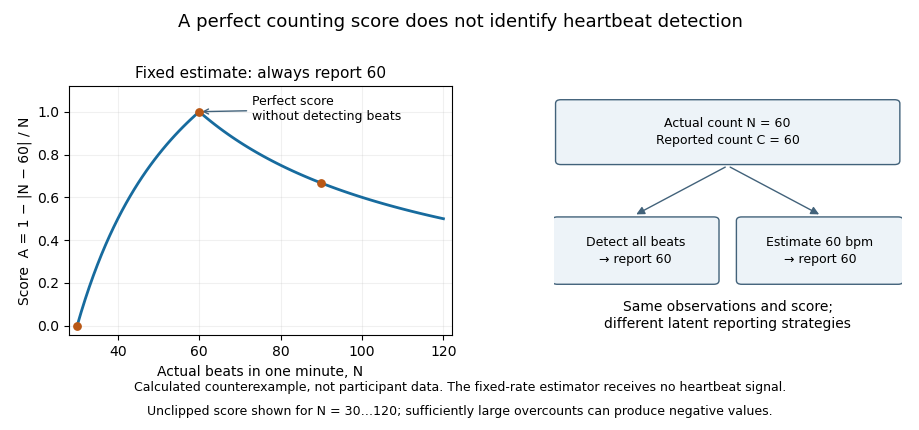

The statistical critique also needs qualification. A published reanalysis argued that several bivariate findings arise from analysing a ratio score and are less decisive than first claimed. This does not resolve every strategy or validity concern, and it does not invalidate the logical counterexample above. Mathematical dependence, sensory detection and behavioural usefulness should be tested as separate questions.[ref]
Are interoceptive accuracy scores from the heartbeat counting task problematic? A comment on Zamariola et al. (2018) by Daniel Zimprich and others. Abstract: reanalysis of ratio scores and qualifications to the bivariate criticisms
A strong interoceptive account must therefore specify the intermediate mechanism. Bodily input may change experienced affect, which changes attention to another person; uncertainty about one’s own state may complicate separating self-generated distress from another’s needs; physiological regulation may help sustain a demanding interaction. These are different causal routes. Each requires measurements of its proposed intermediate steps, temporal ordering and controls for general anxiety, task comprehension and sensory or motor demands. Merely correlating two questionnaires cannot choose among them.
There are also clear limits to generalization. Cardiac detection does not measure every visceral modality, and evidence about recognizing emotional faces does not automatically explain representing a false belief. A shared insular signal is not a complete theory of interpersonal understanding. Good tests combine validated bodily tasks, objective physiology, confidence measures and independently defined social outcomes, ideally manipulating bodily input while testing competing explanations. By the examination date, converging studies supported a contribution to some affective aspects of social cognition; the claim that one interoceptive deficit explains all social difficulties was substantially stronger than the evidence.
Past exam of the clinical social cognitive neuroscience course of the University of Oxford 2022 3 Solution by Codex 0 2026-10-25
Codex 0 2026-10-25Imitation requires a usable mapping from another person’s perceived action to one’s own action system, together with retention, selection and execution appropriate to the task. It does not invariably require explicit theory of mind, verbal instruction or conscious intention to copy. Those processes can organize sophisticated imitation, but simple action matching can occur without them. The first requirement is therefore to establish what was copied and exclude alternative routes to a similar response.
An observer may reproduce an action’s bodily form, its sequence, its object-directed goal or only its environmental outcome. Producing the same outcome by another means is emulation rather than clear evidence of copying the demonstrated movement. Increased object exploration after watching another person is weaker still. A convincing task therefore needs baseline performance and demonstrations that distinguish candidate targets: two demonstrators achieving one goal differently, or the same movement producing different outcomes. Without such contrasts, successful performance does not identify the representation that guided it.
The motor correspondence problem is fundamental. The observer sees another body from an external perspective but controls their own body through motor commands and proprioceptive feedback. Copying a finger lift or facial gesture requires some relation between these different descriptions; literal duplication of retinal coordinates is not enough. A mirror-like spatial response and an anatomical response can even require opposite transformations when facing another person. A system that copies goals can use existing action elements to assemble a new sequence without already possessing a complete motor programme for that sequence.
Experience offers a mechanism for acquiring these relations. Seeing one’s own movements, acting together with others and observing other people imitate oneself can correlate visual and motor events. Counter-mirror training demonstrated that deliberately mismatching observed and executed finger actions changes subsequent matching-related motor responses. Thus correspondence is at least partly learnable. This finding does not prove that all imitation is acquired by the same process or that newborn action matching is impossible; it identifies a concrete source of plasticity in adults.[ref]
Sensorimotor learning configures the human mirror system by Caroline Catmur and others. Abstract: sensorimotor training changes the observation–execution relationship
Automatic imitation experiments isolate one consequence of a mapping. Participants make an instructed finger movement while an irrelevant observed movement is compatible or incompatible with it. Observed action identity influences performance, even when it is not the relevant cue. Comparisons with symbolic and spatial cues show why the similarity between observed and executed actions matters. However, spatial correspondence must be varied separately from action identity: a faster response to a hand on the response side could otherwise be mislabelled imitation. The latency cost indicates competition or facilitation, not a complete account of voluntary copying or empathy.[ref]
Compatibility between observed and executed finger movements: comparing symbolic, spatial, and imitative cues by Marcel Brass and others. Abstract and Experiments 1–3, pp. 124–143: symbolic, spatial and imitative compatibility
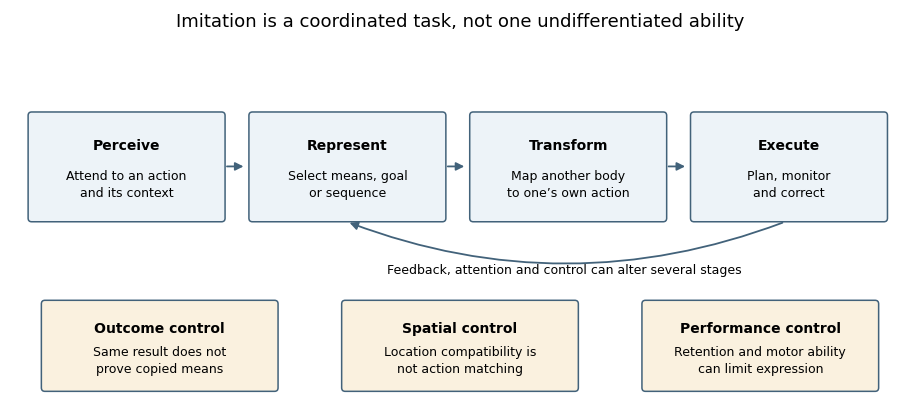
Psychological operations supporting imitation and their experimental controls
. Original functional schematic. The boxes identify task requirements and alternative explanations, not separate anatomical modules. Control and feedback can alter several stages. Details.
Control is as necessary as activation in many circumstances. A person may need to suppress the observed response and execute another instructed response, choose which part of a demonstration matters or adjust movement to a differently sized object. Attention determines which features are encoded; working memory supports sequences and deferred reproduction; motor planning and feedback determine whether an intended match is physically realized. A performance difference at any stage can reduce overt imitation, so failure does not uniquely show absence of a visuomotor mapping.
Goals can organize reproduction beyond visible movement. In a failed-action experiment, 18-month-old children often completed an adult’s intended target act even though the adult had not successfully demonstrated it. Control demonstrations and a mechanical-device comparison constrained accounts based simply on reproducing the visible trajectory. The result supports sensitivity to goal-directed human action, but completing the intended outcome is not proof of copying every bodily means or representing an explicit propositional belief. Goal inference and movement matching remain separable achievements.[ref]
Understanding the intentions of others: re-enactment of intended acts by 18-month-old children by Andrew N. Meltzoff. Experiments 1–2, pp. 838–850: failed attempts, completed acts and mechanical-device comparison
Infants’ copying can also vary with demonstration context. After seeing an adult activate a lamp using the head, 14-month-olds were more likely to repeat that means when the adult’s hands had been free than when the hands were occupied. One interpretation is that observers evaluate whether an unusual means was chosen freely or forced by a constraint. This motivates rational-imitation accounts. Yet differences in visible hands, attention or demonstration familiarity can also change encoding. Context sensitivity therefore requires explanation, but does not uniquely establish adult-like reasoning about reasons.[ref]
Rational imitation in preverbal infants by György Gergely and others. Abstract and p. 755: hands-free versus hands-occupied head-touch demonstration
Claims about prerequisites should also be developmentally precise. Neonatal matching, familiar automatic responses, newly learned gestures and extended technical procedures need not use identical representations or control demands. Disputed longitudinal neonatal findings emphasize the need for selective model-matching and appropriate control gestures rather than counting one commonly elicited action. Whatever their eventual interpretation, newborn findings do not license an inference that sophisticated intentional imitation is present at birth, nor does adult sensorimotor learning settle every neonatal result.[ref]
Comprehensive longitudinal study challenges the existence of neonatal imitation in humans by Janine Oostenbroek and others. Abstract: longitudinal tests across multiple modelled actions and early ages
The necessary psychological architecture is therefore a coordinated set of functions: detect relevant features, represent what is to be reproduced, transform that representation into feasible actions, retain it when required and control execution using feedback. Explicit intention understanding, social motivation and language can influence which actions are selected and why. They are not logical prerequisites for every compatibility effect. Good experiments manipulate these contributions separately and distinguish capacity from attention, opportunity and willingness to express it.
Past exam of the clinical social cognitive neuroscience course of the University of Oxford 2022 2 Solution by Codex 0 2026-10-25
Codex 0 2026-10-25Mirror neurons provide an observation–execution matching property that can contribute to action processing; their existence does not establish one exclusive function such as reading intentions. Plausible roles include linking seen actions to motor representations, predicting familiar action sequences and supporting imitation. The evidence is strongest when a specified task, representation and causal contribution are identified, and weaker when every social capacity is attributed to a broadly defined mirror system.
The original evidence was unusually direct. Single-neuron recordings in macaque premotor area F5 identified cells active both when the animal performed an action and when it observed a related action. Some observation–execution relations were relatively specific, whereas others generalized across aspects of the act. This is evidence about individual recorded cells, rather than merely overlapping brain regions. Yet the experimenter’s action label does not tell us exactly what the cell encodes: movement, object interaction, learned outcome and context can covary.[ref]
Action recognition in the premotor cortex by Vittorio Gallese and others. Summary and pp. 593–609: macaque F5 recordings and observation–execution congruence
An important extension tested incomplete visual information. Some cells responded when the final object interaction was hidden but could be inferred from the preceding situation. Thus a full visual display of the critical movement was not always necessary for activation. This is compatible with an internally generated action representation or prediction. It is not proof that a neuron understands another person’s beliefs, nor that the representation is generated without input from other visual or contextual systems. Familiar-context prediction and mental-state attribution are distinguishable hypotheses.[ref]
I know what you are doing: a neurophysiological study by Maria Alessandra Umiltà and others. Abstract and pp. 155–165: responses during visible and occluded action completion
Human evidence requires care about measurement scale. Functional imaging showing activation during both action observation and execution can involve different cell populations within one voxel. A motor-evoked potential during observation measures a downstream excitability change, not one cell’s selectivity. Intracranial recordings in a clinical epilepsy sample did identify individual observation–execution matching responses, including in supplementary motor and medial-temporal regions. That establishes relevant human cellular responses in the sampled tissue. Electrode placement was clinically determined, however, so it does not supply a representative census of the putative inferior-frontal/parietal system or of the general population.[ref]
Single-neuron responses in humans during execution and observation of actions by Roy Mukamel and others. Abstract and Experimental Procedures: individual-unit responses, clinical sample and electrode-placement constraints
A functional claim then needs a task contrast. Recognizing that a hand grasps an object, anticipating how a lift will unfold, judging the object’s weight and understanding a deceptive intention are not interchangeable forms of “action understanding.” Matching circuitry could improve one without being necessary for all. It may supply motor predictions that combine with visual object knowledge and contextual inference. Calling every successful judgment simulation would make the hypothesis difficult to falsify; the account must predict a deficit or response pattern that alternatives do not predict.
A stimulation experiment addressed a narrower causal question. Disrupting left inferior frontal cortex impaired judgments of a box’s weight from a person lifting it, with comparison tasks involving a bouncing ball and stimulus duration and comparison stimulation sites. These controls strengthen the inference that this region contributes to interpreting the action under those conditions. The manipulation still affected a cortical region, not selectively its mirror neurons. It therefore cannot establish that mirror cells are the sole mechanism, or that the region is necessary for all conceptual understanding of actions.[ref]
Action understanding requires the left inferior frontal cortex by Gorana Pobric and others. Summary and Results, pp. 524–529: weight judgments, nonhuman-motion/duration controls and stimulation sites
Developmental origin is a separate question from present function. In counter-mirror training, participants repeatedly performed one finger action while observing another. Subsequent muscle-specific responses to motor-cortex stimulation changed from the usual matching pattern toward the trained mismatching relation. This supports experience-dependent calibration of the action-observation/motor relationship. It challenges an account in which every relevant mapping is fixed and independent of experience, while leaving open contributions from developmental constraints. The measure was a motor-evoked response, so the experiment did not directly reprogramme an individually recorded mirror cell.[ref]
Sensorimotor learning configures the human mirror system by Caroline Catmur and others. Abstract and pp. 1527–1531: pre/post training muscle-specific responses and reversed sensorimotor pairing
This evidence also separates function from adaptation. A learned matching circuit may currently assist prediction or action selection even if it was not selected by evolution specifically to understand minds. Conversely, showing a plausible contribution to imitation does not show that every matching response exists for imitation. The same representation can be used in several tasks. Evolutionary stories require comparative or developmental evidence beyond the presence of useful response properties in an adult laboratory preparation.
Broad clinical explanations supply further tests. In one child study, several goal-imitation and action-representation measures were preserved in autistic participants despite poorer theory-of-mind performance. These behavioural results argue against a universal loss of action matching explaining every social difficulty. They do not demonstrate normality of every mirror population, because cells were not directly recorded. The important inference is that different social tasks cannot be assumed to stand in for one another.[ref]
The most defensible functional account is therefore contributory and conditional. Matching responses provide a route by which action observation can access action-related representations; learning, context and task goals determine how those representations are used. Single-cell recordings establish the property, controlled training tests plasticity, and well-designed perturbations test task-specific necessity. A comprehensive theory must connect all three while allowing other systems to supply object knowledge, language, attention and mental-state inference. Existence, selectivity, developmental origin and behavioural usefulness are four questions, not four names for the same finding.
Past exam of the clinical social cognitive neuroscience course of the University of Oxford 2022 1 Solution by Codex 0 2026-10-25
Codex 0 2026-10-25Theory of mind and affective empathy are partly dissociable psychological capacities, while cognitive empathy overlaps substantially with mental-state understanding. A person can understand that another has a mistaken belief without sharing the person’s emotion; conversely, another’s distress can elicit an affective response without accurate reasoning about its cause. These possibilities do not establish wholly independent modules. The central question is which operations, measurements and circumstances can be separated.
Theory of mind concerns representing mental states such as beliefs, knowledge, desires and intentions. It can include non-emotional content: predicting where someone will search after an unseen object transfer need not involve feeling that person’s disappointment. Affective empathy involves sharing aspects of another’s affect with a self-other distinction. Cognitive empathy concerns understanding another’s emotional perspective and therefore recruits some of the operations also called theory of mind. Compassion, the concern that motivates helping, is different again; personal distress can be intensely aversive to the observer without yielding accurate understanding or useful assistance. Whether “empathy” dissociates from mentalizing consequently depends partly on which component is meant.
Psychological dissociation requires more than two differently named tasks. A belief story also demands language, working memory and response selection; a pain picture demands visual attention and interpretation. Differences between a story test and an emotional-rating scale could therefore reflect task impurity. A single correlation is equally inconclusive: shared verbal skill or a general tendency to endorse questionnaire items can create apparent unity. Conversely, noisy measurements can conceal a genuine association. The strongest designs measure both constructs within the same people, distinguish their target demands and include independent measures of validity.
The EmpaToM paradigm provides a useful example. Short autobiographical videos varied emotional content independently of whether a subsequent question required mental-state inference or factual reasoning. Affect and compassion ratings were obtained separately from reasoning performance. In the large validation experiment, the corresponding behavioural indices related selectively to activity in distinguishable networks, including anterior insula for affect sharing and temporoparietal regions for mentalizing. This supports separability within one task framework, rather than relying solely on unrelated literatures. It does not establish that the constructs never interact or that their measurement is perfectly pure.[ref]
Dissecting the social brain: Introducing the EmpaToM to reveal distinct neural networks and brain-behavior relations for empathy and Theory of Mind by Philipp Kanske and others. Abstract and Experiments 1–2, pp. 6–19: factorial manipulation, behavioural validation and selective brain–behaviour relationships
Earlier imaging studies help specify the contrast. A self/partner pain experiment identified shared affect-related activity without identical recruitment of every sensory component of directly experienced pain. Belief-story experiments contrasted mental representation with nonmental representation, rather than merely contrasting people with objects. Together these findings suggest different component computations; overlapping or distinct blood-oxygenation signals cannot alone establish psychological identity or independence. An anatomical label is not a definition of empathy, and activating a region implicated in several processes cannot uniquely diagnose which process occurred.[ref]
Empathy for pain involves the affective but not sensory components of pain by Tania Singer and others. Abstract: self-pain versus partner-pain conditions and affective/sensory contrasts
[ref]People thinking about thinking people: the role of the temporo-parietal junction in theory of mind by Rebecca Saxe and others. Experiments 1–2: belief versus nonmental-representation controls
Lesion evidence can strengthen the inference. A study comparing inferior-frontal and ventromedial-prefrontal lesions reported different patterns of emotional and cognitive empathy impairment, a behavioural double dissociation. That pattern argues against a simple single ability differing only in overall difficulty. However, lesions affect networks as well as local tissue, groups can differ in lesion extent, and the measures operationalize particular components rather than all possible mental-state understanding. The result supports multiple contributions, not a claim that one region contains every affective response and another every social inference.[ref]
Two systems for empathy: a double dissociation between emotional and cognitive empathy in inferior frontal gyrus versus ventromedial prefrontal lesions by Simone G. Shamay-Tsoory and others. Abstract and pp. 617–627: lesion-group comparison and cognitive/emotional empathy measures
Atypical development also makes confounding visible. In an empathy-for-pain study, insula responses tracked alexithymia across autistic and non-autistic participants rather than diagnostic group after adjustment. This challenges the inference that a difficulty in one aspect of social cognition necessarily entails an absence of affect sharing. It remains correlational evidence, and a nonsignificant adjusted group difference is not a proof of exact equivalence.[ref]
The capacities can nevertheless cooperate. Understanding that someone is grieving can direct attention toward relevant cues; sharing discomfort can motivate further inquiry into its cause. An observer’s own emotion may also bias interpretation, so stronger affect is not guaranteed to produce more accurate mentalizing. Accurate understanding can support compassionate help or strategic manipulation depending on motivation. These examples distinguish computational interaction from identity: two processes can causally influence one another without being the same process.
The distinction between capacity and spontaneous deployment is especially important. An explicit instruction may elicit reasoning that would not occur automatically in a distracting interaction. A person can also understand another’s state while declining to report an emotion, or feel concern while finding a questionnaire difficult. Better tests combine accuracy, ratings, behavioural choices and physiological measures, while checking reliability, language demands and response bias. Training or perturbation should produce a selective change on independently validated outcomes before being taken as evidence of a psychological separation.
The justified conclusion is therefore graded. Mental-state representation, affect sharing, compassionate concern and self-directed distress can be distinguished conceptually and empirically, with converging task, imaging and lesion evidence. The strongest dissociation concerns mentalizing and affect sharing, rather than every use of the word empathy. Real interactions recruit these components together with attention, learning and motivation; explaining that coordination is more informative than either treating all social understanding as one ability or assuming completely insulated systems.
There are unlisted articles, also show them or only show them.