
Yerco E. Uribe-Bahamonde contributed computational analyses of habituation using the SOP model. The work investigates whether one model of stimulus processing can reproduce several behavioral characteristics across training conditions. These simulations test consequences of the specified mathematical rules; agreement with behavior does not make the model’s internal states direct recordings of neuronal activity. [ref]
Robert C. Honey studies associative learning and the contribution of the hippocampus to behavior. His lesion experiment compared responses to audiovisual sequences that preserved familiar components while changing their trained relationship. Such a comparison separates detection of an unfamiliar item from detection of a mismatch between expected associates. [ref]
Hippocampal lesions disrupt an associative mismatch process by Robert C. Honey and others. 1998, rat hippocampal lesions and audiovisual sequence comparisons
David J. Sanderson studies animal learning and memory in animals. In mice lacking the GluA1 receptor subunit, his study compared short- and long-term spatial memory in animals using novelty preference. Impaired short-term performance together with preserved or enhanced longer-term performance supports distinguishing the processes sampled by different tasks, rather than treating every result as one general memory in animals score. [ref]
Susan E. Brandon studies associative learning. Her experimental work examined how one conditioned stimulus modulates a discrete conditioned reflex in rabbits, while her theoretical work helped develop the SOP model. Separating the elicited reflex from a broader modulatory influence allows a learning model to make predictions about interactions between different trained cues. [ref]
A physician and researcher who helped establish G protein-coupled receptors as identifiable molecular structures. Radioligand binding made receptor recognition experimentally measurable; subsequent isolation and sequence analysis connected a physiological response to a particular protein.[ref]
https://www.nobelprize.org/prizes/chemistry/2012/lefkowitz/biographical/. autobiographical account, receptor binding and molecular characterization

Portrait of Robert Lefkowitz
. Bengt Nyman, Flickr photograph, 7 December 2012; Commons Flickr-license review confirmed CC BY 2.0. Creative Commons Attribution 2.0 Generic., via Wikimedia Commons. Source.
A physiologist whose On the Motion of the Heart and Blood in Animals by William Harvey develops an experimental and quantitative argument for blood circulation.

Portrait of William Harvey
. Anonymous painting; Wellcome Collection / Wellcome Library, London, V0017909. Creative Commons Attribution 4.0 International, creativecommons.org/licenses/by/4.0/ . No alteration other than display scaling. Source.

Historical portrait of Jan Evangelista Purkyně
. Anonymous portrait, published in The Sokols, a 1926 supplement to The Central European Observer. Source: Wikimedia Commons. Source.
A physiologist whose investigations connected digestion, glandular secretion and nervous system control. Preparations separating entry of food from its arrival in the stomach allowed experiments on anticipatory gastric acid secretion, contributing to the study of classical conditioning.[ref]
https://www.nobelprize.org/prizes/medicine/1904/pavlov/lecture/. 1904 Nobel lecture, sham feeding and digestive secretions
A physiologist associated with the experimental development of classical conditioning.[ref]

https://commons.wikimedia.org/wiki/File:Ivan_Pavlov_nobel.jpg. Identity and authorship record

Portrait of Ivan Pavlov
. Official Nobel photograph, circa 1904; photographer unknown. Commons identifies the photograph as public domain. Source.A physician who described a recurring combination of involuntary shaking, altered posture and gait in his 1817 essay. Comparing observations across people helped define a recognizable clinical syndrome before its later neurobiological explanation.[ref]

Signature of James Parkinson on a letter dated 21 February 1809
. Public-domain signature hosted by Wikimedia Commons. Source.

Portrait of Richard Bentley
. George Vertue, line engraving after J. Thornhill; Wellcome Library, London / Wellcome Images, L0021234. Creative Commons Attribution 4.0 International., via Wikimedia Commons. Source.
A paleontologist who coauthored the description of an early Jurassic jumping frog, using comparative anatomy to investigate the evolution of locomotion.[ref]
An Early Jurassic jumping frog by Neil H. Shubin and Farish A. Jenkins Jr.. Author roster and research findings
A paleontologist who studied how transport and burial affect vertebrate remains, connecting taphonomy to reconstruction of an ancient biological population.[ref]
A paleontologist who investigated taphonomy through experiments on soft-tissue fossilization, connecting observable decay and mineralization to exceptional preservation.[ref]

Portrait of Derek Briggs
. External portrait hosted by Yale University, Department of Earth & Planetary Sciences. Source.A paleontologist who studied early jawed vertebrates, including Silurian fossils with character combinations that inform the origins of modern jaw and skull structures.[ref]

Portrait of Min Zhu (paleontologist)
. External portrait hosted by Institute of Vertebrate Paleontology and Paleoanthropology, Chinese Academy of Sciences. Source.Paleontologist studying large-scale evolution and extinction selectivity, including the marine fossil record.

Portrait of David Jablonski
. Image courtesy of Susan M. Kidwell. Source.Paleontologist whose research includes early life and physiological interpretations of mass extinction.

Portrait of Andrew H. Knoll
. The Royal Society (Royal Society uploader); existing crop by Auguel. CC BY-SA 4.0, via Wikimedia Commons. Source.
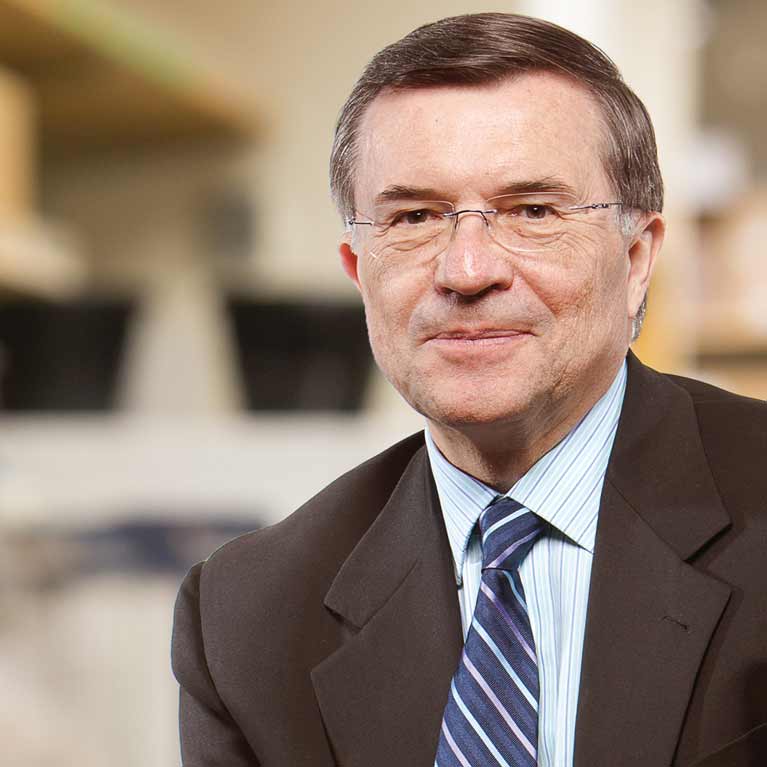
Portrait of Terrence J. Sejnowski
. A biophysicist who coauthored single-molecule methods for estimating the number of subunits in membrane-bound proteins. Counting bleaching steps connected an optical time series to molecular assembly.[ref]
Subunit counting in membrane-bound proteins by Maximilian H. Ulbrich and Ehud Y. Isacoff. study design and results; author roster
A researcher who coauthored adaptive-optics imaging and densitometry of human cone mosaics. Measuring variation among individuals connected retinal sampling with trichromatic vision without assuming one fixed cone ratio for every observer.[ref]
Organization of the Human Trichromatic Cone Mosaic by Heidi Hofer and others. study design and results; author roster
A researcher who coauthored basilar-membrane measurements before and after a reversible physiological perturbation. Changes in sensitivity and tuning tested a contribution of active cochlear feedback.[ref]
There are unlisted articles, also show them or only show them.