Past exam of the physics course of the year 4 of the natural sciences course of the University of Cambridge 2016 Paper 1 Section B B7 Solution by  Codex 0 2026-10-20
The classical minimum is , attained at . The quantum oscillator has , its zero-point energy; simultaneous zero position and momentum uncertainties are forbidden.
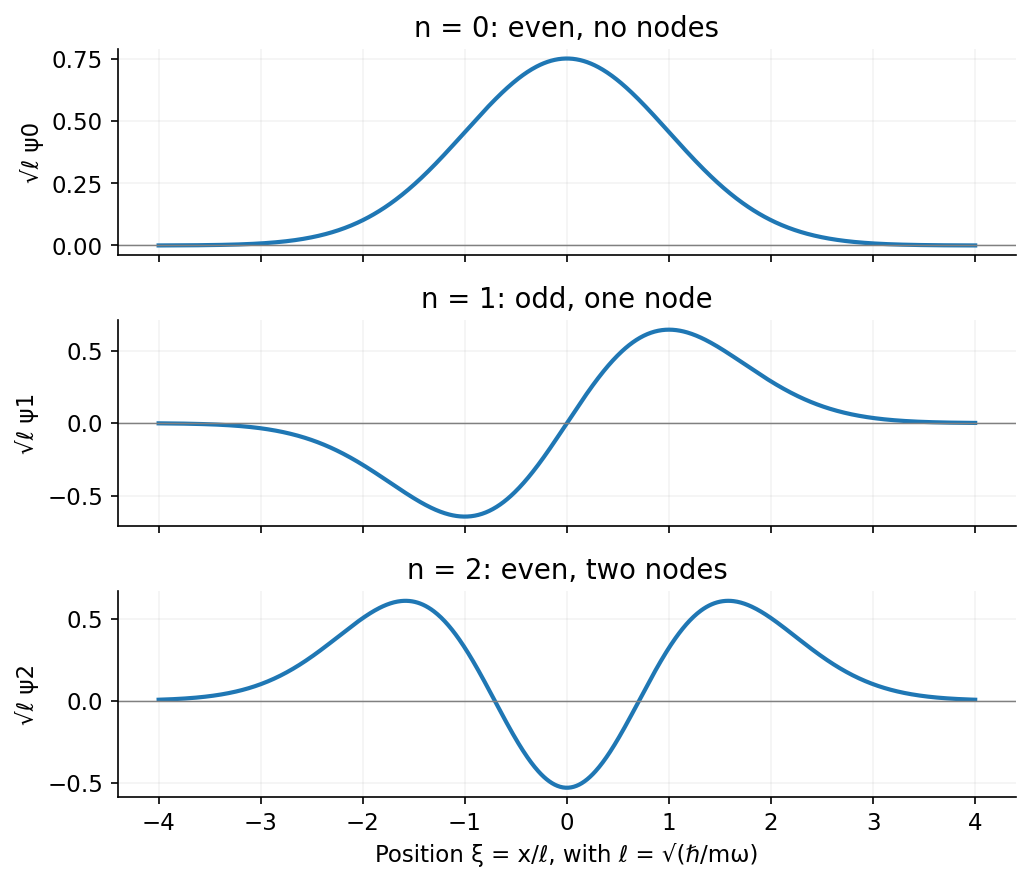
Let and . The first three normalized harmonic oscillator eigenfunctions areThey have respectively zero, one and two nodes, with even, odd and even parity. Their phases may be reversed without changing the state.[ref]
Past exam of the physics course of the year 4 of the natural sciences course of the University of Cambridge 2016 Paper 1 Section B B6 Solution by Codex 0 2026-10-20
Codex 0 2026-10-20Two applications of optical interferometry are precision displacement or strain measurement, and Fourier transform spectroscopy, which recovers a spectrum from an interferogram.
For the round-trip phase in a Michelson interferometer, take a lossless 50:50 beam splitter with and , and mirror reflection amplitude . At the depicted detector, each returning path has one beam-splitter transmission and one reflection. Their amplitudes are and . Consequently,The factor 2 in the phase is the return journey: the labelled is a one-way arm-length difference. The other output port has the complementary intensity. The printed cannot be an intensity: it becomes negative, and does not match the depicted path difference. No choice of normalization fixes that negative minimum. The expression above is the physically consistent result for the drawn output port.
For mutually incoherent spectral components with incident power density ,The plot labels are and ; these printed centres are used here. In the narrow-line, equal-power limit, each line has incident intensity andThere are rapid carrier fringes with approximately mirror-displacement spacing and a slowly varying Interferometric visibility envelope. The first visibility zero is at , and successive visibility revivals are separated byFor the unequal-line visibility in a spectral doublet, with incident line powers , replace the intensity by . The visibility becomesThe visibility minima rise from zero to . The finite widths drawn in the spectrum also make coherence decay with path difference. For example, Gaussian lines of common wave-number standard deviation multiply the oscillatory term by ; the actual linewidth is not specified numerically. Thus the narrow-line plot gives the beat positions, while the true long-delay oscillations die away.[ref]
Interference and Coherence by Sander Konijnenberg, Aurèle J.L. Adam and H. Paul Urbach. Temporal coherence and interference of incoherent spectral components
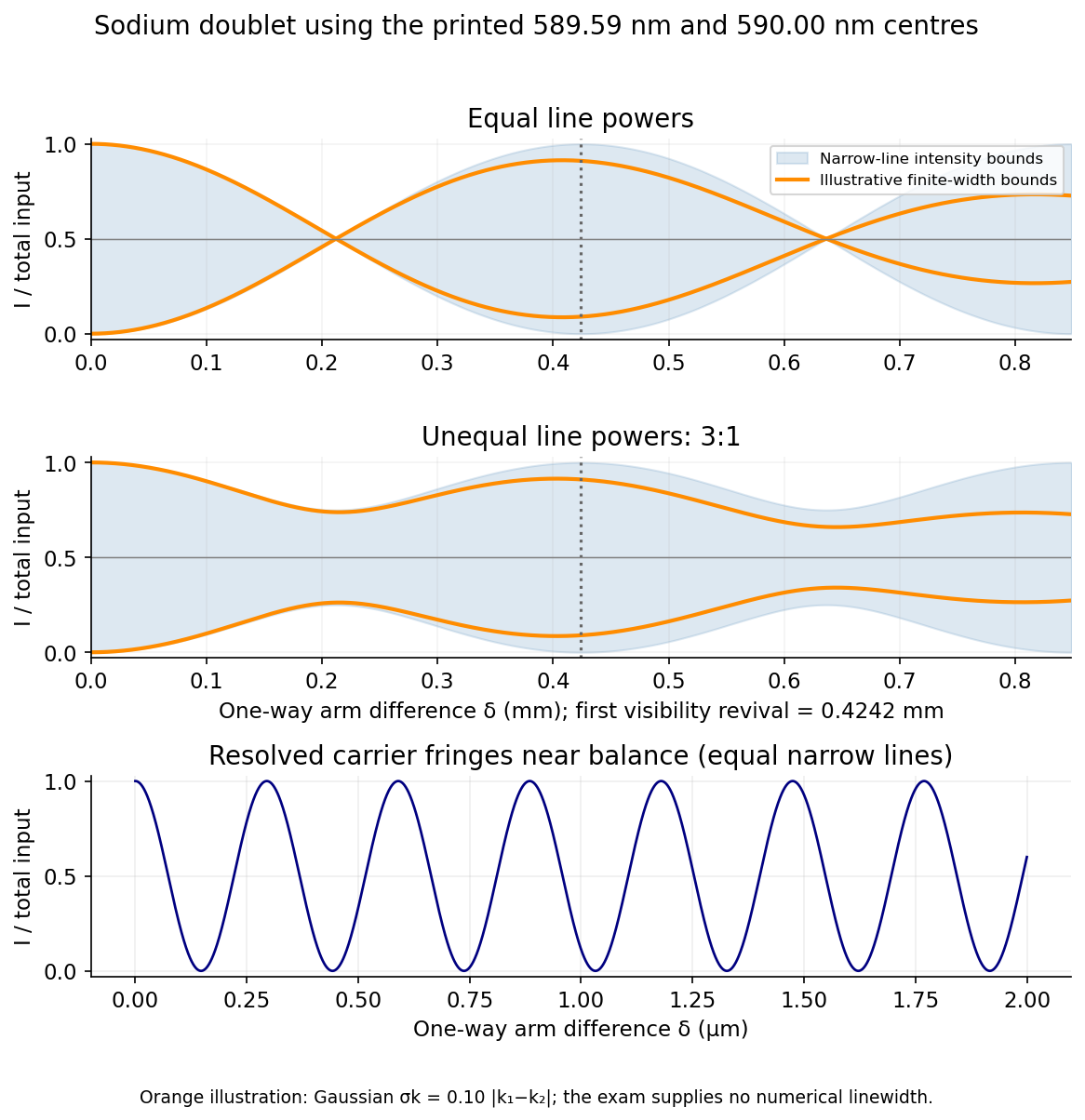
Doublet interferograms: unequal line powers prevent complete loss of visibility; finite linewidth damps the revival envelope
. Source. Details. The common-arm phase cancellation in a balanced interferometer means there is no smallest positive common mirror distance in a balanced interferometer. With the common factor cancels from every intensity, and both paths interfere constructively at this detector for every . Their infimum is zero. The beat length describes changes of arm difference, not of the common arm length. It therefore cannot answer the final request as printed.
Past exam of the physics course of the year 4 of the natural sciences course of the University of Cambridge 2016 Paper 1 Section B B5 Solution by Codex 0 2026-10-20
Codex 0 2026-10-20Nonrelativistic momentum conservation gives , while an elastic collision conserves kinetic energy, . Squaring the momentum equation yields . The two nonzero outgoing velocities are perpendicular. In the degenerate case where one outgoing particle is at rest, its direction is undefined.
For relativistic collisions conserve total four-momentum, with , and . Rest energies must be included; for photons .
For the symmetric relativistic equal-mass scattering angle, the incident momentum is . Energy conservation gives each final particle , hence . Transverse momenta cancel and , givingThe nonrelativistic limit has , so the outgoing angle is as above.
For the symmetric two-photon annihilation angle in the specified electron-positron annihilation, each photon has energy . Momentum conservation gives , soAs the two photons become back-to-back, transverse to the limiting incident direction; as they are forward collimated. Equal photon energies follow from the specified equal angles, and are not a general property of annihilation in a moving laboratory frame.
Past exam of the physics course of the year 4 of the natural sciences course of the University of Cambridge 2016 Paper 1 Section B B4 Solution by Codex 0 2026-10-20
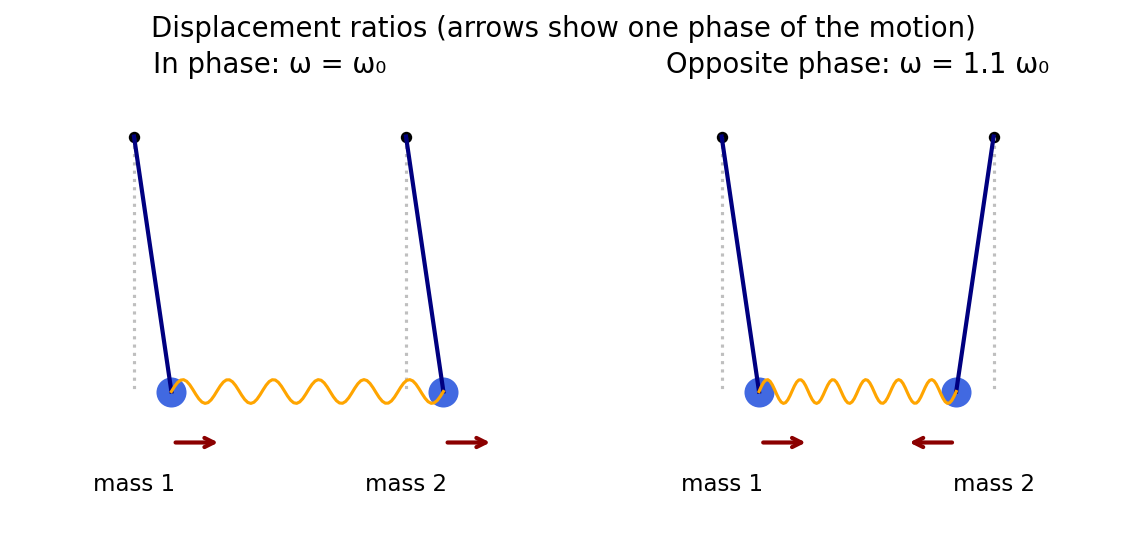
Codex 0 2026-10-20For the normal modes of two spring-coupled equal pendulums, a normal mode has every coordinate oscillating at the same frequency with a fixed displacement ratio. The linearized equations here areTheir normalized displacement patterns and angular frequencies areThe spring is unstretched in the in-phase mode, and stretched or compressed in the opposite-phase mode. The numerical ratio follows from .
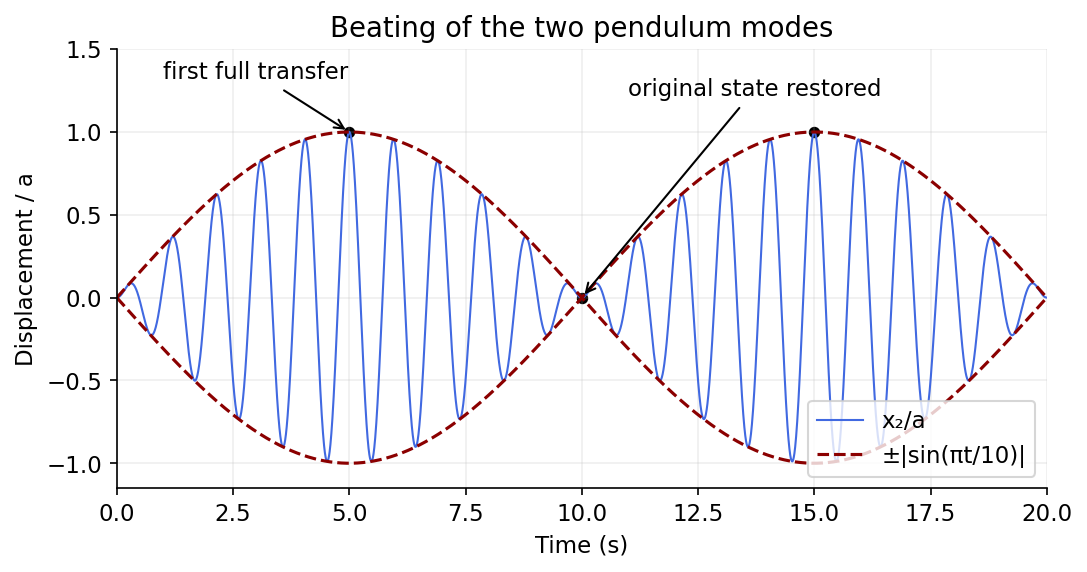
The initial displacement is the equal sum of the two mode patterns, and the initial velocities vanish. ThereforeWith the printed this is , with in seconds. The fast oscillation has frequency and the amplitude is bounded by . The first complete displacement transfer is at , when , and both velocities vanish; the original state returns at . Distinguishing absolute and signed beat envelopes, the absolute beat envelope repeats every , although its signed sine factor has period .
Past exam of the physics course of the year 4 of the natural sciences course of the University of Cambridge 2016 Paper 1 Section B B3 Solution by Codex 0 2026-10-20
Codex 0 2026-10-20For a fixed contour, Faraday's law of induction isThe second equation is the differential Maxwell equation, related to the first by Stokes theorem. For a moving wire, the relevant motional electromotive force is . Thus a static magnetic field can induce current in a moving circuit even when .
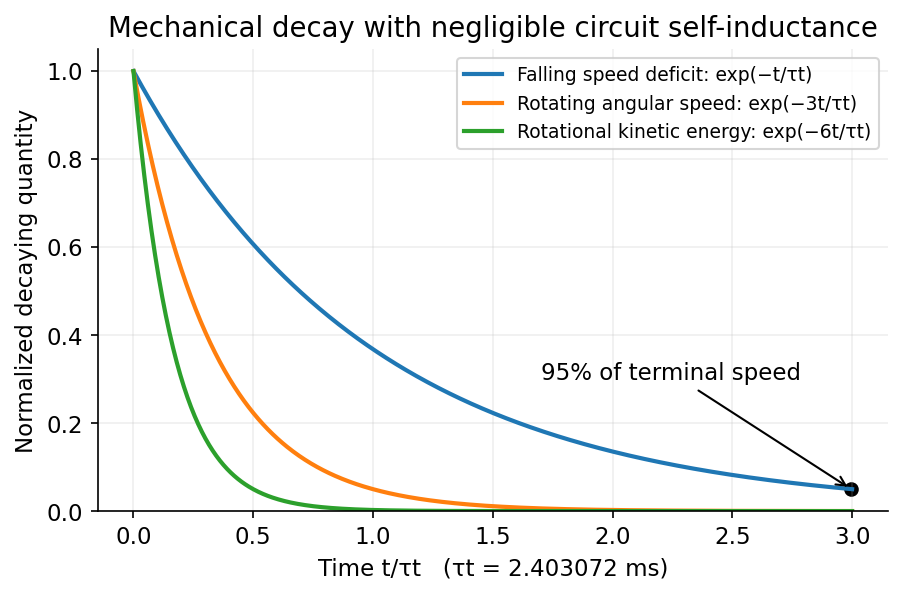
For translational magnetic damping of a square wire loop, while the upper horizontal leg remains in the field, a downward speed reduces the flux at rate . Hence , , and the upward magnetic braking force is . With negligible electrical self-inductance,Let the wire cross-sectional area be , mass density , and resistivity . Since and ,These use the printed copper values and . The wire dimensions cancel. The terminal-speed approximation is restricted to the interval before the upper leg leaves the field, as assumed in the question.
For rotational magnetic damping of a square wire loop, consider rotation about the central axis in a uniform field, the flux is . The induced current produces torque . A thin square loop has moment of inertia : the two legs parallel to contribute , and the other two . Averaging over a rotation givesIf “decay time” means rotational kinetic energy rather than angular speed, gives . This distinction, and the assumed separation between rotation period and slow decay, are essential. The electrical and mechanical time scales in magnetic braking must be separated: electrical self-inductance is neglected in both calculations.


Past exam of the physics course of the year 4 of the natural sciences course of the University of Cambridge 2016 Paper 1 Section A A9 Solution by Codex 0 2026-10-20
Codex 0 2026-10-20For hyperfine coupling for a spin-one nucleus, let the electron spin be and the nuclear spin . First couple , giving , then , giving .
| Allowed | ||
|---|---|---|
For each , the projection is ; electron projections similarly satisfy . Summing gives 18 states for and 30 for , agreeing with .
Notation qualification: if the printed leading “2” denotes the principal quantum number, a hydrogenic bound state does not exist because ; a physical state needs . If a doublet term symbol or was intended, its leading 2 instead means , and the angular-momentum table applies without fixing . The answers above use the explicitly specified values, while retaining this ambiguity.[ref]
Quantum Mechanics by David Tong. Three-dimensional angular momentum and hydrogenic quantum-number restrictions
Past exam of the physics course of the year 4 of the natural sciences course of the University of Cambridge 2016 Paper 1 Section A A8 Solution by Codex 0 2026-10-20
Codex 0 2026-10-20The wave numbers before and after the drop are and . Continuity of and at the finite step givesThus the reflected probability flux fraction isThe transmission probability is , rather than simply . Reflection is possible at a downward potential step even though both sides are classically allowed.
Past exam of the physics course of the year 4 of the natural sciences course of the University of Cambridge 2016 Paper 1 Section A A7 Solution by Codex 0 2026-10-20
Codex 0 2026-10-20The first ideal linear polarizer transmits half of an unpolarized beam. Each subsequent polarizer is from the preceding transmitted polarization, so Malus's law givesIntensities, rather than coherent field amplitudes for different input polarization components, are averaged for the unpolarized beam. The output is polarized along the last polarizer's axis.
Past exam of the physics course of the year 4 of the natural sciences course of the University of Cambridge 2016 Paper 1 Section A A6 Solution by Codex 0 2026-10-20
Codex 0 2026-10-20For the focal length of a rotating liquid mirror, consider steady rigid rotation at angular frequency . The free surface is an equipotential of . HenceA paraboloidal mirror has , givingThe numerical estimate uses the conventional standard acceleration , rather than an asserted local measurement or a recovered handbook entry.[ref]
NIST Guide to the SI, Footnotes by National Institute of Standards and Technology. Footnote 23: conventional standard acceleration of free fall
The mercury density cancels; the ideal surface shape follows from gravity and rotation. Past exam of the physics course of the year 4 of the natural sciences course of the University of Cambridge 2016 Paper 1 Section A A5 Solution by Codex 0 2026-10-20
Codex 0 2026-10-20For contact loss on a smooth sphere, let be the angle from the upward vertical. In the limit of an infinitesimal initial displacement, conservation of energy gives . The inward radial equation isContact is lost at , so and . The distance travelled along the sphere is thereforeThe vertical drop is instead ; it is not the requested arc length. Exact rest at the unstable top would persist in the ideal mathematical solution, so the infinitesimal-displacement limit in the question is essential.
Past exam of the physics course of the year 4 of the natural sciences course of the University of Cambridge 2016 Paper 1 Section A A4 Solution by Codex 0 2026-10-20
Codex 0 2026-10-20For the ultrarelativistic magnetic bending radius, the Lorentz force supplies the transverse momentum change, so . At this energy the proton is ultrarelativistic, giving andThe electronvolt-to-joule conversion cancels the elementary-charge factor numerically. This uses external CODATA light speed and charge definitions.[ref]
CODATA recommended values of the fundamental physical constants 2014 by National Institute of Standards and Technology. Vacuum light speed and electronvolt conversion
If the stated beam energy means total energy, ; if it means kinetic energy, . Either interpretation gives the quoted radius at the precision of the supplied numbers. There are unlisted articles, also show them or only show them.