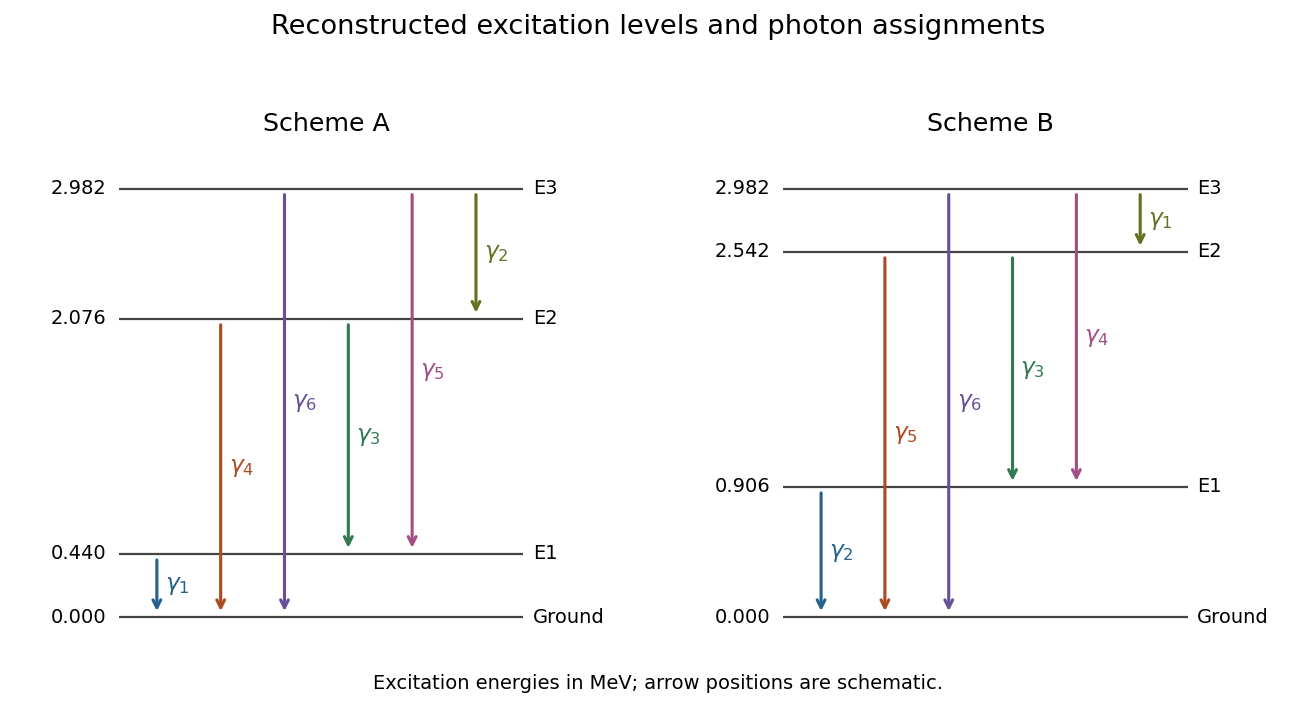
For every daughter energy level, the total number leaving it must equal direct beta feeding plus cascades entering it. Direct feeding cannot be negative. This nuclear level population balance gives a decisive test without assuming any electromagnetic transition-strength model.
In schemeB, the first excited level is populated by 2→1 and 3→1, with counts N3+N4=38500+3770=42270. Its only downward transition is 1→0, whose count is N2=1. Its direct beta feeding would therefore have to be
All are non-negative. Thus schemeA is the compatible scheme. Under the stipulated complete decay sample and the six-transition model, schemeB is ruled out by population conservation, rather than merely being less probable. This inference assumes that the reported emitted-photon counts account for de-excitation: substantial unreported internal conversion or other decay paths would require additional terms.
The largest difference fixes E3=2.982MeV. Since E1,E2 are themselves transitions to the ground state, each must occur among the measured energies. Testing those pairs gives exactly two level schemes:
They are reflections of one another about half the total span: replacing every level E by E3−E preserves the set of differences. The assignment of every observed line is
These original diagrams plot the inferred excitation energies to scale. They do not reproduce the source schematic. The reconstruction treats the supplied three-decimal gamma rayenergiesas the transition gaps, neglecting their much smaller nuclear recoil corrections.
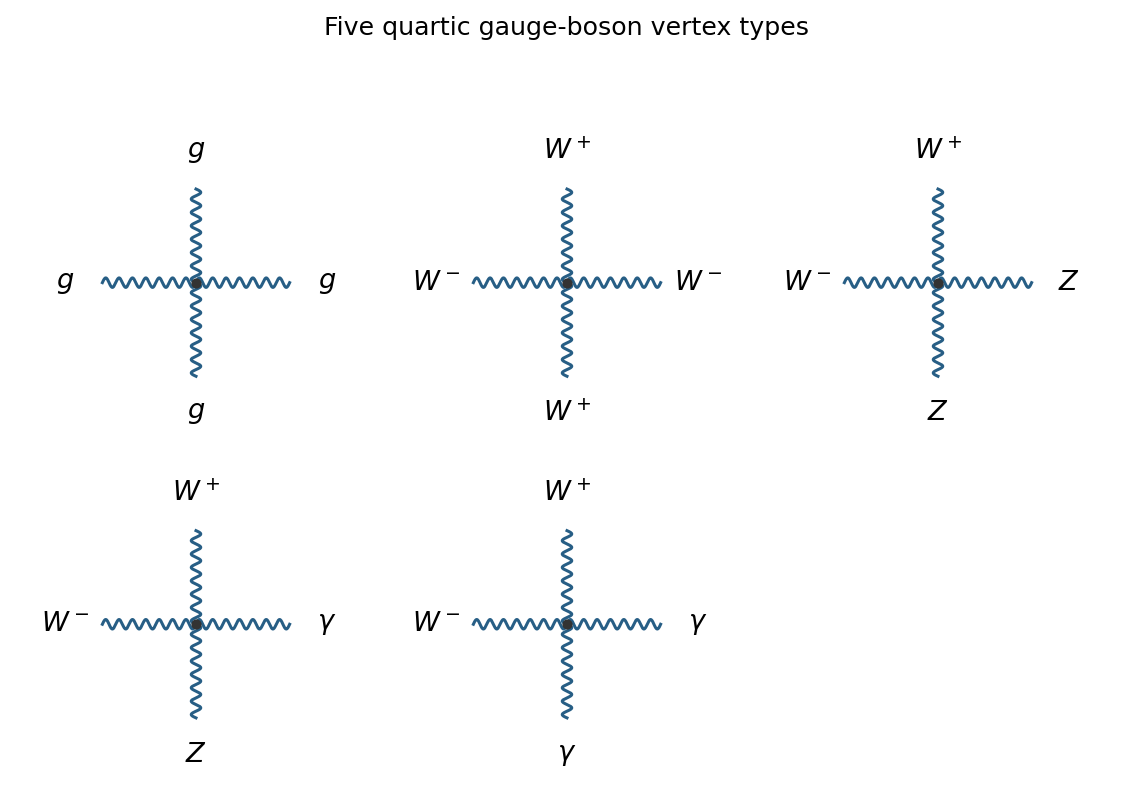
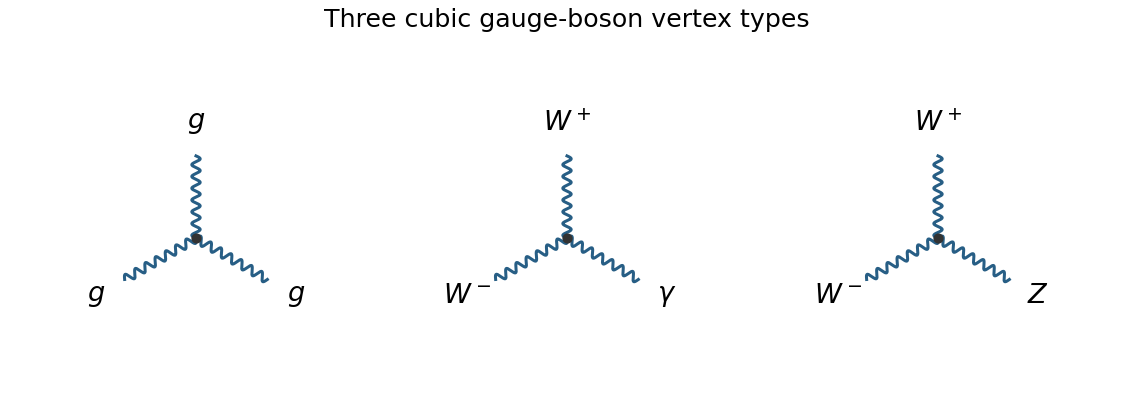
There is a convention to distinguish here: if acalculation expands around massless free fields, quadratic mW2Wμ+W−μ and mZ2ZμZμ/2 terms may be drawn as two-leg mass insertions. Those two insertion types belong to that bookkeeping convention. Similarly, two-point self-energy corrections occur in loop diagrams. Neither is an additional fundamental interaction in the standard physical-mass, tree-level rules used for the count above.
Thus the inferred potassium-argon dating age is about 2.5billionyears, consistent with the proposed 2.5×10⁹-year age to the accuracy of the supplied inputs. Omitting the branching fraction would seriously underestimate the age. At exactly 2.5billionyears, the model predicts Ar/K≃0.307, consistent with the rounded measured 0.3.
A becquerel is one decay per second; this is total activity over all decay branches. Multiplying by the argon-producing branching fraction would give that branch's activity, not the total asked for. Activity alone is also distinct from an absorbed radiation dose.
The qualitative explanation is nuclear pairing: 40K is odd-odd (Z=19,N=21), while both 40Ar and 40Ca are even-even. At A=40, moving from the odd-odd to either even-even branch lowers the pairing contribution to the atomic mass by
However, the particular coefficients printed in this paper do not quantitatively reproduce both allowed directions. Let D=mp+me−mn≃−0.7823MeV. Using every supplied term, rather than pairing alone, gives
Thus this parametrization would forbid the calciumbeta-minus branch. The physical atomic massdifferences are instead approximately +1.505MeV to argon and +1.311MeV to calcium, so both physical directions are allowed.[ref]
The valid interpretation is therefore pairing explains how both directions can be possible, but the supplied smooth massformula is insufficient to establish both for this isotope. The semi-empirical mass formula has MeV-scale residual errors and omits nuclear shell closure corrections; 40Ca has the especially stable Z=N=20 shell closures. One must use measured masses or amodel with those corrections for a quantitative proof, rather than changing the printed numbers silently.
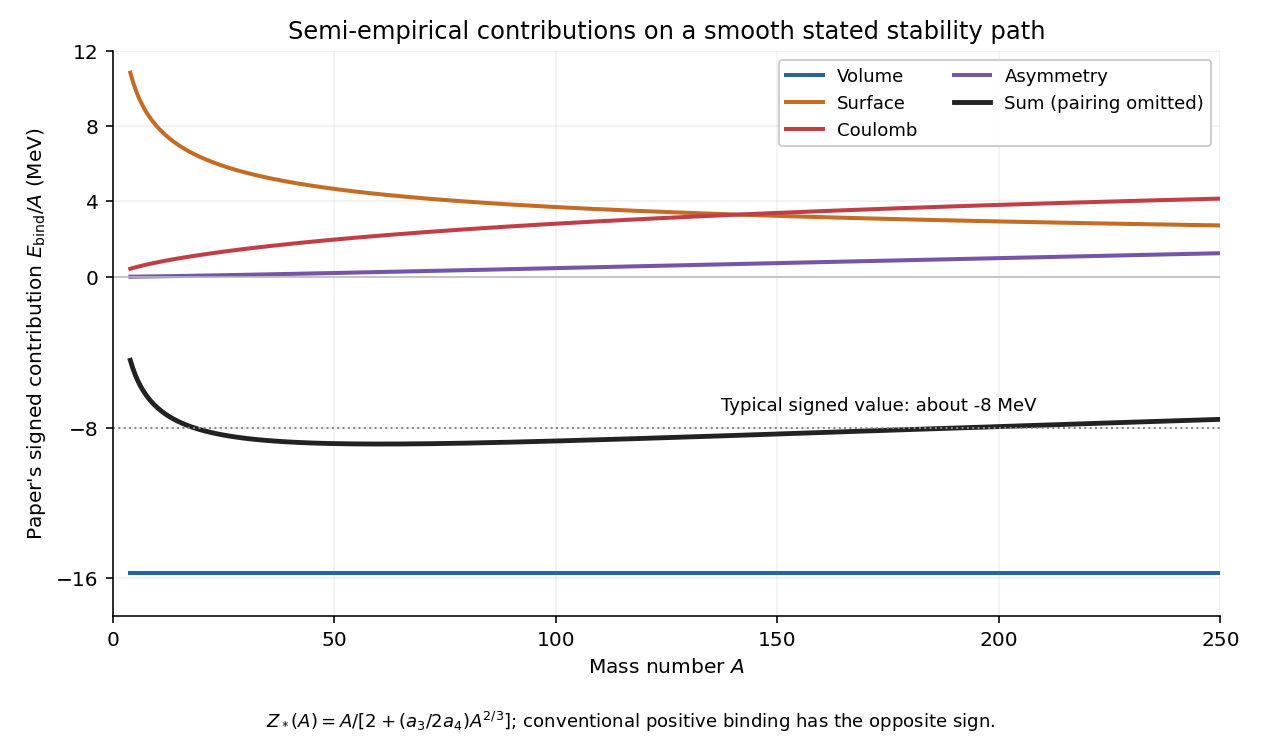
The volume contribution is the constant −15.7MeV. The positive surface correction decreases with A. At fixed protonfraction Z/A, the positive Coulomb correction grows as A2/3, while the asymmetry correction is constant. Along the beta-stable valley the fraction Z/A itself falls, and the asymmetry correction consequently grows.
Because the formula depends on both A and Z, no unique plot against A exists until a path Z(A) is chosen. The original sketch below uses the continuous minimum of the nuclear Coulomb-plus-asymmetry terms,
The four individual terms and their sum appear in one plot. A typical well-bound nucleus has Ebind/A∼−8MeV in the paper's convention, equivalently conventional positive binding energy per nucleonB/A∼+8MeV. If a positive-binding-energy plot is preferred, every plotted contribution must have its sign reversed. The competition between the surface and Coulomb penalties gives the familiar maximum of positive binding per nucleon near the iron-group nuclei.
Zme: the rest energy of the atomic electrons; including this term makes the result an atomic, rather than bare nuclear, mass. Small atomic binding energies are neglected.
a1A, with a1<0: the attractive volume term. The short-range nuclear force mainly binds each nucleon to nearby neighbours, so the leading attraction is extensive.
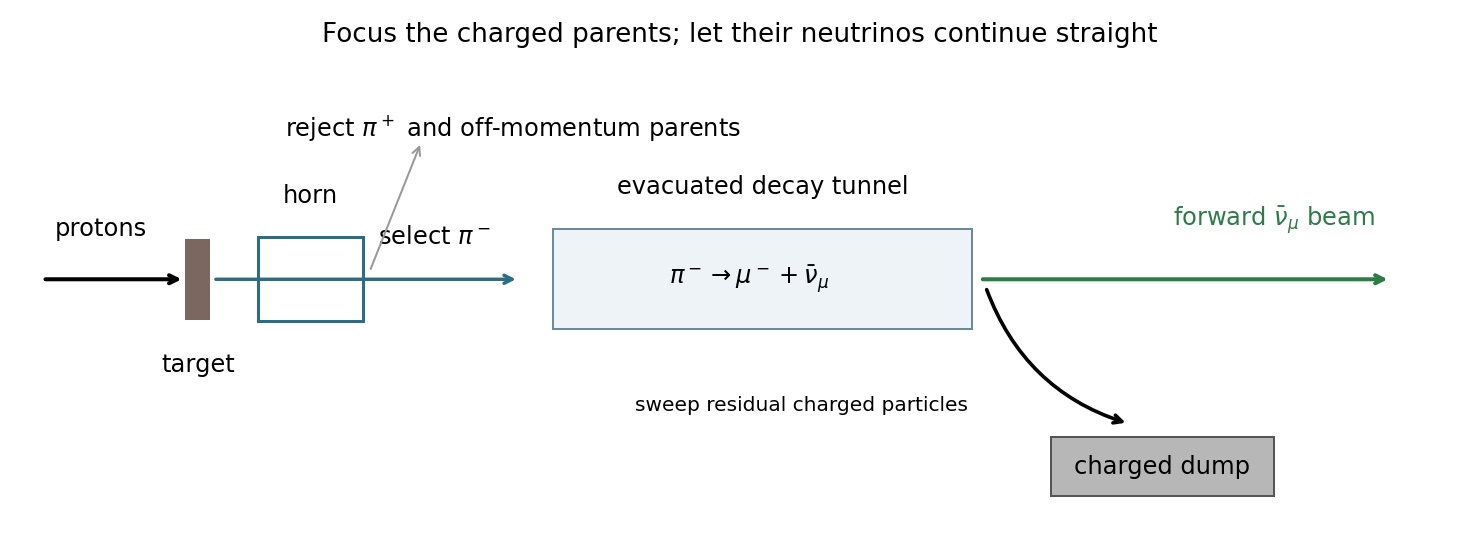
The selected π−travel through an evacuated decay tunnel and undergo π−→μ−νˉμ. Their forward Lorentz boost concentrates the antineutrinos within an angle of order 1/γπ. Choose a tunnel long enough for substantial pion decay but short compared with the boosted muon decay length. Since τμ≃2.2μs is much longer than τπ≃26ns, this reduces secondary μ−→e−νˉeνμ contamination.
Downstream magnets sweep the remaining charged particles into absorbers, and shielding stops residual hadrons and muons. The antineutrino beam continues straight through. Parent-particle collimation, charge selection, and a forward detector improve purity; neutral-kaon decays, remaining wrong-sign parents, and muon decays prevent perfect purity. Neutrinos themselves cannot be focused or charge-selected by these magnets. Neutrinos produced after stopped-muon decay or capture are much less forward and can be reduced by directional and energy selection.
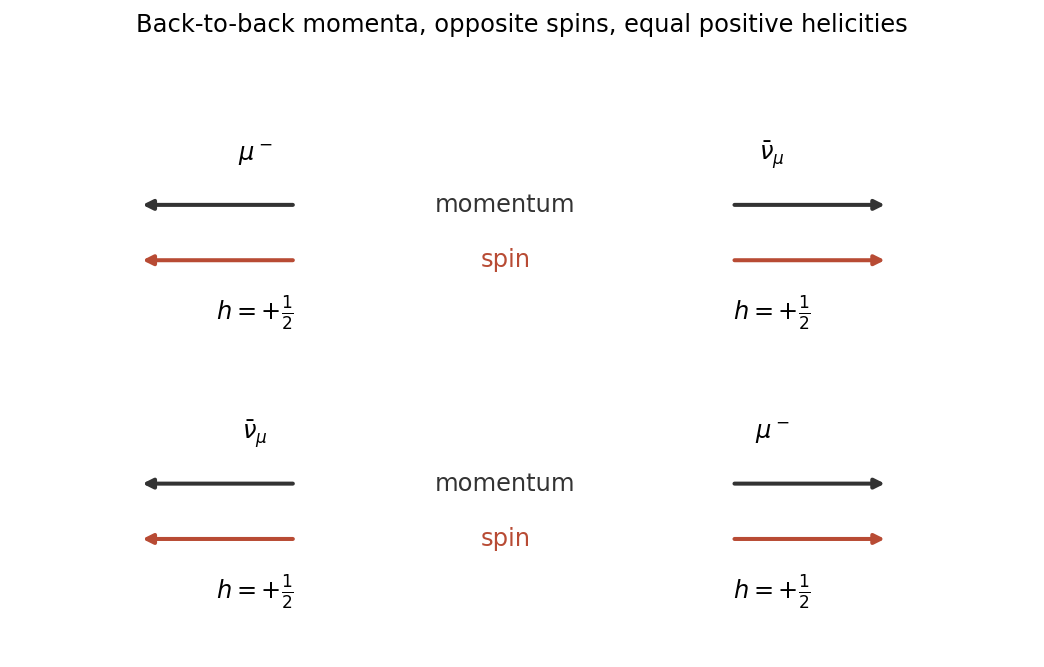
Aspin-zero pion has no preferred emission direction. Choose the antineutrinomomentum along +z. A massless antineutrino has positive helicity, so its spin points along +z. The muon moves along −z, and total Jz=0 requires its spin to point along −z:
The reversed configuration is obtained by rotating the entire event and is equally allowed. The two spins are opposite, while each is aligned with its own particle's momentum; both outgoing helicities are positive. A negative-helicity muon with this fixed antineutrino direction would give a nonzero total spin projection and is forbidden for this two-body decay of aspin-zero parent. The required positive-helicitycharged lepton is the suppressed component of the weak charged current.
 Codex 0 2026-10-18