
A solution is unique when any two objects satisfying the stated conditions are equal. This is an at-most-one assertion; existence is a separate requirement. A common proof assumes two solutions, subtracts their equations, and proves that their difference vanishes. For a linear differential equation this turns the task into a homogeneous problem with zero boundary or initial data.
A solution exists when at least one object satisfies all the stated conditions. In first-order logic, this is expressed by existential quantification. Uniqueness additionally requires that any two solutions are equal.
A description of how mass is assigned to positions, expressed for example by point masses, a mass density, or a measure. Writing allows centre of mass and moment of inertia formulas to cover both discrete and continuous cases.
In Newtonian mechanics, inertial mass is the coefficient in , measuring a body's response to a net force. The weak equivalence principle makes its ratio to passive gravitational mass universal; choosing compatible units then sets the two equal.
Passive gravitational mass is the coefficient in for an imposed Newtonian gravitational field. Active gravitational mass instead measures a body's contribution to the source of that field in Newton's law of universal gravitation. Universality of the ratio of passive gravitational mass to inertial mass is the Newtonian content of the weak equivalence principle. In general relativity, the source is the full stress-energy tensor, rather than a single scalar gravitational mass.
The 1955 paper by James Power Gordon, Herbert Jack Zeiger and Charles Hard Townes acknowledged Nikolay Basov and Aleksandr Prokhorov's independent proposal.[ref]
The Maser—New Type of Microwave Amplifier, Frequency Standard, and Spectrometer by James Power Gordon and others. p. 1264, Introduction and reference 2
The latter authors' theory paper states that they presented the molecular-generator possibility in May 1952, cites their 1954 publication, and separately cites the Gordon–Zeiger–Townes experimental realization. These are contributions from independent groups.[ref]Theory of the Molecular Generator and Molecular Power Amplifier by Nicolay Gennadiyevich Basov and Aleksandr Mikhailovich Prokhorov. p. 426, historical footnote and references 3–4; manuscript submitted December 10, 1954, English publication October 1956
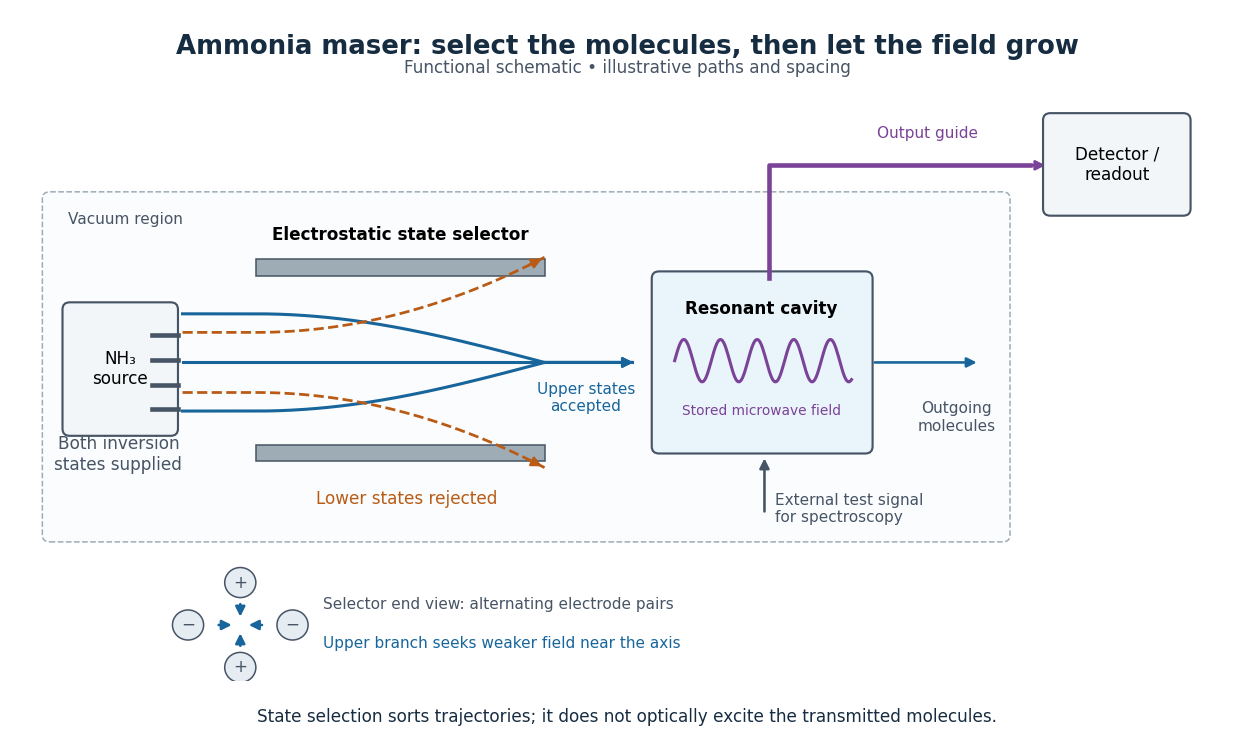
An ammonia maser uses an Ammonia molecular beam, maser state selection and a maser cavity to obtain amplification or sustained microwave oscillation. In the 1954 experiment by James Power Gordon, Herbert Jack Zeiger and Charles Hard Townes, a quadrupolar static electric field focused upper-state molecules toward the cavity and deflected lower-state molecules away. The reported ammonia inversion transition lies near .[ref]
Molecular Microwave Oscillator and New Hyperfine Structure in the Microwave Spectrum of NH3 by James Power Gordon and others. pp. 282–283, Fig. 1 and Fig. 2 caption; 23 870 Mc/sec

A hydrogen maser uses a ground-state hyperfine structure transition of the hydrogen atom to provide a stable microwave signal. A beam source and magnetic state selector prepare a favorable atomic population; a storage bulb within a microwave resonator lets atoms interact with the field for an extended time.
An active device sustains oscillation through stimulated emission, while a passive arrangement interrogates the atomic response with an external signal. Long interrogation supports a narrow frequency reference, but magnetic shifts, wall interactions and cavity resonance still affect its measured output. Short-term stability and long-term accuracy are different properties. [ref]
https://www.nist.gov/pml/time-and-frequency-division/popular-links/time-frequency-z/time-and-frequency-z-h. NIST Time and Frequency from A to Z, Hydrogen maser: atomic transition, stability and cavity-frequency drift
There are unlisted articles, also show them or only show them.