An ammonia maser uses an ammonia molecular beam, maser state selection and a maser cavity to obtain amplification or sustained microwave oscillation. In the 1954 experiment by James Power Gordon, Herbert Jack Zeiger and Charles Hard Townes, a quadrupolar static electric field focused upper-state molecules toward the cavity and deflected lower-state molecules away. The reported ammonia inversion transition lies near .[ref]
Molecular Microwave Oscillator and New Hyperfine Structure in the Microwave Spectrum of NH3 by James Power Gordon and others. pp. 282–283, Fig. 1 and Fig. 2 caption; 23 870 Mc/sec

In ammonia, the nitrogen chemical atom can lie on either side of the plane of the three hydrogen chemical atoms. Quantum tunnelling couples these configurations; the resulting pair of energy levels permits an electric dipole transition. This geometrical inversion is distinct from population inversion, which concerns how many molecules occupy each level.[ref]
For an idealized pair of energy levels with equal quantum degeneracy, the Boltzmann distribution gives at positive temperature . A warm source therefore supplies upper-state molecules together with an unwanted lower-state population. Selecting the former can produce population inversion in the transmitted beam without exciting each transmitted molecule during selection. The energy per net downward transition isHere is the Planck constant. Taking the reported as a rounded input gives . This calculation is a conversion of the reported frequency, not a new measurement of the ammonia inversion transition.
Maser state selection separates paths according to the Stark effect, the dependence of a molecule's energy levels on an electric field. It prepares a transmitted population by sorting. Optical pumping, by contrast, changes populations through absorption of light and subsequent transitions. Both can produce a useful population imbalance, but they are different preparation mechanisms.
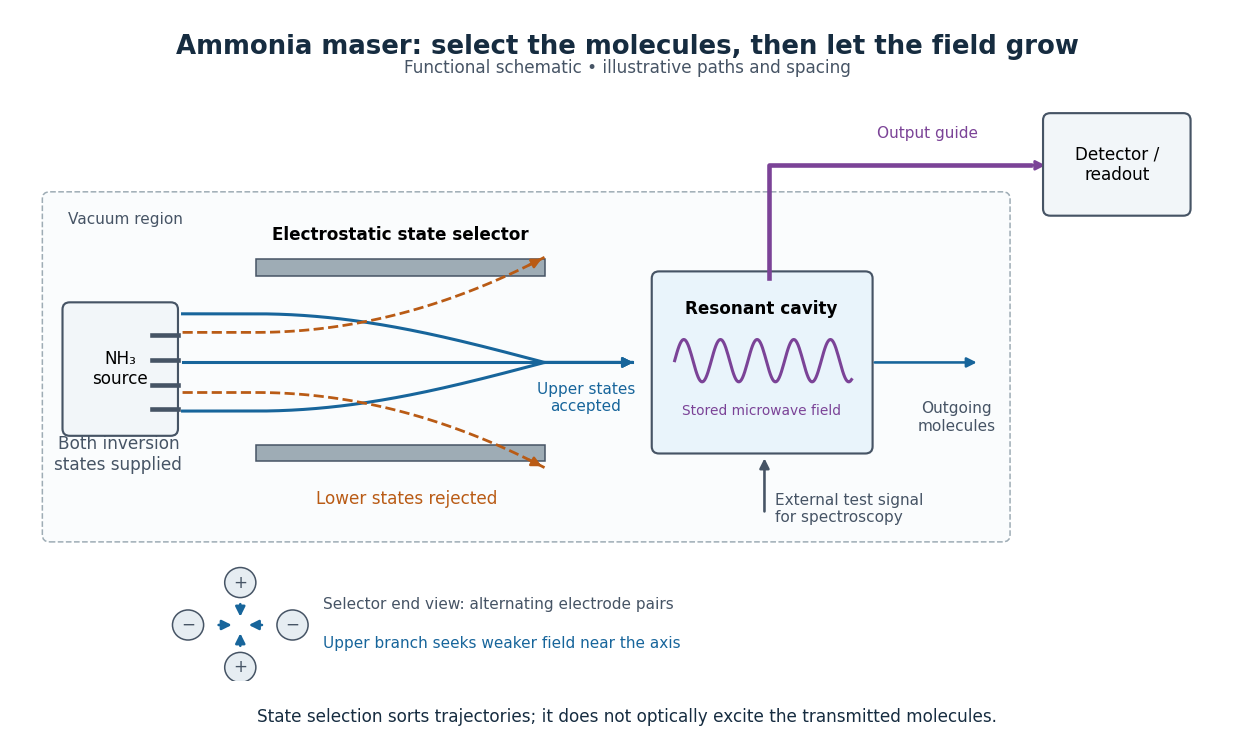
A simple two-level system explains the sign of the focusing force. Ignore additional splittings and let the magnitude of the relevant projected electric dipole moment be . Model the two local energy levels in an electric field of magnitude byFor an ideal quadrupolar electrostatic potential , the electric field magnitude is , where . Since increases with , the force points inward. The lower branch has the opposite sign and is defocused. The upper branch is thus low-field seeking. This argument uses the gradient of internal energy, rather than a net electric charge on the molecule. The square-root splitting is the usual two-state description.[ref] The idealized two-level system omits the actual rotational and hyperfine structure sublevels and their different transmission efficiencies.
The maser cavity stores a resonant electromagnetic wave so that an arriving molecule encounters a field left by earlier molecules. An output coupling lets part of that stored energy reach a detector. The same coupling also removes energy, so increasing extraction can prevent startup. The cavity provides feedback; the selected molecular beam supplies the useful internal energy.
Let be stored field energy, , and the total passive energy decay rate. Internal dissipation and output extraction contribute and to lost power. With this energy convention, the loaded quality factor isThe field amplitude decays at ; confusing amplitude and energy decay introduces a factor of two into a maser oscillation threshold calculation.
The following original model isolates amplification by inverted electric dipoles. Let be the excess number in the upper member of one equally degenerate resonant pair. Let be a slowly varying cavity amplitude with photon number , and let describe the collective molecular dipole component in the amplifying phase convention. On exact resonance, stipulate the linear equationsThe dipole relaxation rate is , and is a single-molecule coupling in the chosen mode normalization. Here is an electric dipole moment matrix element, is the field's zero-point amplitude, and . Field overlap and dipole orientation enter this coupling. The characteristic polynomial for growth rate isFor , one root becomes positive precisely when . If dipole relaxation is fast enough to eliminate , then andThus positive population inversion alone is insufficient: the gain rate must exceed the passive decay rate. This reduction describes the onset near resonance; it does not predict output phase noise, actual transit dynamics or an exact historical threshold. Nikolay Basov and Aleksandr Prokhorov's molecular-generator theory likewise treats self-excitation as competition between molecular gain and resonator-plus-load losses.[ref]
Theory of the Molecular Generator and Molecular Power Amplifier by Nicolay Gennadiyevich Basov and Aleksandr Mikhailovich Prokhorov. p. 426, Introduction; pp. 427–428, dipole response and self-excitation
To include replenishment, suppose upper-state molecules enter at rate and both levels leave with residence rate . A deliberately simple ordinary differential equation model isOne downward transition removes two units of the difference , so . Below onset the unsaturated inversion is , givingFor fixed mode volume , the equivalent number density condition is . Raising selected beam intensity raises gain; increasing quality factor lowers the loss rate at fixed frequency. These statements hold with , residence time and mode overlap fixed.
Above onset, the nonzero steady state hasThe inversion is clamped while excess supply supports output. A finite initial seed is understood: the noiseless equations leave exactly unchanged even above onset. Actual startup has spontaneous emission and field fluctuations.
Maser oscillation threshold, output loading and the maser microwave energy budget
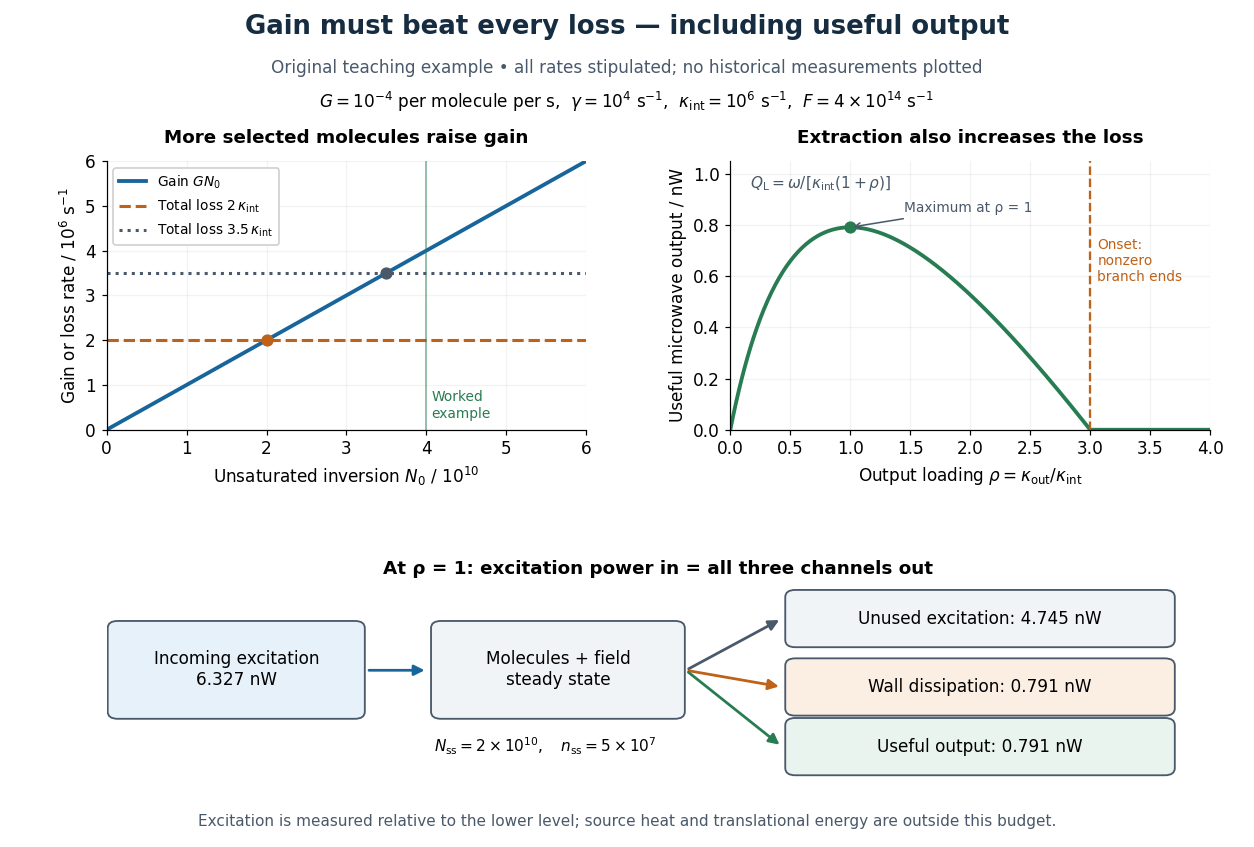
. Original illustrative model, not historical measurements. Left: gain rises with selected beam supply, crossing two chosen total loss rates. Right: with fixed supply, output initially grows with output coupling, then falls to zero when that coupling makes the total loss too large. The lower panel accounts for incoming excitation, unused excitation leaving in the beam, wall dissipation and useful output for the worked example. Details.
Multiplying the upper-level and photon equations by makes the cancellation of internal transfer visible:Incoming excitation becomes unused excitation carried away, internal dissipation, useful output, or a change in stored energy. Translational kinetic energy, the source's other internal states and preparation losses lie outside this two-level budget. The output cannot exceed the incoming excitation power .
Choose per unit inversion, , , and . These are stipulated teaching parameters. Then , , and . Using the rounded ammonia inversion transition frequency, the loaded quality factor is approximately . The incoming excitation power is : leaves unused, becomes internal dissipation and is useful output, with rounding in these displayed values.
There is an instructive extraction optimum within this model. With the same , and , put and . For ,Differentiation gives . At zero coupling no power is extracted; at the device reaches onset and the nonzero branch disappears. The optimum balances extraction against the inversion required to compensate that extraction. Equal residence rates and loss of molecular phase memory are simplifying assumptions; the calculated efficiency is not a universal bound for beam masers.
Ammonia gas entered a vacuum chamber through fine channels; the selected beam entered a cavity with input and output waveguides.[ref]
The Maser—New Type of Microwave Amplifier, Frequency Standard, and Spectrometer by James Power Gordon and others. pp. 1264–1265, Fig. 1, source and vacuum
With external microwaves swept across a molecular resonance, the 1954 experiment read an increase in transmitted power; with sufficient beam emission, it sustained oscillation.[ref]The 1955 readout mixed two maser signals with a local oscillator in a crystal detector, amplified them at an intermediate frequency, and combined them in a diode detector. An oscilloscope showed their beat frequency. Changing cavity tuning, source pressure or focuser field tested sensitivity; excessive detuning stopped oscillation.[ref]
The Maser—New Type of Microwave Amplifier, Frequency Standard, and Spectrometer by James Power Gordon and others. pp. 1266–1267, Experimental Results, heterodyne and controls
The beat tests relative frequency stability; it does not by itself establish an absolute frequency or an intrinsic linewidth independent of detector noise. Detuning also changes the field–molecule interaction, so the threshold model's constant cannot describe arbitrary tuning scans. Articles by others on the same topic
There are currently no matching articles.