With a low-level opening, the dense incoming coldfluid tends to spread along the floor instead of falling through the warm interior. Acold lower layer and warm upper layer develop, giving stable density stratification. The incoming fluid can short-circuit back out through the low opening after that layer occupies it, leaving warm fluid above poorly ventilated. Thus the uniform-temperature assumption is generally inappropriate: cooling becomes vertically nonuniform and substantially slower for the upper warm fluid. If mixing were artificially maintained, the same lumped budget would still apply; it is the loss of that assumption, rather than a reversal of buoyancy, that changes the physical outcome.
For dense clusters the vacuumforce is small compared with their internal gravity. If retained in the hydrostatic equation, it changes GM/r2 to GM/r2−Λr/3 and adds Λr3/(3G) to the massformula above. The optical virial relation likewise uses the separate vacuum contribution derived in part (c). Comparing optical and X-ray estimates tests the dynamical assumptions and exposesa gravitating mass much larger than the luminous stellar component.
Use the physical root of the cubic which tends to 1/2as η→0. For 0<η<1, the cubic has value 1 at x=0 and value −η/4 at x=1/2, and its derivative 6ηx2−(2+η) is negative throughout that interval. Thus it has exactly one root there. Implicit differentiation gives
The smaller ratio does not meanvacuum repulsion makes turnaround easier. At fixed turnaround data, Um=−A−B is more negative than for Λ=0. If one tried x=1/2, the virialized energy would be −A−B/2, which is not negative enough to equal Um. Extra contraction is necessary to increase the magnitude of the gravitational binding energy. Thus vacuum repulsion inhibits formation of a bound shell, while the shell that does form has a smaller idealized final-to-turnaround ratio under the stated energy and profile assumptions.
Construct the conjugacy of positive real-line bumps using u=v=α. Since both αf and αg are greater than β, choose the fundamental-interval map to be identity on [α,β] and then increase from β to the respective right endpoints. Equivariant extension along f and g gives a conjugator on their supports fixing [α,β]. Extend it over the remaining portions of J=[γ,γh], fixing the endpoints of J; both support intervals lie strictly inside J. Call the resulting interval bijection b0. It satisfies fb0=b0g on J.
The point γ lies in a positive orbital of h, because γh>γ. Its half-open cells Jhn, n∈Z, partition that orbital. Extend by
and set b to identity outside the orbital. Since b0 fixes the cell endpoints, this is an order automorphism and satisfies bh=hb. Each cell is preserved; f and g are identity on all cells other than the original one, so fb=bg holds everywhere. Finally b fixes [α,β]pointwise, and a is supported inside that interval. Hence ba=ab. Thus
Write the two supportsas If=(lf,rf) and Ig=(lg,rg). Every point in asupport moves strictly right: a positive nonidentity order automorphism has no fixed point inside its one support interval. Choose u∈If, v∈Ig and an increasing bijection θ:[u,uf]→[v,vg] matching endpoints. The half-open intervals [ufn,ufn+1), for n∈Z, partition If, because the iterates tend to its endpoints. Define
The endpoint choices make adjacent pieces fit, giving an increasing bijection b:If→Ig with fb=bg. Extend over the two complementary closed rays by increasing maps taking lf,rf to lg,rg. Outside the supports both automorphisms are identity, so fb=bg still holds. Therefore b−1fb=g. This gives the conjugacy of positive real-line bumps.
For a faithful transitive ordered action, primitivity here means that the only invariant equivalence relations with convex classes are equality and the universal relation. The trichotomy is: a regular Archimedean action, an order two-transitive action, or a periodic action. In the regular case the chain is an ordered additive subgroup of R, acting by translations. In the periodic case there is afixed-point-free period z on the Dedekind completion, commuting with the action and having cofinal and coinitial integer iterates; inside a period interval the relevant stabilizer acts order two-transitively. These are the cases of the McCleary trichotomy theorem.
Only the regular Archimedean case satisfies the inequality. It is a linearly ordered group. For positive a,b, if a≤b, then ab≤b2≤b2a2; if b≤a, then ab≤a2≤b2a2. Taking a=∣f∣, b=∣g∣ proves the displayed inequality.
To exclude an order two-transitive action, choose x<y<z<t. Choose an automorphism taking (x,y) to (y,z) and replace it by its pointwise join with the identity, giving positive a with xa=y, ya=z. Similarly obtain positive b with xb=x, yb=t. Then
Thus ab≤b2a2, while ∣a∣=a and ∣b∣=b. The same construction inside a period interval excludes the periodic case, using the order two-transitive stabilizer supplied by the classification.
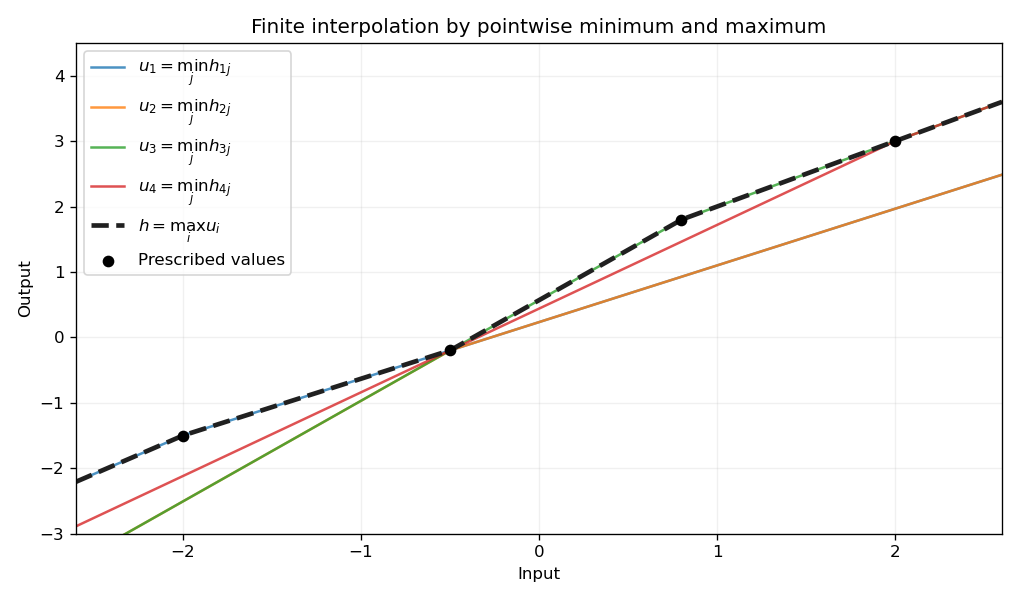
Here transitivity is order n-transitivity: increasing tuples are compared, rather than arbitrary reorderings. For increasing tuples α1<⋯<αn and β1<⋯<βn, choose hij sending both αi to βi and αj to βj when i=j, using order two-transitivity. For i=j, choose an element sending the single point to its target, using transitivity. Define
This belongs to the lattice-ordered permutation group. At αi, all terms in its ith inner meet equal βi. At αk, every inner meet is at most βk, because its j=k term takes that value. The outer join is consequently exactly βk there. Thus hmaps the whole tuple to its target. This finite interpolation by lattice operations proves every finite order-transitivity without assuming the group permits arbitrary cut-and-paste restrictions of its elements.
By compactness theorem, finitely many extension axioms σ1,…,σs already entail this particular universally quantified equivalence. Each has asymptotic probability one by the assumption. The union bound gives
For an unrestricted binary relation R, the extension axioms permit arbitrary directed edges and loops. For each m≥0 and each choice of bits ϵi,δi,η∈{0,1}, require that every tuple of distinct x1,…,xmhas a fresh element y with
y=xifor all i,R(y,y)η∧⋀i=1m(R(y,xi)ϵi∧R(xi,y)δi).
 Codex 0 2026-10-14