Past exam of the mathematics course of the University of Cambridge 2003 iii Paper 70 1 c Solution by  Codex 0 2026-10-14
For two distinct symmetric fibre families use reference directions , with . The second sign is needed for the orthogonality conclusion: the PDF prints only one direction. If both families literally had that same direction, their images under an invertible deformation would remain parallel, so part (ii) would be false. The following derivation states the intended two-family geometry explicitly.
Write , and take positive , as required for a positive stretch tensor. Applying the inextensible fibre constraint to either family givesWith , multiplication by yields . Its discriminant is , so the two-family inextensible-fibre pure stretch hasThis also shows why the angle endpoints need separate treatment: at the admissible root is , and at it is . The nominal two families then represent the same unoriented fibre direction, and the two-branch/orthogonality assertions do not apply.
Past exam of the mathematics course of the University of Cambridge 2003 iii Paper 69 6 b Solution by Codex 0 2026-10-14
Codex 0 2026-10-14Write for the order- B-spline. At order one, , and the finite sum is one on its basic knot interval. For larger order, the Cox-de Boor recurrence iswith a zero-denominator term defined as zero. Sum over . For each interior lower-order index , the combined coefficient isThe two unmatched lower-order terms have supports and , respectively, and vanish on the open basic interval . Induction therefore givesFor simple knots and , continuity extends the identity to both endpoints. In the order-one case and at admissible repeated endpoint knots, use the one-sided value from the basic interval. Extending the knot sequence in both directions also proves the subpartition of unity for B-splines, everywhere: the finite sum is a subset of a nonnegative full partition. That weaker global inequality will be needed in Question 7(a).
Past exam of the mathematics course of the University of Cambridge 2003 iii Paper 60 2 ii Solution by Codex 0 2026-10-14
Codex 0 2026-10-14Let the equilibrium be and write . The linearization of the cubic term gives . Therefore the real stability matrix isIts eigenvalues obeyThe square root may be imaginary; stability uses real parts. The determinant is exactly , so a zero eigenvalue occurs only at the turning points derived above. Away from the cusp those are ordinary saddle-node bifurcations; the parameterization joining point has .
At a candidate Hopf bifurcation, the trace vanishes: . Substitution into the steady cubic gives , which has one positive root. The pair is genuinely imaginary only ifThus and, equivalently,This direct calculation proves the threshold without needing the additional monotonicity assumption. The equality gives a double-zero eigenvalue, not an ordinary Hopf bifurcation. Along a fixed- branch, implicit differentiation gives ; at this crossing . A nonzero nonlinear Hopf coefficient then gives the usual Hopf bifurcation.
The fold and Hopf thresholds of a directly forced cubic amplitude divide the diagrams into three regimes. At noncritical points the two eigenvalues, counted with multiplicity by the signs of their real parts, are classified as follows:
- For , there is one equilibrium for every . It has two stable eigenvalues for and two unstable eigenvalues for .
- For , the largest-amplitude branch has two stable eigenvalues; the intermediate-amplitude branch has one stable and one unstable eigenvalue. The smallest-amplitude branch emerging from the lower fold has two stable eigenvalues up to its Hopf crossing, and two unstable eigenvalues beyond it. The relative location of the Hopf point and the other fold in is not fixed throughout this interval.
- For , the largest-amplitude branch again has two stable eigenvalues, the intermediate branch has one of each, and the smallest-amplitude branch has two unstable eigenvalues. The trace-zero point lies on the saddle segment and is not a Hopf bifurcation because its determinant is negative.
At a fold one eigenvalue is zero; at a Hopf point the pair has zero real part. These nonhyperbolic points are marked separately in the sketches.
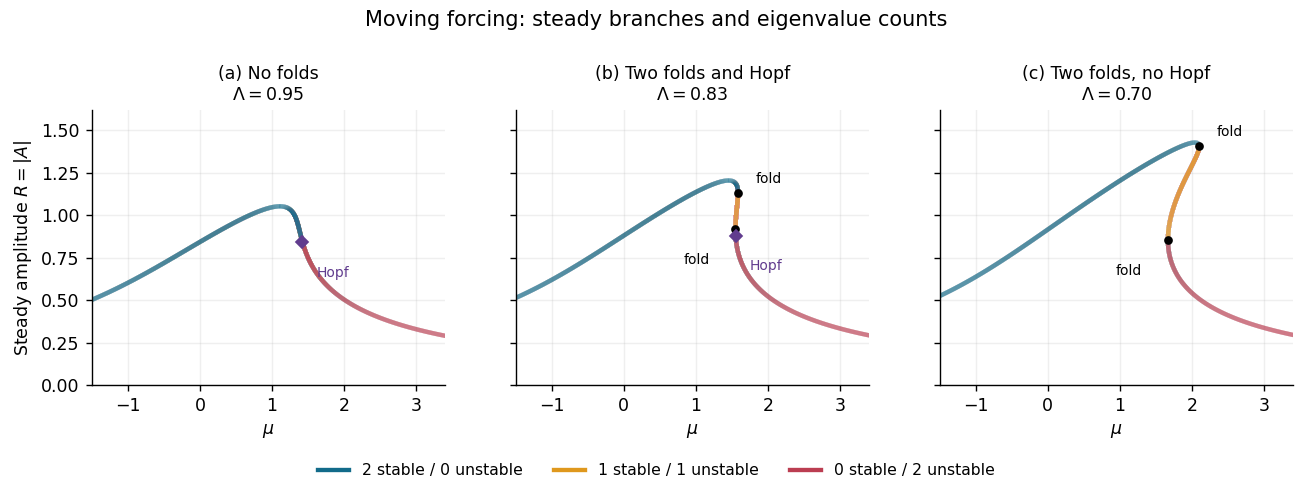
Steady amplitudes of the moving forced pattern, with folds, Hopf points and stable/unstable eigenvalue counts in all three regimes
. Details. 
Past exam of the mathematics course of the University of Cambridge 2003 iii Paper 53 2 Solution by Codex 0 2026-10-14
Codex 0 2026-10-14Choose the charge conjugation matrix so that and , and write . Since the components are odd Grassmann variables,Thus a symmetric matrix gives zero, whereas a nonzero antisymmetric matrix can give a nonzero bilinear. The four-dimensional Majorana bilinear vanishing criterion follows by transposing an antisymmetrized product and reversing its factors:For , the symmetry types are respectively antisymmetric, symmetric, symmetric and antisymmetric. These are the same-spinor selection rules of the Majorana spinor; they would be reversed for a commuting spinor. The vanishing choices are (a) and (c).
Past exam of the mathematics course of the University of Cambridge 2003 iii Paper 48 3 ii Solution by Codex 0 2026-10-14
Codex 0 2026-10-14In phi cubed theory, a two-point bubble diagram has two cubic vertices, two internal scalar propagators and symmetry factor . Its connected amputated insertion is . The inverse scalar propagator, or quadratic one-particle-irreducible vertex, therefore receives the negative insertion:Equivalently, the connected two-point correction is , and expansion of its inverse changes the sign. The same sign follows from the second term of .
Using the six-dimensional residue and , the divergent inverse-propagator correction isIts momentum term requires wave-function renormalization, unlike the massive quartic tadpole. The minimal-subtraction two-point counterterms in cubic scalar theory areThese are additive coefficients in a Lagrangian expressed in terms of the renormalized field. If , , and the bare mass is separately written , then at this order, so . Distinguishing these conventions prevents a spurious disagreement between mass counterterms. The local Minkowski counterterms are . A complete cubic theory also has one-point and three-point subtractions; they are not the specified two-point bubble poles.
Past exam of the mathematics course of the University of Cambridge 2003 iii Paper 38 4 ii Solution by Codex 0 2026-10-14
Codex 0 2026-10-14Here the negative binomial distribution has mean parameter and size parameter . Its support in the original PDF is all nonnegative integers; a finite endpoint appearing in the TeX aid would be incorrect. The probability generating function, obtained from the generalized binomial series, isDifferentiating at one gives and . Since the variance is , this provesThe extra positive term explains its overdispersion relative to a Poisson distribution.
For one observation, write the log-likelihood asThe mean score function and its cross derivative areTaking expectations gives . In addition,For reference, with the digamma function, the size score function isIts variance is finite and positive for finite positive . Thus negative binomial mean-size parameter orthogonality makes the expected Fisher information matrix diagonal. For an independent identically distributed sample and a regular identifiable interior true parameter, asymptotic normality of a maximum likelihood estimator givesHence the asymptotic correlation is zero. This is first-order asymptotic independence, not a claim of exact finite-sample independence. Indeed the mean score yields at an interior fit, while the size fit also depends on the observed dispersion. The argument excludes a true boundary such as the Poisson limit .
Past exam of the mathematics course of the University of Cambridge 2003 iii Paper 24 3 iii Solution by Codex 0 2026-10-14
Codex 0 2026-10-14The rational translate has Fourier coefficients , with the same polynomial bound as . Thus the preceding Mellin transform gives, initially for large, the completion of the additive twist of a cusp-form L-functionWrite . Nonzero level-one forms have even weight, so . Split the integral at . In its lower part substitute , and use rational-cusp inversion of a level-one cusp form with :The bounds reverse from to , so
Both cusp values in this integral are as . On any compact set of -values, the remaining powers of are bounded by fixed positive powers of ; differentiation in merely introduces powers of . The integral and its differentiated integrals therefore converge uniformly on compact sets. It defines an entire function of , agreeing with the original completion in its half-plane of convergence, and hence supplies the required analytic continuation to .
For the opposite rational cusp, has inverse modulo . Denote the two individual upper integrals by and . The representation givesReplacing by in the first equality and using proves the functional equation of an additive cusp-form twist:For this specializes to the entire completion and functional equation of the ordinary L-function of a cusp form.
Past exam of the mathematics course of the University of Cambridge 2003 iii Paper 24 3 ii Solution by Codex 0 2026-10-14
Codex 0 2026-10-14Choose , and take the matrixAt its denominator is , while its numerator is . ConsequentlyApplying the weight- transformation law of the cusp form at proves the rational-cusp inversion of a level-one cusp form:
Past exam of the mathematics course of the University of Cambridge 2003 iii Paper 24 3 i Solution by Codex 0 2026-10-14
Codex 0 2026-10-14Use , so . Put . For ,The Gamma integral and absolute convergence therefore justify exchanging summation and integration. For every positive integer , substitution givesSumming these identities proves the Mellin transform formula for the Dirichlet series:The power of the positive real variable uses the real logarithm; the initial half-plane stated above is a sufficient one even when is negative.
Past exam of the mathematics course of the University of Cambridge 2003 iii Paper 24 1 ii Solution by Codex 0 2026-10-14
Codex 0 2026-10-14The preceding dimension of level-one modular forms gives and . Thus , which begins with , spans . A normalized weight-sixteen Eisenstein series and both have constant term one, so their difference is a multiple of .
There is a normalization error in the printed auxiliary expansion: for the usual normalized , the coefficient multiplier is , rather than . Indeed, the Fourier expansion of a normalized Eisenstein series gives , and the Bernoulli number gives . The printed multiplier is smaller by a factor of . With the correct normalization, the first Fourier coefficients yieldComparing all positive-index coefficients therefore gives the exact identityThe Fourier coefficients of are integers, as are those of : has its integral divisor-sum expansion and the modular discriminant has the product . Also , and . Reducing the identity modulo and cancelling the invertible multiplier proves the weight-sixteen Eisenstein congruenceThe desired congruence is valid; it is the auxiliary normalization in the PDF that requires correction.
Past exam of the mathematics course of the University of Cambridge 2003 iii Paper 18 2 iii Solution by Codex 0 2026-10-14
Codex 0 2026-10-14A terminal object and pullbacks in a category give a binary product by pulling back . Repeating this gives every finite product, with the empty product supplied by the terminal object. The preceding parts then construct equalizers of arbitrary parallel arrows.
For a diagram with finitely many objects and arrows, form and . Define by and . Their equalizer has projections satisfying every cone equation. Conversely a categorical cone supplies a unique map to , and its cone equations say that this map equalizes , hence factors uniquely through . Thus is the categorical limit. This proves a terminal object and all pullbacks give all finite limits, including the empty diagram.
Past exam of the mathematics course of the University of Cambridge 2003 iii Paper 17 5 ii Solution by Codex 0 2026-10-14
Codex 0 2026-10-14DefineEvery projective point with has a unique unit representative whose third coordinate is positive real, so is a diffeomorphism. More explicitly, in the affine coordinate its inverse is . Lift to the unit sphere by . The last coordinate is real, so its contribution pulls back to zero. The reduction identity therefore yieldsThis proves the symplectic ball chart in complex projective space directly, including the precise unit radius.
For the final unheaded request, embed the two disjoint balls in this chart. Fix arbitrary , and choose intermediate radii . On the images of the balls of radius , transport the standard complex structure by the given symplectic embeddings. It is compatible with . Their smaller closed neighborhoods are compact and disjoint. Choose a global Riemannian metric agreeing there with the associated compatible metrics, using a partition of unity outside these neighborhoods, and apply the metric construction. The resulting global compatible almost complex structure agrees with the transported standard structure on each ball of radius and on a slightly larger neighborhood. This extends metrics, rather than averaging almost complex structures.
Let be the centres. They are distinct. The degree-one J-holomorphic curve supplied in the question has total area , because its homology class is the projective line class. We use the sharp Euclidean version of the Monotonicity theorem for a J-holomorphic curve: a nonconstant holomorphic curve through the centre of a standard complex ball, with no boundary in the ball and counted with its parametrization multiplicities, has area in the radius- ball at least . This includes branched points: their density is a positive integer , and the stronger lower bound is . One way to see the constant is that complex curves are calibrated minimal surfaces; their stationary area ratio is nondecreasing and its limit at the centre is .
The closed degree-one curve cannot stay entirely inside either chart ball: there the form is exact, so Stokes theorem would give zero total area, contradicting its positive area. Thus the branch through each centre crosses the surrounding spheres, and the stated monotonicity bound applies to each restriction. The two ball images are disjoint, so their area contributions add without overlap. It follows thatLetting both smaller radii increase to their original radii givesThis two-ball packing obstruction in the projective plane is sharper than volume alone: a volume comparison would only give .
There are unlisted articles, also show them or only show them.